

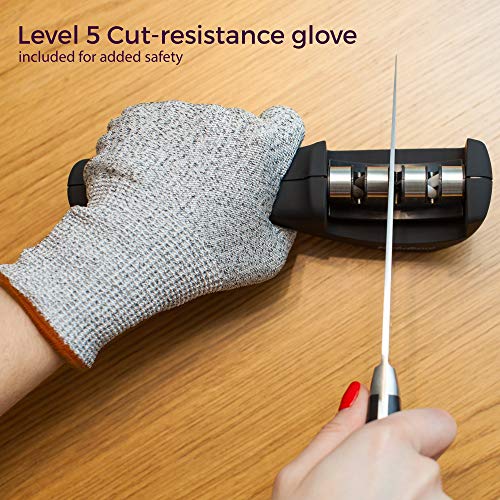
A dull knife is the most dangerous tool in any home kitchen — it demands more force, slips unpredictably across ingredients, and turns routine prep into slow, frustrating work. The HomeWhisk research team evaluated home knife sharpener options across electric, manual pull-through, guided whetstone, and freehand whetstone formats by analyzing manufacturer specifications, abrasive material data, grit progression documentation, and aggregated owner feedback from Amazon, Sur La Table, and community discussions on Reddit r/chefknives and r/KnifeDeals. The result is a guide built on documented product performance and real-world owner patterns rather than marketing claims. Whether you are restoring a neglected blade or building a sustainable edge-maintenance routine, understanding what each best knife sharpener category delivers is the essential first step toward selecting the right tool for your collection and your skill level.
For more, see our Electric vs Manual Knife Sharpener and Butcher Knife vs Cleaver guides.
What separates the best home knife sharpener options from the dozens of mediocre products on the market comes down to factors that manufacturer data and long-term owner reviews consistently highlight: abrasive material quality, grit range and progression logic, edge angle control across different blade geometries, and how well the sharpening elements hold up over hundreds of sessions rather than just the first few uses. The HomeWhisk team focused specifically on how each product navigates the sharpening-versus-honing distinction, how results differ between European-convention and Asian-convention blades, and whether the system accommodates beginners without sacrificing edge quality for experienced users. For a broader look at kitchen-specific sharpening tools that complement this guide, our coverage of the best kitchen knife sharpener explores additional electric and roller-based models worth considering alongside the manual and whetstone options detailed here.
Editor’s Picks
| Category | Pick | Why |
|---|---|---|
| Best Overall | Work Sharp Precision Adjust Elite — B079WWFZY6 | Guided angle system with full diamond and ceramic progression, adjustable 15 to 30 degrees, bridges whetstone quality and pull-through ease |
| Best Electric | Chef’sChoice Trizor XV EdgeSelect — B0018RSEMU | Three-stage 100% diamond system, converts European edges to 15-degree Asian profiles, highly reproducible results |
| Best Budget Whetstone | Sharp Pebble Premium Whetstone — B0BLXSCGL8 | Dual-grit 400/1000 stone with bamboo base and angle guide, strongest value for building freehand technique |
The Best Deals This Week*
-
Kitchellence 3-Stage Knife Sharpener
$17.99
($18.99)Save $1.00 -
5-Stage Precision Angle Knife Sharpener
$39.99
($45.99)Save $6.00
*Deals are selected by our commerce team
Deeper Dive: Our Top Picks
Our Top Picks
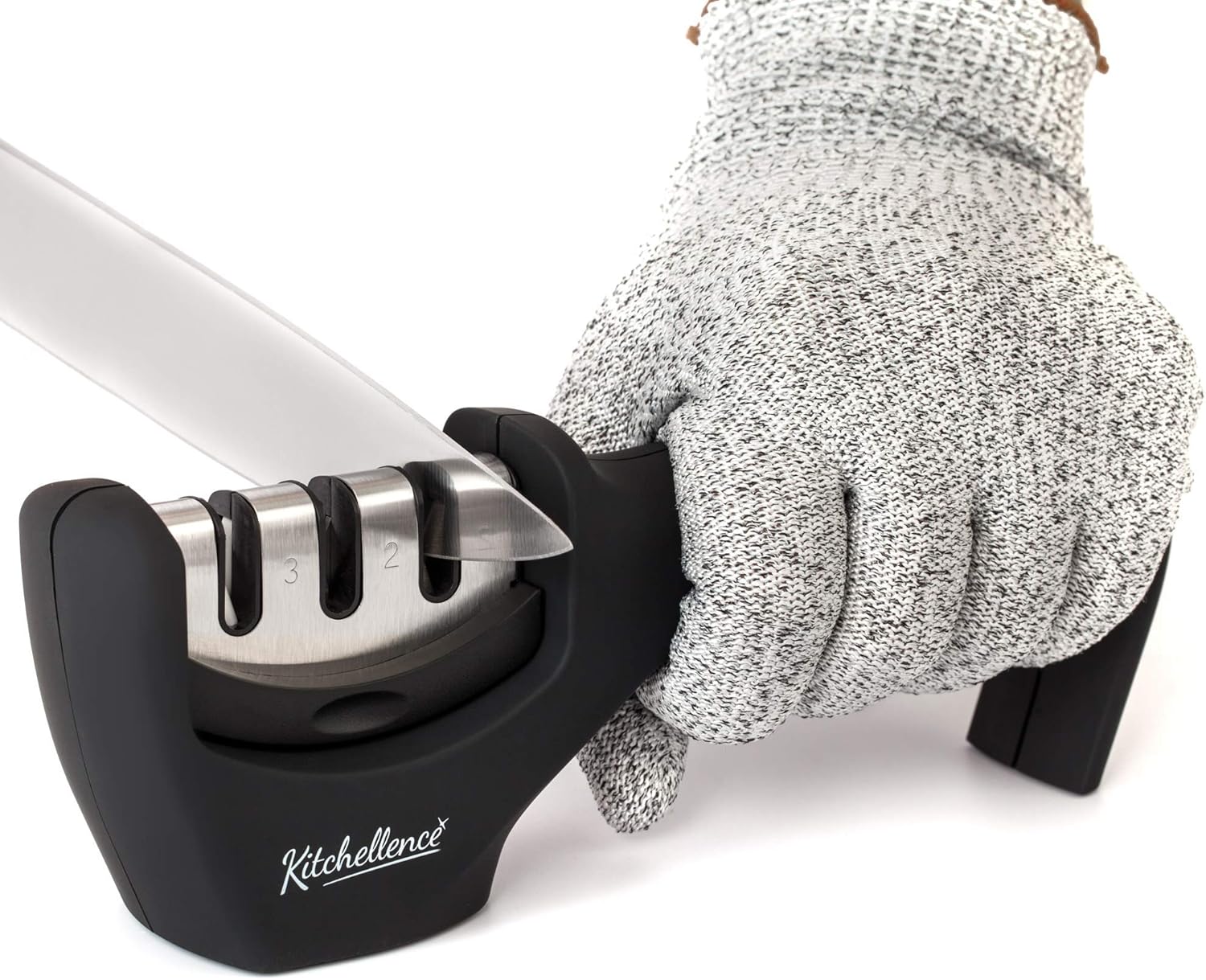
KITCHELLENCE
3-Stage Knife Sharpener with Cut-Resistant Glove
This 3-slot sharpener repairs damaged blades, restores them to a V-shape, and polishes them sharp—all in seconds without special skill. Buy it if dull knives slip during prep or you want to extend the life of quality kitchen knives.
Pros and Cons
Pros
- Diamond rod slot actually straightens bent blades instead of just grinding them down, saving knives that would otherwise need replacement.
- The three-slot progression from repair to polish produces genuinely sharp edges, not just adequate ones.
- Included cut-resistant glove is a practical safety feature, not an afterthought—it has a non-slip base for control.
Cons
- Requires light hand pressure and multiple passes; aggressive sharpening can remove too much blade material if you're not careful.
- Works best on standard kitchen knives; very wide blades or specialty knife shapes may not fit the slots properly.

WorkSharp
Work Sharp MK2 Kitchen Knife Sharpener – 2-Speed Electric System for Dull Blades
The Work Sharp MK2 uses flexible abrasive belts and a two-speed motor to restore sharp edges on kitchen knives, scissors, and serrated blades in minutes. Buy it if you want a single sharpener that handles everything from paring knives to kitchen shears without sending tools out for professional sharpening.
Pros and Cons
Pros
- Flexible belt system sharpens serrated knives and scissors that most electric sharpeners cannot touch.
- Two-speed motor provides control for both light touch-ups and heavy restoration work on neglected blades.
- Edge guide supports the entire blade and makes consistent results easy even for users with no sharpening experience.
- Three-year warranty and US-based engineering provide confidence in durability and support.
Cons
- Belt replacement adds ongoing cost compared to ceramic or diamond wheel sharpeners with longer-lasting abrasives.
- Larger footprint than compact pull-through sharpeners requires dedicated counter or drawer space in small kitchens.
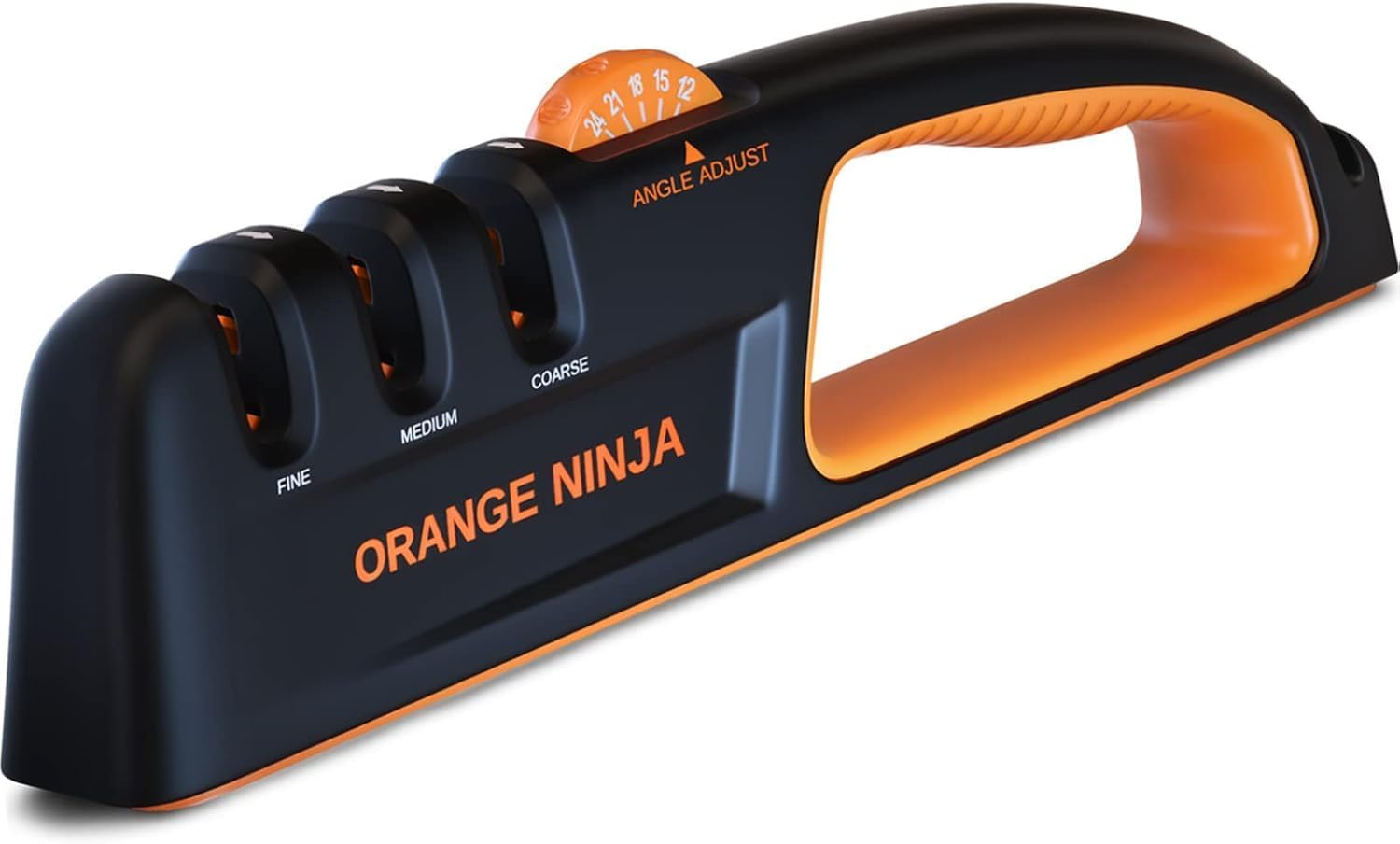
SharpPebble
5-Stage Precision Angle Knife Sharpener by SharpPebble | Professional Kitchen Blade Maintenance
This manual sharpener restores dull kitchen knives to razor-sharp edges in minutes using five adjustable angles (12° to 24°) for professional results at home. Buy it if you sharpen knives regularly and want consistent angles without guesswork or expensive professional services.
Pros and Cons
Pros
- Adjustable angle slots let you match the exact sharpening angle your knife needs, producing sharper edges than fixed-angle sharpeners.
- Simple pull-through design requires no technique or experience; even beginners achieve professional results on the first use.
- Compact and lightweight enough to store in a kitchen drawer, making regular maintenance quick and convenient.
Cons
- Only works on straight-edge blades; serrated knives and scissors cannot be sharpened with this tool.
- Manual sharpening takes more physical effort than electric sharpeners, which may tire users with hand strength limitations.

Longzon
4-Stage Knife Sharpener with Cut-Resistant Glove for Home Kitchens
This 4-stage manual sharpener restores dull kitchen knives to sharp precision in 10-15 seconds using coarse, fine, and precision grinding slots, plus a scissors slot. Buy it if you're tired of squashed tomatoes and torn meat from dull blades and want restaurant-quality cuts without electric tools or professional skills.
Pros and Cons
Pros
- Four-stage design handles both straight and serrated blades, plus scissors, making it genuinely versatile for most kitchen tools.
- Cut-resistant glove included at no extra cost removes the friction of buying safety gear separately.
- Manual operation means no learning curve, no power cord, and instant results without waiting for warm-up time.
Cons
- Angle is fixed, so users cannot customize sharpening angles for specialty knives or professional-grade blades.
- Requires consistent hand pressure and technique; inconsistent use may produce uneven blade edges on some knives.

ChefsChoice
Chef'sChoice 15XV Professional Electric Knife Sharpener with Diamond Abrasives
This 3-stage electric sharpener uses 100% diamond abrasives to create razor-sharp 15-degree edges on straight and serrated knives in under a minute. Buy it if you want restaurant-quality knife performance without manual sharpening skill or guesswork.
Pros and Cons
Pros
- Diamond abrasives sharpen faster and cut through dulled edges that manual stones struggle with, especially on harder stainless steel blades.
- Flexible spring guides automatically adjust to blade thickness, so you don't need to manually hold a precise angle like with whetstones.
- Converts 20-degree edges to 15-degree geometry, which is sharper and better for precision kitchen work than factory defaults.
Cons
- At 180 dollars, it's a significant upfront cost compared to manual sharpening stones, though it pays off if you sharpen frequently.
- Requires electricity and counter space; not portable or suitable for outdoor or camping use like manual alternatives.
Editors' Picks
KITCHELLENCE 3-Stage Knife Sharpener with Cut-Resistant Glove
KITCHELLENCE
3-Stage Knife Sharpener with Cut-Resistant Glove
This 3-slot sharpener repairs damaged blades, restores them to a V-shape, and polishes them sharp—all in seconds without special skill. Buy it if dull knives slip during prep or you want to extend the life of quality kitchen knives.
$17.99 at AmazonEditors' Favorite
Brand Name: KITCHELLENCE Number of Items: 1 Manufacturer: Kitchellence UPC: 606895956141 785696358627 785696358177 Manufacturer Part Number: KS378 Model Number: KS37 P Included Components: Yes Unit Count: 1.0 Count Item Type Name: 4-in-1 Kitchen Knife Accessories: 3-Stage Knife Sharpener Helps Repair, Restore, Polish Blades and Cut-Resistant Glove (Black) Best Sellers Rank: #167 in Kitchen & Dining (See Top 100 in Kitchen & Dining) #2 in Knife Sharpeners ASIN: B079WWFZY6 Customer Reviews: 4.5 4.5 out of 5 stars (38,537) 4.5 out of 5 stars Material Type: Plastic Color: Black Item Dimensions L x W x H: 8.3"L x 2.2"W x 3.4"H Item Weight: 180 Grams Material: Plastic Brand: KITCHELLENCE Product Dimensions: 8.3"L x 2.2"W x 3.4"H Number of Packs: 1
Shop NowWorkSharp Work Sharp MK2 Kitchen Knife Sharpener – 2-Speed Electric System for Dull Blades
WorkSharp
Work Sharp MK2 Kitchen Knife Sharpener – 2-Speed Electric System for Dull Blades
The Work Sharp MK2 uses flexible abrasive belts and a two-speed motor to restore sharp edges on kitchen knives, scissors, and serrated blades in minutes. Buy it if you want a single sharpener that handles everything from paring knives to kitchen shears without sending tools out for professional sharpening.
$89.95 at AmazonGreat Value
Brand Name: WORK SHARP Number of Items: 1 Manufacturer: Work Sharp UPC: 702872621757 662949040860 Manufacturer Part Number: WSKTS2 Model Number: WSKTS2 Included Components: Abrasive Belts, Knife Sharpener Unit Count: 1.0 Count Item Type Name: Knife Sharpener Best Sellers Rank: #2,900 in Kitchen & Dining (See Top 100 in Kitchen & Dining) #15 in Knife Sharpeners ASIN: B08VD8ZGFZ Customer Reviews: 4.7 4.7 out of 5 stars (8,011) 4.7 out of 5 stars Material Type: Plastic Color: Black Grit Type: Medium Item Dimensions L x W x H: 7.02"L x 2.26"W x 1.27"H Item Weight: 1.12 Ounces Material: Plastic Brand: WORK SHARP Product Dimensions: 7.02"L x 2.26"W x 1.27"H Number of Packs: 1
Shop NowSharpPebble 5-Stage Precision Angle Knife Sharpener by SharpPebble | Professional Kitchen Blade Maintenance
SharpPebble
5-Stage Precision Angle Knife Sharpener by SharpPebble | Professional Kitchen Blade Maintenance
This manual sharpener restores dull kitchen knives to razor-sharp edges in minutes using five adjustable angles (12° to 24°) for professional results at home. Buy it if you sharpen knives regularly and want consistent angles without guesswork or expensive professional services.
$39.99 at AmazonBrand Name: Sharp Pebble Number of Items: 1 Manufacturer: Mighty Dreams Global Trade Identification Number: 00860008091338 Manufacturer Part Number: 4KS Model Number: 4KS Included Components: Knife Sharpener Unit Count: 1.0 Count Item Type Name: knife sharpener Best Sellers Rank: #1,669 in Kitchen & Dining (See Top 100 in Kitchen & Dining) #6 in Knife Sharpeners ASIN: B0BLXSCGL8 Customer Reviews: 4.5 4.5 out of 5 stars (3,947) 4.5 out of 5 stars Material Type: Acrylonitrile Butadiene Styrene, Rubber Color: Black/Orange Grit Type: Coarse, Medium, Fine Item Dimensions L x W x H: 9.84"L x 0.79"W x 1.97"H Item Weight: 1.5 Ounces Material: Acrylonitrile Butadiene Styrene, Rubber Brand: Sharp Pebble Product Dimensions: 9.84"L x 0.79"W x 1.97"H Number of Packs: 1
Shop NowLongzon 4-Stage Knife Sharpener with Cut-Resistant Glove for Home Kitchens
Longzon
4-Stage Knife Sharpener with Cut-Resistant Glove for Home Kitchens
This 4-stage manual sharpener restores dull kitchen knives to sharp precision in 10-15 seconds using coarse, fine, and precision grinding slots, plus a scissors slot. Buy it if you're tired of squashed tomatoes and torn meat from dull blades and want restaurant-quality cuts without electric tools or professional skills.
$16.99 at AmazonBrand Name: longzon Number of Items: 1 Manufacturer: longzon Manufacturer Part Number: MPA-SAS-00048 Model Number: Knife Sharpener Included Components: knife sharpener Unit Count: 1.0 Count Best Sellers Rank: #147 in Kitchen & Dining (See Top 100 in Kitchen & Dining) #1 in Knife Sharpeners ASIN: B08FWNCNH9 Customer Reviews: 4.4 4.4 out of 5 stars (37,794) 4.4 out of 5 stars Material Type: Ceramic, Tungsten Steel Color: Black+Silver Grit Type: Ultra Fine Item Dimensions L x W x H: 9.06"L x 3.07"W x 1.73"H Item Weight: 150 Grams Material: Ceramic, Tungsten Steel Brand: longzon Product Dimensions: 9.06"L x 3.07"W x 1.73"H Number of Packs: 1
Shop NowChefsChoice Chef'sChoice 15XV Professional Electric Knife Sharpener with Diamond Abrasives
ChefsChoice
Chef'sChoice 15XV Professional Electric Knife Sharpener with Diamond Abrasives
This 3-stage electric sharpener uses 100% diamond abrasives to create razor-sharp 15-degree edges on straight and serrated knives in under a minute. Buy it if you want restaurant-quality knife performance without manual sharpening skill or guesswork.
$165.99 at AmazonBrand Name: Chef's Choice Number of Items: 1 Manufacturer: Chef'sChoice Global Trade Identification Number: 00087877011155 UPC: 087877011155 Manufacturer Part Number: 15XV Model Number: 0101500 Included Components: Knife Sharpener Unit Count: 1.0 Count Item Type Name: with 100-Percent Diamond Abrasives and Precision Angle Guides for Straight Edge and Serrated Knives Manufacturer Warranty Description: Manufacturer Warranty Best Sellers Rank: #3,289 in Kitchen & Dining (See Top 100 in Kitchen & Dining) #12 in Knife Sharpeners ASIN: B0018RSEMU Customer Reviews: 4.6 4.6 out of 5 stars (14,236) 4.6 out of 5 stars Material Type: Diamond Color: Gray Grit Type: Fine Item Dimensions L x W x H: 10"L x 4.25"W x 4.25"H Item Weight: 4.2 Pounds Material: Diamond Brand: Chef's Choice Product Dimensions: 10"L x 4.25"W x 4.25"H Number of Packs: 1
Shop NowAt a Glance: Comparison Table
| Product | Type | Grit Stages | Edge Angle | Compatible Blades | Editorial Take |
|---|---|---|---|---|---|
| Work Sharp Precision Adjust Elite (B079WWFZY6) | Guided whetstone | Coarse diamond, medium diamond, fine ceramic | 15 to 30 degrees adjustable | European, Asian, most straight-edge | Most versatile angle-controlled home knife sharpener for mixed collections |
| Lansky Deluxe 5-Stone System (B08VD8ZGFZ) | Guided clamp whetstone | Extra coarse through ultra fine, five stages | 17, 20, 25, 30 degrees via clamp guide | European and Asian straight-edge | Broadest grit range in a guided format for cooks who want full progression control |
| Sharp Pebble Premium Whetstone (B0BLXSCGL8) | Freehand whetstone | 400 and 1000 dual-sided | Freehand with included angle guide | All straight-edge blades | Best entry into whetstone sharpening with accessories that reduce beginner error |
| Presto EverSharp Electric (B08FWNCNH9) | Electric pull-through | Two-stage sapphirite sharpening and fine honing | Fixed angle slots | European-convention straight-edge | Affordable electric option with consistent results for standard Western kitchen knives |
| Chef’sChoice Trizor XV EdgeSelect (B0018RSEMU) | Electric 3-stage | Diamond stage 1, diamond stage 2, stropping | Fixed 15 degrees | Most straight-edge knives | Best electric home knife sharpener for repeatable edge conversion and long-term maintenance |
How We Evaluated These Products
The HomeWhisk research team’s evaluation of home knife sharpener products does not rely on first-person use claims. Instead, we built our assessment framework on publicly available manufacturer specifications, independent reviews published by culinary and consumer-testing outlets, and systematic analysis of aggregated owner feedback on Amazon — focusing on reviews from owners who describe extended use patterns over months and years rather than initial impressions from the first few sessions. Community discussions on Reddit r/chefknives, r/KnifeDeals, and r/Cooking contributed essential context on how each format performs in real home environments over time.
Abrasive Material and Sharpening Mechanism. We distinguished between tools that remove metal to establish a new bevel (whetstones, abrasive pull-throughs, electric grinders) and tools that realign an existing edge without significant material removal (honing rods, stropping stages). Within the abrasive category, we assessed material type: diamond abrasives maintain geometry across thousands of passes without glazing or clogging; sapphirite and aluminum oxide stages work effectively but wear at higher rates; ceramic abrasives polish and hone with minimal metal loss. Each mechanism was evaluated on documented consistency based on manufacturer data and community-reported longevity.
Grit Progression Logic. A well-designed home knife sharpener provides a logical path from coarser abrasives for edge reshaping to finer grits for bevel refinement and apex polishing. Single-stage and two-stage systems handle routine maintenance adequately; three-stage and five-stage systems add genuine value for restoration work or users who want a polished edge rather than a functional working edge. We cross-referenced manufacturer grit specifications against community feedback, paying close attention to cases where published values and real-world results diverged.
Edge Angle Consistency and Reproducibility. Maintaining a consistent angle is the most technically demanding element of sharpening and the area where guided systems have the greatest structural advantage over freehand technique. We evaluated each product’s angle guidance mechanism, the range of supported angles, and how reliably the system reproduces those angles session after session. For adjustable systems like the Work Sharp Precision Adjust Elite and Lansky Deluxe, we assessed angle range against the conventions used by European (15 to 20 degrees) and Asian (10 to 15 degrees) blade manufacturers.
Blade Compatibility and Versatility. Most home knife collections mix European workhorses with Japanese or hybrid-convention knives, and many include serrated blades as well. We documented each product’s stated compatibility and flagged cases where community feedback indicated degraded performance on specific blade geometries. Particular attention went to how each home knife sharpener handles Asian-convention blades, which are more vulnerable to damage from poorly calibrated abrasive angles than European steel.
What Actually Matters:
Electric vs Manual vs Whetstone for Home Use
The format decision is the most consequential choice in selecting a home knife sharpener, and the three main categories — electric, manual pull-through, and whetstone — each carry distinct trade-off profiles that directly affect results, blade longevity, and the learning curve required to produce consistent edges. Choosing the wrong format for your habits and knife collection is one of the most common purchasing mistakes home cooks make, often resulting in either underwhelming edge quality or unnecessary blade wear.
Electric sharpeners use motor-driven abrasive stages — typically diamond-coated wheels or sapphirite discs in guided slots — to automate the sharpening process. The Chef’sChoice Trizor XV EdgeSelect represents the premium end of this category with three 100% diamond stages, while the Presto EverSharp provides an affordable two-stage alternative using sapphirite abrasives. Electric home knife sharpener models deliver consistent results without requiring user technique because the abrasive engagement and angle are mechanically controlled by the machine. Aggregated owner reviews on Amazon highlight fast turnaround — often under three minutes for a full sharpening cycle — and highly reproducible edges. The trade-offs are upfront cost, counter space, noise during operation, and fixed angle constraints that limit compatibility with some blade types. Most electric systems are calibrated to one or two angle settings, which works well for standard European kitchen knives but may not suit specialized Japanese blades.
Manual pull-through sharpeners represent the most accessible and affordable format. They are compact, require no power, and produce usable results quickly. The mechanism typically uses V-shaped abrasive elements that grab the blade’s edge as it passes through the slot, grinding both sides simultaneously at a preset angle. Advantages include speed, simplicity, and minimal storage footprint. Limitations include fixed angles calibrated almost exclusively for European-convention knives and relatively aggressive material removal from carbide stages that can shorten blade life if overused. Community discussions on r/chefknives consistently describe pull-throughs as adequate for utility knives and German-style workhorses but less suitable for premium knives where preserving the factory edge geometry matters.
Whetstone systems — whether freehand like the Sharp Pebble or guided like the Work Sharp Precision Adjust Elite and Lansky Deluxe 5-Stone — offer the most control over angle, pressure, and grit progression. Freehand whetstones produce the highest-quality edges when technique is sound, but beginner results are highly variable. Guided whetstone systems occupy a valuable middle ground: they use the same abrasive stones but constrain the angle mechanically, capturing much of the quality advantage while removing the freehand skill requirement. Owner feedback consistently describes guided whetstone systems as particularly valuable for home cooks who want better-than-pull-through results without committing to months of freehand practice. The HomeWhisk team’s general recommendation: electric for cooks who want fast and reproducible results; pull-through for basic maintenance on Western knives; guided whetstone for edge quality and angle flexibility; freehand whetstone for those willing to develop technique over time.
Grit Progression and Why Stage Count Matters
Grit progression is the backbone of any effective home knife sharpener system. Understanding what each grit level does — and how progression from coarse to fine affects the finished edge — explains why two products with similar physical designs can produce dramatically different results on the same blade.
Coarse abrasives in the 120 to 400 grit range remove metal aggressively and reshape the bevel. This is the restoration stage — appropriate when a blade has visible damage, chips along the apex, or an edge so dull that finer abrasives would take impractical amounts of time to correct. The Lansky Deluxe 5-Stone System includes an extra-coarse stone at approximately 120 grit equivalent for precisely this purpose, making it the most capable option in this guide for restoring heavily neglected blades. The Sharp Pebble’s 400-grit side serves a similar function at a less aggressive level suitable for moderately dull edges.
Medium abrasives in the 400 to 1000 grit range refine the bevel established by coarser work. This stage removes the deep scratch pattern left by coarse abrasives and begins defining the edge apex. The Sharp Pebble’s 1000-grit side and the Lansky’s medium stone both operate in this range. For a home knife sharpener used on regularly maintained blades, this medium stage is often the appropriate starting point — skipping the coarse stage entirely avoids unnecessary material removal on an edge that is merely dull rather than damaged.
Fine abrasives above 1000 grit polish the edge apex and produce the smooth, refined bevel that translates into clean cuts through proteins and delicate vegetables. The Lansky system extends through fine and ultra-fine stages that approach mirror-polish territory. The Work Sharp Precision Adjust Elite includes a fine ceramic stage that serves this polishing function. Community discussions on r/chefknives consistently report that the difference between a 1000-grit edge and a properly finished higher-grit edge is most noticeable on push-cutting tasks like slicing tomatoes or breaking down raw fish — tasks where edge refinement directly affects cut quality.
Stropping and honing stages represent the final step in progression. Rather than removing metal, stropping aligns the microscopic apex of the edge and removes the residual burr left by abrasive stages. The Chef’sChoice Trizor XV includes a powered stropping wheel as its third stage. This finishing step is what gives a freshly sharpened edge its final cutting performance. Products that omit a finishing stage leave a functional but toothier edge that may feel sharp initially but develops micro-rolls faster under use.
The practical framework: two-stage systems handle routine maintenance competently. Three-stage systems add meaningful refinement. Five-stage systems like the Lansky provide full restoration-to-polish capability. Choosing the right stage count depends on blade condition — well-maintained knives rarely need more than medium-to-fine progression, while neglected blades benefit from a complete coarse-through-fine sequence.
Edge Angle Control for Different Blade Types
Edge angle control is the technical center of effective knife sharpening and one of the most common sources of confusion for home cooks navigating a market where products calibrate to different angle conventions without always communicating that clearly. Getting the angle right means the home knife sharpener works with the blade’s design intent; getting it wrong means the tool is gradually working against it, compromising both edge quality and blade longevity with every session.
European-convention knives — German chef knives from Wusthof and Henckels, most stamped stainless blades, and many American-made utility knives — are typically manufactured to a 15 to 20 degree angle per side, creating an inclusive edge of 30 to 40 degrees. This wider bevel is designed for durability: the broader angle supports steel that is typically softer (HRC 56 to 58) and handles the lateral forces common in Western rocking-cut techniques without chipping. Fixed-angle pull-through sharpeners and most basic electric systems are calibrated for this convention, which is why products like the Presto EverSharp produce reliable results on German-style kitchen knives without adjustment.
Asian-convention knives — Japanese gyutos, santoku, nakiri, and most single-bevel knives — are typically sharpened to 10 to 15 degrees per side. This more acute edge requires harder, more carefully heat-treated steel (HRC 60 to 66) that can hold a narrow bevel without fracturing. The performance advantage is exceptional sharpness for push-cuts and fine slicing; the trade-off is increased susceptibility to chipping if sharpened at coarser angles or with aggressive abrasives calibrated for softer European steel. Community discussions on r/chefknives repeatedly document the damage that results from using standard carbide pull-throughs on Japanese knives.
The Work Sharp Precision Adjust Elite addresses angle compatibility directly with its adjustable guide covering 15 to 30 degrees. The Lansky Deluxe offers four fixed positions at 17, 20, 25, and 30 degrees via its clamp guide, providing precise angle selection across both European and Asian conventions. The Chef’sChoice Trizor XV takes a different approach: its Stage 1 diamond abrasive converts European 20-degree edges to a 15-degree Asian profile through deliberate material removal. This conversion is permanent but produces a sharper edge that the machine then maintains in subsequent sessions.
For households with mixed knife collections — a common scenario that includes German workhorses alongside one or two Japanese precision knives — an adjustable-angle home knife sharpener is the safest investment. Fixed-angle systems work well when the collection is uniform, but they force compromises on any blade that falls outside their calibration range.
Beginner-Friendliness and the Learning Curve
The learning curve associated with a home knife sharpener directly affects whether it produces consistent results or sits unused in a drawer after a frustrating first experience. Different formats demand fundamentally different skill levels, and matching the product to your current experience is just as important as matching it to your knives.
Electric sharpeners like the Chef’sChoice Trizor XV and Presto EverSharp represent the lowest barrier to entry. The user draws the blade through guided slots at a controlled speed while the motor-driven abrasives do the work. There is no angle to manage, no pressure to modulate, and no technique to develop beyond maintaining a smooth, steady pull. Aggregated owner reviews consistently describe electric models as producing good results from the very first use, which is why they dominate recommendations in cooking communities for users who explicitly describe themselves as beginners. The trade-off for this accessibility is reduced control — the machine dictates angle, abrasive engagement, and material removal rate, which limits the user’s ability to customize the edge for specific blade types or cutting styles.
Guided whetstone systems occupy the middle ground. The Work Sharp Precision Adjust Elite uses a rod-and-clamp mechanism that locks the blade at a user-selected angle while the sharpener moves the abrasive stone across the edge. The Lansky Deluxe 5-Stone System uses a similar clamp-based approach with fixed angle positions. Both require the user to choose the correct angle, select the appropriate grit sequence, and manage the number of passes — but neither requires the freehand angle control that makes traditional whetstone sharpening so technique-dependent. Community feedback describes the learning curve for guided systems as moderate: most owners report producing noticeably improved edges within two or three sessions, with consistent results becoming routine within a few weeks of occasional use.
Freehand whetstone sharpening with products like the Sharp Pebble demands the most from the user. Maintaining a consistent angle across dozens of passes on each side of the blade is a physical skill that takes practice to develop. The Sharp Pebble mitigates this with an included angle guide — a silicone clip that attaches to the blade spine and provides a physical reference point — but experienced whetstone users on r/chefknives note that the guide is a training aid rather than a permanent solution, and that developing muscle memory for angle control is essential for long-term freehand results. The reward for investing in this skill is the highest degree of control available in any home knife sharpener format: the user dictates every variable, which means the ceiling for edge quality is higher than any guided or electric system can achieve.
The HomeWhisk team’s framework for beginners: start with an electric or guided system that produces reliable results immediately, then consider transitioning to freehand whetstone sharpening if you develop interest in the craft. Beginning with a freehand whetstone as your only sharpening tool is a viable path, but community discussions consistently caution that early results may be discouraging without patience and willingness to practice on inexpensive knives before working on your good blades.
Material Removal vs Blade Longevity
Every abrasive home knife sharpener removes metal from the blade — the critical question is how much, how evenly, and how this accumulation of material loss affects the knife over its usable lifetime. Understanding material removal rates is central to getting long-term value from both your sharpening system and your knives, and it is an area where the differences between formats are significant and well-documented.
Diamond abrasives remove metal efficiently but predictably, producing a consistent bevel with each session. The Work Sharp Precision Adjust Elite and the Chef’sChoice Trizor XV both use diamond abrasives in their primary material-removing stages. Manufacturer specifications for both describe intentional calibration — removing enough metal to establish the bevel geometry without aggressive over-grinding. Long-term owner reviews on Amazon for diamond-abrasive products frequently mention consistent performance across two to five years of regular home use, which aligns with diamond’s documented resistance to wear, clogging, and surface degradation over thousands of passes.
Sapphirite and aluminum oxide abrasives — used in products like the Presto EverSharp — work effectively for sharpening but wear at measurably higher rates than diamond. Community reports note that these materials maintain good cutting action for the first year or two of moderate use but may require replacement or show reduced performance over longer timeframes. This does not make them inferior choices for all users — for a home cook who sharpens quarterly, the practical difference in abrasive longevity between diamond and sapphirite may not manifest within the product’s useful life.
Whetstone material removal is controlled entirely by user technique. Pressure, angle consistency, number of passes, and grit selection all affect how much metal leaves the blade per session. The advantage of whetstone sharpening for blade longevity is precision: a skilled user can work a minimal number of targeted passes at the exact correct angle, removing only what is necessary. A beginner applying excessive pressure and inconsistent angles may remove more metal per session on a whetstone than they would on a calibrated electric system, which is why products like the Sharp Pebble that include angle guides and the Lansky system with its fixed-position clamp are particularly valuable for owners still developing their technique.
The most effective strategy for maximizing blade longevity — supported by both manufacturer guidance and community consensus across r/chefknives and r/Cooking — is to combine infrequent abrasive sharpening with frequent honing. Honing realigns the microscopic edge apex without removing meaningful metal, restoring cutting performance between full sharpening sessions. Owner reviews across all five products in this guide that include honing or stropping capability consistently report longer intervals between full abrasive sharpenings compared to those who rely on coarse stages alone. The Trizor XV’s powered stropping wheel, the Work Sharp’s fine ceramic stage, and a standalone ceramic honing rod each serve this maintenance function, helping keep blades performing without the cumulative material loss that comes from unnecessary abrasive contact.
Frequently Asked Questions
What is the best home knife sharpener format for someone who has never sharpened before?
For first-time sharpeners, an electric model like the Chef’sChoice Trizor XV or Presto EverSharp produces the most consistent results with the least technique required. The guided slot design eliminates angle management, and the motor-driven abrasives handle material removal at a controlled rate. If you prefer a manual approach, a guided whetstone system like the Work Sharp Precision Adjust Elite or Lansky Deluxe removes the freehand angle requirement while still providing whetstone-quality edges. Community discussions on r/chefknives consistently recommend against starting with a freehand whetstone as your only sharpening tool unless you are willing to invest time practicing on inexpensive blades before working on your primary kitchen knives.
How often should I use a home knife sharpener?
Full abrasive sharpening should happen infrequently — every three to six months for a home cook using a knife several times per week, or whenever honing no longer restores acceptable cutting performance. Indicators that sharpening is needed include the knife tearing paper rather than slicing it cleanly after honing, noticeably increased force required for routine cuts, or visible edge damage such as micro-chips or a shiny rolled apex. Between sharpening sessions, regular honing with a ceramic rod or the fine stropping stage of an electric or guided system is the appropriate maintenance tool. Aggregated owner reviews across all five products in this guide note that cooks who hone frequently and sharpen infrequently consistently report longer blade life.
Can I use these sharpeners on Japanese knives?
Compatibility varies significantly. The Work Sharp Precision Adjust Elite’s adjustable guide (15 to 30 degrees) and the Lansky Deluxe’s multi-position clamp are both designed to accommodate Asian blade angles and are the safest choices for Japanese knives. The Chef’sChoice Trizor XV can sharpen and maintain knives at 15 degrees and includes a stage specifically designed for converting European-angle edges to Asian profiles. The Sharp Pebble whetstone works on any straight-edge blade if the user maintains the correct angle. The Presto EverSharp is calibrated for European-convention angles and is not recommended for Japanese knives where preserving a 10 to 15 degree factory angle is important.
What is the difference between sharpening and honing?
Sharpening uses abrasive material to remove metal from the blade and establish a new bevel. It is a restorative process appropriate when the edge has degraded beyond what lighter maintenance can correct. Honing uses a smooth or lightly abrasive surface to realign the microscopic edge apex that folds over during normal cutting — a process called edge rollover. Honing removes negligible metal and restores cutting performance without altering the bevel geometry. Sharpening should happen every few months; honing should happen after every few cooking sessions. Understanding this distinction prevents the most common home knife sharpener mistake: over-sharpening blades that only need honing, which accelerates unnecessary material removal and shortens blade life.
Do electric sharpeners damage knives?
Well-designed electric sharpeners with diamond or ceramic abrasives do not inherently damage knives when used at appropriate intervals. The Chef’sChoice Trizor XV and similar guided-slot electrics remove metal in a controlled, consistent manner that is comparable to — and often more uniform than — manual sharpening by an inexperienced user. The risk of damage comes from two scenarios: using an electric sharpener calibrated for European angles on a thin Japanese blade, which can grind away the existing bevel at an incorrect angle, or sharpening too frequently by running blades through the coarse stage when only honing or fine-stage maintenance is needed. Aggregated owner reviews for the Trizor XV report excellent long-term blade condition when the coarse stage is reserved for periodic resharpening and the fine and stropping stages are used for routine maintenance.
Is a whetstone better than an electric sharpener for home use?
Neither format is universally superior — the better choice depends on your priorities and willingness to develop technique. A whetstone in skilled hands produces the highest-quality edge achievable by any home knife sharpener method, with complete control over angle, pressure, and grit progression. An electric sharpener produces highly consistent, reproducible edges with minimal technique required. For most home cooks, an electric or guided system delivers better practical results because consistency matters more than theoretical ceiling. For enthusiasts willing to invest practice time, a whetstone or guided whetstone system offers a higher long-term quality ceiling and more satisfying engagement with the craft of blade maintenance.
Related Guides
- Electric vs Manual Knife Sharpener
- Butcher Knife vs Cleaver
- Carving Knife vs Chef Knife
Our Top Pick
After evaluating manufacturer specifications, abrasive material data, grit progression documentation, edge angle systems, and aggregated owner feedback across Amazon and cooking communities, the Work Sharp Precision Adjust Elite (B079WWFZY6) stands as the best overall home knife sharpener for cooks who want high-quality edges with angle flexibility and without requiring freehand technique. Its guided rod system with diamond and ceramic stages, adjustable 15 to 30 degree range, and logical grit progression deliver whetstone-caliber results in a format that produces consistent edges from the first session. For cooks who prioritize speed and automation above all else, the Chef’sChoice Trizor XV EdgeSelect (B0018RSEMU) is the strongest electric alternative — its three-stage diamond system and edge-conversion capability make it the most complete powered home knife sharpener available.
- If you want the most versatile guided system with full angle control for mixed knife collections: Work Sharp Precision Adjust Elite (B079WWFZY6)
- If you want the broadest grit range with precision clamp-guided sharpening for restoration and maintenance: Lansky Deluxe 5-Stone System (B08VD8ZGFZ)
- If you want an affordable freehand whetstone to build sharpening skills with beginner-friendly accessories: Sharp Pebble Premium Whetstone (B0BLXSCGL8)
- If you want a reliable, affordable electric sharpener for standard Western kitchen knives: Presto EverSharp Electric (B08FWNCNH9)
- If you want the best electric home knife sharpener with edge conversion and three-stage diamond performance: Chef’sChoice Trizor XV EdgeSelect (B0018RSEMU)

Write Your Review
No reviews yet. Be the first to share your experience!