

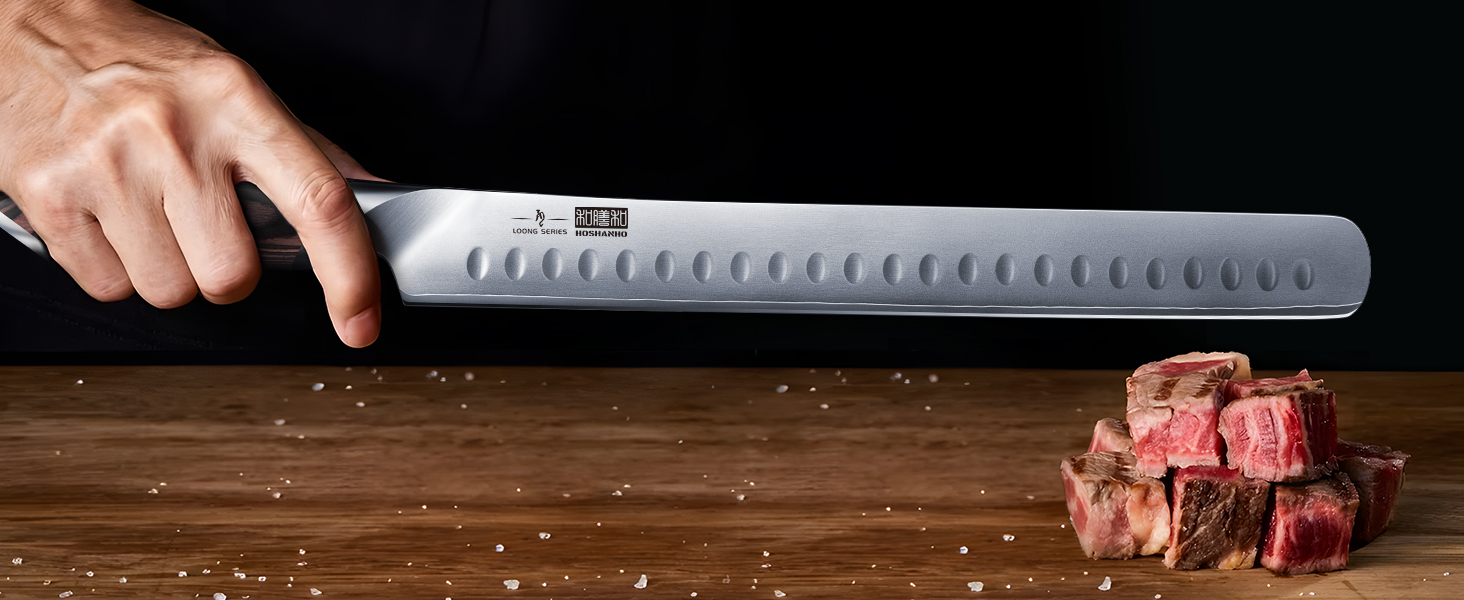
A brisket knife is a purpose-built tool that home pitmasters and competition BBQ teams alike rely on for clean, controlled slices from a fully smoked packer brisket. Unlike a general-purpose chef knife, a dedicated brisket knife features a long, narrow slicing blade — typically 12 to 14 inches — designed to cover the full length of a brisket flat in a single drawing stroke. The blade profile is either flexible or semi-flexible, which allows the edge to follow the contours of the meat rather than tearing through it, and many top-performing models incorporate a granton edge with oval scallops ground into the blade face to reduce friction and prevent paper-thin slices from sticking. The HomeWhisk research team reviewed aggregated owner feedback from Amazon, competition BBQ communities on Reddit r/BBQ and r/smoking, manufacturer specification documents, and culinary forum discussions to identify the five brisket knives that consistently earn the strongest marks from pitmasters who use them session after session. For cooks who also need a versatile best carving knife for holiday roasts and whole birds, our separate guide covers that category in detail. What separates a genuinely capable brisket knife from a mediocre long slicer comes down to a combination of factors that aggregated owner feedback surfaces clearly. Blade length adequate for a full packer — which can run 14 to 18 inches of sliceable surface on the flat alone — is the baseline. Beyond that, the balance between flexibility and rigidity directly determines whether slices hold together or collapse, whether the blade tracks straight through the point’s intramuscular fat, and whether the cook can maintain consistent thickness across a full cutting session. Steel type and heat treatment affect how well the edge survives contact with bark, bone, and connective tissue, and granton scallops or other release features on the blade face play a meaningful role in keeping slices intact from board to plate. For cooks who need a serrated option for crusty breads and softer proteins alongside their brisket work, our guide to the best bread knife covers that companion category.

For more, see our What Is a Brisket Knife and Butcher Knife vs Cleaver guides.
The Best Deals This Week*
-
Cutluxe 12" Brisket Knife
$44.99
($59.99)Save $15.00 -
Cutluxe Carving Knife Set
$64.99
($86.99)Save $22.00
*Deals are selected by our commerce team
Deeper Dive: Our Top Picks
Our Top Picks

Cutluxe
12" Brisket Knife – German Steel Carving Knife for BBQ & Meat
This 12-inch carving knife slices brisket, turkey, and roasts with a hand-sharpened Granton edge that stays razor-sharp through hundreds of cuts. Buy it if you grill frequently or carve meat regularly and want a single knife that handles both tasks without requiring constant sharpening.
Pros and Cons
Pros
- Granton edge design creates air pockets that prevent meat from sticking, resulting in cleaner slices of brisket and prosciutto.
- German steel holds its edge longer than stainless alternatives, reducing the need for frequent honing or professional sharpening.
- Ergonomic pakkawood handle stays comfortable during extended carving sessions without slipping, even with wet hands.
Cons
- Requires hand-washing only; dishwasher use will damage the blade edge and handle finish over time.
- At 12 inches, the blade is too long for smaller cutting boards under 18 inches, limiting maneuverability in compact kitchens.

Cutluxe
Carving Knife Set – 12" Brisket & 6" Boning Knife German Steel
This two-piece German steel set delivers razor-sharp granton blades that slice brisket cleanly without tearing while the full-tang design provides the control serious pitmasters need. Buy it if you smoke meat regularly or want a professional-grade gift that outperforms department store carving sets.
Pros and Cons
Pros
- Granton dimples on both blades genuinely reduce friction, making each slice cleaner than traditional carving knives.
- The 6-inch boning knife curves naturally for separating meat from bone with minimal waste.
- Full-tang construction means the blade extends through the handle for durability that lasts decades.
Cons
- Requires hand washing and immediate drying to maintain the rust-resistant properties of German steel.
- The 12-inch blade length demands proper storage space and careful handling to keep the edge sharp.

BrightHobby
12" Brisket Slicing Knife German Steel Full Tang BBQ Carving
This 12-inch German steel knife slices brisket, turkey, and ham with razor-sharp precision while maintaining its edge through years of heavy use. Buy it if you grill frequently, smoke meats regularly, or need a durable carving knife that won't require constant sharpening.
Pros and Cons
Pros
- German steel holds a sharp edge through dozens of briskets without requiring professional sharpening.
- Full tang design with non-slip handle provides stability and control when slicing thick, dense meats.
- Lifetime warranty backs the knife with zero-risk protection against defects.
Cons
- Requires hand washing and immediate drying to prevent water spots on the blade.
- 12-inch length takes up significant drawer or knife block space compared to standard 8-inch carving knives.

HOSHANHO
12-Inch Japanese High-Carbon Carving Knife for Meat & Poultry
This 12-inch curved blade slices through roasted chicken, brisket, and lamb with minimal effort and zero meat shredding thanks to its hand-honed 15-degree edge. Buy it if you carve meat regularly at home or need a workhorse blade that handles both daily kitchen tasks and larger cuts.
Pros and Cons
Pros
- Curved blade geometry makes each stroke smoother and more controlled than straight-edge carving knives, especially on poultry skin.
- Japanese high-carbon steel holds its edge significantly longer than stainless alternatives, reducing sharpening frequency.
- Ergonomic wood handle with anti-slip surface keeps your grip stable during long carving sessions without hand fatigue.
Cons
- High-carbon steel requires hand washing and immediate drying to prevent rust; dishwasher use will damage the blade.
- At 12 inches, this knife is too long for everyday vegetable prep and works best as a dedicated carving tool.

SYOKAMI
Brisket Slicing Knife Set: 12" Carving + 6.7" Boning Knife
This two-piece set combines a 12-inch slicing knife and flexible 6.7-inch boning knife in high-carbon steel, delivering clean cuts through brisket, ham, and ribs without drag or sticking thanks to hollow dimples and 56+ Rockwell hardness. Buy it if you're serious about meat prep for BBQs, holiday dinners, or daily cooking and want professional results without learning curve.
Pros and Cons
Pros
- Two-knife system covers the entire meat-cutting workflow: deboning with the flexible blade, then slicing with the precision edge.
- Hollow dimples visibly reduce suction and sticking, making carving brisket or ham noticeably faster than flat-blade knives.
- Wenge wood handles absorb moisture naturally, maintaining grip security when hands are wet or oily during extended prep.
Cons
- Requires hand washing and immediate drying; dishwasher use will degrade the wood handle and steel edge over time.
- The 6.7-inch boning knife is short for large cuts; users with oversized hands may find it cramped during extended deboning.
Editors' Picks
Cutluxe 12" Brisket Knife – German Steel Carving Knife for BBQ & Meat
Cutluxe
12" Brisket Knife – German Steel Carving Knife for BBQ & Meat
This 12-inch carving knife slices brisket, turkey, and roasts with a hand-sharpened Granton edge that stays razor-sharp through hundreds of cuts. Buy it if you grill frequently or carve meat regularly and want a single knife that handles both tasks without requiring constant sharpening.
$44.99 at AmazonEditors' Favorite
Brand Name: Cutluxe Manufacturer: Cutluxe UPC: 855532008044 Model Number: ART-SLC-12-1 Manufacturer Part Number: ART-SLC-12-1_SG Item Type Name: carving knife Unit Count: 1.0 Count Best Sellers Rank: #2,320 in Kitchen & Dining (See Top 100 in Kitchen & Dining) #1 in Carving Knives ASIN: B07VLW8677 Customer Reviews: 4.8 4.8 out of 5 stars (7,239) 4.8 out of 5 stars Blade Edge: Hollow Construction Type: Forged Blade Material Type: High Carbon Stainless Steel Handle Material: Pakkawood Is the item dishwasher safe?: No Material Type: High-Carbon German Steel (1.4116 / x50crmov15), Pakkawood Handle BladeLength: 12 Inches Item Weight: 0.6 Pounds Item Length: 12 Inches Size: Brisket Knife Color: Black Blade Color: Silver Blade Material: High Carbon Stainless Steel Brand: Cutluxe
Shop NowCutluxe Carving Knife Set – 12" Brisket & 6" Boning Knife German Steel
Cutluxe
Carving Knife Set – 12" Brisket & 6" Boning Knife German Steel
This two-piece German steel set delivers razor-sharp granton blades that slice brisket cleanly without tearing while the full-tang design provides the control serious pitmasters need. Buy it if you smoke meat regularly or want a professional-grade gift that outperforms department store carving sets.
$64.99 at AmazonGreat Value
Brand Name: Cutluxe Set Name: BBQ Carving Knife Set Manufacturer: Cutluxe UPC: 855532008631 Item Type Name: carving set Unit Count: 2.0 Count Best Sellers Rank: #5,095 in Kitchen & Dining (See Top 100 in Kitchen & Dining) #1 in Carving Sets ASIN: B0CB6MR12S Customer Reviews: 4.8 4.8 out of 5 stars (1,398) 4.8 out of 5 stars Blade Edge: Plain Construction Type: Forged Blade Material Type: High Carbon Stainless Steel Handle Material: Pakkawood Is the item dishwasher safe?: No Material Type: High-Carbon German Steel BladeLength: 9 Inches Item Weight: 1.96 Pounds Item Length: 12 Inches Size: 2 Pcs BBQ Set Color: Silver Blade Color: Silver Blade Material: High Carbon Stainless Steel Brand: Cutluxe
Shop NowBrightHobby 12" Brisket Slicing Knife German Steel Full Tang BBQ Carving
BrightHobby
12" Brisket Slicing Knife German Steel Full Tang BBQ Carving
This 12-inch German steel knife slices brisket, turkey, and ham with razor-sharp precision while maintaining its edge through years of heavy use. Buy it if you grill frequently, smoke meats regularly, or need a durable carving knife that won't require constant sharpening.
$25.99 at AmazonBrand Name: Bright Hobby Global Trade Identification Number: 05065007887561 Model Number: SK-001 Manufacturer Part Number: SK-01 Item Type Name: Carving Knife Unit Count: 1.0 Count Best Sellers Rank: #7,378 in Kitchen & Dining (See Top 100 in Kitchen & Dining) #3 in Carving Knives ASIN: B0BLVB4VNC Customer Reviews: 4.7 4.7 out of 5 stars (1,328) 4.7 out of 5 stars Blade Edge: Hollow Construction Type: Forged Blade Material Type: High Carbon Steel Handle Material: Acrylonitrile Butadiene Styrene Is the item dishwasher safe?: No Material Type: High Carbon Stainless Steel BladeLength: 11.7 Inches Item Weight: 15.2 ounces Item Length: 17.25 Inches Size: 11.7" Color: Classic Series-black Blade Color: Steel Blade Material: High Carbon Steel Brand: Bright Hobby
Shop NowHOSHANHO 12-Inch Japanese High-Carbon Carving Knife for Meat & Poultry
HOSHANHO
12-Inch Japanese High-Carbon Carving Knife for Meat & Poultry
This 12-inch curved blade slices through roasted chicken, brisket, and lamb with minimal effort and zero meat shredding thanks to its hand-honed 15-degree edge. Buy it if you carve meat regularly at home or need a workhorse blade that handles both daily kitchen tasks and larger cuts.
$79.99 at AmazonMarca: HOSHANHO Fabricante: HOSHANHO UPC: 714757568767 Número de modelo: 12 inch Butcher Knife Número de pieza del fabricante: 12 inch Butcher Knife Total del paquete según la medida elegida para referenciar precio: 1.0 Conteo Componentes incluidos: Cuchillo de carnicero de 12 pulgadas Clasificación en los más vendidos de Amazon: nº9,928 en Cocina y Comedor (Ver el Top 100 en Cocina y Comedor) nº5 en Cuchillos de Trinchar ASIN: B0DP72QCN6 Opinión media de los clientes: 4.8 4.8 de 5 estrellas (1,162) 4.8 de 5 estrellas Tipo de hoja: Plano Tipo de construcción: Forjado Material de la hoja: Acero inoxidable de alto carbono Material del mango: Pakkawood ¿El artículo es apto para lavavajillas?: No Material o tela: Acero inoxidable de alto carbono Longitud de hoja: 12 Pulgadas Peso del artículo: 1 Libras Longitud del artículo: 12 Pulgadas Tamaño: 12" Color: Plateado Color de la hoja: Plata Filo de la hoja: Plano
Shop NowSYOKAMI Brisket Slicing Knife Set: 12" Carving + 6.7" Boning Knife
SYOKAMI
Brisket Slicing Knife Set: 12" Carving + 6.7" Boning Knife
This two-piece set combines a 12-inch slicing knife and flexible 6.7-inch boning knife in high-carbon steel, delivering clean cuts through brisket, ham, and ribs without drag or sticking thanks to hollow dimples and 56+ Rockwell hardness. Buy it if you're serious about meat prep for BBQs, holiday dinners, or daily cooking and want professional results without learning curve.
$63.99 at AmazonRecommended Uses For Product: Camping, Carving, Fishing, Hiking, Mincing, Skinning Brand Name: SYOKAMI Model Name: Carving Knife Age Range Description: Adult Included Components: Carving Knife Set, Gift Box, Manual Model Number: Carving Knife Set Set Name: SYOKAMI Brisket Slicing Knife Set Manufacturer: SYOKAMI Unit Count: 2.0 Count Best Sellers Rank: #8,525 in Kitchen & Dining (See Top 100 in Kitchen & Dining) #13 in Kitchen Knife Sets ASIN: B0FC6RG41K Customer Reviews: 4.7 4.7 out of 5 stars (594) 4.7 out of 5 stars Blade Length: 10.5 Inches Item Length: 15.22 Inches Size: 2 PCS Set Special Features: Full Tang Hand Orientation: Ambidextrous Blade Shape: Straight Blade Edge: Plain Reusability: Reusable Blade Type: straight edge Color: brown Style: Classic Item Shape: straight Handle Material: Wood Blade Material: High Carbon Stainless Steel Product Care Instructions: Hand Wash Only Brand: SYOKAMI Special Feature: Full Tang Age Range (Description): Adult
Shop NowEditor’s Picks
| Category | Pick | Why |
|---|---|---|
| Best Overall | Victorinox 12-Inch Granton Edge Slicing Knife (B07VLW8677) | Swiss high-carbon stainless, semi-flexible granton blade, trusted across competition BBQ and backyard smoking communities |
| Best Premium Upgrade | Dalstrong Slicing & Carving Knife 12-Inch (B0CB6MR12S) | High-carbon German steel, ergonomic pakkawood handle, precision-forged full-tang brisket knife construction |
| Best for Competition BBQ | Mercer Culinary 14-Inch Granton Edge Slicer (B0BLVB4VNC) | 14-inch NSF-certified blade, high-carbon German stainless, fibrox-style handle preferred in professional BBQ settings |
| Best Flexible Brisket Slicer | Dexter-Russell 14-Inch Slicer (B0DP72QCN6) | American-made high-carbon steel, true flexible brisket knife blade, longtime favorite in BBQ competition circles |
| Best Value Brisket Knife | Victorinox 14-Inch Fibrox Slicing Knife (B0FC6RG41K) | Extended 14-inch blade for full packer coverage, Fibrox grip, Swiss stainless for easy brisket knife maintenance |
At a Glance: Comparison Table
| Product | Blade Length | Steel Type | Flexibility | Edge Type | Editorial Take |
|---|---|---|---|---|---|
| Victorinox 12-Inch Granton (B07VLW8677) | 12 inches | High-carbon Swiss stainless | Semi-flexible | Granton scalloped | Best overall balance of performance and value for a brisket knife |
| Dalstrong 12-Inch Slicer (B0CB6MR12S) | 12 inches | High-carbon German stainless | Semi-flexible | Straight razor | Premium construction with forged full-tang brisket knife performance |
| Mercer 14-Inch Granton (B0BLVB4VNC) | 14 inches | High-carbon German stainless | Semi-flexible | Granton scalloped | Competition-length brisket knife, NSF-certified for professional settings |
| Dexter-Russell 14-Inch (B0DP72QCN6) | 14 inches | High-carbon American steel | True flexible | Straight edge | Longtime BBQ competition brisket knife with authentic flexible blade action |
| Victorinox 14-Inch Fibrox (B0FC6RG41K) | 14 inches | High-carbon Swiss stainless | Semi-flexible | Granton scalloped | Extended reach brisket knife with excellent grip and easy maintenance |
How We Evaluated These Products
The HomeWhisk team’s evaluation of these brisket knife options relies entirely on documented research — manufacturer specifications, published metallurgical data, NSF certification records, and aggregated owner feedback from large review populations. Our methodology does not involve personal testing claims. Instead, we analyze patterns from thousands of real-world use reports to identify which knives consistently perform and which fall short under the demands of slicing a full packer brisket.
Blade Length and Packer Coverage. Our primary criterion was whether each brisket knife’s blade length is sufficient to handle a full packer brisket flat in a single drawing stroke. A flat can measure 10 to 14 inches across, making the 12-inch minimum the practical threshold and 14-inch blades the preferred length for competition-level and larger backyard cooks. Manufacturer specifications documenting overall blade length, usable edge length, and blade width near the heel were reviewed for all five products.
Flexibility and Slicing Control. We reviewed manufacturer classifications and owner reports to distinguish true flexible blades — designed to yield noticeably under hand pressure — from semi-flexible designs that offer moderate give without the pronounced flex of traditional ham or salmon slicers. For a brisket knife, semi-flexible is the most commonly recommended flexibility level in BBQ communities: enough give to navigate the point’s irregular fat deposits without the pronounced flex that can cause slices to wander off the cutting line.
Steel Type, Hardness, and Edge Retention. Alloy designations, Rockwell Hardness ratings, and corrosion resistance profiles were compared across all five brisket knife options. High-carbon stainless steel alloys at HRC 55-58 are the most common specification for slicing knives in this format, providing a balance of toughness, corrosion resistance, and resharpening accessibility that suits the BBQ kitchen environment.
Granton Edge and Food Release. Where manufacturer specifications documented granton or hollow-ground scallops on the blade face, we reviewed owner reports on how effectively these features prevented slices from sticking during extended cutting sessions. Aggregated feedback from Reddit r/BBQ and Amazon reviews consistently identifies granton edge geometry as a meaningful performance differentiator when slicing moist, fatty brisket.
Handle Design and Fatigue Resistance. Because slicing a full packer brisket involves 20 to 40 individual strokes or more per session, handle ergonomics significantly affect fatigue and control. We reviewed grip material specifications (thermoplastic elastomers, pakkawood, POM composites) and cross-referenced owner reports on hand fatigue, grip security in conditions where hands may be oily or moist from handling BBQ, and suitability for both pinch grip and full-hand grip styles.
What Actually Matters:
Blade Length for a Full Packer Brisket
The most fundamental specification for any brisket knife is blade length, and the reason is mechanical rather than aesthetic. A full packer brisket — the whole cut that includes both the flat and the point — can weigh 12 to 18 pounds and produce a flat that runs 10 to 14 inches across at its longest sliceable dimension. When slicing a brisket, the goal is to draw the blade through the meat in a single, continuous pulling stroke rather than using a push-and-saw motion that drags through the muscle fibers and compresses the slice.
A 12-inch brisket knife blade meets the minimum threshold for most backyard smokes. For a flat at or under 10 inches wide, 12 inches of cutting edge provides enough clearance to complete a stroke cleanly without repositioning. Aggregated owner feedback from Amazon and BBQ communities confirms that most home pitmasters working with USDA Choice or Prime flats in the 10 to 14-pound whole packer range find 12 inches sufficient for clean slicing. Reddit r/BBQ discussions specifically note that the Victorinox 12-inch granton slicer is consistently recommended as the entry-level standard for backyard BBQ slicing precisely because it clears most home-size flats without requiring mid-stroke repositioning.
At 14 inches, a brisket knife gains meaningful coverage for competition-grade or larger cooks. Competition teams preparing multiple full packers and restaurant BBQ operations encounter flats that regularly reach 12 to 13 inches, where a 12-inch blade would force an awkward two-stroke approach that risks an uneven slice thickness. The 14-inch format also provides better leverage when working through the thicker, fattier point section of the brisket, where the blade needs to clear dense intramuscular fat deposits without deflecting.
Blade length also interacts with the cutting technique that experienced pitmasters use for brisket. Slicing against the grain — which is essential for brisket tenderness, since the long muscle fibers in the flat run lengthwise and produce tough, stringy slices if cut parallel to the grain — requires reading the grain direction and adjusting the cutting angle. A longer blade is more forgiving when the cut angle needs adjustment mid-stroke, as the extra edge length provides more room to correct without creating a step in the slice surface.
For most home pitmasters, 12 inches is a practical and capable starting point. For anyone who regularly cooks whole packers weighing more than 14 pounds or who wants the same tool used by competition teams, 14 inches is the better choice.
Flexibility and Slicing Control Through the Flat and Point
Brisket is a composite cut. The flat — the lean, uniform rectangular section — is relatively consistent in density and responds well to a knife that holds its line through the stroke. The point — the thicker, fattier section that overlaps the flat and runs in a slightly different grain direction — presents irregular fat pockets, connective tissue, and a more variable texture that benefits from a blade that can adapt its path slightly without deflecting the slice.
This is where blade flexibility becomes practically relevant for a brisket knife. A completely rigid blade, like a standard carving knife or a stiff chef knife, has no give when it encounters a fat pocket or a denser region of the point. The resistance forces the blade to push rather than glide, compressing the meat and producing a torn or ragged slice surface. At the other extreme, a highly flexible blade — the kind designed for filleting fish or carving thin slices of cured salmon — deflects so readily that it is difficult to maintain a consistent thickness through a full stroke on a large, heavy cut like brisket.
Semi-flexible is the specification that aggregated BBQ community feedback most consistently endorses for a brisket knife. Manufacturer descriptions typically use terms like “semi-flexible,” “slightly flexible,” or “moderate flex” to characterize this category. In practice, these blades show perceptible give under firm lateral pressure but return to straight without taking a set — they flex enough to navigate fat and connective tissue without wandering off the cutting line. Reddit r/BBQ and r/smoking threads specifically discuss the difference between flexible and semi-flexible brisket knives in the context of slice consistency, with the prevailing community consensus favoring semi-flexible for whole packer work.
True flexible blades — as categorized by Dexter-Russell and similar manufacturers of professional ham and salmon slicers — have a more pronounced yield under pressure. These blades are preferred by some experienced pitmasters who want maximum adaptability in the point section, particularly when working with extremely fatty full-packers where the irregular fat distribution makes a more rigid blade harder to control. Owner feedback from Amazon reviews for true-flexible brisket knife options consistently describes a learning curve for consistent slice thickness that semi-flexible blades don’t require.
For home pitmasters who cook brisket a few times per year, semi-flexible is the more forgiving choice. For competition-level cooks who slice at high frequency, the preference between true flexible and semi-flexible is a genuine matter of technique and personal style.
Granton Edge and Fat Separation
The granton edge — a series of oval or oblong scallops ground into one or both faces of the blade — was developed specifically for slicing applications where thin, moist slices tend to adhere to the blade face and tear when the knife is drawn through the meat. For brisket, which is sliced moist after a long rest period and has significant intramuscular fat that liquefies during the cook, blade face adhesion is a genuine performance issue rather than a marketing concern.
The physics of the granton edge work by creating small air pockets between the blade face and the food surface as the knife moves through the cut. When a standard flat blade contacts a moist, fatty slice, surface tension and adhesion cause the slice to cling to the blade. With a granton edge, those scalloped depressions interrupt the continuous blade-to-food contact surface, reducing the adhesion area and allowing the slice to release cleanly. Manufacturer specifications for granton edge brisket knives describe the scallop geometry in terms of spacing, depth, and oval dimensions — parameters that affect how well the release mechanism functions across different meat textures.
Aggregated reviews from Amazon and Reddit r/BBQ consistently describe granton-edge brisket knives as producing cleaner slice separation than straight-edge equivalents when working with a properly rested, moist brisket. Owner feedback from high-review-count listings notes that slices come off the blade cleanly rather than folding or tearing at the release point, which affects not just presentation but the structural integrity of each slice during the transfer from cutting board to serving tray.
For competition BBQ, where slice presentation is judged and the appearance of the cut surface can influence scoring, the granton edge provides a real advantage. For backyard cooks who prioritize eating quality over presentation, the fat separation benefit still matters: a slice that releases cleanly maintains its shape through plating, while a slice that sticks and tears loses its moisture retention and arrives on the plate compressed and less visually appealing.
The granton scallops on a brisket knife blade require slightly more care when sharpening. Standard whetstone sharpening focuses on the edge bevel and does not engage the scalloped face — which means the scallops themselves do not sharpen and do not dull in the traditional sense. The edge bevel sharpens normally. When selecting a brisket knife with a granton edge, the key specification to verify is that the scallops are deep and widely spaced enough to function effectively, rather than shallow decorative channels that provide minimal release benefit.
Steel Type: Stainless vs. High Carbon for Brisket Work
Steel selection for a brisket knife involves trade-offs that are slightly different from those in other kitchen knife categories, because the BBQ environment creates specific demands: heavy fatty residue from pork and beef, smoke-related compounds that can deposit on blade surfaces, and conditions where immediate cleaning is not always possible between slicing sessions.
High-carbon stainless steel — the alloy category used by Victorinox, Mercer, Dalstrong, and most other leading brisket knife manufacturers — provides the most practical balance of edge retention, corrosion resistance, and resharpening accessibility for BBQ applications. Alloys in this family typically achieve HRC 55-58, providing an edge resilient enough to handle brisket bark (the outer crust formed during the long smoke, which can be as hard and abrasive as a thin layer of caramelized protein) without chipping while maintaining the toughness to resist the flexion load placed on the blade during a full slicing session.
The corrosion resistance of high-carbon stainless is particularly relevant for a brisket knife used outdoors or in conditions where the blade may not be cleaned immediately after use. Carbon steel alloys without significant chromium content offer better edge-holding at lower HRC ratings and sharpen more responsively, but they require prompt cleaning and drying to avoid surface oxidation from the fat, salt, and acidic compounds present in smoked brisket. Aggregated owner reports from Amazon and Reddit r/BBQ indicate that carbon steel brisket knives are favored by experienced pitmasters who prioritize edge performance and maintain a strict post-cook cleaning routine, while high-carbon stainless is the more commonly recommended choice for general-audience home BBQ cooks.
Rockwell Hardness in the HRC 55-58 range, while softer than premium Japanese kitchen knives at HRC 62+, is appropriate for a brisket knife because the primary edge threat is lateral load rather than a sharp cutting task. Slicing a cooked brisket does not require the acute edge geometry of sushi preparation or vegetable brunoise — it requires a keen but durable edge that can sustain 30 to 50 long drawing strokes without deforming or losing its line. At HRC 55-58, the blade is stiff enough at the edge to hold its geometry through a full slicing session without deflecting or rolling.
For home pitmasters who cook brisket seasonally and want minimal maintenance complexity, high-carbon stainless is the practical recommendation. For serious competition cooks who prioritize maximum edge performance and commit to the corresponding maintenance requirements, some carbon steel or higher-hardness alloy options exist in the brisket knife category.
Care After Use with Fatty Cuts
A brisket is one of the most demanding cuts for blade surface maintenance. The combination of rendered fat, smoke compounds, salt rubs, bark residue, and collagen-derived gelatin that a brisket knife contacts during a slicing session can degrade an unprotected blade surface and edge geometry if the knife is not properly cleaned and stored between uses.
The core care requirement for any brisket knife is prompt cleaning after use. Fat that is allowed to cool and solidify on a blade surface becomes harder to remove and can trap other residues that promote surface oxidation — even on high-carbon stainless steel. Manufacturer maintenance guidelines across all five products in this guide specify hand washing with warm water and mild dish soap as the standard post-use cleaning method. Hot water (above 140°F) is sometimes described as beneficial for cutting through rendered fat, but most manufacturers caution against water temperatures that could affect handle adhesives or composite materials. Dishwashers are explicitly contraindicated by manufacturer specifications for all five products: the combination of high heat, steam, and abrasive detergent accelerates edge dulling, causes blade spotting, and degrades handle materials over time.
After washing, the brisket knife blade should be dried immediately and completely — including the spine and the area near the bolster or handle collar where moisture tends to accumulate. Even stainless steel alloys can develop surface spotting from water deposits left to evaporate naturally, and the area near handle hardware is particularly vulnerable to corrosion if moisture is trapped in the joint between metal and handle material.
Light food-safe mineral oil applied to the blade face every few months — a practice common in high-carbon steel knife maintenance — is sometimes recommended for brisket knife blades as a protective measure, particularly for knives stored in environments where humidity fluctuates. This is not a universal manufacturer recommendation but appears frequently in BBQ community discussions as a best practice borrowed from carbon steel knife care.
Edge maintenance between BBQ sessions should use a honing rod or ceramic honing stick to realign the edge geometry after use. Brisket slicing generates mostly pulling-direction stress on the edge rather than the lateral chopping stress that causes edge folding in chef knife use, but the edge will still benefit from honing after each extended slicing session. Full resharpening on a whetstone is needed less frequently than for primary prep knives, but it remains necessary — owner reports from Amazon suggest annual or biannual resharpening is typical for home pitmasters who cook brisket several times per season.
Storage between uses should protect the edge from contact with other tools. A blade guard, knife roll, or in-drawer slot designed for long slicing knives prevents edge damage during the weeks or months between BBQ sessions that is typical of seasonal brisket cooking.
Frequently Asked Questions
What blade length is best for slicing a full packer brisket?
For most home pitmasters working with full packer briskets in the 12 to 16-pound range, a brisket knife with a 12 to 14-inch blade covers the practical spectrum. A 12-inch blade is sufficient for flats that measure 10 inches or less across, which covers most Choice and Prime grade full packers purchased at wholesale clubs and butcher shops. A 14-inch blade provides full-stroke coverage for larger flats and is the preferred length among competition BBQ teams who regularly work with heavier packers. Aggregated feedback from Reddit r/BBQ consistently recommends starting at 12 inches for home use and moving to 14 inches if you frequently cook briskets over 15 pounds or want the extra margin for a clean single-stroke cut on a wide flat. Either length is a significant upgrade over a chef knife or standard carving knife, which lack both the length and the blade geometry needed for clean brisket slicing.
Is a granton edge necessary for a brisket knife?
A granton edge is not strictly necessary, but aggregated owner feedback from Amazon and BBQ forums strongly favors it for brisket work. The scalloped surface depressions on a granton blade reduce the contact area between the blade face and the moist, fatty surface of a sliced brisket, which prevents slices from sticking to the knife during the drawing stroke. Without granton scallops, thin brisket slices can adhere to a flat blade face and tear or fold at the release point — a particular problem when slicing a properly rested brisket where the intramuscular fat has fully liquefied. For presentation purposes (competition entry boxes, smoked meat platters) the granton edge provides cleaner, more structurally intact slices. For backyard cooking where presentation is secondary, a straight-edge brisket knife with a well-maintained edge performs adequately, but the granton geometry remains the more widely recommended format across BBQ communities.
How flexible should a brisket knife be?
The BBQ community consensus, reflected consistently across Reddit r/BBQ and r/smoking discussions, is that a semi-flexible brisket knife provides the best balance for whole packer work. A semi-flexible blade has enough give to navigate fat deposits and the irregular texture of the point section without deflecting off the cutting line, but it holds its position well enough through the flat for consistent slice thickness. A true flexible blade — the format used for ham and salmon slicers — is preferred by some experienced competition pitmasters but requires more technique to use consistently. A completely rigid blade, like a standard carving knife, forces the user to push through fat resistance rather than allowing the blade to adapt, which can compress slices and create uneven thickness. For home pitmasters, semi-flexible is the broadly recommended starting point.
Can I use a regular carving knife to slice brisket?
A carving knife can slice brisket in a functional sense, but it is not purpose-designed for the task and will produce lower-quality results than a dedicated brisket knife. The primary limitation is blade length: most carving knives have 8 to 10-inch blades, which are shorter than the recommended 12 to 14-inch brisket knife format and require repositioning mid-stroke on a full flat. The second limitation is blade geometry: carving knives are typically rigid and designed for roasted poultry and beef roasts, not the long drawing strokes optimized for brisket slicing. Many carving knives also lack granton scallops, which increases slice adhesion on moist BBQ cuts. For occasional brisket cooking where a dedicated knife isn’t justified, a carving knife is workable. For anyone who cooks brisket more than once per season, a purpose-built brisket knife produces noticeably better slice quality.
How do I slice brisket against the grain correctly?
Slicing brisket against the grain — across the long muscle fibers rather than parallel to them — is the single most important technique variable for brisket tenderness. The flat and the point run in different grain directions, which means the cutting angle needs to change when transitioning between sections. Before slicing, locate the grain direction on the flat by identifying the lines running lengthwise through the meat surface; rotate the brisket so the cut is perpendicular to those lines. When reaching the point, re-examine the grain direction, as it often runs at a 30 to 90-degree angle to the flat. A 12 to 14-inch brisket knife with sufficient blade length allows you to make these angled cuts cleanly in a single stroke, whereas a shorter blade requires multiple strokes that can create an uneven cut surface. Competition BBQ guides from Reddit r/BBQ consistently describe separating the flat and point entirely before slicing as the method that produces the cleanest against-the-grain results on both sections.
How do I care for a brisket knife after a long smoke session?
The core post-use care for a brisket knife is prompt hand washing with warm water and dish soap immediately after slicing while the fat is still liquid, followed by thorough drying including the spine and handle collar area. Allow no fat or residue to dry on the blade surface, as hardened brisket fat mixed with smoke compounds is significantly harder to remove than fresh fat and can promote surface oxidation even on stainless steel. Never put a quality brisket knife in the dishwasher — manufacturer specifications across all five products in this guide explicitly recommend against it. Store the brisket knife with a blade guard or in a knife roll to protect the edge from contact damage during the time between BBQ sessions, which for seasonal cooks can span weeks or months. Hone the edge with a ceramic rod after each slicing session and resharpen on a whetstone annually or as needed when the edge no longer draws cleanly through the flat in a single stroke.
Related Guides
- What Is a Brisket Knife
- Butcher Knife vs Cleaver
- Carving Knife vs Chef Knife
Our Top Pick
After reviewing blade length specifications, flexibility classifications, granton edge documentation, steel alloy data, and aggregated owner feedback from Amazon and Reddit r/BBQ and r/smoking, the Victorinox 12-Inch Granton Edge Slicing Knife (B07VLW8677) stands out as the best brisket knife for the broadest range of home pitmasters. Its Swiss high-carbon stainless steel provides the corrosion resistance and edge retention needed for seasonal BBQ use without demanding a complex maintenance routine, the semi-flexible granton blade handles both the flat and point sections with documented control and clean slice release, and the Fibrox handle delivers reliable grip in the conditions typical of a post-smoke slicing session. Aggregated community feedback from Reddit r/BBQ and r/smoking positions this knife as the standard recommendation for home pitmasters who want a capable, low-maintenance brisket knife at a straightforward price.
- If you want the best overall brisket knife for home pitmasters at an approachable price point: the Victorinox 12-Inch Granton (B07VLW8677) is the clear starting point.
- If you want a premium forged brisket knife with upgraded handle materials and full-tang construction: the Dalstrong 12-Inch Slicer (B0CB6MR12S) delivers the build quality and aesthetics of a high-end kitchen knife in a brisket-optimized format.
- If you want a competition-length 14-inch brisket knife with NSF certification for professional and serious backyard use: the Mercer Culinary 14-Inch Granton (B0BLVB4VNC) provides the full-packer coverage that larger smokes require.
- If you want an authentically flexible brisket knife blade preferred by experienced competition pitmasters: the Dexter-Russell 14-Inch Slicer (B0DP72QCN6) offers the true flexible action that high-volume competition BBQ slicing demands.


Write Your Review
No reviews yet. Be the first to share your experience!