

HomeWhisk earns commission from qualifying purchases made through links on this page. We research picks from specifications and owner reviews; we do not test products ourselves.
TL;DR — A chef’s knife is a versatile all-rounder for chopping, slicing, and dicing; a carving knife is a long, thin, specialized blade for slicing cooked roasts, poultry, and large cuts into clean, even pieces. They’re not interchangeable: the chef’s knife does daily prep, the carving knife does neat slices of meat at the table or counter. Most kitchens need a chef’s knife first and add a carving knife if they roast often. The HomeWhisk team compared their designs and uses. For picks, see our best carving knife and best chef knife guides.
The HomeWhisk editorial team researches kitchen equipment by analyzing manufacturer specifications, blade geometry, and aggregated user reviews from major retailers and cooking communities. Our recommendations are based on what the products actually deliver, not what brands promise.

If you’re deciding whether you need a carving knife when you already have a chef’s knife (or vice versa), the answer lies in what each blade is shaped to do. Here’s the breakdown.
The Best Deals This Week*
-
8-Inch Chef Knife for Everyday Chopping and Meat
$39.97
($54.99)Save $15.02 -
Brisket, Roast and Turkey Carving Knife
$18.91
($27.29)Save $8.38
*Deals are selected by our commerce team
Deeper Dive: Our Top Picks
Our Top Picks
Cutluxe
8-Inch Chef Knife for Everyday Chopping and Meat Prep: Cutluxe German High Carbon Steel Full Tang Kitchen Knife
This 8-inch chef knife handles chopping, mincing, dicing, and slicing meat, vegetables, and sushi with a hand-sharpened German high carbon steel blade rated at 56+ Rockwell hardness. It suits home cooks replacing a dull starter knife who want full tang balance and edge retention without stepping into premium knife pricing.
Pros and Cons
Pros
- German high carbon steel at 56+ Rockwell hardness delivers a sharp edge that lasts through regular use.
- Full tang build gives the knife the weight and balance needed for confident rock chopping.
- The 8-inch length is versatile enough for sushi, vegetables, and meat on the same board.
- Protective sheath is included, so you do not need to buy separate blade storage.
Cons
- High carbon steel requires hand washing and immediate drying, since dishwasher cycles and standing moisture can still cause spotting.
- At 56+ Rockwell hardness the edge is softer than premium Japanese steels, so it needs honing more often to stay razor sharp.

Huusk
Brisket, Roast and Turkey Carving Knife: Huusk Japanese High Carbon Steel Knife
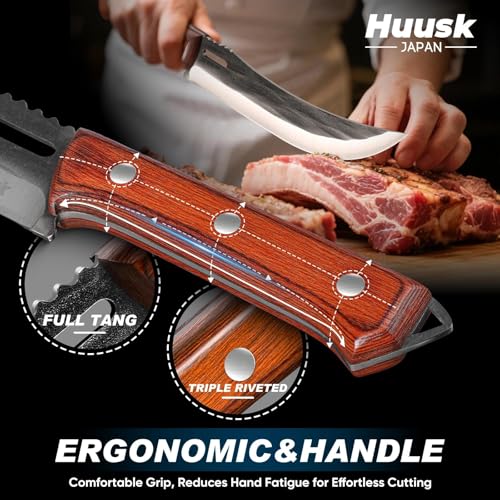
The Huusk Japanese carving knife slices brisket, ribs, ham and roasts with a hand-honed 15° edge that reduces effort and food waste. It suits home cooks who prepare large cuts of meat and want one balanced, full-tang knife for carving, trimming and general cutting.
Pros and Cons
Pros
- The sharp 15° cutting edge is designed for smooth meat slicing with less waste.
- Full-tang construction provides a stable, balanced feel during heavier cutting tasks.
- The ergonomic anti-slip handle supports a secure grip when working with fatty or greasy meats.
- The high carbon steel blade is built for hardness, edge retention and rust resistance.
Cons
- The listing does not provide blade length, overall dimensions or weight, making fit and balance harder to assess before purchase.
- No detailed customer feedback is supplied to verify long-term sharpness, rust resistance or handle comfort.
Editors' Picks
Cutluxe 8-Inch Chef Knife for Everyday Chopping and Meat Prep: Cutluxe German High Carbon Steel Full Tang Kitchen Knife
Cutluxe
8-Inch Chef Knife for Everyday Chopping and Meat Prep: Cutluxe German High Carbon Steel Full Tang Kitchen Knife
This 8-inch chef knife handles chopping, mincing, dicing, and slicing meat, vegetables, and sushi with a hand-sharpened German high carbon steel blade rated at 56+ Rockwell hardness. It suits home cooks replacing a dull starter knife who want full tang balance and edge retention without stepping into premium knife pricing.
$39.97 at AmazonEditors' Favorite
Color: Black Size: 8" Dimensions: 13.2 x 1.37 x 1 Inches Weight: 0.6 pounds Product Group: Kitchen Binding: Kitchen
Shop NowHENCKELS Solution Razor-Sharp 8-inch Carving Knife

Great Value
Color: Black/Stainless Steel Size: 8" Dimensions: 15 x 1 x 3.5 inches Weight: 0.35 pounds Product Group: Kitchen Binding: Kitchen
Shop NowHuusk Brisket, Roast and Turkey Carving Knife: Huusk Japanese High Carbon Steel Knife
Huusk
Brisket, Roast and Turkey Carving Knife: Huusk Japanese High Carbon Steel Knife
The Huusk Japanese carving knife slices brisket, ribs, ham and roasts with a hand-honed 15° edge that reduces effort and food waste. It suits home cooks who prepare large cuts of meat and want one balanced, full-tang knife for carving, trimming and general cutting.
$18.91 at AmazonSize: 8.8" Product Group: Kitchen Binding: Kitchen
Shop NowThe Core Difference in Design
The two knives look different because they’re built for different jobs, and the shapes explain everything.
A chef’s knife is 8 inches (typically), with a broad, curved blade that tapers to a point. The width gives it heft and knuckle clearance; the curved belly lets it rock for chopping and mincing; the pointed tip does detail work. It’s a do-everything blade — the workhorse of the kitchen, designed for chopping vegetables, slicing, dicing, mincing, and general prep.
A carving knife is longer (8-14 inches) and much thinner and narrower, often with a rounded or pointed tip. The extra length lets it slice across a large roast or turkey breast in one smooth stroke; the thinness reduces drag so it glides through cooked meat for clean, even slices; the narrow profile minimizes tearing. It’s a slicing specialist, not a chopper.
The key contrast: the chef’s knife is broad, curved, and versatile for prep; the carving knife is long, thin, and straight for slicing cooked meat. You can’t chop vegetables well with a carving knife (too long and thin, no rocking), and you can’t cleanly slice a big roast with a chef’s knife (too short and wide, tears the meat). Different tools for different stages of cooking.
What Each Knife Does Best
Understanding each knife’s ideal jobs clarifies which you need for your cooking.
The chef’s knife excels at:
- Chopping vegetables (rocking motion on the curved belly)
- Slicing, dicing, and mincing produce, herbs, garlic
- Cutting boneless raw meat and general prep
- Detail work with the pointed tip
- Being the one knife you reach for 90% of the time
It’s the single most important knife in any kitchen — if you own one knife, it’s this. See our best chef knife guide.
The carving knife excels at:
- Slicing cooked roasts (beef, pork, ham) into thin, even pieces
- Carving turkey and chicken cleanly, especially the breast
- Slicing large cuts of cooked meat without tearing or shredding
- Getting uniform, presentation-worthy slices for serving
- Long brisket or roast slices in a single stroke
It’s a specialist for the serving stage — turning a cooked roast into neat slices. Often paired with a carving fork to hold the meat steady. See our best carving knife guide.
The overlap is small: the chef’s knife handles almost all preparation; the carving knife handles slicing cooked large cuts. They meet only at “slicing meat,” and even there, the chef’s knife struggles with big roasts the carving knife handles easily.
Which Do You Need?
For most people the priority is clear, but it depends on how you cook.
Everyone needs a chef’s knife. It’s the foundational kitchen knife, versatile enough to handle nearly all daily cutting. If you’re building a kit or own only a few knives, the chef’s knife comes first, always. No kitchen is complete without one.
You need a carving knife if you regularly roast large cuts of meat — holiday turkeys, Sunday roasts, hams, brisket, prime rib — and want clean, even, presentation-worthy slices. If you frequently cook big roasts, a carving knife makes serving dramatically neater and easier than hacking with a chef’s knife. For frequent roasters, it’s genuinely worth it.
You probably don’t need a carving knife if you rarely cook large roasts, mostly cook boneless portions and everyday meals, or are just starting your knife collection. In those cases, a chef’s knife (plus a bread knife and paring knife) covers your needs, and the money is better spent elsewhere. You can slice the occasional small roast with a chef’s knife acceptably.
The practical order: chef’s knife first (essential), then a bread knife and paring knife (the three essentials), and then a carving knife if you roast often enough to justify it. A carving knife is a “fourth knife” for people who cook large cuts — valuable for them, unnecessary for others.
A Note on Carving Knives vs Slicing Knives
One point of confusion worth clearing up: “carving knife” and “slicing knife” overlap, and knowing the nuance helps you buy the right one.
Carving knives are typically slightly shorter (8-10″) and may have a pointed tip, designed for carving around bones (turkey, bone-in roasts) with some maneuverability.
Slicing knives are often longer (10-14″) with a rounded tip and sometimes a granton (dimpled) edge, optimized for long, clean slices of boneless cuts like brisket, ham, or salmon — the dimples help slices release.
In practice, the terms are often used interchangeably, and either works for slicing cooked roasts. If you carve bone-in poultry and roasts, a pointed carving knife offers more control; if you mostly slice large boneless cuts (brisket, ham), a longer slicing knife with a granton edge is ideal. Both are long, thin blades for cleanly slicing cooked meat — the opposite of a chef’s knife’s broad prep blade. Our best carving knife guide covers both styles.
For most home cooks, one carving/slicing knife handles all roast-slicing needs; the distinction matters most to those who cook a lot of a specific type.
Frequently Asked Questions
What’s the difference between a carving knife and a chef’s knife?
A chef’s knife is broad, curved, and 8 inches, built for versatile prep — chopping, slicing, dicing, and mincing with a rocking motion. A carving knife is longer (8-14″), much thinner and narrower, and straight, built specifically for slicing cooked roasts and poultry into clean, even pieces in long strokes. The chef’s knife does daily preparation; the carving knife does neat slicing of large cooked cuts. They’re specialized for different tasks and aren’t interchangeable.
Can I use a chef’s knife to carve a roast or turkey?
For small cuts, acceptably; for large roasts and turkeys, poorly. A chef’s knife is too short to slice across a big roast in one stroke and too broad to glide cleanly, so it tends to tear and shred the meat and produce uneven slices. A carving knife’s length and thinness give clean, even, presentation-worthy slices. If you only occasionally slice small cooked cuts, a chef’s knife manages; if you regularly roast large cuts, a carving knife is far better.
Do I need a carving knife?
Only if you regularly cook large roasts — turkeys, hams, brisket, prime rib, Sunday roasts — and want clean, even slices for serving. For frequent roasters, it makes carving dramatically easier and neater. If you rarely cook big roasts, mostly cook boneless portions, or are building your first knife kit, you don’t need one — a chef’s knife plus bread and paring knives cover your needs. A carving knife is a worthwhile “fourth knife” for those who roast, optional for everyone else.
What’s the difference between a carving knife and a slicing knife?
They overlap and are often used interchangeably. Carving knives tend to be slightly shorter (8-10″) and may have a pointed tip for maneuvering around bones in poultry and bone-in roasts. Slicing knives are often longer (10-14″) with a rounded tip and sometimes a granton (dimpled) edge, optimized for long clean slices of boneless cuts like brisket, ham, and salmon. Both are long, thin blades for slicing cooked meat. For carving bone-in meat, choose pointed; for slicing big boneless cuts, choose a long granton slicer.
Which knife should I buy first?
A chef’s knife, always. It’s the foundational, most versatile kitchen knife, handling nearly all daily cutting — chopping, slicing, dicing, mincing. Build from there: add a serrated bread knife and a paring knife (the three essentials), which cover the vast majority of tasks. A carving knife comes later, only if you roast large cuts often enough to justify a specialist. Starting with a quality chef’s knife gives you the most capability for one purchase. See our best chef knife guide.
Is a longer carving knife better?
Longer helps for slicing large cuts, up to a point. A longer blade (10-14″) can slice across a big brisket, ham, or roast in a single smooth stroke, giving cleaner, more even slices than sawing with a shorter blade. But an overly long knife is harder to control and store, and for smaller roasts or bone-in poultry, a slightly shorter (8-10″) carving knife with more maneuverability works better. Match the length to what you slice: long for big boneless cuts, shorter for bone-in carving.
Related buying guides: best knife sets, best bread knife and best chef knife under 100.
The Bottom Line
A chef’s knife and a carving knife are specialists for different stages of cooking. The chef’s knife is broad, curved, and versatile — your everyday workhorse for chopping, slicing, and dicing, and the first knife every kitchen needs. The carving knife is long, thin, and straight — a specialist for slicing cooked roasts and poultry into clean, even pieces, worth owning if you roast large cuts regularly. They aren’t interchangeable: the chef’s knife tears big roasts, the carving knife can’t chop. Buy the chef’s knife first; add a carving knife if you roast often. See our best chef knife and best carving knife guides.

Write Your Review
No reviews yet. Be the first to share your experience!