

I have bought more bad chef knives than I care to admit, mostly because I was broke and impatient. The pattern was always the same: the knife felt fine in the store or looked sharp out of the box, then a week of real cooking exposed everything wrong with it. So before I tell you what a hundred dollars can actually buy, I want to walk through the ways cheap chef knives let you down, because once you know the failure modes you stop getting fooled by a shiny blade and a low price tag.
The steel goes dull in a week, and here’s why
The most common failure is soft steel. You slice a couple of onions, dice a butternut squash, and by the weekend the edge is folding instead of cutting. The knife still looks fine. It just skates off a tomato skin now. What happened is that the maker used a low-carbon stainless blend and either skipped a proper heat treatment or ran it cheap. Hardness is measured on the Rockwell C scale, and a decent chef knife lands somewhere around HRC 56 to 60. Under that, the edge deforms under normal pressure; you are basically pushing a soft wire into your food. A lot of no-name knives sit at HRC 52 to 54 and never advertise the number, which is a tell in itself. If a knife won’t tell you its steel or its hardness, assume both are bad.
The other half of this problem is the factory edge. Even good steel gets ground badly at the low end. I have unboxed knives with a visibly uneven bevel, one shoulder fatter than the other, so the blade wanders left when you try to cut straight down. That edge might feel sharp against your thumb because it has a wire burr on it, but the burr snaps off in the first hour and then you are left with the dull, poorly shaped edge underneath.
Blade-heavy balance and a tang that isn’t really there
Pick a cheap knife up and pinch it right where the blade meets the handle. If the tip nosedives toward the floor, it is blade-heavy, and your wrist pays for that over a long prep session. Good balance sits at or just behind that pinch point so the knife feels like an extension of your hand instead of a hatchet you are fighting. Budget makers get this wrong because they pour metal into the blade and put a hollow plastic handle on the back with nothing inside to counterweight it.
Which brings up the tang. Marketing loves the phrase “full tang,” meaning the steel runs the entire length of the handle and you can see it sandwiched between the two scales. Plenty of sub-$100 knives fake it. They stamp a little stub of steel, call it a partial tang, and hide it inside molded plastic, or they print a fake tang line on the handle so it looks full when it is hollow behind the bolster. A partial tang is not automatically going to break, but it does move the weight forward and it is the first thing to fail if you ever pry with the knife, which everybody does eventually.
The spine that chews up your finger
This one nobody warns you about until you have done an hour of prep and your index finger is raw. When you choke up on a knife or rest a finger on the spine to guide it, a cheap blade has a sharp, square-cut spine with a burr left on it from grinding. It feels like dragging your finger along the edge of a cut piece of sheet metal, because that is basically what it is. Better knives round and polish the spine and the heel so the top of the blade is comfortable to press on. It costs the factory an extra finishing step, so it is the first thing dropped to hit a price. You can fix it yourself with sandpaper, but you shouldn’t have to, and it is a clear sign of how much care went into the rest of the knife.
Why these knives fail: the root cause
Almost every problem above traces back to one decision: the maker spent the budget on the wrong things. A knife has a fixed cost to produce, and if the company blows it on a fancy handle, a splashy box, and a Damascus-looking etched pattern, there is nothing left for heat treatment, edge grinding, and finishing. Those three invisible steps are exactly what separate a knife that stays sharp and feels good from one that looks the part and disappoints you by Thursday. The etched wavy pattern in particular is a trap at this price. Real forged Damascus is expensive; the cheap version is a cosmetic acid etch over ordinary steel, and it tells you the company is selling looks, not performance. Spend your hundred dollars on the parts you can’t see and you will be fine.
What a hundred dollars actually buys
The good news is that this is a genuinely great price bracket. The under-$100 range is where the honest workhorse knives live, and you have two real paths. The first is a German-style forged knife in X50CrMoV15 steel. That alloy shows up in almost every well-known German brand and it is a sensible choice: tough, easy to sharpen, rust-resistant, and hardened to roughly HRC 56 to 58. It won’t hold an edge as long as harder Japanese steel, but it takes abuse, it survives the dishwasher-adjacent chaos of a busy kitchen even though you shouldn’t put it in there, and you can bring it back to sharp on a honing rod in ten seconds. A classic forged 8-inch German chef knife from a reputable maker regularly sells for $60 to $90.
The second path is a Japanese or Japanese-style knife, usually made from a harder steel run around HRC 60. These are thinner, lighter, and scary sharp out of the box, and at this price they are often stamped rather than forged, which is not the insult people think it is. A well-made stamped knife from a serious Japanese brand outperforms a badly forged one every time. The trade-off is that harder steel is more brittle, so you keep it off bones and frozen food and you learn to sharpen it properly. If you cut a lot of vegetables and want that clean, effortless glide, this is the direction I lean.
Whichever way you go, stick with an 8-inch blade for your first real knife. It is the standard length for a reason: long enough to rock through an onion or slice a melon, short enough to control when you are boning a chicken thigh. A 6-inch feels like a toy for anything but small hands, and a 10-inch is a lot of knife to steer when you are learning. Get the 8, use it for a year, and then you will actually know what you want next.
How to check a knife before you commit
If you can hold the knife, do the pinch test for balance, run a finger gently along the spine, and look at the bevel under a light to see if it is even on both sides. Read the listing for the actual steel name and the hardness number; vague words like “high-carbon stainless” with no alloy or HRC figure mean they don’t want you to know. Buying online, lean on the brand’s reputation for heat treatment rather than the photos, because a good etch photographs better than a good edge. And weigh it in your mind: a forged German 8-inch usually runs 8 to 10 ounces and feels planted, while a Japanese one might be 5 to 7 ounces and feel nimble. Neither is wrong. It is about which one disappears in your hand while you work.
Is a forged knife always better than a stamped one under $100?
No, and this is the myth that costs people money. Forging can produce a stiffer blade with a nice bolster, but the process only matters if the heat treatment and grinding are good. A cheaply forged knife with soft steel and a sloppy edge is worse than a well-made stamped knife from a maker who takes heat treatment seriously. Judge the steel and the hardness and the finishing first; treat forged-versus-stamped as a distant tiebreaker, not a headline.
How often will I have to sharpen a sub-$100 chef knife?
With a decent knife in this range, you hone it on a steel every few uses to straighten the edge, and you actually sharpen it on a stone or a pull-through once or twice a year for a home cook. Softer German steel needs honing more often but sharpens back easily; harder Japanese steel holds its edge longer between sharpenings but is less forgiving when you finally do it. Either way, most of what feels like a dull knife is really just a rolled edge that a few passes on a honing rod will fix in seconds.
Do I need a whole knife set, or just one chef knife?
Buy one good chef knife, not a block set. Those 15-piece sets that cost the same as one quality knife are how companies hide bad steel behind a big number, and you end up with a dozen tools you never touch and one dull chef knife you use for everything. A single well-made 8-inch does about ninety percent of home cooking. Add a paring knife and a serrated bread knife later when you feel the gap, and you will have spent less and cut better than anyone who bought the block.
The Best Deals This Week*
-
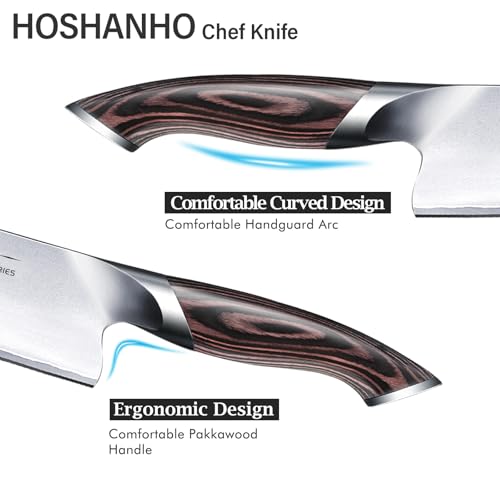
HOSHANHO Kitchen Knife in Japanese High Carbon
$35.74
($64.99)Save $29.25 -
Everyday Chopping and Slicing
$23.79
($43.99)Save $20.20 -
imarku 8 Inch Japanese Chef Knife
$39.99
($61.99)Save $22.00 -
imarku 7-Inch Santoku Knife for Precision Slicing
$39.99
($69.99)Save $30.00
*Deals are selected by our commerce team
Deeper Dive: Our Top Picks
Our Top Picks

SHANZU
SHAN ZU 8 Inch Damascus Chef Knife | 67-Layer Japanese Steel Professional Blade
This 8-inch Damascus chef knife delivers a 15° blade angle with 62 HRC hardness for precise, long-lasting cuts through proteins, vegetables, and herbs without frequent sharpening. Buy it if you prep daily and want authentic Damascus layering (not laser etching) with professional performance at mid-range pricing.
Pros and Cons
Pros
- Authentic Damascus construction with 67 folded steel layers delivers visible pattern depth and genuine durability, not cosmetic etching.
- G10 handle material resists moisture and bacterial growth better than wood, making it safer for high-volume kitchen prep.
- 62 HRC hardness rating keeps the edge sharp through 200+ cuts before noticeable dulling, reducing maintenance burden.
Cons
- No customer reviews yet on this specific ASIN, so you cannot verify real-world performance or edge retention claims from actual users.
- G10 handle requires hand-washing only; dishwasher use will degrade the material and void the warranty.

PAUDIN
Everyday Chopping and Slicing: PAUDIN 8-Inch High-Carbon Stainless Steel Chef Knife
The PAUDIN 8-inch chef knife chops, slices, minces, and dices everyday ingredients, with a hand-polished 2mm blade providing its biggest advantage: versatile sharp cutting. It suits home cooks and restaurant users who want one ergonomic knife for preparing vegetables, bread, fish, chicken, and beef.
Pros and Cons
Pros
- Its multipurpose 8-inch blade can prepare bread, produce, fillets, and several types of meat.
- The hand-polished edge is designed to deliver sharp performance and retain its cutting ability over time.
- An ergonomic wood handle and balanced blade design support comfortable, controlled cutting.
- The waved blade pattern adds visual interest without affecting the knife's broad kitchen utility.
Cons
- The waved pattern is decorative, and the blade is not genuine Damascus steel.
- The product data does not provide an exact knife weight, which may matter to buyers with a strong balance preference.
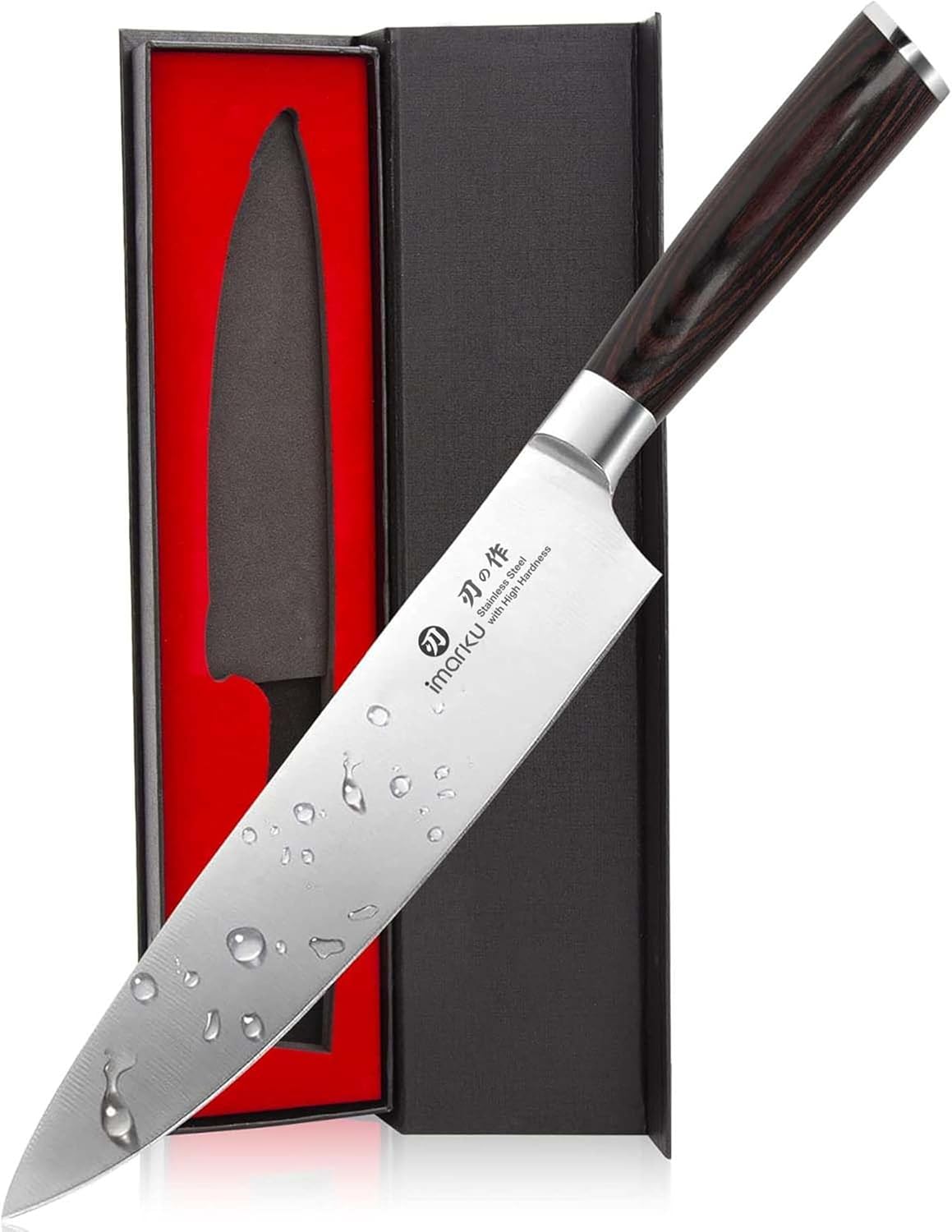
imarku
8 Inch Japanese Chef Knife | High-Carbon Stainless Steel Gyutou
This 8-inch gyutou knife delivers professional-grade sharpness for slicing, dicing, and chopping with a high-carbon stainless steel blade that stays sharp through tough kitchen tasks. Buy it if you prep vegetables and proteins regularly and want a durable, ergonomic knife that won't require constant sharpening.
Pros and Cons
Pros
- 32,768-layer blade construction from 108 traditional forging steps delivers exceptional durability and edge retention compared to mass-produced knives.
- At 8 inches, the blade length balances control for detail work with enough surface area for efficient slicing of larger cuts.
- FSC-certified African Pakka wood handle provides comfortable grip without slipping, even when wet or during repetitive cutting motions.
Cons
- Requires hand-washing and immediate drying to prevent water spots and maintain the stainless steel finish; dishwasher use will damage the blade.
- The high-carbon content means the blade can chip if used on hard surfaces like bone or frozen foods without proper technique.
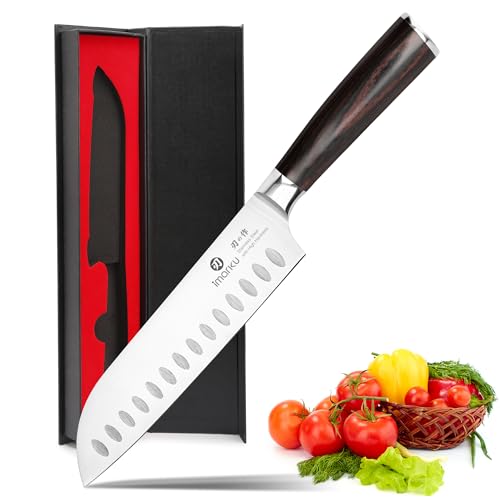
imarku
7-Inch Santoku Knife for Precision Slicing
The imarku 7-inch Santoku knife combines a hollow scalloped edge and 15-18 degree hand-polished bevel to reduce drag and prevent food from sticking during high-volume prep work. Home cooks and apartment dwellers who want a restaurant-capable knife without the steep price will find it covers meat, vegetables, and bread with a single blade.
Pros and Cons
Pros
- The 2.5mm blade thickness paired with the hollow edge design handles both delicate julienne cuts and heavier chopping without flexing or wedging.
- Pakkawood handle construction offers a more sanitary and dimensionally stable grip than standard composite or natural wood handles.
- The 15-18 degree edge angle matches professional Japanese knife geometry, giving it a noticeably sharper out-of-box performance than German-style knives at this price.
- Versatile enough for meat, vegetables, fruit, and bread, making it a practical single-knife solution for small kitchens with limited storage.
Cons
- With zero verified reviews available, long-term edge retention and handle durability under daily use remain unconfirmed by real buyers.
- The 3-month refund window is shorter than the lifetime guarantees offered by competing brands at the same price point.
Editors' Picks
HOSHANHO Kitchen Knife in Japanese High Carbon Steel

Editors' Favorite
Color: 8 inch Chef Knife Size: 8" Dimensions: 13.4645669154 x 0.01181102361 x 0.01181102361 inches Weight: 0.771617917 Pounds Product Group: Kitchen Binding: Kitchen
Shop NowSHANZU SHAN ZU 8 Inch Damascus Chef Knife | 67-Layer Japanese Steel Professional Blade
SHANZU
SHAN ZU 8 Inch Damascus Chef Knife | 67-Layer Japanese Steel Professional Blade
This 8-inch Damascus chef knife delivers a 15° blade angle with 62 HRC hardness for precise, long-lasting cuts through proteins, vegetables, and herbs without frequent sharpening. Buy it if you prep daily and want authentic Damascus layering (not laser etching) with professional performance at mid-range pricing.
$89.99 at AmazonGreat Value
Brand Name: SHAN ZU Manufacturer: SHAN ZU UPC: 714757573303 Model Number: SZPCS-2017-002 Manufacturer Part Number: SZPCS-2017-002 Unit Count: 1.0 Count Best Sellers Rank: #13,584 in Kitchen & Dining (See Top 100 in Kitchen & Dining) #33 in Chef's Knives ASIN: B071JV1GDP Blade Edge: Plain Construction Type: Forged Blade Material Type: Alloy Steel Handle Material: G10 Glass Fiber Handle Is the item dishwasher safe?: No Material Type: resin BladeLength: 8 Inches Item Weight: 260 Grams Item Length: 8 Inches Size: 8" Color: Chef Knife Blade Color: Silver Blade Material: Alloy Steel Brand: SHAN ZU
Shop NowPAUDIN Everyday Chopping and Slicing: PAUDIN 8-Inch High-Carbon Stainless Steel Chef Knife
PAUDIN
Everyday Chopping and Slicing: PAUDIN 8-Inch High-Carbon Stainless Steel Chef Knife
The PAUDIN 8-inch chef knife chops, slices, minces, and dices everyday ingredients, with a hand-polished 2mm blade providing its biggest advantage: versatile sharp cutting. It suits home cooks and restaurant users who want one ergonomic knife for preparing vegetables, bread, fish, chicken, and beef.
$23.79 at AmazonColor: Silver Size: 8" Dimensions: 203 x 45 x 2 Inches Weight: 0.43 pounds Product Group: Kitchen Binding: Kitchen
Shop Nowimarku 8 Inch Japanese Chef Knife | High-Carbon Stainless Steel Gyutou
imarku
8 Inch Japanese Chef Knife | High-Carbon Stainless Steel Gyutou
This 8-inch gyutou knife delivers professional-grade sharpness for slicing, dicing, and chopping with a high-carbon stainless steel blade that stays sharp through tough kitchen tasks. Buy it if you prep vegetables and proteins regularly and want a durable, ergonomic knife that won't require constant sharpening.
$39.99 at AmazonBrand Name: imarku Manufacturer: imarku UPC: 667673934065 604753870875 652129610679 Global Trade Identification Number: 00667673934065 Model Number: 8-inch chef knife Manufacturer Part Number: SC10-01 9inch Item Type Name: Ergonomic Equipment Unit Count: 1.0 Count Included Components: 1 pc chef knife Best Sellers Rank: #963 in Kitchen & Dining (See Top 100 in Kitchen & Dining) #1 in Gyutou Knives ASIN: B01DDBJF12 Customer Reviews: 4.6 4.6 out of 5 stars (10,340) 4.6 out of 5 stars Blade Material Type: High Carbon Stainless Steel Handle Material: Pakkawood Is the item dishwasher safe?: No Material Type: stainless steel BladeLength: 8 Inches Item Weight: 0.41 Pounds Item Length: 13 Inches Size: 8" Color: brown and silver Blade Color: Silver Blade Edge: Plain Construction Type: Forged Blade Material: High Carbon Stainless Steel Brand: imarku
Shop Nowimarku 7-Inch Santoku Knife for Precision Slicing
imarku
7-Inch Santoku Knife for Precision Slicing
The imarku 7-inch Santoku knife combines a hollow scalloped edge and 15-18 degree hand-polished bevel to reduce drag and prevent food from sticking during high-volume prep work. Home cooks and apartment dwellers who want a restaurant-capable knife without the steep price will find it covers meat, vegetables, and bread with a single blade.
$39.99 at AmazonColor: Brown and Silver Size: 7" Dimensions: 12 x 3 x 1 inches Weight: 0.43 pounds Product Group: Kitchen Binding: Kitchen
Shop Now

Write Your Review
No reviews yet. Be the first to share your experience!