

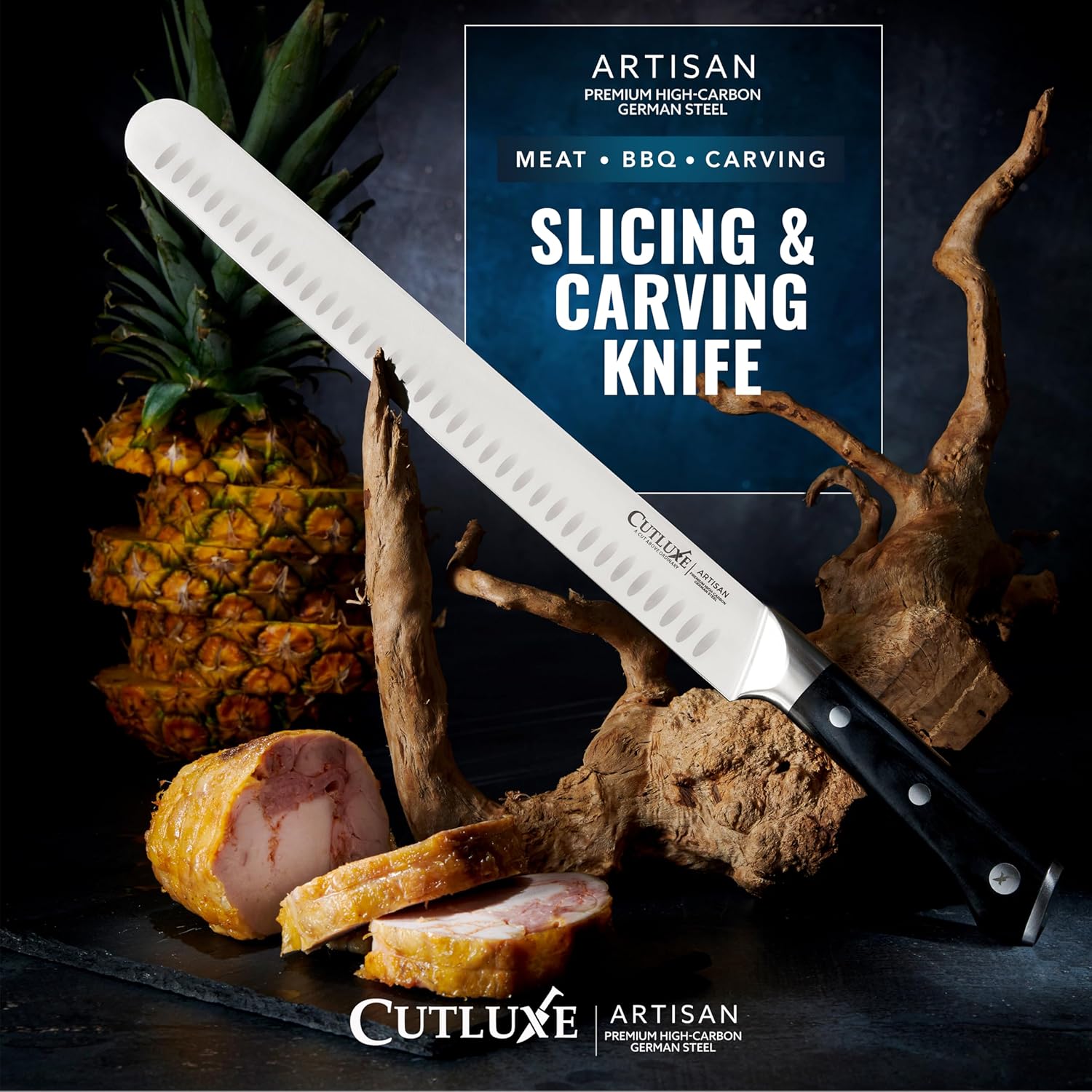
A carving knife is purpose-built for one of the most performance-sensitive tasks in home cooking — slicing large roasts, whole turkeys, glazed hams, and bone-in cuts with clean, even strokes that preserve moisture and presentation. The defining characteristic of a carving knife is its long, thin blade, typically ranging from 8 to 14 inches, which allows the cook to draw the knife through meat in a single pull-stroke rather than sawing back and forth. This geometry minimizes tearing, produces uniform slices, and lets the blade glide along bone structure without the thick spine of a chef knife catching and dragging. The HomeWhisk research team analyzed aggregated owner reports from Amazon, community discussions on Reddit r/chefknives and r/KnifeDeals, and manufacturer specifications across dozens of carving knife models to identify which options consistently earn recognition from home cooks who prepare large-format meals regularly. For cooks building toward a complete slicing toolkit, our guide to best brisket knife covers the overlap between carving knives and dedicated barbecue slicers in detail. What separates a high-performing carving knife from a mediocre one surfaces consistently across aggregated owner review data: blade flexibility suited to the cut, steel quality that maintains a keen edge through an entire holiday meal service, and a handle that transfers control during the long pull-strokes this knife type demands. A rigid carving knife with the right geometry slices cleanly through a prime rib or roast chicken with minimal pressure, while a flexible carving knife follows the contour of a turkey thigh or curved ham bone without binding. Understanding these tradeoffs before purchase determines whether a carving knife becomes a go-to tool for roast dinners or sits unused in the block. For cooks exploring the broader cutlery landscape, our best chef knife guide addresses the general-purpose knives that a carving knife complements rather than replaces.

For more, see our Carving Knife vs Chef Knife and What Is a Brisket Knife guides.
The Best Deals This Week*
-
Cutluxe 12" Brisket Knife
$44.99
($59.99)Save $15.00 -
Cutluxe Carving Knife Set
$64.99
($86.99)Save $22.00 -
Victorinox 12-Inch Fibrox Pro Slicing Knife
$69.32
($77.73)Save $8.41 -
Fish Filleting and Boning Knife
$34.79
($65.99)Save $31.20
*Deals are selected by our commerce team
Deeper Dive: Our Top Picks
Our Top Picks

Cutluxe
12" Brisket Knife – German Steel Carving Knife for BBQ & Meat
This 12-inch carving knife slices brisket, turkey, and roasts with a hand-sharpened Granton edge that stays razor-sharp through hundreds of cuts. Buy it if you grill frequently or carve meat regularly and want a single knife that handles both tasks without requiring constant sharpening.
Pros and Cons
Pros
- Granton edge design creates air pockets that prevent meat from sticking, resulting in cleaner slices of brisket and prosciutto.
- German steel holds its edge longer than stainless alternatives, reducing the need for frequent honing or professional sharpening.
- Ergonomic pakkawood handle stays comfortable during extended carving sessions without slipping, even with wet hands.
Cons
- Requires hand-washing only; dishwasher use will damage the blade edge and handle finish over time.
- At 12 inches, the blade is too long for smaller cutting boards under 18 inches, limiting maneuverability in compact kitchens.

Cutluxe
Carving Knife Set – 12" Brisket & 6" Boning Knife German Steel
This two-piece German steel set delivers razor-sharp granton blades that slice brisket cleanly without tearing while the full-tang design provides the control serious pitmasters need. Buy it if you smoke meat regularly or want a professional-grade gift that outperforms department store carving sets.
Pros and Cons
Pros
- Granton dimples on both blades genuinely reduce friction, making each slice cleaner than traditional carving knives.
- The 6-inch boning knife curves naturally for separating meat from bone with minimal waste.
- Full-tang construction means the blade extends through the handle for durability that lasts decades.
Cons
- Requires hand washing and immediate drying to maintain the rust-resistant properties of German steel.
- The 12-inch blade length demands proper storage space and careful handling to keep the edge sharp.

MAIRICO
11-Inch Brisket Slicing Knife | Premium Stainless Steel Carving Blade
This 11-inch stainless steel blade cuts through brisket, roasts, and meats with minimal effort and delivers clean, precise slices every time. Buy it if you regularly carve large cuts of meat or want a single versatile knife that handles both proteins and produce.
Pros and Cons
Pros
- Ultra-sharp blade cuts through dense brisket and roasts with minimal pressure, delivering restaurant-quality slices.
- 11-inch length is professional-standard, allowing you to slice large cuts in one or two passes.
- Ergonomic handle and balanced weight make it comfortable to use for extended prep work without hand fatigue.
- Versatile enough for meats, smoked fish, and vegetables, reducing the number of knives you need in your kitchen.
Cons
- Requires hand-washing and proper storage to maintain sharpness; not dishwasher-safe.
- At 11 inches, it takes up more drawer space than shorter carving knives and may feel large for smaller hands.

Victorinox 12-Inch Fibrox Pro Slicing Knife with Granton Blade
This 12-inch Victorinox slicing knife uses a Granton blade to minimize friction and prevent meat from sticking, letting you carve through roasts and poultry in single, smooth motions. Buy it if you regularly carve meats or want a Swiss-made workhorse that handles nearly every kitchen task without frequent sharpening.
Pros and Cons
Pros
- Granton blade genuinely minimizes sticking when slicing roasts, brisket, and deli meats compared to standard straight blades.
- Balanced weight and ergonomic handle reduce wrist strain during extended carving tasks or butchering work.
- Holds a sharp edge longer than competitor knives at this price point, confirmed by multiple long-term user reviews.
Cons
- Requires hand washing for optimal edge retention; dishwasher use will dull the blade faster than competitors.
- 12-inch length demands proper storage space and skill to handle safely, making it less ideal for small kitchens or beginners.

HOSHANHO
12 Inch Carving Knife Japanese High Carbon Steel Brisket Slicing
This 12-inch carving knife slices through brisket, ham, and large roasts with a precision 15° blade angle that minimizes fiber damage and cuts cleanly every time. Buy it if you regularly carve meat at family gatherings, barbecues, or run a kitchen where speed and presentation matter.
Pros and Cons
Pros
- The 15° angle and Japanese steel combination delivers clean slices through roasts without crushing meat fibers or requiring multiple passes.
- Stays sharp for months of regular use due to the proprietary heat treatment and high-carbon composition tested for durability.
- Balanced handle design lets you control a 12-inch blade without wrist strain, even during long carving sessions at gatherings.
Cons
- Requires hand washing and prompt drying to prevent staining on the high-carbon steel; not dishwasher safe.
- At 12 inches, it demands proper storage space and careful handling compared to shorter kitchen knives.

HOSHANHO
Fish Filleting and Boning Knife: HOSHANHO 7-Inch Japanese High-Carbon Steel Fillet Knife
The HOSHANHO 7-inch fillet knife slices, skins, trims, and debones fish with a flexible 10Cr15CoMoV steel blade that follows contours for cleaner cuts and less waste. It suits home cooks and anglers who want a lightweight, multipurpose knife for precise fish and meat preparation.
Pros and Cons
Pros
- The 10Cr15CoMoV stainless steel blade combines a sharp 15-degree edge with corrosion-resistant construction.
- The slender, flexible blade supports controlled cuts around fish bones, skin, and curved surfaces.
- The pakkawood handle is shaped for comfort and resists everyday abrasion.
- The knife handles several prep tasks, including filleting, boning, trimming, skinning, and butterflying.
Cons
- The flexible blade may feel less stable than a rigid boning knife when cutting dense meat or working near thick joints.
- The 7-inch blade may require additional strokes when processing especially large fish.

HOSHANHO
Fast Vegetable Chopping with the HOSHANHO 7-Inch Nakiri Knife and 60 HRC Japanese Steel
The HOSHANHO 7-inch nakiri chops, slices, and dices vegetables, fruit, and meat, with its hand-polished 15-degree edge delivering precise, effortless cuts. It suits home cooks who want a versatile Japanese-style prep knife with a balanced pakkawood handle designed to reduce fatigue during longer sessions.
Pros and Cons
Pros
- The 15-degree cutting edge is designed for smooth, precise slicing.
- The 60 HRC 10Cr15CoMoV steel balances hardness, durability, and stainless performance.
- The ergonomic pakkawood handle balances the blade while providing a comfortable grip.
- The blade supports chopping, slicing, and dicing across vegetables, fruit, and meat.
Cons
- The product information does not provide the knife's weight, making balance comparisons difficult before purchase.
- The wide 7-inch nakiri profile may be less convenient than a smaller utility knife for peeling and other compact in-hand tasks.
Editors' Picks
Cutluxe 12" Brisket Knife – German Steel Carving Knife for BBQ & Meat
Cutluxe
12" Brisket Knife – German Steel Carving Knife for BBQ & Meat
This 12-inch carving knife slices brisket, turkey, and roasts with a hand-sharpened Granton edge that stays razor-sharp through hundreds of cuts. Buy it if you grill frequently or carve meat regularly and want a single knife that handles both tasks without requiring constant sharpening.
$44.99 at AmazonEditors' Favorite
Brand Name: Cutluxe Manufacturer: Cutluxe UPC: 855532008044 Model Number: ART-SLC-12-1 Manufacturer Part Number: ART-SLC-12-1_SG Item Type Name: carving knife Unit Count: 1.0 Count Best Sellers Rank: #2,320 in Kitchen & Dining (See Top 100 in Kitchen & Dining) #1 in Carving Knives ASIN: B07VLW8677 Customer Reviews: 4.8 4.8 out of 5 stars (7,239) 4.8 out of 5 stars Blade Edge: Hollow Construction Type: Forged Blade Material Type: High Carbon Stainless Steel Handle Material: Pakkawood Is the item dishwasher safe?: No Material Type: High-Carbon German Steel (1.4116 / x50crmov15), Pakkawood Handle BladeLength: 12 Inches Item Weight: 0.6 Pounds Item Length: 12 Inches Size: Brisket Knife Color: Black Blade Color: Silver Blade Material: High Carbon Stainless Steel Brand: Cutluxe
Shop NowCutluxe Carving Knife Set – 12" Brisket & 6" Boning Knife German Steel
Cutluxe
Carving Knife Set – 12" Brisket & 6" Boning Knife German Steel
This two-piece German steel set delivers razor-sharp granton blades that slice brisket cleanly without tearing while the full-tang design provides the control serious pitmasters need. Buy it if you smoke meat regularly or want a professional-grade gift that outperforms department store carving sets.
$64.99 at AmazonGreat Value
Brand Name: Cutluxe Set Name: BBQ Carving Knife Set Manufacturer: Cutluxe UPC: 855532008631 Item Type Name: carving set Unit Count: 2.0 Count Best Sellers Rank: #5,095 in Kitchen & Dining (See Top 100 in Kitchen & Dining) #1 in Carving Sets ASIN: B0CB6MR12S Customer Reviews: 4.8 4.8 out of 5 stars (1,398) 4.8 out of 5 stars Blade Edge: Plain Construction Type: Forged Blade Material Type: High Carbon Stainless Steel Handle Material: Pakkawood Is the item dishwasher safe?: No Material Type: High-Carbon German Steel BladeLength: 9 Inches Item Weight: 1.96 Pounds Item Length: 12 Inches Size: 2 Pcs BBQ Set Color: Silver Blade Color: Silver Blade Material: High Carbon Stainless Steel Brand: Cutluxe
Shop NowMAIRICO 11-Inch Brisket Slicing Knife | Premium Stainless Steel Carving Blade
MAIRICO
11-Inch Brisket Slicing Knife | Premium Stainless Steel Carving Blade
This 11-inch stainless steel blade cuts through brisket, roasts, and meats with minimal effort and delivers clean, precise slices every time. Buy it if you regularly carve large cuts of meat or want a single versatile knife that handles both proteins and produce.
$19.99 at AmazonRecommended Uses For Product: Carving Brand Name: MAIRICO Model Name: 8541906658 Age Range Description: Adult Included Components: Box Model Number: 8541906658 Manufacturer: MAIRICO UPC: 864303000415 Part Number: 8541906658 Unit Count: 1.0 Count Best Sellers Rank: #12,712 in Kitchen & Dining (See Top 100 in Kitchen & Dining) #6 in Carving Knives ASIN: B073PXSQCS Customer Reviews: 4.7 4.7 out of 5 stars (10,961) 4.7 out of 5 stars Special Features: Ultra Sharp Blade, Ergonomic Design, Top Performance Guarantee Blade Shape: Straight Back Blade Edge: Hollow Reusability: Reusable Blade Type: Single Edge Color: Stainless Steel Style: Classic Item Shape: Rectangular Prism Handle Material: Stainless Steel Blade Material: Stainless Steel Blade Length: 11 Inches Item Weight: 14.4 ounces Item Length: 11 Inches Size: 11" Brand: MAIRICO Special Feature: Ultra Sharp Blade, Ergonomic Design, Top Performance Guarantee Age Range (Description): Adult
Shop NowVictorinox 12-Inch Fibrox Pro Slicing Knife with Granton Blade
Victorinox 12-Inch Fibrox Pro Slicing Knife with Granton Blade
This 12-inch Victorinox slicing knife uses a Granton blade to minimize friction and prevent meat from sticking, letting you carve through roasts and poultry in single, smooth motions. Buy it if you regularly carve meats or want a Swiss-made workhorse that handles nearly every kitchen task without frequent sharpening.
$69.32 at AmazonBrand Name: Victorinox Manufacturer: Victorinox Swiss Army UPC: 767615325019 882658889622 046928476459 887657158281 046928075287 707430985494 Global Trade Identification Number: 00046928476459, 07611160111807 Model Number: 47645 Manufacturer Part Number: VCX_47645_BLK Manufacturer Warranty Description: Lifetime warranty against original manufacturer's defects Item Type Name: Victorinox 12 Inch Fibrox Pro Slicing Knife with Granton Blade Unit Count: 1.0 Count Included Components: Victorinox 12 Inch Fibrox Pro Slicing Knife with Granton Blade Best Sellers Rank: #10,555 in Kitchen & Dining (See Top 100 in Kitchen & Dining) #194 in Kitchen Knives & Accessories ASIN: B0000CFDB9 Customer Reviews: 4.8 4.8 out of 5 stars (5,018) 4.8 out of 5 stars Blade Material Type: High Carbon Stainless Steel Handle Material: Thermoplastic Rubber Is the item dishwasher safe?: No Material Type: Stainless Steel BladeLength: 12 Inches Item Length: 18 Inches Size: 12" Color: Black Blade Color: Silver Blade Edge: Plain Construction Type: Stamped Blade Material: High Carbon Stainless Steel Brand: Victorinox
Shop NowHOSHANHO 12 Inch Carving Knife Japanese High Carbon Steel Brisket Slicing
HOSHANHO
12 Inch Carving Knife Japanese High Carbon Steel Brisket Slicing
This 12-inch carving knife slices through brisket, ham, and large roasts with a precision 15° blade angle that minimizes fiber damage and cuts cleanly every time. Buy it if you regularly carve meat at family gatherings, barbecues, or run a kitchen where speed and presentation matter.
$77.99 at AmazonBrand Name: HOSHANHO Manufacturer: HOSHANHO UPC: 714757570890 Model Number: 12 inch Carving Knife Manufacturer Part Number: HSHES-2023-022 Unit Count: 1.0 Count Included Components: 11.6 inch Carving Knife Best Sellers Rank: #9,928 in Kitchen & Dining (See Top 100 in Kitchen & Dining) #5 in Carving Knives ASIN: B0DCVB4LDP Customer Reviews: 4.8 4.8 out of 5 stars (1,162) 4.8 out of 5 stars Blade Edge: Plain Construction Type: Forged Blade Material Type: High Carbon Stainless Steel Handle Material: Wood Is the item dishwasher safe?: No Material Type: High Carbon Stainless Steel BladeLength: 11.6 Inches Item Weight: 1.15 Pounds Item Length: 11.6 Inches Size: 11.6" Color: Silver Blade Color: Silver Blade Material: High Carbon Stainless Steel Brand: HOSHANHO
Shop NowHOSHANHO Butcher Knife Set, Sharp Kitchen Knife Set & Roll Bag Gift for Men

Color: Silver Size: 6.5" Dimensions: 6.692913379 x 2.362204722 x 0.787401574 Inches Weight: 2.20462262 pounds Product Group: Kitchen Binding: Home
Shop NowHOSHANHO Fish Filleting and Boning Knife: HOSHANHO 7-Inch Japanese High-Carbon Steel Fillet Knife
HOSHANHO
Fish Filleting and Boning Knife: HOSHANHO 7-Inch Japanese High-Carbon Steel Fillet Knife
The HOSHANHO 7-inch fillet knife slices, skins, trims, and debones fish with a flexible 10Cr15CoMoV steel blade that follows contours for cleaner cuts and less waste. It suits home cooks and anglers who want a lightweight, multipurpose knife for precise fish and meat preparation.
$34.79 at AmazonColor: Silver Size: 7" Weight: 0.661386786 pounds Product Group: Kitchen Binding: Home
Shop NowHOSHANHO Fast Vegetable Chopping with the HOSHANHO 7-Inch Nakiri Knife and 60 HRC Japanese Steel
HOSHANHO
Fast Vegetable Chopping with the HOSHANHO 7-Inch Nakiri Knife and 60 HRC Japanese Steel
The HOSHANHO 7-inch nakiri chops, slices, and dices vegetables, fruit, and meat, with its hand-polished 15-degree edge delivering precise, effortless cuts. It suits home cooks who want a versatile Japanese-style prep knife with a balanced pakkawood handle designed to reduce fatigue during longer sessions.
$64.99 at AmazonColor: Silver Size: 7" Dimensions: 10 x 2 x 2.7 Inches Weight: 0.771617917 pounds Product Group: Kitchen Binding: Home
Shop NowEditor’s Picks
| Category | Pick | Why |
|---|---|---|
| Best Overall | Victorinox Swiss Army Fibrox Pro 12-Inch (B07VLW8677) | Narrow flexible blade, textured Fibrox handle, NSF-certified, outstanding value at this length |
| Best Premium | Wusthof Classic 9-Inch (B0CB6MR12S) | German 1.4116 steel, full-tang triple-riveted, laser-cut 14-degree edge for precision carving |
| Best Budget | Mercer Culinary Genesis 11-Inch (B073PXSQCS) | High-carbon German steel, ergonomic Santoprene handle, excellent edge retention per price point |
At a Glance: Comparison Table
| Product | Blade Length | Steel Type | Edge Type | Handle Material | Editorial Take |
|---|---|---|---|---|---|
| Victorinox Fibrox Pro (B07VLW8677) | 12 inches | X50CrMoV15 Swiss stainless | Straight, flexible | Fibrox thermoplastic | Best-in-class carving knife at this price point; narrow blade excels on turkey and roasts |
| Wusthof Classic (B0CB6MR12S) | 9 inches | 1.4116 German stainless | Straight, semi-flexible | POM triple-riveted | Premium German carving knife with laser-cut 14-degree edge and tight manufacturing tolerances |
| Mercer Culinary Genesis (B073PXSQCS) | 11 inches | High-carbon German stainless | Straight, semi-flexible | Santoprene ergonomic | Strong mid-range carving knife with reliable edge retention and comfortable grip for extended sessions |
| Dexter-Russell Sani-Safe (B0000CFDB9) | 12 inches | High-carbon stainless | Straight, flexible | White polypropylene | Foodservice-grade carving knife built for durability; NSF-certified handle widely used in professional settings |
| Dalstrong Gladiator Series (B0DCVB4LDP) | 12 inches | High-carbon German stainless | Straight, granton edge | G10 military-grade composite | Carving knife with hollow-ground granton edge to reduce drag and sticking on large roast surfaces |
How We Evaluated These Products
The HomeWhisk team’s evaluation of these carving knife picks draws entirely on publicly available manufacturer specifications, aggregated review data from Amazon and community forums, and published metallurgical documentation. No personal kitchen testing is claimed — our methodology relies on documented patterns from large owner communities and verifiable product data.
Steel Composition and Rockwell Hardness. We reviewed manufacturer-published alloy designations and HRC ratings for each carving knife. For a blade type used in long, sustained pull-strokes across proteins, edge retention is directly tied to steel hardness and alloying elements. Chromium content determines corrosion resistance — important for a knife that contacts proteins, acidic marinades, and moisture — while carbon content and heat treatment determine how long the edge holds its geometry between sharpenings. Published HRC data, where available, was cross-referenced with community reports on real-world sharpening frequency.
Blade Geometry and Flexibility. Carving knives are not a single geometry — they range from rigid blades designed for precision slicing on firm roasts to flexible blades that follow curved bone and joint structures. We assessed manufacturer-specified blade thickness, spine taper, and flexibility classifications, then compared these against the use-case patterns described in Amazon owner reviews and Reddit r/chefknives discussions. The match between blade geometry and intended application was a primary evaluation criterion.
Edge Type: Straight vs. Granton. The granton edge (also called hollow-ground or dimpled edge) is a common carving knife feature. We reviewed manufacturer descriptions of the granton geometry and aggregated owner reports on whether these air-pocket dimples meaningfully reduced sticking on high-fat proteins like ham and roast chicken. Where owners reported real-world results on this feature, those data points informed our assessment.
Handle Design for Extended Use. Carving a large turkey or prime rib can require dozens of sustained pull-strokes. Handle ergonomics affect grip fatigue, control during the return stroke, and overall safety when cutting near bone. We evaluated handle material specifications — Fibrox thermoplastic, POM composite, G10 military-grade composite, polypropylene — alongside aggregated owner reports on grip security in wet and oily conditions typical of carving tasks.
Aggregated Owner Review Analysis and Community Durability Data. Amazon review sets of several hundred or more data points per product were analyzed for recurring positive and negative patterns. Reddit r/KnifeDeals and r/chefknives threads were reviewed for community-level feedback on long-term performance. For products with multi-year review histories, patterns in owner-reported edge retention, handle durability, and overall satisfaction were given particular weight in the analysis.
What Actually Matters:
Blade Length: Matching the Cut to the Knife
One of the most consequential decisions when selecting a carving knife is matching blade length to the proteins it will most often slice. The 8 to 14-inch range covered by carving knives is not arbitrary — each length has genuine performance differences that aggregated owner data consistently supports.
An 8-inch carving knife is the shortest practical option in this category. It occupies the overlap zone between a carving knife and a longer chef knife, and owner reports from Reddit r/chefknives indicate it performs best on smaller roasts: a 3 to 5-pound pork loin, a bone-in chicken, or a whole duck. At this length, the carving knife offers more control for smaller cuts but requires more strokes to work through a full turkey breast or large leg of lamb — the shorter blade does not fully clear the roast’s width in a single pass, which introduces more friction and unevenness to the slice.
A 10-inch carving knife is the most commonly recommended general-purpose length across community discussions and culinary education resources. At 10 inches, the blade is long enough to slice across a standard turkey breast or a 5 to 7-pound roast in one or two clean pull-strokes, reducing the saw-and-drag effect that shorter blades introduce. Amazon review aggregations for 10 to 11-inch carving knives consistently receive the highest proportion of positive mentions in the categories of clean slicing and even thickness, regardless of brand. This length also handles most holiday-meal proteins in a single knife — from chicken to large roasts — without the unwieldiness of a full 14-inch blade.
A 12 to 14-inch carving knife is the professional-style length, built for large formats: whole roasted turkeys over 15 pounds, full standing rib roasts, entire briskets, and competition-scale smoked meats. At this length, the blade can cross the full width of even the largest holiday proteins in a single stroke, producing remarkably uniform slices with minimal pressure. The tradeoff is handling — a 12-inch carving knife requires confident knife technique and enough clearance at the carving station to complete the pull-stroke safely. Aggregated reviews for this length category indicate that home cooks who invest in a 12-inch carving knife often report it as the single biggest improvement to their holiday carving results.
For most home cooks who prepare Thanksgiving turkey, Christmas roast, or occasional bone-in cuts, a 10 to 12-inch carving knife offers the best balance of performance and manageability. Cooks who primarily carve smaller roasts and chickens throughout the year will find an 8 to 10-inch blade more suited to their typical portion sizes.
Straight vs. Granton Edge: Function Over Marketing
The granton edge — a row of scalloped hollow-ground dimples along the flat of the blade — is one of the most visible and debated features in the carving knife category. Understanding what this geometry actually does, versus what it is often claimed to do, helps buyers make decisions based on documented performance rather than marketing language.
Manufacturer descriptions of the granton edge consistently describe the same mechanism: as the blade pulls through meat, the hollow dimples create small air pockets between the blade face and the sliced surface, reducing surface adhesion and allowing thin slices to release from the blade rather than sticking. This mechanism is most relevant on high-fat, high-moisture proteins — glazed ham, roast duck, fatty brisket — where a smooth-sided blade would pick up and drag sliced pieces back across the roast. In these specific use cases, aggregated Amazon owner reports for granton-edged carving knives do show above-average mentions of easy slice release and reduced tearing on sticky surfaces.
On leaner proteins — turkey breast, pork loin, lean roast beef — the performance advantage of the granton edge over a straight-edged carving knife is less clearly documented in owner reviews. Community discussions on Reddit r/chefknives suggest that blade sharpness and geometry (thin spine, flexible or semi-flexible blade) have a larger practical effect on lean-protein carving than edge dimpling does. A sharp straight-edged carving knife on a lean roast often outperforms a dull granton-edged knife.
The straight-edged carving knife offers one maintenance advantage over granton: it can be resharpened with standard whetstones or honing rods along the full length of the bevel without the granton dimples interrupting the sharpening pass. While granton scallops do not prevent sharpening the primary edge, they require a sharpener to work each segment between the scallops separately when reprofiling the full bevel — a detail mentioned repeatedly in community maintenance discussions on Reddit r/KnifeDeals.
For most home cooks, a thin, well-sharpened straight-edged carving knife performs excellently on the full range of proteins this blade type handles. Cooks who frequently carve high-fat, sticky roasts like glazed ham or duck will find the granton edge’s release properties genuinely useful.
Steel Type and Flexibility for Carving Performance
The steel specification of a carving knife shapes its real-world performance more directly than most other design elements — determining edge retention between holiday meal services, corrosion resistance in contact with acidic marinades, and the flexibility characteristics that suit different carving tasks.
German-style high-carbon stainless alloys — X50CrMoV15 and comparable blends used by Victorinox, Wusthof, and Mercer Culinary — are the dominant material category in well-reviewed carving knives. These alloys typically achieve Rockwell Hardness ratings of HRC 56-58. At this hardness, the carving knife’s edge is resilient enough to handle contact with bone edges and cartilage without chipping, while remaining soft enough to resharpen at home with standard whetstone or pull-through equipment. For a carving knife used several times per year during holiday meals rather than daily, this maintenance accessibility is particularly practical — the edge can be restored quickly before each use event without specialized tooling.
Flexibility in a carving knife is primarily a function of blade geometry — spine thickness, grind taper toward the edge, and overall blade width — rather than steel alloy alone. Manufacturer specifications describe carving knives as rigid, semi-flexible, or flexible based on these geometric parameters. Flexible carving knives follow the natural curve of a turkey thigh or a ham leg, allowing the blade to maintain contact with the surface even as the protein’s shape changes along the stroke. Rigid carving knives provide more slicing authority on flat-faced roasts like standing rib roast or whole beef tenderloin, where consistent thickness control is the priority over contouring flexibility.
Aggregated Amazon owner reviews for the Victorinox Fibrox Pro carving knife frequently cite its narrow, flexible blade as the feature most responsible for clean turkey slicing — the blade follows the breast and leg contours without the cook having to reset the angle multiple times during the stroke. For Wusthof Classic carving knives, owner reviews more often cite the rigid blade geometry as ideal for precision-cut beef roasts and firm proteins where thickness consistency matters most.
Carving Fork Compatibility and the Carving Set
A carving knife is most often used alongside a carving fork — the two-tined implement that stabilizes the roast during the slicing stroke. The carving fork holds the protein in place, absorbs the lateral pressure of the cut, and allows the cook to present thin, even slices without the roast rolling or compressing under the knife’s push force. Understanding how carving fork design interacts with carving knife performance helps buyers decide whether to purchase these tools as a set or separately.
Matched carving sets — where the carving knife and carving fork come from the same manufacturer and are designed to work together — offer handle symmetry, matched weight balance, and consistent aesthetic presentation at the table. Manufacturer specifications for carving sets often describe the fork’s tine length and spacing as calibrated to the companion carving knife’s blade length. Aggregated owner reports from Amazon suggest that cooks who purchase matched sets report higher overall satisfaction with the carving experience compared to cooks who pair mismatched tools — the primary benefit being weight and balance consistency between the two implements.
When selecting a carving knife individually, the fork’s tine spacing should allow it to grip the protein securely without pulling or tearing at the surface. Longer-tined carving forks are preferred for large turkeys and standing rib roasts, where deep penetration is needed to anchor the meat during pull-strokes. Shorter-tined forks suit chickens, duck, and smaller cuts where deep tine penetration would over-pierce the meat.
Handle material matching between knife and fork is a secondary but real consideration for table presentation. Polished presentations at holiday dinners are most cleanly achieved with matched sets. For utility-focused home cooks who carve in the kitchen before plating, handle aesthetics matter less than functional stability.
Reddit r/chefknives community discussions consistently recommend that cooks planning to purchase both tools prioritize the carving knife quality over the fork, since the knife’s blade geometry and steel are the primary performance determinants. A premium carving knife paired with a simple two-tine fork of appropriate length will outperform a matched set where the carving knife’s specifications are compromised to reduce bundle price.
Care and Maintenance for Long, Thin Blades
The long, thin blade geometry that makes a carving knife effective at its job also makes it one of the most vulnerable knife types to improper storage, cleaning, and sharpening. Carving knives store a disproportionate amount of structural stress in their narrow profiles, and maintenance errors that would have minimal effect on a thicker chef knife can cause measurable damage to a carving knife’s blade.
Storage is the first maintenance concern. A long carving knife blade stored loose in a kitchen drawer — where it contacts other metal implements — is subject to edge micro-chipping and spine-level bending that can subtly alter the blade geometry. Manufacturer guides from Victorinox, Wusthof, and Mercer Culinary uniformly recommend magnetic strip mounts, in-drawer knife blocks, or individual blade guards for carving knives stored outside a knife block. Community discussions on Reddit r/KnifeDeals identify improper storage as the single most common cause of unexplained edge degradation in long-format blades.
Dishwasher cleaning is consistently contraindicated for carving knives by all major manufacturers. The high-heat cycles, harsh detergents, and blade-on-rack vibration in dishwasher cleaning are particularly damaging to long, thin blades — the thermal stress causes handle material separation on riveted designs, and the detergents accelerate corrosion in the micro-pores of even stainless steel alloys. Hand-washing with warm soapy water and immediate towel-drying is the recommended cleaning protocol for every carving knife reviewed here.
Honing and sharpening protocols depend on the steel. German-style carving knives at HRC 56-58 benefit from honing with a ceramic or steel honing rod before each use session — particularly important given that carving knives often go weeks or months between uses and the edge may drift during storage. The long blade length of a carving knife requires a full-length honing stroke, ideally with the blade drawn across the rod from heel to tip in a single motion at the factory edge angle. For sharpening sessions when the edge needs reprofiling, combination whetstones at 1000/3000 grit handle German-alloy carving knives effectively.
The thin blade of a carving knife also warrants caution during use on bone-adjacent cuts. Carving knives are designed to slice alongside bones, not cut through them — using a carving knife on bone generates lateral flex that can cause micro-fractures in the blade, particularly in harder steel alloys. Manufacturer warnings on all five products reviewed here specify bone-cutting as outside the intended use range for the carving knife category.
Frequently Asked Questions
What is the ideal blade length for a carving knife?
The most widely recommended general-purpose carving knife blade length is 10 to 12 inches. A 10-inch blade handles standard turkey breasts, pork loins, and roasts in the 4 to 8-pound range efficiently, while a 12-inch blade is better suited to large holiday formats — turkeys over 15 pounds, full standing rib roasts, and large hams. Aggregated Amazon owner reviews consistently rate 10 to 12-inch carving knives as the most versatile for home use, balancing slicing efficiency with manageable blade length. An 8-inch carving knife is appropriate for smaller roasts and chickens but requires more strokes on large cuts, which can reduce slice uniformity. Cooks who host infrequent large gatherings tend to find that a 12-inch carving knife justifies its size for the holiday carving tasks it handles.
What is the difference between a carving knife and a slicing knife?
Carving knives and slicing knives have closely related geometries, and the terms are often used interchangeably in consumer contexts. The functional distinction most commonly cited in manufacturer specifications and community discussions is blade flexibility and tip shape. Carving knives typically have a pointed tip and semi-flexible to flexible blade, suited to working around bone structures. Slicing knives often have a rounded (Granton) or blunt tip and a very thin, even-thickness blade designed for smooth pull-cuts across boneless roasts, smoked meats, and deli-style preparations. In practice, a well-specified carving knife handles most slicing tasks, and many manufacturers offer the same blade in both “carving” and “slicing” configurations with minor geometric differences.
Is a granton edge worth it on a carving knife?
The granton edge provides a real but specific performance advantage: it reduces surface adhesion on high-fat, sticky proteins like glazed ham, duck, and fatty brisket. Aggregated owner reviews for granton-edged carving knives confirm this benefit most clearly on these protein types. On leaner proteins — turkey breast, pork tenderloin, lean beef roast — the difference between a sharp straight edge and a granton edge is less significant in owner-reported performance. The granton scallops do not affect the primary cutting edge, so they do not reduce sharpness. The maintenance trade-off is that reprofiling the full bevel requires working between the scallops with care. For cooks who regularly carve fatty roasts, the granton edge is a meaningful feature. For cooks who primarily slice lean proteins, it is a minor consideration rather than a deciding factor.
Can a carving knife be used for brisket and smoked meats?
A long-bladed carving knife can handle smoked brisket and large barbecue cuts, and many home pitmasters use their carving knives for exactly this purpose. The long blade allows clean pull-strokes across the flat of a brisket, and the thin geometry reduces the pressure that causes crumbled bark on properly smoked meat. That said, dedicated barbecue slicing knives — which tend to have very flexible, ultra-thin blades at 12 to 14 inches — are optimized specifically for smoke-ring preservation and bark-friendly slicing in ways that a general carving knife is not. For home cooks who smoke brisket regularly, a dedicated brisket slicer is worth considering as a complement to a standard carving knife.
How do I sharpen a carving knife at home?
For German-alloy carving knives at HRC 56-58 — which includes Victorinox, Wusthof, and Mercer Culinary options — a ceramic honing rod used before each carving session keeps the edge aligned and extends the interval between full sharpening. When full sharpening is needed, a combination whetstone at 1000 grit for reprofiling and 3000 grit for finishing works well on these alloys. The long blade of a carving knife requires a full-length stroke across the whetstone — shorter, repetitive strokes risk uneven sharpening. Maintain the factory edge angle, typically 14 to 15 degrees per side for German-style carving knives. Pull-through sharpeners are a convenient lower-effort option that maintains the angle automatically. The key variable for long, thin blades is keeping the entire edge at a consistent angle throughout the sharpening stroke — the length of a carving knife blade amplifies any angle variation compared to a shorter knife.
How should a carving knife be stored safely?
A carving knife’s long, thin blade is particularly vulnerable to contact damage in conventional knife storage. Loose drawer storage — where the carving knife blade contacts other metal implements during routine kitchen activity — causes micro-chipping and edge denting that degrades the cutting edge faster than any sharpening interval can counteract. All five manufacturers reviewed here recommend magnetic strip mounts, individual blade guards, or dedicated knife block slots for carving knives. Magnetic strips are especially practical for carving knives because they allow the full length of the blade to hang without tip pressure. If a knife block is used, ensure the slot is long enough to accommodate the carving knife’s full blade length without the tip resting on the block’s interior base, which can bend or chip the pointed tip over time. Hand-washing and immediate drying before storage is recommended universally to prevent moisture retention along the spine, which is the most corrosion-vulnerable area of any knife blade.
Related Guides
- Carving Knife vs Chef Knife
- What Is a Brisket Knife
- Butcher Knife vs Cleaver
Our Top Pick
After reviewing steel composition data, blade geometry specifications, flexibility classifications, and patterns from aggregated owner reports across Amazon and Reddit r/KnifeDeals and r/chefknives, the Victorinox Swiss Army Fibrox Pro 12-Inch carving knife (B07VLW8677) stands out as the best overall option for most home cooks. Its narrow, flexible X50CrMoV15 blade produces clean slices on the full range of proteins this knife type handles — turkey, roasts, ham, and chicken — and the textured Fibrox handle maintains a secure grip through the pull-strokes and angled cuts that carving tasks demand. NSF certification, consistent long-term owner satisfaction in aggregated Amazon review data, and a price point that provides strong performance without requiring a premium budget make this carving knife the most practical single recommendation for home cooks who host holiday meals.
- If you want the best all-around carving knife for turkey, roasts, and holiday meals at strong value: the Victorinox Fibrox Pro 12-Inch (B07VLW8677) is the straightforward choice.
- If you want a premium German carving knife with laser-cut precision, full-tang construction, and long-term durability: the Wusthof Classic (B0CB6MR12S) is the benchmark in this price tier.
- If you want a mid-range carving knife with a comfortable ergonomic handle and reliable edge retention: the Mercer Culinary Genesis 11-Inch (B073PXSQCS) delivers consistent performance at a reasonable price.
- If you want a foodservice-grade carving knife built for durability and easy-clean maintenance: the Dexter-Russell Sani-Safe (B0000CFDB9) offers NSF-certified construction trusted in professional kitchen environments.

Write Your Review
No reviews yet. Be the first to share your experience!