

HomeWhisk earns commission from qualifying purchases made through links on this page. We research picks from specifications and owner reviews; we do not test products ourselves.
TL;DR — Electric sharpeners are fast, easy, and consistent but remove more metal and give less control; manual sharpeners (pull-through or whetstone) remove less metal, cost less, and offer more control but take more effort and skill. For speed and convenience, electric; for knife longevity, control, and cheaper touch-ups, manual. The best edge comes from a whetstone (a manual method) with practice. The HomeWhisk team compared the types against aggregated feedback. For picks, see our best knife sharpener guide.
The HomeWhisk editorial team researches kitchen equipment by analyzing manufacturer specifications, sharpening mechanisms, and aggregated user reviews from major retailers and cooking communities. Our recommendations are based on what the products actually deliver, not what brands promise.
Choosing a knife sharpener comes down to a trade-off between convenience and control. Here’s how electric and manual sharpeners compare and which suits you. For specific models, see our best knife sharpener and best home knife sharpener guides.
Pros & Cons
Pros
- Fixed blade guides remove the guesswork, so a first-time user gets an even bevel without practice.
- Grinding and honing are separate stages, letting you touch up a decent edge without stripping extra steel.
- Works across most non-serrated blades, from thin paring knives to heavier carving knives.
- Compact enough to store in a cabinet and pull out between prep sessions.
Cons
- Serrated bread and steak knives cannot be run through either slot, so those still need a separate solution.
- It is wired for 120 volt North American outlets and removes more steel than a whetstone, which is hard on thin Japanese blades.
Details
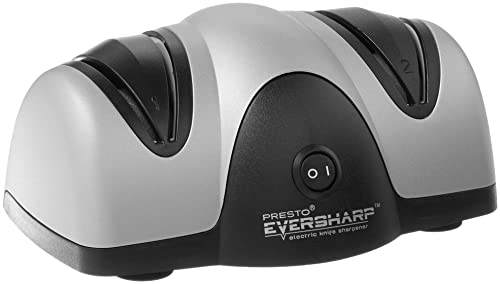
The Presto 08800 EverSharp is a countertop electric sharpener that solves the daily problem of dull knives crushing tomatoes and sliding off onion skins instead of cutting them.
Stage one grinds a precisely angled bevel and stage two hones and polishes it. A few passes per slot restores a neglected chef’s knife to clean slicing.
Sapphirite abrasive wheels, the same ultra-hard material professional shops use, do the cutting, while precision blade guides hold the knife at a fixed angle so results do not depend on your technique.
It accepts non-serrated blades only and runs on 120 volt power built to North American electrical standards, so bread knives and overseas kitchens are out.
Best for home cooks who want a repeatable edge in seconds without learning whetstone technique.
Care Guide
Wipe each blade with a damp cloth after sharpening to remove metal filings, then dry it fully. Leftover grit transfers to food and can start rust spots on carbon steel.
Draw the knife through with light pressure in a steady pull from heel to tip. Pressing down does not sharpen faster, it only grinds away steel and shortens blade life.
Unplug the unit before clearing accumulated filings, and touch up knives briefly and often instead of waiting until they are badly dull. Short frequent passes remove far less metal.

Save $35.00
Pros & Cons
Pros
- Diamond abrasives sharpen quickly without the blade overheating or the wheels wearing smooth.
- The guided angle removes the main skill barrier, so results are consistent from the first knife onward.
- Handles chef, paring, and boning knives, covering most of a standard kitchen block with one device.
- Magnetic shaving collection and silicone feet make it practical to use on an open counter.
Cons
- It is built for straight-edge blades only, so serrated bread knives and scissors need a separate solution.
- The fixed 20-degree angle does not suit Japanese knives ground to a narrower bevel, which will be reprofiled if run through it.
Details
An electric three-stage sharpener for home kitchens, aimed at the dull chef’s knife that crushes tomatoes instead of slicing them.
Coarse, fine, and polish slots use diamond wheels at a fixed 20-degree angle. A pass of 10 to 15 seconds per slot, repeated three or four times, takes a neglected blade back to cutting cleanly.
Four silicone pads damp vibration and anchor the housing to the counter, and a magnetic box inside catches steel swarf so it never reaches the worktop.
Compatibility is limited to straight-edge blades at a Western bevel, so serrated knives and thin Japanese edges are out.
Best for the home cook with a Western knife set who wants sharp edges on demand without whetstone practice.
Care Guide
Wipe the blade with a damp cloth after sharpening to remove metal dust, then dry it fully before storing. Grit left on an edge dulls it and can pit the steel.
Empty the magnetic collector every few sessions. Shavings build up, and a full box stops catching new debris.
Use the coarse slot only on genuinely dull or chipped blades. Routine upkeep in the fine and polish stages removes far less steel and extends knife life.

Pros & Cons
Pros
- Flexible belt system sharpens serrated knives and scissors that most electric sharpeners cannot touch.
- Two-speed motor provides control for both light touch-ups and heavy restoration work on neglected blades.
- Edge guide supports the entire blade and makes consistent results easy even for users with no sharpening experience.
- Three-year warranty and US-based engineering provide confidence in durability and support.
Cons
- Belt replacement adds ongoing cost compared to ceramic or diamond wheel sharpeners with longer-lasting abrasives.
- Larger footprint than compact pull-through sharpeners requires dedicated counter or drawer space in small kitchens.
Details
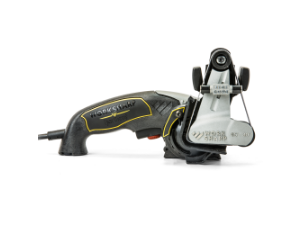
The Work Sharp MK2 is an electric belt sharpener designed to restore edges on kitchen knives, serrated blades, scissors, and other cutting tools without professional service.
The flexible abrasive belt conforms to blade curves and serrations, while the two-speed motor provides 1,500 RPM for delicate edges and 2,500 RPM for damaged or thick blades. The edge guide holds knives at the correct angle from heel to tip.
The unit measures approximately 12 inches long and weighs around 3 pounds. The belt system uses replaceable 3/4-inch by 12-inch abrasive belts. Oregon-designed construction includes a three-year warranty.
The belt system requires periodic replacement, adding cost over time compared to fixed-wheel sharpeners. The larger size demands more storage space than compact manual or pull-through models.
Best for home cooks who sharpen multiple types of blades regularly and want a single tool that handles everything from chef knives to kitchen shears.
Care Guide
Replace abrasive belts when they glaze over or stop cutting efficiently. Worn belts generate heat and round edges instead of sharpening them. Keep spare belts on hand to avoid interruptions.
Brush metal dust off the belt and guides after each use to prevent buildup that clogs the abrasive surface. Unplug the unit before cleaning and avoid water on the motor housing.
Store the sharpener in a dry location away from moisture. Humidity and temperature swings can damage the motor and cause belts to deteriorate faster. Keep the power cord wrapped loosely to prevent internal wire damage.
The Three Main Types
“Electric vs manual” actually covers three tools, so it helps to define them before comparing.
Electric sharpeners have motorized abrasive wheels or belts. You pull the knife through guided slots, and the motor grinds a new edge quickly. They usually have multiple stages (coarse to fine) and built-in angle guides. Fast and nearly foolproof.
Manual pull-through sharpeners are handheld or countertop devices with fixed abrasive slots (carbide and/or ceramic). You pull the knife through by hand, and the preset slots set the angle. No power, cheap, easy — a middle ground between electric ease and whetstone control.
Whetstones (sharpening stones) are the traditional manual method: flat abrasive stones you hold the knife against at a chosen angle. They offer the most control and the sharpest results but require skill and practice (see our whetstone guide). Technically manual, but a category of its own.
So “manual” spans both the easy pull-through sharpeners and the skill-based whetstone. This article focuses mainly on electric vs manual pull-through (the common everyday comparison), with the whetstone as the control-focused option. Our best knife sharpener guide covers all types.
Electric Sharpeners: Fast and Easy
Electric sharpeners win on speed and convenience. Here’s their case.
Strengths:
- Speed: they sharpen a knife in seconds to a minute — the fastest method by far.
- Ease and consistency: built-in angle guides and motorized wheels mean you don’t need skill; results are consistent pull to pull. Nearly foolproof for beginners.
- Multi-stage: most have coarse (sharpen) and fine (hone/polish) stages for a complete edge in one tool.
- Effortless: minimal physical effort, good if you have many knives or dull ones to restore.
Weaknesses:
- Removes more metal: the aggressive motorized grinding takes off more metal than manual methods, wearing knives down faster over years of use. This is the main drawback — it shortens a knife’s lifespan.
- Less control: you’re locked to the sharpener’s angle (often ~20°), which may not match Japanese knives (15°) or your preference.
- Can overheat/over-grind: aggressive use can remove too much or (rarely) heat the edge.
- Cost and size: pricier and bulkier than manual, and needs power.
Best for: people who want fast, easy, consistent sharpening, have many knives, own mid-range Western knives (not delicate premium blades), or don’t want to learn technique. Our best knife sharpener guide flags good electric options.
Manual Sharpeners: Control and Longevity
Manual sharpeners (pull-through and whetstone) win on knife care, control, and cost. Here’s their case.
Pull-through manual sharpeners:
- Gentler on knives: remove less metal than electric, so knives last longer.
- Cheap and simple: inexpensive, no power, compact, easy to store.
- Easy enough: preset slots set the angle, so little skill needed — nearly as easy as electric, just requires hand effort.
- Trade-offs: fixed angle (like electric), carbide slots can be aggressive/scratchy, and results are less refined than a whetstone. Good for quick touch-ups on everyday knives.
Whetstones:
- Best edge and full control: you choose the angle (essential for Japanese knives) and grit, producing the sharpest, most refined edge and removing only necessary metal — gentlest over a knife’s life.
- Versatile: sharpens any knife at any angle.
- Trade-offs: steepest learning curve, takes time and practice, requires maintaining/flattening the stone.
Best for manual overall: people who want to preserve their knives (less metal removed), own quality or Japanese knives, want control over the angle, prefer a cheaper tool, or (for whetstones) want the sharpest possible edge and are willing to learn. See our best home knife sharpener guide.
The metal-removal point matters: if you own expensive knives you want to last decades, manual methods (especially whetstones) are kinder than aggressive electric grinding.
Which Should You Choose?
Match the sharpener to your knives, skills, and priorities.
Choose an electric sharpener if you value speed and ease above all, have many knives or very dull ones to restore, own mid-range Western knives you’re not precious about, dislike learning technique, and don’t mind that it removes more metal over time. It’s the convenient, foolproof choice.
Choose a manual pull-through sharpener if you want an inexpensive, simple tool for quick touch-ups, prefer to remove less metal than electric, want something compact and power-free, and are fine with a fixed angle and less-refined edge. A practical middle ground for everyday knives.
Choose a whetstone if you want the sharpest, most refined edge, own quality or Japanese knives, want full control over angle and grit, care most about preserving your knives, and are willing to learn the technique. The enthusiast’s choice for the best results (see our whetstone guide).
A common smart combo: many cooks use a manual pull-through or electric sharpener for quick sharpening plus a honing steel for frequent between-uses maintenance (honing isn’t sharpening — see our honing guide). Enthusiasts add a whetstone for periodic proper sharpening.
The bottom line: electric for speed and ease, manual for control and knife longevity, whetstone for the best edge. Match to how much you value your knives versus your time. Our best knife sharpener and best home knife sharpener guides cover options in each category.
Frequently Asked Questions
Is an electric or manual knife sharpener better?
Neither is universally better — it’s a trade-off. Electric sharpeners are faster, easier, and more consistent, but remove more metal (wearing knives down sooner) and lock you to a fixed angle. Manual sharpeners (pull-through and whetstone) remove less metal, cost less, and offer more control, but take more effort or skill. Choose electric for speed and convenience, manual for knife longevity and control. For the sharpest edge, a whetstone (manual) wins; for the easiest, an electric sharpener wins.
Do electric sharpeners ruin knives?
Not exactly ruin, but they remove more metal than manual methods, which wears knives down faster over years of use and can shorten their lifespan. Aggressive or frequent use accelerates this. They’re fine for mid-range everyday Western knives, but for expensive or delicate knives (especially Japanese blades), the extra metal removal and fixed ~20° angle make gentler manual methods or a whetstone a better choice. Used sensibly, electric sharpeners are convenient without ruining knives, but they’re harder on them than manual options.
What’s the best knife sharpener for beginners?
For ease with no skill required, an electric sharpener or a manual pull-through sharpener — both use built-in angle guides so you just pull the knife through, getting consistent results without technique. Electric is fastest and most foolproof; manual pull-through is cheaper, gentler on knives, and nearly as easy. A whetstone gives the best edge but has a learning curve, so it’s not the easiest starting point. Beginners wanting simple, consistent results should start with a pull-through or electric sharpener.
Are manual pull-through sharpeners good?
Yes, for what they are: quick, cheap, easy touch-ups on everyday knives. They remove less metal than electric sharpeners (gentler on knives), need no power, are compact, and their preset slots set the angle so little skill is needed. The trade-offs are a fixed angle, sometimes-aggressive carbide slots, and a less refined edge than a whetstone. For maintaining mid-range kitchen knives conveniently, they’re a solid, practical choice — just not the tool for the sharpest possible edge or delicate premium knives.
Which sharpener is best for Japanese knives?
A whetstone. Japanese knives typically have a finer edge angle (around 15°) and harder steel, and a whetstone lets you match that exact angle, use fine grits, and remove minimal metal — preserving the delicate, keen edge these knives are prized for. Electric and fixed-angle pull-through sharpeners often use a ~20° angle and remove more metal, which is too aggressive and wrong-angled for fine Japanese blades. If you own quality Japanese knives, learn to use a whetstone (or use a sharpener with a 15° setting).
Should I sharpen or hone my knife?
Both, at different frequencies — and they’re not the same. Honing (with a steel) realigns the edge and should be done frequently (every use or two); it removes no metal. Sharpening (with an electric, manual, or whetstone sharpener) grinds a new edge and is done occasionally (every few months to a year). A common routine: hone often to keep the edge aligned, and sharpen only when honing no longer restores sharpness. See our separate honing guide for the technique and how the two differ.
Related buying guides: best chef knife, best knife block set and best japanese knife.
The Bottom Line
Electric and manual knife sharpeners trade convenience against control. Electric sharpeners are fast, easy, and consistent — great for speed and beginners — but remove more metal (wearing knives faster) and lock you to a fixed angle. Manual sharpeners remove less metal and cost less: pull-through models are cheap, simple touch-up tools, while whetstones give the sharpest, most controlled edge for those willing to learn. Choose electric for ease, manual pull-through for gentle everyday touch-ups, and a whetstone for the best edge and knife longevity — especially for Japanese knives. Pair any of them with regular honing. See our best knife sharpener and best home knife sharpener guides.


Write Your Review
No reviews yet. Be the first to share your experience!