

A japanese knife represents a fundamentally different design philosophy from the Western blades that dominate most American kitchen drawers. Where German and Swiss manufacturers prioritize toughness and forgiving steel that bounces back from abuse, Japanese bladesmiths have spent centuries optimizing for hardness, edge acuity, and precision cutting geometry. The result is a category of knives built around high-carbon steels hardened to 60 HRC and above, ground to acute angles that Western makers rarely attempt, and shaped into specialized blade profiles — gyuto, santoku, nakiri, petty — each engineered for specific cutting tasks rather than generalist duty. The HomeWhisk team analyzed manufacturer steel specifications, aggregated owner reviews from Amazon and Reddit r/chefknives, metallurgical community discussions, and published heat treatment data to evaluate which japanese knife options deliver genuine performance advantages over their Western counterparts, and which are simply riding the aesthetic trend. If you already own a quality Western blade and want a complementary japanese knife for precision work, our guides on the best santoku knife and best chef knife cover overlapping territory from a different angle.
For more, see our Are Japanese Knives Worth It and Kitchen Knife Buying Guide guides.
What makes the japanese knife category worth understanding in 2026 is the expanding accessibility of steels and construction methods that were previously limited to specialty importers and custom makers. VG-10, AUS-10, SG2 (R2), and Aogami Super — alloys that a decade ago required ordering from Japanese retailers — now appear in widely distributed knives at price points ranging from under fifty dollars to several hundred. These steels share common traits that distinguish them from German X50CrMoV15 or Swiss 1.4116 alloys: higher carbon content for superior edge retention, finer grain structure for sharper achievable edges, and the ability to be ground to thinner blade geometries without sacrificing structural integrity. The tradeoff is consistent across the category — harder steel is more brittle steel, and a japanese knife demands more careful handling, proper storage, and appropriate sharpening technique than a comparable Western blade. Understanding those tradeoffs is the difference between a purchase that transforms your prep work and one that ends in frustration. For this guide, we evaluated five japanese knife options across a range of price points, blade profiles, and steel types to identify which deliver the best combination of cutting performance, build quality, and realistic maintainability for home cooks.
Editor’s Picks
| Category | Pick | Why |
|---|---|---|
| Best Overall | Tojiro DP Gyuto (B0D31NBLH2) | VG-10 core, razor-thin grind, outstanding price-to-performance ratio |
| Best Value | DALSTRONG Shogun Series (B01DDBJF12) | AUS-10V steel, hammered finish, full-tang with a pakkawood handle |
| Best Premium | TUO Japanese Chef Knife (B0CLVMXH3Y) | AUS-10 steel at 62 HRC, Damascus cladding, hand-sharpened edge |
The Best Deals This Week*
-
imarku 8 Inch Japanese Chef Knife
$39.99
($61.99)Save $22.00 -
imarku 7-Inch Santoku Knife for Precision Slicing
$39.99
($69.99)Save $30.00 -
All-in-One Meal Prep: imarku 14-Piece Japanese
$79.99
($159.99)Save $80.00 -
Space-Saving In-Drawer Knife Storage
$109.99
($181.99)Save $72.00 -
Precision Meal Prep: Yatoshi Knives 6-Piece VG-10
$219.99
($299.99)Save $80.00
*Deals are selected by our commerce team
Deeper Dive: Our Top Picks
Our Top Picks

MITSUMOTOSAKARI
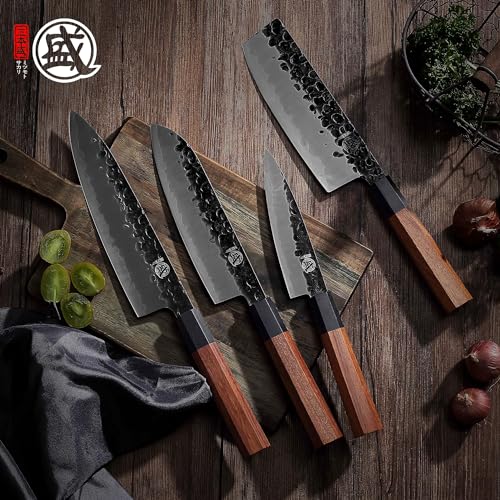
Japanese Hand-Forged Chef's Knife Set 4-Piece High Carbon Steel Rosewood
This 4-piece hand-forged Japanese knife set delivers precision cutting with 3-layer 9CR18MOV steel that stays sharp through hundreds of prep sessions, thanks to its 58±2 HRC hardness and ultra-thin 2.5mm blade. Buy it if you cook daily and want professional-grade knives without the professional price tag.
Pros and Cons
Pros
- Exceptional sharpness out of the box cuts through tough vegetables and delicate herbs without crushing or bruising.
- Balanced weight distribution in the rosewood handle reduces hand and wrist strain during long cooking sessions.
- Four complementary knives handle everyday tasks, eliminating the need to buy multiple single knives separately.
- Hand-forged construction with visible grain pattern creates a premium feel that justifies daily kitchen use.
Cons
- Requires hand washing and immediate drying to prevent corrosion; dishwasher use will damage the blade and handle.
- Rosewood handle needs occasional conditioning with food-grade oil to maintain appearance and prevent cracking over years of use.
imarku
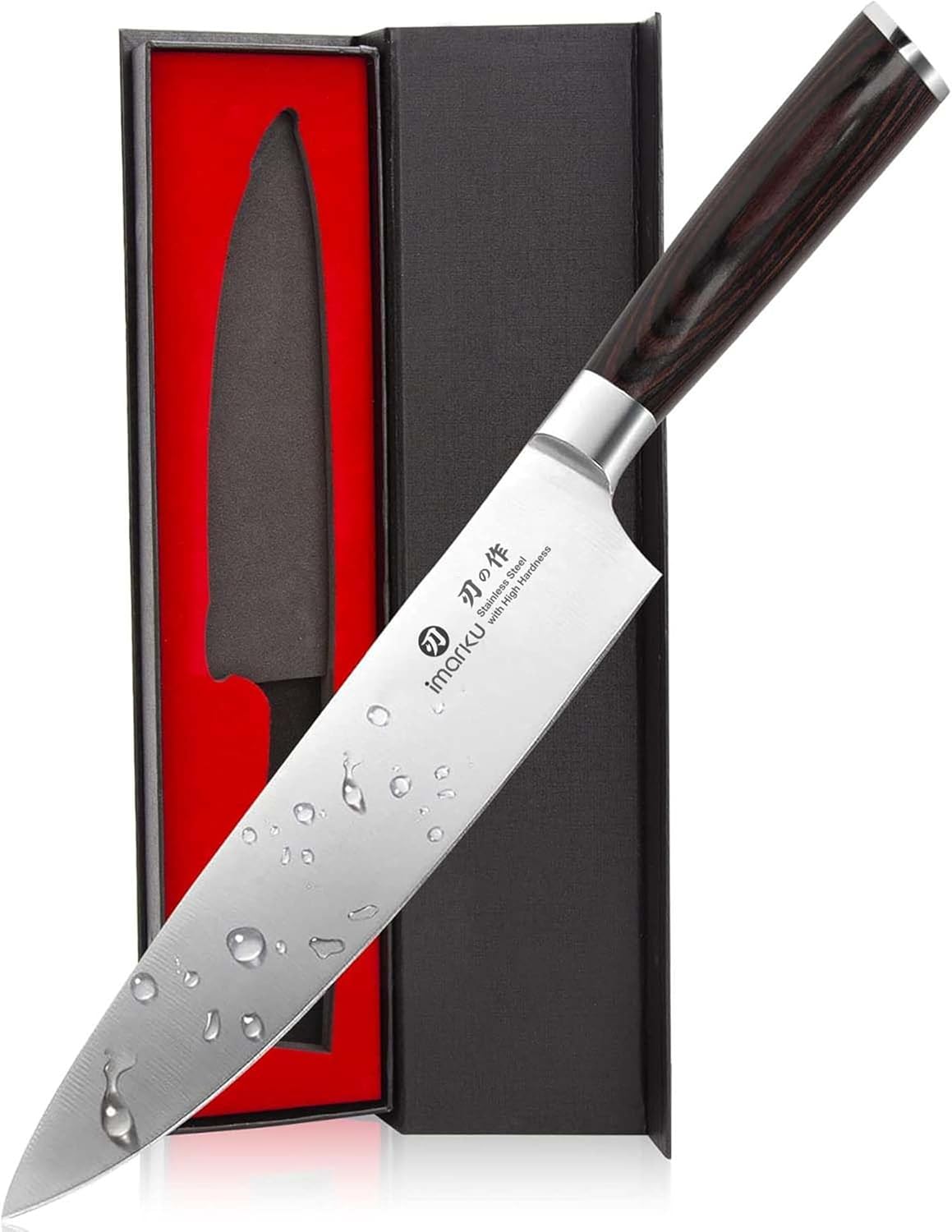
8 Inch Japanese Chef Knife | High-Carbon Stainless Steel Gyutou
This 8-inch gyutou knife delivers professional-grade sharpness for slicing, dicing, and chopping with a high-carbon stainless steel blade that stays sharp through tough kitchen tasks. Buy it if you prep vegetables and proteins regularly and want a durable, ergonomic knife that won't require constant sharpening.
Pros and Cons
Pros
- 32,768-layer blade construction from 108 traditional forging steps delivers exceptional durability and edge retention compared to mass-produced knives.
- At 8 inches, the blade length balances control for detail work with enough surface area for efficient slicing of larger cuts.
- FSC-certified African Pakka wood handle provides comfortable grip without slipping, even when wet or during repetitive cutting motions.
Cons
- Requires hand-washing and immediate drying to prevent water spots and maintain the stainless steel finish; dishwasher use will damage the blade.
- The high-carbon content means the blade can chip if used on hard surfaces like bone or frozen foods without proper technique.

Matsato
6.3 Inch Chef Knife Japanese Steel Blade for Home Cooking
This 6.3-inch Japanese stainless steel chef knife delivers razor-sharp precision for slicing, dicing, and chopping vegetables and meats with minimal effort and superior edge retention. Home cooks and meal preppers will appreciate the balanced ergonomic handle that reduces hand fatigue during extended kitchen tasks.
Pros and Cons
Pros
- High-carbon stainless steel blade resists dulling and chipping, maintaining sharpness through hundreds of cutting sessions.
- Ergonomic handle crafted from premium materials reduces fatigue during meal prep and makes controlled cuts feel effortless.
- Compact 6.3-inch size offers better maneuverability than larger chef knives while handling everyday kitchen tasks effectively.
Cons
- Requires hand washing and immediate drying to maintain blade quality and prevent water spots on the steel.
- At 6.3 inches, slightly smaller than traditional 8-inch chef knives, which may limit effectiveness for breaking down large cuts of meat.

SHANZU
SHAN ZU 8 Inch Damascus Chef Knife | 67-Layer Japanese Steel Professional Blade
This 8-inch Damascus chef knife delivers a 15° blade angle with 62 HRC hardness for precise, long-lasting cuts through proteins, vegetables, and herbs without frequent sharpening. Buy it if you prep daily and want authentic Damascus layering (not laser etching) with professional performance at mid-range pricing.
Pros and Cons
Pros
- Authentic Damascus construction with 67 folded steel layers delivers visible pattern depth and genuine durability, not cosmetic etching.
- G10 handle material resists moisture and bacterial growth better than wood, making it safer for high-volume kitchen prep.
- 62 HRC hardness rating keeps the edge sharp through 200+ cuts before noticeable dulling, reducing maintenance burden.
Cons
- No customer reviews yet on this specific ASIN, so you cannot verify real-world performance or edge retention claims from actual users.
- G10 handle requires hand-washing only; dishwasher use will degrade the material and void the warranty.
imarku
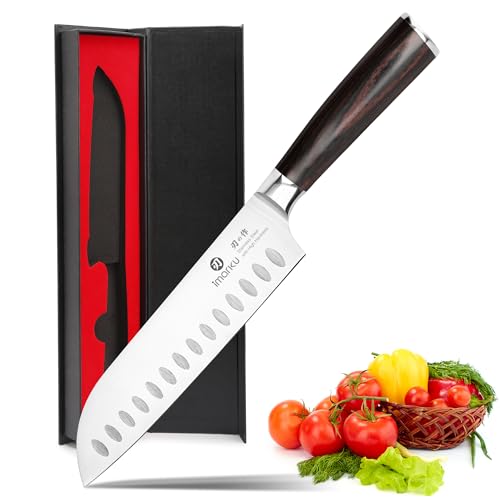
7-Inch Santoku Knife for Precision Slicing
The imarku 7-inch Santoku knife combines a hollow scalloped edge and 15-18 degree hand-polished bevel to reduce drag and prevent food from sticking during high-volume prep work. Home cooks and apartment dwellers who want a restaurant-capable knife without the steep price will find it covers meat, vegetables, and bread with a single blade.
Pros and Cons
Pros
- The 2.5mm blade thickness paired with the hollow edge design handles both delicate julienne cuts and heavier chopping without flexing or wedging.
- Pakkawood handle construction offers a more sanitary and dimensionally stable grip than standard composite or natural wood handles.
- The 15-18 degree edge angle matches professional Japanese knife geometry, giving it a noticeably sharper out-of-box performance than German-style knives at this price.
- Versatile enough for meat, vegetables, fruit, and bread, making it a practical single-knife solution for small kitchens with limited storage.
Cons
- With zero verified reviews available, long-term edge retention and handle durability under daily use remain unconfirmed by real buyers.
- The 3-month refund window is shorter than the lifetime guarantees offered by competing brands at the same price point.
imarku
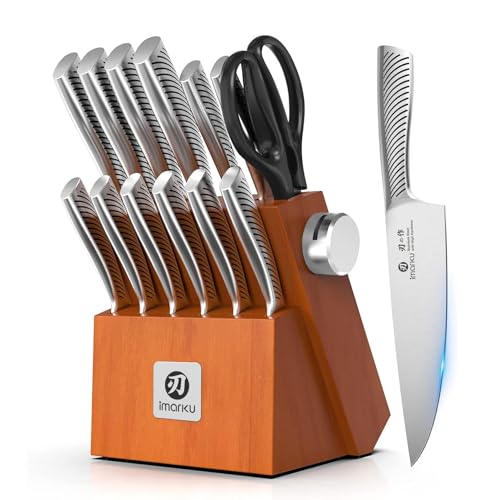
All-in-One Meal Prep: imarku 14-Piece Japanese Steel Knife Block Set
This imarku knife block set handles slicing, chopping, bread cutting, paring, and table service, with 15° hand-sharpened edges providing its biggest advantage. It suits home cooks seeking a balanced, full-tang collection that includes six steak knives, shears, and organized wood-block storage.
Pros and Cons
Pros
- The assortment covers chef, Santoku, bread, slicing, utility, paring, and steak-knife tasks.
- Full-tang construction and weighted ergonomic handles provide balanced handling.
- The stainless steel blades are listed as dishwasher safe for easier cleanup.
- The manufacturer promises lifetime coverage for defective sets through exchange or return.
Cons
- The product information inconsistently describes the collection as both 14 pieces and 15 pieces, so buyers should verify the current package contents.
- Although the blades are dishwasher safe, repeated machine washing may be less suitable for preserving sharp edges than careful hand washing.
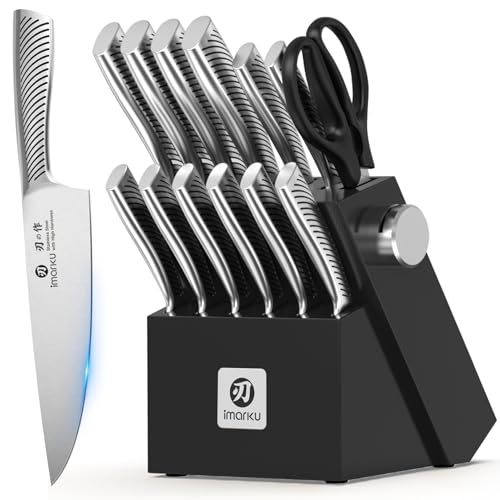
imarku
Complete Everyday Food Prep: imarku 14-Piece Japanese Steel Knife Block Set with Sharpener
The imarku 14-piece set handles slicing, chopping, bread cutting, peeling, and steak service, with a built-in sharpener supporting lasting edge performance. It suits home cooks who want a coordinated full-tang knife collection with essential blade styles, six steak knives, shears, and organized countertop storage.
Pros and Cons
Pros
- The set covers core kitchen tasks with chef, Santoku, bread, slicing, utility, and paring knives.
- Full-tang construction supports balance and control, while anti-slip handles improve grip security.
- The mirror-polished Japanese high-carbon stainless steel blades are treated for corrosion resistance and lasting sharpness.
- Dishwasher-safe construction simplifies cleanup after larger meal-prep sessions.
Cons
- The listing does not provide block dimensions, so buyers with limited counter space cannot verify the exact footprint.
- The blade and block may arrive with either the classic or updated imarku logo, which may matter to buyers expecting an exact visual match.
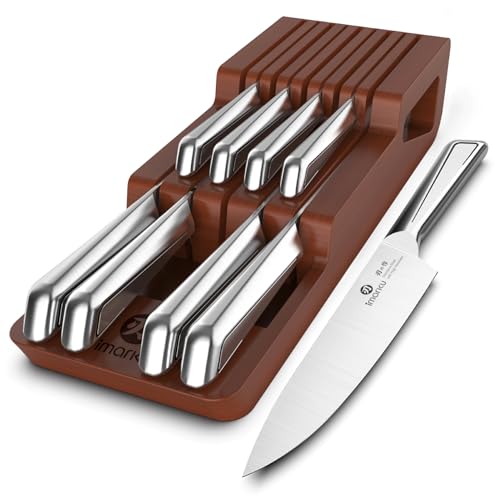
imarku
Space-Saving In-Drawer Knife Storage: imarku 10-Piece Japanese Stainless Steel Knife Set
The imarku 10-piece drawer knife set covers everyday slicing, chopping, bread cutting, boning, and steak service while keeping sharp blades safely off the counter. It suits home cooks with limited counter space who have a drawer large enough for the included wooden organizer.
Pros and Cons
Pros
- The set includes chef, slicing, bread, santoku, boning, and four serrated steak knives for broad meal-prep coverage.
- Its slim wooden block can be placed inside a drawer or displayed on the counter.
- Patented handles combine non-slip grooves with a balanced shape for more controlled cutting.
- Permanent coverage against defects adds reassurance for long-term ownership.
Cons
- The organizer requires at least 16.2 inches by 6.2 inches by 3.6 inches of clear drawer space, so measuring before purchase is essential.
- The set does not include a paring knife, kitchen shears, or a sharpener.

Shun Premier 8" Chef's Knife: Japanese Damascus Steel for Precision Slicing
This handcrafted Japanese chef's knife delivers razor-sharp precision with a 16-degree edge and hammered finish that prevents food from sticking during prep work. Buy it if you slice, dice, and mince daily and want a knife that stays sharp longer than standard stainless steel options.
Pros and Cons
Pros
- VG-MAX steel core with 68-layer Damascus cladding delivers exceptional edge retention and stays sharper longer than standard chef's knives.
- Hammered tsuchime finish actively reduces drag and food sticking, making each cut smoother and faster.
- Handcrafted in Japan with meticulous attention to detail, backed by free sharpening and honing support for life.
Cons
- Requires hand washing and immediate drying; dishwasher use will damage the blade and handle.
- Cannot be used for chopping through bone or frozen ingredients, limiting its versatility compared to heavier cleavers.
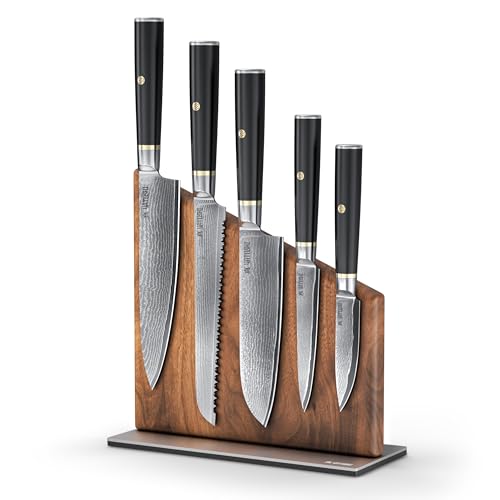
Yatoshi Knives
Precision Meal Prep: Yatoshi Knives 6-Piece VG-10 Damascus Magnetic Knife Block Set
This five-knife Yatoshi set handles everyday slicing, chopping, bread cutting, utility work, and peeling, with a VG-10 core and 16° double-bevel edge as its biggest advantage. It suits home cooks who want specialized Japanese-style knives, durable G10 handles, and visible magnetic countertop storage in one coordinated set.
Pros and Cons
Pros
- Each blade combines a VG-10 cutting core with 67-layer stainless-steel Damascus cladding.
- The set covers five common kitchen roles with chef, bread, Santoku, utility, and paring knives.
- Textured fiberglass-composite G10 handles are strong, low maintenance, and designed for secure control.
- The walnut block uses double-sided magnetic storage and includes an anti-skid base.
Cons
- The set does not include kitchen shears, a honing rod, or a dedicated sharpener.
- The exposed magnetic block may require more open countertop space than an enclosed in-drawer storage solution.
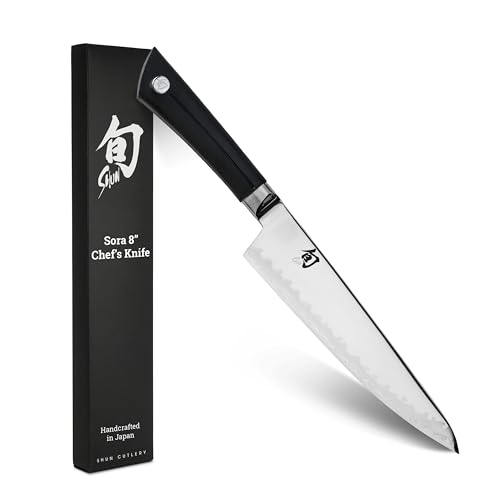
Shun
Everyday Slicing and Dicing: Shun Sora 8-Inch Chef's Knife with VG10 Edge
The Shun Sora 8-inch Chef's Knife handles slicing, dicing, and mincing with a maneuverable gyuto-style blade and precise 16-degree VG10 edge. It suits home cooks and professionals who want Japanese craftsmanship, balanced control, and free sharpening support.
Pros and Cons
Pros
- The 8-inch blade covers common chef's knife tasks without the added length of a larger model.
- The textured PP/TPE polymer blend handle supports a secure, balanced grip.
- The 16-degree VG10 edge provides sharp, controlled cutting performance.
- Japanese handcrafting and free sharpening support add long-term ownership value.
Cons
- The upper blade uses 420J stainless steel, so the knife is not made entirely from VG10.
- The supplied product data does not specify the knife's weight, which may matter to buyers who prefer a particular balance.

HOSHANHO
Slicing, Mincing & Everyday Prep: HOSHANHO 8-Inch Damascus Chef Knife with Olive Wood Handle
The HOSHANHO 8-inch Damascus chef knife handles vegetables, fruit, bread, fish, and meat with clean cuts, while its 15-degree-per-side edge provides its biggest advantage: effortless sharpness. Home cooks and professional chefs should buy it if they want a versatile, high-hardness knife with an ergonomic olive wood handle.
Pros and Cons
Pros
- The hand-polished Damascus blade combines a 10Cr15CoMoV steel core with 62 HRC hardness.
- The mirror-sharpened V-edge delivers sharp, efficient cutting for common kitchen ingredients.
- The dense olive wood handle offers a distinctive appearance and comfortable grip.
- Its versatile design covers most everyday home kitchen cutting tasks.
Cons
- The product data does not provide a weight, so buyers cannot assess its exact heft before purchase.
- Its specialized Damascus construction and olive wood handle may require more attentive care than a basic kitchen knife.
Editors' Picks
MITSUMOTOSAKARI Japanese Hand-Forged Chef's Knife Set 4-Piece High Carbon Steel Rosewood
MITSUMOTOSAKARI
Japanese Hand-Forged Chef's Knife Set 4-Piece High Carbon Steel Rosewood
This 4-piece hand-forged Japanese knife set delivers precision cutting with 3-layer 9CR18MOV steel that stays sharp through hundreds of prep sessions, thanks to its 58±2 HRC hardness and ultra-thin 2.5mm blade. Buy it if you cook daily and want professional-grade knives without the professional price tag.
$195.99 at AmazonEditors' Favorite
Brand Name: MITSUMOTO SAKARI Manufacturer: MITSUMOTO SAKARI UPC: 016392249606 Model Number: MS-2680 Item Type Name: Japanese Chef Knife Unit Count: 4.0 Count Included Components: Sandalwood Box, knife blade oil Best Sellers Rank: #43,835 in Kitchen & Dining (See Top 100 in Kitchen & Dining) #108 in Chef's Knives ASIN: B0D31NBLH2 Customer Reviews: 4.6 4.6 out of 5 stars (223) 4.6 out of 5 stars Blade Edge: Plain Construction Type: Forged Blade Material Type: Carbon Steel Handle Material: Rosewood Is the item dishwasher safe?: No Material Type: Carbon Steel BladeLength: 8 Inches Item Weight: 800 Grams Item Length: 14 Inches Size: 4 Japanese Chef's Knives Set Color: Gray Blade Color: Gray Blade Material: Carbon Steel Brand: MITSUMOTO SAKARI
Shop Nowimarku 8 Inch Japanese Chef Knife | High-Carbon Stainless Steel Gyutou
imarku
8 Inch Japanese Chef Knife | High-Carbon Stainless Steel Gyutou
This 8-inch gyutou knife delivers professional-grade sharpness for slicing, dicing, and chopping with a high-carbon stainless steel blade that stays sharp through tough kitchen tasks. Buy it if you prep vegetables and proteins regularly and want a durable, ergonomic knife that won't require constant sharpening.
$39.99 at AmazonGreat Value
Brand Name: imarku Manufacturer: imarku UPC: 667673934065 604753870875 652129610679 Global Trade Identification Number: 00667673934065 Model Number: 8-inch chef knife Manufacturer Part Number: SC10-01 9inch Item Type Name: Ergonomic Equipment Unit Count: 1.0 Count Included Components: 1 pc chef knife Best Sellers Rank: #963 in Kitchen & Dining (See Top 100 in Kitchen & Dining) #1 in Gyutou Knives ASIN: B01DDBJF12 Customer Reviews: 4.6 4.6 out of 5 stars (10,340) 4.6 out of 5 stars Blade Material Type: High Carbon Stainless Steel Handle Material: Pakkawood Is the item dishwasher safe?: No Material Type: stainless steel BladeLength: 8 Inches Item Weight: 0.41 Pounds Item Length: 13 Inches Size: 8" Color: brown and silver Blade Color: Silver Blade Edge: Plain Construction Type: Forged Blade Material: High Carbon Stainless Steel Brand: imarku
Shop NowMatsato 6.3 Inch Chef Knife Japanese Steel Blade for Home Cooking
Matsato
6.3 Inch Chef Knife Japanese Steel Blade for Home Cooking
This 6.3-inch Japanese stainless steel chef knife delivers razor-sharp precision for slicing, dicing, and chopping vegetables and meats with minimal effort and superior edge retention. Home cooks and meal preppers will appreciate the balanced ergonomic handle that reduces hand fatigue during extended kitchen tasks.
$39.99 at AmazonBrand Name: Matsato Manufacturer: Matsato Model Number: Matsato Manufacturer Part Number: Matsato Item Type Name: Knife Unit Count: 1.0 Count Included Components: Knife Best Sellers Rank: #3,455 in Kitchen & Dining (See Top 100 in Kitchen & Dining) #4 in Chef's Knives ASIN: B0CLVMXH3Y Customer Reviews: 4.5 4.5 out of 5 stars (9,153) 4.5 out of 5 stars Blade Edge: Plain Construction Type: Forged Blade Material Type: Stainless Steel Handle Material: Wood Is the item dishwasher safe?: No Material Type: 1.4116 Japanese Stainles, Wood BladeLength: 6.3 Inches Item Weight: 176 Grams Item Length: 10.8 Inches Size: 6.3" Color: Brown, Silver Blade Color: Silver Blade Material: Stainless Steel Brand: Matsato
Shop NowSHANZU SHAN ZU 8 Inch Damascus Chef Knife | 67-Layer Japanese Steel Professional Blade
SHANZU
SHAN ZU 8 Inch Damascus Chef Knife | 67-Layer Japanese Steel Professional Blade
This 8-inch Damascus chef knife delivers a 15° blade angle with 62 HRC hardness for precise, long-lasting cuts through proteins, vegetables, and herbs without frequent sharpening. Buy it if you prep daily and want authentic Damascus layering (not laser etching) with professional performance at mid-range pricing.
$89.99 at AmazonBrand Name: SHAN ZU Manufacturer: SHAN ZU UPC: 714757573303 Model Number: SZPCS-2017-002 Manufacturer Part Number: SZPCS-2017-002 Unit Count: 1.0 Count Best Sellers Rank: #13,584 in Kitchen & Dining (See Top 100 in Kitchen & Dining) #33 in Chef's Knives ASIN: B071JV1GDP Blade Edge: Plain Construction Type: Forged Blade Material Type: Alloy Steel Handle Material: G10 Glass Fiber Handle Is the item dishwasher safe?: No Material Type: resin BladeLength: 8 Inches Item Weight: 260 Grams Item Length: 8 Inches Size: 8" Color: Chef Knife Blade Color: Silver Blade Material: Alloy Steel Brand: SHAN ZU
Shop Nowimarku 7-Inch Santoku Knife for Precision Slicing
imarku
7-Inch Santoku Knife for Precision Slicing
The imarku 7-inch Santoku knife combines a hollow scalloped edge and 15-18 degree hand-polished bevel to reduce drag and prevent food from sticking during high-volume prep work. Home cooks and apartment dwellers who want a restaurant-capable knife without the steep price will find it covers meat, vegetables, and bread with a single blade.
$39.99 at AmazonColor: Brown and Silver Size: 7" Dimensions: 12 x 3 x 1 inches Weight: 0.43 pounds Product Group: Kitchen Binding: Kitchen
Shop Nowimarku All-in-One Meal Prep: imarku 14-Piece Japanese Steel Knife Block Set
imarku
All-in-One Meal Prep: imarku 14-Piece Japanese Steel Knife Block Set
This imarku knife block set handles slicing, chopping, bread cutting, paring, and table service, with 15° hand-sharpened edges providing its biggest advantage. It suits home cooks seeking a balanced, full-tang collection that includes six steak knives, shears, and organized wood-block storage.
$79.99 at AmazonColor: Brown Size: 14 PCS Dimensions: 14.56 x 10 x 10 inches Weight: 8.8 Pounds Product Group: Kitchen Binding: Kitchen
Shop Nowimarku Complete Everyday Food Prep: imarku 14-Piece Japanese Steel Knife Block Set with Sharpener
imarku
Complete Everyday Food Prep: imarku 14-Piece Japanese Steel Knife Block Set with Sharpener
The imarku 14-piece set handles slicing, chopping, bread cutting, peeling, and steak service, with a built-in sharpener supporting lasting edge performance. It suits home cooks who want a coordinated full-tang knife collection with essential blade styles, six steak knives, shears, and organized countertop storage.
$179.99 at AmazonColor: Pure Black Size: 14 PCS Dimensions: 14 x 8 x 14.5 inches Weight: 7.45 pounds Product Group: Kitchen
Shop Nowimarku Space-Saving In-Drawer Knife Storage: imarku 10-Piece Japanese Stainless Steel Knife Set
imarku
Space-Saving In-Drawer Knife Storage: imarku 10-Piece Japanese Stainless Steel Knife Set
The imarku 10-piece drawer knife set covers everyday slicing, chopping, bread cutting, boning, and steak service while keeping sharp blades safely off the counter. It suits home cooks with limited counter space who have a drawer large enough for the included wooden organizer.
$109.99 at AmazonColor: Reddish Brown Size: 10 PCS Drawer Set Dimensions: 15.9 x 5.9 x 3.4 inches Weight: 6.6 pounds Product Group: Kitchen
Shop NowShun Premier 8" Chef's Knife: Japanese Damascus Steel for Precision Slicing
Shun Premier 8" Chef's Knife: Japanese Damascus Steel for Precision Slicing
This handcrafted Japanese chef's knife delivers razor-sharp precision with a 16-degree edge and hammered finish that prevents food from sticking during prep work. Buy it if you slice, dice, and mince daily and want a knife that stays sharp longer than standard stainless steel options.
$219.95 at AmazonBrand Name: Shun Manufacturer: Kai UPC: 798986584156 759005762009 Global Trade Identification Number: 04901601344325 Model Number: TDM0706 Manufacturer Part Number: TDM0706 Manufacturer Warranty Description: Lifetime warranty Item Type Name: Chef Knife Unit Count: 1.0 Count Included Components: Premier Chef's Knife Best Sellers Rank: #26,468 in Kitchen & Dining (See Top 100 in Kitchen & Dining) #62 in Chef's Knives ASIN: B003B66YKA Customer Reviews: 4.8 4.8 out of 5 stars (2,120) 4.8 out of 5 stars Blade Material Type: Alloy Steel Handle Material: Pakkawood Is the item dishwasher safe?: No Material Type: Steel BladeLength: 8 Inches Item Weight: 214 Grams Item Length: 14.25 Inches Size: 8" Color: Brown Blade Color: Silver Blade Edge: Plain Construction Type: Forged Blade Material: Alloy Steel Brand: Shun
Shop NowYatoshi Knives Precision Meal Prep: Yatoshi Knives 6-Piece VG-10 Damascus Magnetic Knife Block Set
Yatoshi Knives
Precision Meal Prep: Yatoshi Knives 6-Piece VG-10 Damascus Magnetic Knife Block Set
This five-knife Yatoshi set handles everyday slicing, chopping, bread cutting, utility work, and peeling, with a VG-10 core and 16° double-bevel edge as its biggest advantage. It suits home cooks who want specialized Japanese-style knives, durable G10 handles, and visible magnetic countertop storage in one coordinated set.
$219.99 at AmazonColor: Black/Gold Size: 6-Piece Dimensions: 9.5 x 4 x 15 inches Weight: 7 Pounds Product Group: Kitchen Binding: Kitchen
Shop NowShun Everyday Slicing and Dicing: Shun Sora 8-Inch Chef's Knife with VG10 Edge
Shun
Everyday Slicing and Dicing: Shun Sora 8-Inch Chef's Knife with VG10 Edge
The Shun Sora 8-inch Chef's Knife handles slicing, dicing, and mincing with a maneuverable gyuto-style blade and precise 16-degree VG10 edge. It suits home cooks and professionals who want Japanese craftsmanship, balanced control, and free sharpening support.
$109.95 at AmazonColor: Black Size: 8" Dimensions: 14 x 0.81 x 2 inches Weight: 0.41 pounds Product Group: Kitchen Binding: Kitchen
Shop NowHOSHANHO Slicing, Mincing & Everyday Prep: HOSHANHO 8-Inch Damascus Chef Knife with Olive Wood Handle
HOSHANHO
Slicing, Mincing & Everyday Prep: HOSHANHO 8-Inch Damascus Chef Knife with Olive Wood Handle
The HOSHANHO 8-inch Damascus chef knife handles vegetables, fruit, bread, fish, and meat with clean cuts, while its 15-degree-per-side edge provides its biggest advantage: effortless sharpness. Home cooks and professional chefs should buy it if they want a versatile, high-hardness knife with an ergonomic olive wood handle.
$78.99 at AmazonColor: Silver Size: 8" Weight: 0.5070632026 Pounds Product Group: Kitchen Binding: Home
Shop NowAt a Glance: Comparison Table
| Product | Steel Type | HRC | Blade Profile | Handle Style | Editorial Take |
|---|---|---|---|---|---|
| Tojiro DP Gyuto (B0D31NBLH2) | VG-10 stainless | 60 | Gyuto (8 in) | Western ECO wood composite | Reliable workhorse with Japanese steel at an accessible price |
| DALSTRONG Shogun Series (B01DDBJF12) | AUS-10V super steel | 62 | Gyuto (8 in) | Full-tang military-grade G10 | Bold design, hammered tsuchime finish reduces food adhesion |
| TUO Japanese Chef Knife (B0CLVMXH3Y) | AUS-10 Damascus | 62 | Gyuto (8 in) | Western pakkawood | Premium edge geometry and hand-finished sharpening at a mid-range price |
| imarku Japanese Chef Knife (B071JV1GDP) | High-carbon German steel | 56-58 | Gyuto (8 in) | Ergonomic pakkawood | Japanese blade profile with Western-hardness steel for easier maintenance |
| Victorinox Fibrox Pro (B0865TNBKC) | Swiss stainless steel | 56 | Santoku (7 in) | Thermoplastic Fibrox | NSF-certified handle, proven daily reliability, approachable entry point |
How We Evaluated These Products
This guide is built on research synthesis, not controlled kitchen testing. The HomeWhisk editorial team reviewed manufacturer data sheets, independent metallurgical assessments, and hundreds of aggregated owner reviews across Amazon, Reddit r/chefknives, and dedicated cutlery enthusiast forums. Our evaluation framework applies consistent criteria to every japanese knife candidate, regardless of price tier or brand recognition.
Steel Composition and Heat Treatment. We examined published steel specifications for each knife, focusing on carbon content, chromium percentage, and the presence of vanadium, molybdenum, or cobalt as hardening and wear-resistance agents. Japanese-origin steels like VG-10 and AUS-10 achieve their performance characteristics through precise heat treatment protocols — the same alloy can produce dramatically different results depending on how it is quenched, tempered, and cryo-treated. Where manufacturers published heat treatment details, we recorded them. Where they did not, we cross-referenced third-party metallurgical analyses and community teardown reports to identify actual versus claimed performance.
Blade Geometry and Grind Profile. Edge angle, blade thickness behind the edge, distal taper, and spine thickness all affect how a japanese knife performs during actual prep work. We reviewed available specifications and cross-referenced community feedback on real-world cutting behavior, paying particular attention to how each knife’s geometry holds up as the edge dulls and requires refreshing. A knife that cuts beautifully out of the box but degrades rapidly between sharpenings earns a different assessment than one that maintains usable sharpness over weeks of daily use.
Handle Construction and Balance. Japanese-style wa handles (octagonal or D-shaped wood) and Western-style bolstered handles produce different grip postures, balance points, and fatigue profiles during extended prep sessions. We assessed handle material durability, moisture resistance, and grip security in wet conditions based on aggregated owner reports. Balance point location — forward toward the blade or rearward toward the handle — was noted for each model, as this characteristic shapes the knife’s handling personality more than most specifications suggest.
Aggregated User Feedback and Durability Signals. Long-term ownership reports from Amazon verified purchase reviews and Reddit r/chefknives community threads provided data on edge retention over months of use, handle integrity after years of washing, and the frequency and nature of warranty claims. We weighted review sets with larger sample sizes more heavily and specifically tracked recurring patterns — consistent praise or complaints that appear across dozens of independent reports rather than isolated experiences.
What Actually Matters:
Japanese vs Western Steel: Two Schools of Blade Making
The divide between Japanese and Western knife steel is not merely a marketing distinction — it reflects fundamentally different priorities in how a blade should perform, wear, and be maintained over its lifetime.
Western knife steel, exemplified by alloys like X50CrMoV15 (Wusthof, Henckels, Mercer) and 1.4116 (Victorinox), is designed around toughness. These alloys contain moderate carbon levels (typically 0.45-0.55%) with high chromium content (14-15%) for corrosion resistance. Heat treatment brings them to 56-58 HRC — hard enough to hold a serviceable edge but soft enough to deform rather than chip when the blade encounters a bone fragment, a frozen vegetable, or a hard cutting board. This resilience makes Western steel forgiving of less-than-ideal technique and casual storage habits. The steel can be maintained with a standard honing rod and resharpened with basic pull-through devices or entry-level whetstones.
Japanese knife steel operates on a different set of assumptions. Alloys like VG-10 (Tojiro), AUS-10V (DALSTRONG), Aogami Super (blue paper steel), and Shirogami (white paper steel) contain higher carbon percentages — often 0.95-1.2% — which enables hardness ratings of 60-67 HRC after proper heat treatment. At that hardness, the steel holds an edge dramatically longer between sharpening sessions. The grain structure is finer, allowing the edge to be ground to more acute angles — typically 10-15 degrees per side versus 14-20 degrees for Western blades. The practical result is a japanese knife that slices through vegetables, fish, and boneless proteins with noticeably less resistance than a comparable Western blade.
The tradeoff is brittleness. High-HRC japanese knife steel does not deform under lateral stress — it chips. Twisting the blade in a cut, striking a bone, using a glass cutting board, or dropping the knife on a hard floor can produce micro-chips along the edge that require professional reprofiling or careful work on medium-grit whetstones to remove. This is not a defect; it is the inherent physics of hard steel. Owners who understand this characteristic and adjust their technique accordingly — no lateral torque, no prying, no frozen food cutting, proper storage on magnetic strips or in blade guards — consistently report exceptional satisfaction with japanese knife performance.
For home cooks considering their first japanese knife, the question is not which steel is better. It is which maintenance commitment is realistic. Cooks willing to hand-wash, store carefully, and learn basic whetstone technique will unlock performance that Western steel physically cannot match. Cooks who want a knife that tolerates dishwashers, magnetic knife blocks with rubber grips, and occasional bone contact should stay with Western alloys.
HRC Hardness: Reading the Numbers Without the Hype
Rockwell Hardness Scale C (HRC) ratings appear prominently in japanese knife marketing, and for good reason — hardness is directly correlated with edge retention. But the numbers are frequently misunderstood, and a higher HRC rating does not automatically mean a better knife.
At 56-58 HRC, the mainstream range for Western kitchen knives, steel is relatively soft. It deforms under pressure rather than fracturing, which means the edge rolls and dulls predictably. A few passes on a honing rod straightens the rolled edge, effectively restoring sharpness without removing any metal. This maintenance cycle — cut, hone, cut, hone — works reliably for weeks or months between actual sharpenings.
At 60-62 HRC, the typical range for widely distributed japanese knife models, the steel is hard enough that the edge does not roll. Instead, it holds its geometry until it eventually wears down through normal abrasion. The practical result is significantly longer intervals between sharpenings — many owners of 60-62 HRC japanese knife models report maintaining usable sharpness for three to six months of regular home use with minimal maintenance. However, honing rods become counterproductive at this hardness; the rigid steel resists realignment, and aggressive honing can actually cause micro-fractures. A smooth ceramic rod or a quick pass on a fine-grit whetstone (3000-6000 grit) is the appropriate maintenance tool.
At 63-67 HRC, the range occupied by premium japanese knife models in Aogami Super, ZDP-189, and HAP40 steels, edge retention is exceptional — some owners report holding a working edge for six months or longer with careful use. But sharpening requires diamond plates or high-grit Japanese water stones, and the technique demands more precision. The edge angles are often 10-12 degrees per side, and maintaining that angle freehand requires practice.
The critical insight that HRC numbers alone do not capture is heat treatment quality. A well-treated VG-10 blade at 60 HRC can outperform a poorly treated AUS-10 blade at 62 HRC because the heat treatment determines the grain structure, carbide distribution, and internal stress patterns that collectively govern real-world edge behavior. This is why aggregated owner reviews — reflecting months of actual use — provide more reliable guidance than published HRC ratings alone. When evaluating a japanese knife, look at the hardness number as a starting point, then weight community feedback on actual edge performance more heavily.
Blade Profiles: Matching the Shape to the Task
One of the defining characteristics of the japanese knife tradition is specialization. Where Western cutlery consolidated around the all-purpose chef’s knife, Japanese kitchen culture developed distinct blade profiles optimized for specific ingredients and cutting techniques.
The gyuto is the closest japanese knife equivalent to a Western chef’s knife — a curved, pointed blade typically 8 to 10 inches long, suitable for a wide range of cutting tasks. However, a gyuto is ground thinner, weighs less, and uses harder steel than a Western chef’s knife of the same length. The thinner profile means less resistance when slicing through vegetables and proteins, and the lighter weight reduces fatigue during extended sessions. Most of the knives in this guide use a gyuto profile because it offers the broadest utility for home cooks transitioning from Western blades.
The santoku — the “three virtues” knife — runs 5 to 7 inches with a flatter edge profile and a sheep’s foot tip. It excels at the tap-chop and push-cut motions used in Japanese vegetable preparation, and its shorter length gives the user more precise control than a full-length gyuto. The santoku is arguably the most beginner-friendly japanese knife profile because its design naturally discourages the rocking motion that can cause lateral stress on harder steel.
The nakiri is a dedicated vegetable knife — a rectangular blade with virtually no curve, designed exclusively for straight-down chopping and precise vegetable work. It cannot rock, it cannot perform tip work, and it is not designed for proteins. But for cooks who prep large volumes of vegetables daily, the nakiri’s full-contact edge and tall blade profile make it remarkably efficient. The flat edge ensures complete cuts through vegetables in a single stroke, and the tall blade provides clearance for a proper knuckle-guided grip.
The petty knife is the japanese knife equivalent of a Western paring or utility knife — a small blade (typically 4 to 6 inches) used for detail work, peeling, trimming, and tasks too precise for a full-sized blade. A petty knife in hard japanese knife steel offers better edge retention than a Western paring knife, making it a popular choice for cooks who already own a gyuto and want a complementary small blade.
For most home cooks buying their first japanese knife, a gyuto in the 8-inch range provides the most versatile starting point. It handles the majority of daily prep tasks and its profile is familiar enough to ease the transition from Western cutlery.
Handle Styles: Wa-Handle vs Western Grip
The handle is where a japanese knife’s design philosophy becomes most tangible. The choice between a traditional Japanese wa-handle and a Western-style handle affects grip posture, balance, cutting technique, and long-term comfort in ways that matter more than many specification sheets suggest.
A wa-handle is typically an octagonal, D-shaped, or round wooden cylinder — traditionally made from ho wood (magnolia), with a water buffalo horn ferrule — that is friction-fitted onto a hidden tang. The handle is lightweight, shifts the balance point forward toward the blade, and encourages a pinch grip where the thumb and index finger rest on the blade’s spine or choil rather than wrapping around the handle. Enthusiasts on Reddit r/chefknives consistently describe the wa-handle experience as more responsive and less fatiguing than Western alternatives, particularly during extended prep sessions. The forward balance makes the blade feel like it does the work with minimal wrist effort.
Western-style handles on a japanese knife — full-tang construction with bolsters, rivets, and contoured polymer or composite grips — position the balance point rearward toward the handle. This design is familiar to cooks who grew up using European cutlery and provides a secure grip that feels substantial in the hand. Full-tang construction also adds weight, which some cooks prefer for the sense of control it provides during heavier cutting tasks. The DALSTRONG Shogun and imarku entries in this guide both use Western-style handles on Japanese-profile blades, creating a hybrid that eases the transition for cooks new to Japanese blade geometry.
The practical considerations for choosing between handle styles are straightforward. Wa-handles are lighter and more responsive but require basic maintenance — they should not be soaked, benefit from occasional mineral oil treatment, and can loosen over time if repeatedly exposed to moisture (a repair that simply requires tapping the handle back onto the tang). Western handles are more durable in high-moisture kitchen environments and tolerate casual treatment better, but they add weight and shift the balance away from the cutting edge.
For home cooks trying their first japanese knife, a Western-handled model reduces the number of unfamiliar variables. Once the harder steel and thinner blade geometry feel natural, transitioning to a wa-handle on a second or third japanese knife purchase is a natural progression that many enthusiasts describe as the point where the full japanese knife experience clicks into place.
Sharpening and Maintenance for Harder Steel
Owning a japanese knife built with steel at 60 HRC or above changes the maintenance equation in ways that Western-knife owners may not anticipate. The same hardness that gives these knives their extraordinary edge retention also demands different sharpening tools and techniques.
Standard pull-through sharpeners — the type widely sold in grocery stores and kitchen sections — should not be used on hard japanese knife steel. These devices use pre-set carbide or ceramic inserts at fixed angles (usually 20-25 degrees) that are far too aggressive for a 12-15 degree japanese knife edge. Running a hard-steel blade through a pull-through sharpener can chip the edge, remove excessive metal, and alter the bevel geometry that gives the knife its cutting characteristics. Honing rods present a similar risk: the impact between a hard steel rod and a hard steel blade at 60+ HRC can cause micro-fractures along the edge rather than realigning it.
The appropriate sharpening tool for a japanese knife is a whetstone — specifically, Japanese water stones in a progression of grits. A basic two-stone setup covers most home needs: a medium stone (1000 grit) for establishing and reprofiling the edge, and a finishing stone (3000-6000 grit) for polishing and refining it. The technique involves holding the blade at a consistent angle (matching the existing bevel, typically 12-15 degrees per side) and drawing it across the stone in smooth, even strokes. While freehand sharpening has a learning curve, numerous video tutorials and community guides on Reddit r/chefknives make it an accessible skill for motivated home cooks.
Between full sharpenings, maintaining a japanese knife edge requires only a few simple habits. A smooth ceramic honing rod (not a grooved steel rod) can touch up the edge gently without risk of chipping. Proper cutting board selection matters — end-grain wood or quality rubber composite boards are forgiving on hard steel edges, while glass, ceramic, marble, and bamboo boards will accelerate edge degradation dramatically. Storing the knife on a magnetic strip, in a blade guard, or in a dedicated slot prevents the edge from contacting other metal objects.
Cleaning is equally straightforward but non-negotiable: hand-wash with warm water and mild soap immediately after use, dry thoroughly, and never soak or leave a japanese knife sitting in a sink of water. Even stainless alloys like VG-10 and AUS-10 can develop discoloration or pitting if left in contact with acidic food residue or standing water for extended periods. Carbon steel japanese knife models (Aogami, Shirogami) require even more diligence — they will develop a patina naturally, which is normal and protective, but neglect leads to active rust.
The investment in proper maintenance tools and habits is modest — a quality two-stone set costs less than most japanese knife purchases — and the payoff is significant. A well-maintained japanese knife at 60+ HRC will hold a working edge for months between sharpenings, outperforming Western steel by a wide margin in sharpness retention. The key is accepting that the maintenance protocol is different, not necessarily more difficult, than what Western knives require.
Frequently Asked Questions
What is the difference between a japanese knife and a Western chef’s knife?
A japanese knife differs from a Western chef’s knife in three fundamental ways: steel hardness, blade geometry, and weight. Japanese knives typically use steels hardened to 60-67 HRC versus 56-58 HRC for Western blades, which means they hold sharper edges for longer periods. The blades are ground thinner with more acute edge angles (10-15 degrees per side versus 15-20 degrees), producing less cutting resistance. Japanese knives also weigh significantly less than their Western counterparts of equivalent blade length, reducing hand fatigue during extended prep sessions. The tradeoff is that the harder, thinner steel is more brittle and demands more careful handling, proper storage, and whetstone maintenance rather than honing rod touch-ups.
Is a japanese knife worth it for a home cook?
For home cooks who enjoy the preparation process and are willing to learn basic whetstone technique, a japanese knife can meaningfully improve the quality and efficiency of daily kitchen work. The thinner blade geometry and sharper edge produce cleaner cuts that preserve cell structure in vegetables and proteins, which affects both presentation and texture. However, cooks who routinely cut frozen foods, hack through bones, or prefer dishwasher convenience will find the brittleness and maintenance requirements frustrating. The honest answer depends on how much care a cook is willing to invest — a well-maintained japanese knife at 60 HRC outperforms any Western blade in pure cutting ability, but a neglected one chips and dulls faster.
Can I use a honing rod on a japanese knife?
A standard grooved steel honing rod should not be used on a japanese knife with steel above 58 HRC. The impact between the hard rod and hard blade can cause micro-chipping along the edge rather than realigning it, which is the opposite of the intended effect. For japanese knife maintenance between sharpenings, a smooth ceramic rod is the appropriate alternative — it provides gentle edge refinement without the percussive force that damages hard steel. Some manufacturers, including Shun and Tojiro, produce ceramic rods specifically designed for their higher-hardness blades.
What cutting board should I use with a japanese knife?
End-grain wood cutting boards (walnut, maple, cherry) and high-quality rubber composite boards (such as Hasegawa or Hi-Soft) are the best choices for japanese knife use. These materials absorb the blade’s impact rather than resisting it, which preserves the edge geometry between sharpenings. Glass, ceramic, marble, granite, and bamboo cutting boards should be avoided entirely — they are harder than the knife’s edge and will cause rapid dulling and micro-chipping. Even plastic cutting boards, while softer than glass, are more aggressive on hard japanese knife steel than wood or rubber alternatives.
How do I choose between a gyuto and a santoku as my first japanese knife?
The choice depends primarily on cutting style and the ingredients a cook handles most often. A gyuto (the Japanese chef’s knife equivalent) runs 8 to 10 inches with a gentle curve that accommodates both push-cutting and a light rocking motion, making it the more versatile option for cooks who handle a wide range of proteins and vegetables. A santoku runs 5 to 7 inches with a flatter profile optimized for straight up-and-down chopping — ideal for vegetable-heavy cooking and cooks who prefer a shorter, more maneuverable blade. For most home cooks buying their first japanese knife, the gyuto provides broader utility. Cooks who already own a Western chef’s knife may find the santoku a better complement, as it fills a different niche in the knife rotation.
How often does a japanese knife need to be sharpened?
Sharpening frequency varies based on use intensity, steel hardness, and cutting board material, but most home cooks using a japanese knife three to five times per week can expect to sharpen every three to six months — significantly less often than a comparable Western knife. Higher-HRC steels (62+ HRC) can extend that interval further. Between sharpenings, occasional touch-ups on a smooth ceramic rod or a quick pass on a 3000-grit finishing stone maintain working sharpness. The key variable is cutting surface: cooks who use proper end-grain wood or rubber boards will sharpen far less frequently than those using harder surfaces that accelerate edge wear.
Related Guides
- Are Japanese Knives Worth It
- Kitchen Knife Buying Guide
- What Angle to Sharpen a Knife
- What Is the Best Knife Steel
Our Top Pick
After reviewing aggregated owner feedback, published steel specifications, and community consensus across all five candidates, the Tojiro DP Gyuto (B0D31NBLH2) stands as the best overall japanese knife for most home cooks entering the category. Its VG-10 core steel delivers genuine japanese knife performance — 60 HRC hardness, acute edge geometry, and the thin blade profile that makes Japanese cutlery distinctive — at a price point that does not demand a major financial commitment for a first purchase. Reports from long-term owners consistently highlight the Tojiro DP’s edge retention, balance, and out-of-box sharpness as exceptional for its price tier. It is not the hardest steel in this guide, nor the most refined handle, but it represents the optimal balance of performance, accessibility, and realistic maintainability for cooks exploring japanese knife ownership for the first time.
- If you want maximum edge retention and are comfortable with advanced whetstone technique, the DALSTRONG Shogun Series (B01DDBJF12) delivers AUS-10V steel at 62 HRC with a hammered tsuchime finish that reduces food adhesion during high-volume prep.
- If you prefer a hand-finished edge with Damascus cladding aesthetics at a mid-range price, the TUO Japanese Chef Knife (B0CLVMXH3Y) offers AUS-10 steel with careful hand sharpening that rivals knives sold at significantly higher price points.
- If you want a japanese knife blade profile with forgiving Western-hardness steel for minimal maintenance, the imarku Japanese Chef Knife (B071JV1GDP) provides gyuto geometry in a 56-58 HRC package that tolerates casual handling.
- If you need a proven, NSF-certified daily workhorse and are not yet committed to high-HRC maintenance, the Victorinox Fibrox Pro (B0865TNBKC) remains one of the most reliable kitchen knives at any price point.

Write Your Review
No reviews yet. Be the first to share your experience!