

TL;DR — Yes, if you value a sharper, lighter, more precise knife and will care for it properly; no, if you want a low-maintenance, do-everything workhorse you can treat roughly. Japanese knives use harder steel for a keener edge that holds longer, but they’re more brittle and demand careful use and sharpening. It’s a genuine upgrade for the right cook, and overkill for the wrong one. The HomeWhisk team compared Japanese and Western knives against aggregated feedback. For picks, see our best japanese knife guide.
The HomeWhisk editorial team researches kitchen equipment by analyzing manufacturer specifications, steel properties, and aggregated user reviews from major retailers and cooking communities. Our recommendations are based on what the products actually deliver, not what brands promise.
Japanese knives have a devoted following and premium prices, prompting the fair question: are they actually worth it, or is it hype? The honest answer is “it depends on you.” Here’s the breakdown. For picks, see our best japanese knife guide.
What Makes Japanese Knives Different
To judge whether they’re worth it, you first need to understand what actually sets them apart — it’s mostly the steel and geometry.
Harder steel. Japanese knives typically use harder steel (often 60-64 HRC vs Western ~56 HRC). Harder steel holds a sharp edge longer and can be ground to a finer, more acute angle. This is the core difference and drives everything else. See our guide on knife steel.
A sharper, more acute edge. Because the hard steel supports it, Japanese knives are sharpened to a lower angle (10-15° per side vs Western ~20°), making them noticeably sharper out of the box and keener in use. Many people are surprised how much sharper a Japanese knife feels.
Lighter and thinner. Japanese knives are generally lighter, thinner, and more nimble than heftier Western knives, favoring precise push-cutting over rocking. This suits delicate, precise work.
The trade-off — brittleness. Harder steel is more brittle, so Japanese knives chip more easily if misused (twisting, hitting bone, prying, cutting frozen food). They demand more careful use than tough, forgiving Western steel.
Craftsmanship and variety. Japanese knives come in specialized shapes (gyuto, santoku, nakiri, sujihiki) and often feature notable craftsmanship, which is part of the appeal — and the price. Our best japanese knife brands guide covers the makers.
So the Japanese knife’s advantages (sharpness, edge retention, precision, light feel) and its drawback (brittleness, care needs) both stem from the same source: harder steel and a finer edge. Whether that trade is “worth it” depends on how you cook.
The Case For (When They’re Worth It)
Japanese knives are genuinely worth it for a specific kind of cook. Here’s when the premium pays off.
You value sharpness and precision. If you appreciate a keen edge and precise cuts — clean slices, fine julienne, delicate work — a Japanese knife delivers a noticeably sharper, more controlled cut than a typical Western knife. For cooks who notice and enjoy this, it’s a real upgrade.
You do a lot of precise cutting. Vegetable-heavy prep, fish, sushi, fine slicing — tasks where a keen, thin blade shines — benefit most. A nakiri or santoku (see our guides) excels here.
You’ll maintain it properly. If you’re willing to hand-wash and dry immediately, use wood/soft cutting boards, hone regularly, and sharpen carefully at the right angle (ideally on a whetstone), the knife rewards you with lasting sharpness. Enthusiasts who enjoy knife care love them.
You prefer a light, nimble knife. If a heavy German knife feels clunky, the lighter Japanese feel is more comfortable and precise for many cooks, especially those with smaller hands.
You value edge retention. The harder steel holds its edge longer, so it stays sharp through more cutting before needing sharpening.
For the cook who cuts precisely, values sharpness, and will care for the knife, a Japanese knife is absolutely worth it — often a highlight of the kitchen. See our best japanese knife guide.
The Case Against (When to Skip Them)
Japanese knives are the wrong choice for some cooks, and it’s worth being honest about that.
You want a low-maintenance workhorse. If you’d rather not fuss over careful drying, gentle use, and precise sharpening, a tough Western knife (softer steel) is more forgiving — it tolerates rougher treatment, occasional dishwasher trips (though not ideal), and easy sharpening. Japanese knives punish neglect with chips.
You cut rough or varied things. If you hack through the occasional bone, cut hard squash carelessly, pry, twist, or cut frozen food, a Japanese knife’s brittle edge will chip. Western knives shrug off this abuse better. Match the knife to your habits honestly.
You won’t sharpen at the right angle. Japanese knives need sharpening at their finer angle, ideally on a whetstone; using a fixed-angle Western sharpener (~20°) reshapes and dulls their edge. If you rely on pull-through sharpeners and won’t learn whetstone technique, a Western knife suits you better.
You want one do-everything knife and treat it roughly. A durable Western chef’s knife is the more practical single workhorse for cooks who want to just grab it and go without precious handling.
Budget matters. Quality Japanese knives cost more. If budget is tight, a good Western knife delivers excellent everyday performance for less, and the money is better spent there. (Note: there are affordable Japanese knives too — see our best japanese knife guide.)
For cooks who want forgiving, low-maintenance, rough-and-ready knives, Western blades are the smarter, cheaper choice — and there’s no shame in it. The “best” knife is the one that fits how you actually cook.
Frequently Asked Questions
Are Japanese knives worth the money?
For the right cook, yes. If you value sharpness and precision, do a lot of careful cutting, prefer a light nimble knife, and will maintain it properly (hand-wash, gentle use, careful sharpening), a Japanese knife’s keener edge, better edge retention, and precise feel are a genuine upgrade worth the premium. If you want a low-maintenance, do-everything workhorse you can treat roughly, a tougher Western knife is more practical and cheaper. It comes down to how you cook and whether you’ll care for it.
Why are Japanese knives sharper than Western knives?
Because they use harder steel (typically 60-64 HRC vs Western ~56 HRC), which supports a finer, more acute edge angle — around 10-15° per side versus the Western ~20°. The harder steel holds this keener edge without rolling as easily, so Japanese knives feel noticeably sharper and stay sharp longer. The trade-off is that harder steel is more brittle and chips more easily if misused. The sharpness and the fragility both come from the same hard-steel, fine-edge design.
Do Japanese knives chip easily?
More easily than Western knives, yes — their harder steel is more brittle, so twisting, prying, hitting bone, or cutting frozen food can chip the fine edge. Used properly (cutting on wood or soft plastic, no bones or frozen food, no prying) and maintained well, they hold up fine and last for years. But they demand more careful use than forgiving Western knives. If you tend to treat knives roughly, a tougher Western blade is more suitable and less likely to chip.
Are Japanese knives harder to sharpen?
They require sharpening at their finer angle (around 15° per side), ideally on a whetstone, which takes some skill. Using a fixed-angle Western pull-through sharpener (~20°) reshapes and dulls their edge, so it’s the wrong tool for them. If you’re willing to learn whetstone technique (or use a sharpener with a 15° setting), maintaining them is very doable and rewarding. If you rely on pull-through sharpeners and won’t learn, a Western knife that suits those tools is a better fit.
Should a beginner buy a Japanese knife?
It depends on the beginner. If you’re excited about knives, will learn proper care and sharpening, and value sharpness, a Japanese knife (even an affordable one) is a great, motivating first knife. If you want a forgiving, low-maintenance knife you can use and sharpen without fuss, start with a durable Western chef’s knife — it tolerates rougher treatment and easier sharpening while you learn. Many beginners do well starting Western and moving to Japanese once they’ve developed care habits.
Japanese vs German knife — which is better?
Neither is universally better; they suit different cooks. Japanese knives are sharper, lighter, more precise, and hold an edge longer, but are more brittle and need careful use and sharpening. German (Western) knives are heavier, tougher, more forgiving of rough use, and easier to sharpen, but less keen and duller sooner. Choose Japanese for precision, sharpness, and if you’ll maintain it; choose German for a durable, low-maintenance workhorse. Many enthusiasts own both. See our best japanese knife and best chef knife guides.
Related buying guides: best knife sets and best bread knife.
The Bottom Line
Japanese knives are worth it for cooks who value a sharper, lighter, more precise knife and will care for it properly — the harder steel gives a keener edge that holds longer, ideal for precise cutting and those who enjoy knife maintenance. They’re not worth it for cooks who want a low-maintenance, do-everything workhorse they can treat roughly, since the harder steel is more brittle, chips if misused, and needs careful whetstone sharpening. It’s a genuine upgrade for the right cook and overkill for the wrong one — match the knife to how you actually cook. See our best japanese knife and best japanese knife brands guides.

Pros & Cons
Pros
- Exceptional sharpness out of the box cuts through tough vegetables and delicate herbs without crushing or bruising.
- Balanced weight distribution in the rosewood handle reduces hand and wrist strain during long cooking sessions.
- Four complementary knives handle everyday tasks, eliminating the need to buy multiple single knives separately.
- Hand-forged construction with visible grain pattern creates a premium feel that justifies daily kitchen use.
Cons
- Requires hand washing and immediate drying to prevent corrosion; dishwasher use will damage the blade and handle.
- Rosewood handle needs occasional conditioning with food-grade oil to maintain appearance and prevent cracking over years of use.
Details
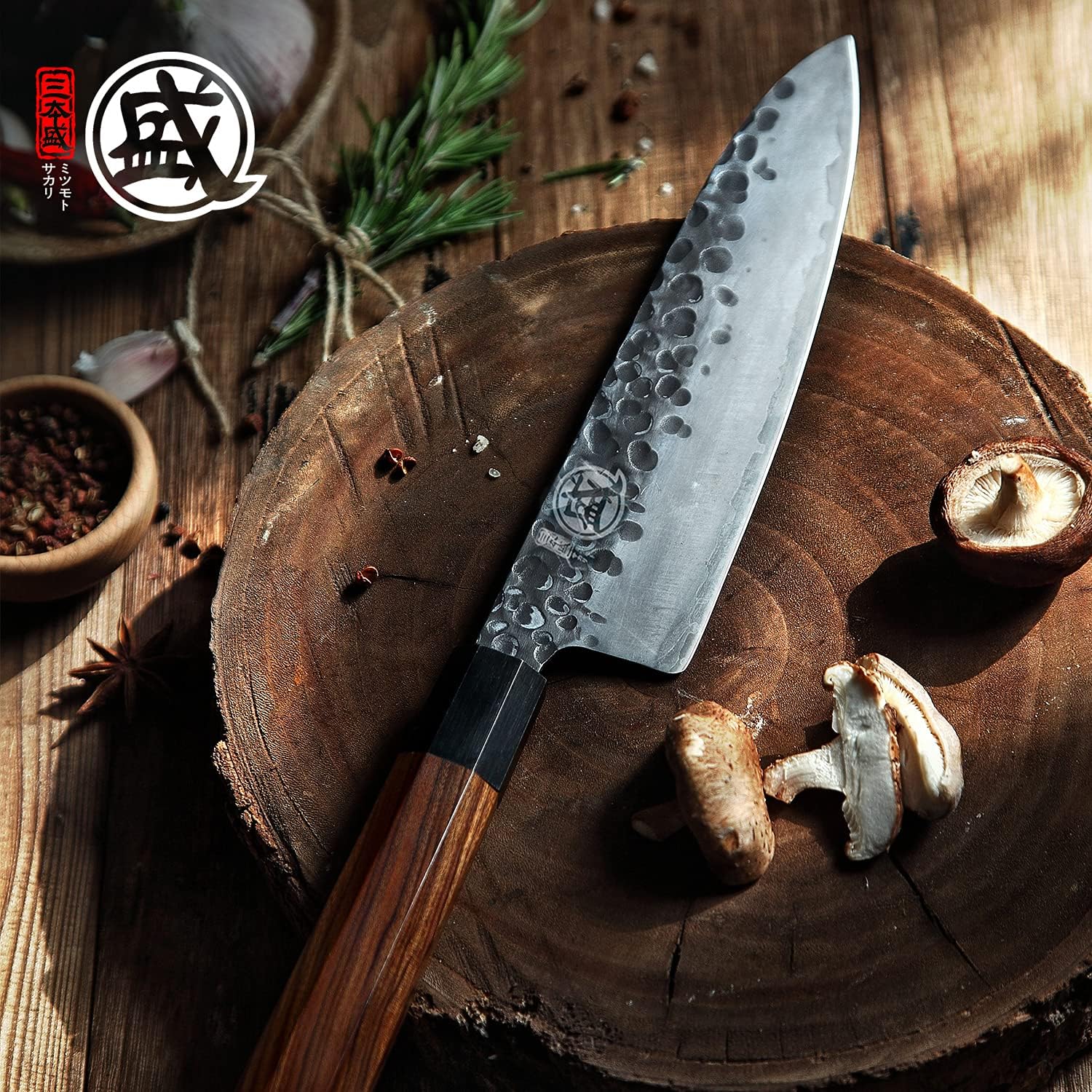
A four-piece Japanese knife set engineered to solve the problem of dull, frustrating prep work by combining traditional hand-forging with modern high-carbon steel.
The 8-inch gyuto blade cuts through proteins and vegetables with minimal resistance, while the 3-layer laminated steel core (9CR18MOV at 58±2 HRC hardness) maintains its edge through hundreds of cuts. The ultra-thin 2.5mm blade design preserves food texture and moisture better than standard Western knives.
Each knife features a rosewood octagonal handle hand-crafted for balance and ergonomics, reducing wrist tension during extended prep. The set includes an 8-inch gyuto, 7-inch santoku, 7-inch nakiri, and 5.5-inch petty knife in a sandalwood presentation box.
Limitation: requires hand washing and immediate drying to prevent corrosion of the high-carbon steel blade.
Best for home cooks and professional chefs who prepare food daily and want precision cutting performance without commercial kitchen pricing.
Care Guide
Hand wash immediately after use with warm soapy water and dry completely with a soft cloth. High-carbon steel oxidizes quickly when wet, so never leave the blade damp or store in a damp environment.
Condition the rosewood handle monthly with food-grade mineral oil or beeswax to prevent drying and cracking. Apply oil along the grain, wipe excess, and let sit for 30 minutes before using.
Store knives separately in a knife block or on a magnetic strip to protect the blade edge and prevent accidental damage to the handle. Hone the blade weekly with a honing steel before use to maintain alignment; sharpen professionally every 6-12 months depending on use frequency.
Pros & Cons
Pros
- 32,768-layer blade construction from 108 traditional forging steps delivers exceptional durability and edge retention compared to mass-produced knives.
- At 8 inches, the blade length balances control for detail work with enough surface area for efficient slicing of larger cuts.
- FSC-certified African Pakka wood handle provides comfortable grip without slipping, even when wet or during repetitive cutting motions.
Cons
- Requires hand-washing and immediate drying to prevent water spots and maintain the stainless steel finish; dishwasher use will damage the blade.
- The high-carbon content means the blade can chip if used on hard surfaces like bone or frozen foods without proper technique.
Details
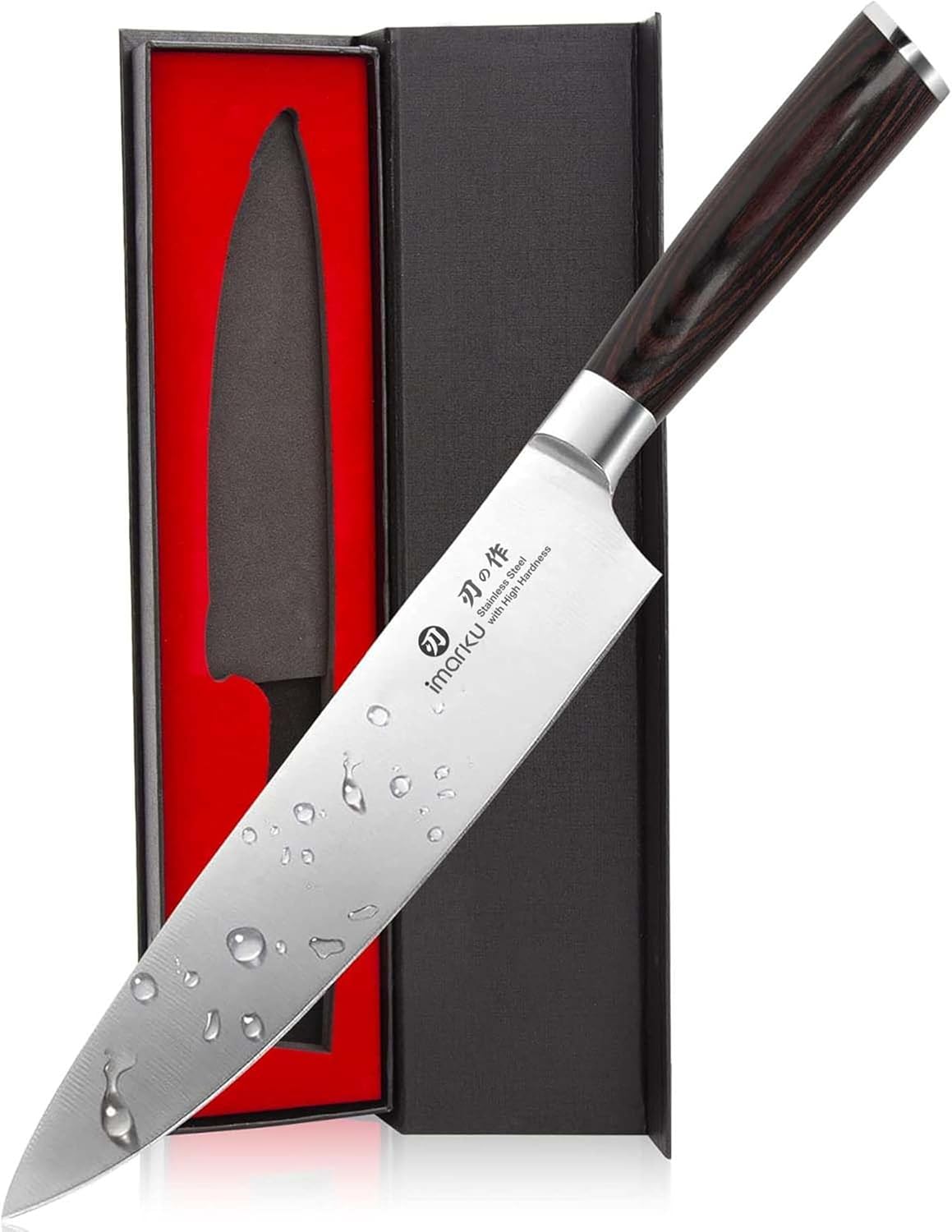
This is an 8-inch gyutou knife designed to replace multiple knives in your kitchen. It slices proteins, dices vegetables, and chops herbs with a single blade, solving the problem of owning too many single-purpose knives.
The 56-58 HRC hardness rating makes it twice as hard as standard kitchen knives, staying sharp through hundreds of cuts. The high-carbon stainless steel (16-18% chrome) resists rust and maintains its glossy finish for years.
The blade weighs approximately 6-7 ounces with an 8-inch cutting edge. The Pakka wood handle is textured for grip control and designed to reduce hand fatigue during extended prep work.
The main limitation is maintenance: it requires hand-washing and immediate drying to prevent water spots and corrosion. Dishwasher use will dull and damage the blade.
Best for home cooks and meal-prep enthusiasts who want a single, reliable knife that handles 80% of daily kitchen tasks without constant sharpening.
Care Guide
Hand-wash immediately after use with warm soapy water and a soft cloth. Dry the blade completely with a kitchen towel to prevent water spots and mineral buildup on the stainless steel surface.
Store the knife in a knife block or on a magnetic strip to protect the edge and prevent accidental dulling. Never store loose in a drawer where it contacts other utensils.
Hone the blade monthly with a honing steel to realign the edge. Professional sharpening every 1-2 years will restore the blade if it loses sharpness despite proper care and use.

Pros & Cons
Pros
- High-carbon stainless steel blade resists dulling and chipping, maintaining sharpness through hundreds of cutting sessions.
- Ergonomic handle crafted from premium materials reduces fatigue during meal prep and makes controlled cuts feel effortless.
- Compact 6.3-inch size offers better maneuverability than larger chef knives while handling everyday kitchen tasks effectively.
Cons
- Requires hand washing and immediate drying to maintain blade quality and prevent water spots on the steel.
- At 6.3 inches, slightly smaller than traditional 8-inch chef knives, which may limit effectiveness for breaking down large cuts of meat.
Details
The Matsato Chef Knife solves the problem of dull blades and hand fatigue during daily meal prep by combining Japanese stainless steel with ergonomic balance.
High-carbon stainless steel maintains its edge significantly longer than standard blades while resisting rust and corrosion from regular hand washing. The well-balanced handle distributes weight evenly, reducing wrist strain during extended chopping sessions.
The 6.3-inch blade is crafted from 1.4116 Japanese stainless steel at 0.14-inch thickness, providing durability without excessive weight. The solid handle uses premium materials for comfortable daily use.
This knife requires hand washing and immediate drying to prevent water damage and maintain the blade finish.
Best for home cooks and meal preppers who need a reliable, balanced knife for everyday vegetable, fruit, and meat preparation.
Care Guide
Hand wash immediately after use with warm soapy water and dry completely with a soft cloth. Never place in the dishwasher, as high heat and harsh detergents can damage the blade and handle finish.
Store the blade in a knife block, magnetic strip, or protective sheath to prevent dulling and accidental contact. Keep the blade away from extreme heat sources and prolonged moisture exposure.
Sharpen periodically using a whetstone or honing steel to maintain the razor edge. The high-carbon steel construction allows for easy sharpening and long-term edge retention with minimal maintenance.

Pros & Cons
Pros
- Authentic Damascus construction with 67 folded steel layers delivers visible pattern depth and genuine durability, not cosmetic etching.
- G10 handle material resists moisture and bacterial growth better than wood, making it safer for high-volume kitchen prep.
- 62 HRC hardness rating keeps the edge sharp through 200+ cuts before noticeable dulling, reducing maintenance burden.
Cons
- No customer reviews yet on this specific ASIN, so you cannot verify real-world performance or edge retention claims from actual users.
- G10 handle requires hand-washing only; dishwasher use will degrade the material and void the warranty.
Details
This 8-inch Damascus chef knife solves the problem of edge retention during daily prep work. Its 67-layer Damascus steel and 62 HRC hardness mean fewer sharpening sessions compared to standard stainless blades.
The 15° blade angle cuts through proteins, vegetables, and herbs with minimal effort. Real Damascus layering (created through repeated forging and heat treatment) won’t fade or peel like laser-etched patterns.
Weighs 270g with a 5.3-inch handle and 2.2mm blade thickness. G10 glass fiber handle resists moisture and provides secure grip during wet prep work. Requires hand-washing only.
Limitation: No user reviews yet on this ASIN, so edge retention claims rely on manufacturer specs rather than verified owner feedback.
Best for: Home cooks and line cooks who prep daily and want authentic Damascus construction without premium Japanese brand pricing.
Care Guide
Hand-wash immediately after use with warm soapy water and dry with a cloth. Never soak or place in the dishwasher, as moisture and heat will damage the G10 handle and degrade the blade finish.
Hone the blade weekly using a honing steel at a 15° angle to realign the edge. Sharpen professionally every 6–12 months depending on prep volume, or use a whetstone at 15° if you sharpen at home.
Store vertically in a knife block or on a magnetic strip to prevent edge contact with other utensils. A dull blade requires more pressure and increases slip risk, so maintain the edge regularly.
Pros & Cons
Pros
- The 2.5mm blade thickness paired with the hollow edge design handles both delicate julienne cuts and heavier chopping without flexing or wedging.
- Pakkawood handle construction offers a more sanitary and dimensionally stable grip than standard composite or natural wood handles.
- The 15-18 degree edge angle matches professional Japanese knife geometry, giving it a noticeably sharper out-of-box performance than German-style knives at this price.
- Versatile enough for meat, vegetables, fruit, and bread, making it a practical single-knife solution for small kitchens with limited storage.
Cons
- With zero verified reviews available, long-term edge retention and handle durability under daily use remain unconfirmed by real buyers.
- The 3-month refund window is shorter than the lifetime guarantees offered by competing brands at the same price point.
Details
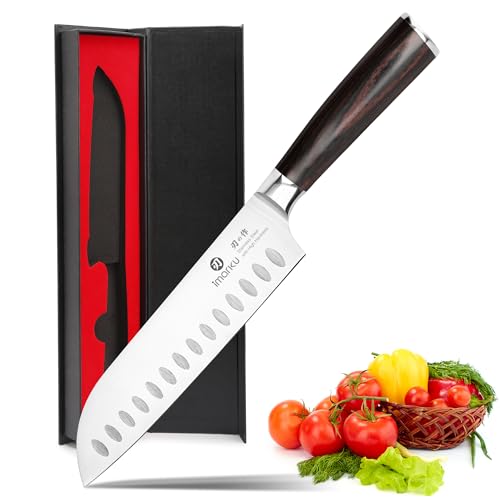
The imarku Santoku solves the sticking problem common with flat-edge knives by using a hollow scalloped blade that keeps sliced food from clinging during fast prep.
Its 15-18 degree hand-polished edge cuts with less force than wider-angle Western knives, which matters most when processing large volumes of vegetables or thin-sliced proteins.
Built from high carbon stainless steel at 2.5mm thickness with a Pakkawood handle, it balances rigidity and grip comfort across different hand sizes.
The brand upgrade notice means packaging and minor cosmetics may vary from product photos, though materials and construction are stated to be unchanged.
Best for home cooks who want one capable, low-maintenance knife that handles daily prep without occupying much counter or drawer space.
Care Guide
Hand-wash with warm soapy water immediately after use and dry thoroughly before storage. Dishwasher cycles degrade the Pakkawood handle and accelerate edge micro-chipping on high carbon steel.
Hone the blade on a ceramic rod every 3-4 uses to maintain the 15-18 degree edge angle. Sharpen on a whetstone at the same angle when honing no longer restores bite.
Store on a magnetic strip or in a knife block. Loose drawer storage causes edge-on-edge contact that dulls the blade faster than actual cooking use.
About These Recommendations
The technique above is the point of this guide; the products are here because they help. We have not tested them ourselves — we did not buy or use this gear. The recommendations come from comparing specifications and materials against the patterns in verified owner reviews, so treat them as a shortlist worth researching rather than a verdict from our own kitchen.
Availability and prices change often, so check the current listing before buying. We earn a commission on purchases made through links on this page, which never affects what we recommend.

Write Your Review
No reviews yet. Be the first to share your experience!