

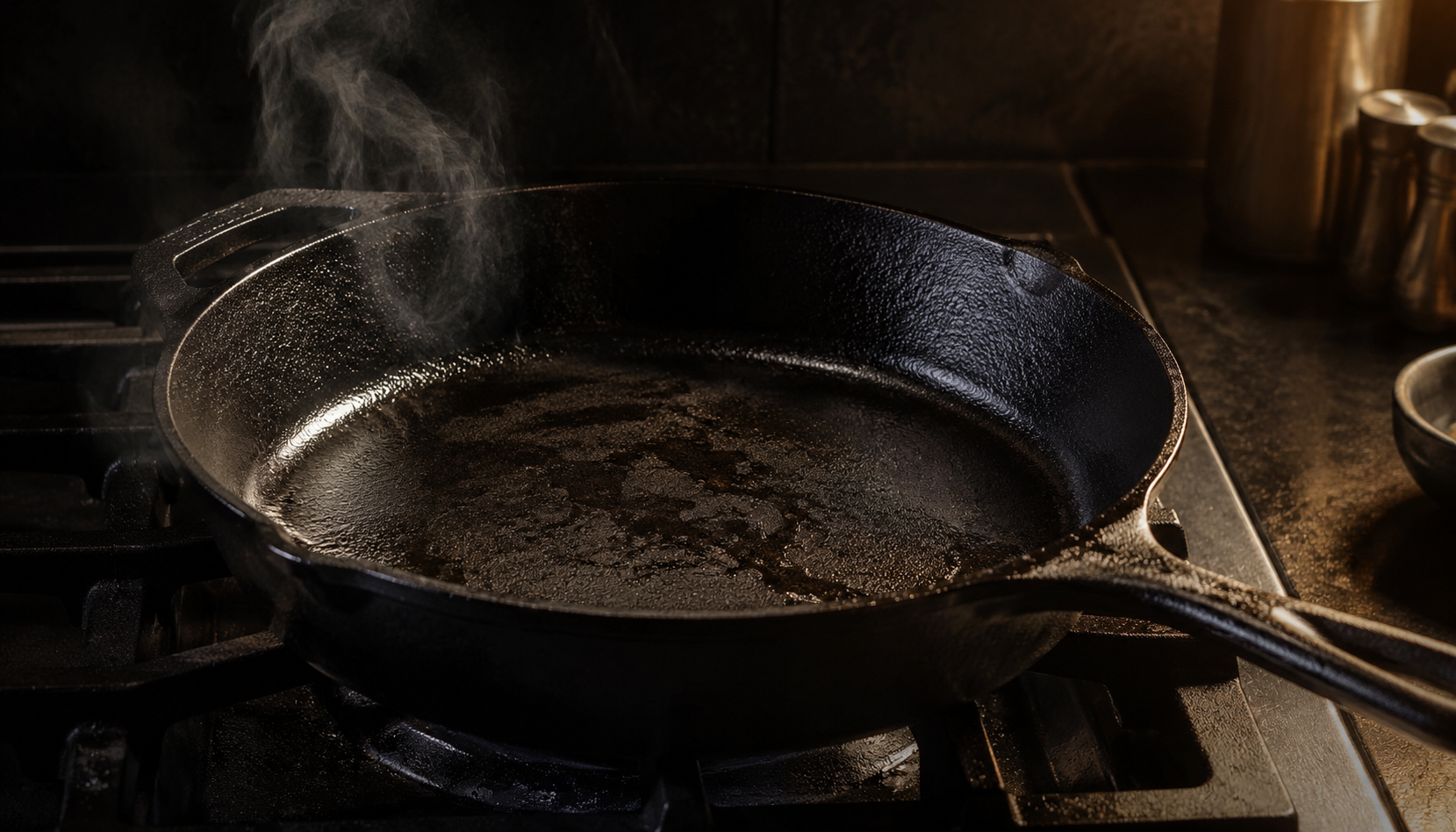
To season a cast iron skillet, you bake thin layers of oil onto the bare metal until they polymerize into a slick, rust-resistant patina. Most beginners need three coats of flaxseed or grapeseed oil, baked at 450-500°F for one hour each, with a full cool-down between rounds. The first attempt to season cast iron skillet surfaces takes an afternoon — about four hours of mostly hands-off oven time — and the results last for years if you maintain the pan correctly.

Deeper Dive: Our Top Picks
Our Top Picks
Commercial CHEF
Campfire, Oven, and Stovetop Cooking with Commercial CHEF CHCI03PK Cast Iron Skillet Set
The Commercial CHEF CHCI03PK provides three pre-seasoned cast iron skillets for frying, grilling, searing, and baking, with even heating and strong heat retention. It suits home cooks and campers who want versatile cookware in 8-inch, 10-inch, and 12-inch sizes without synthetic coatings.
Pros and Cons
Pros
- The 8-inch, 10-inch, and 12-inch sizes cover a broad range of cooking tasks.
- Pre-seasoned vegetable-oil surfaces avoid synthetic coatings and support easier food release.
- The skillets work indoors and outdoors, including on stovetops, in ovens, under broilers, and over campfires.
- Cast iron delivers useful heat retention for browning meat and cooking vegetables.
Cons
- The skillets require handwashing with gentle detergent and thorough towel drying after use.
- Cast iron cookware needs ongoing care to help prevent rust and maintain its seasoned surface.

Old Timer Heritage Products
Cast Iron Skillet Cleaning Soap for Odors
Old Timer Heritage Products Cast Iron Soap cleans cast iron cookware while preserving its seasoning and removing odors without stripping away oils. It suits home cooks and campers who need a detergent-free cleaner for skillets, griddles, Dutch ovens and grill grates.
Pros and Cons
Pros
- Plant-based and detergent-free formula avoids parabens, sulfates, perfumes and petroleum.
- Removes odors and residue without removing the cookware’s seasoning oils.
- Can be used on compatible Blackstone griddles, Dutch ovens, skillets and grill grates.
- Made in the USA at GMP-compliant facilities.
Cons
- The product data does not provide size or weight information.
- Cleaning requires hot water, a soft-bristle brush, rag or wooden scraper, followed by seasoning oil.
Cast Iron Skillet and Dutch Oven Cooking Guide for Beginners: Seasoning
This beginner's guide explains how to season, cook with, and care for cast iron skillets and Dutch ovens, with confidence-building instruction as its main advantage. It suits new cast iron owners who want one focused resource for learning essential cooking and maintenance skills.
Pros and Cons
Pros
- Covers the three core skills named in the title: seasoning, cooking, and caring for cast iron.
- Designed specifically for beginners rather than experienced cast iron cooks.
- Applies to both skillets and Dutch ovens.
Cons
- The product data does not provide specific recipes, illustrations, or technical specifications.
- Its focus is limited to cast iron skillets and Dutch ovens rather than broader kitchen techniques.

Workman Publishing Company
Cast-Iron Skillet Cookbook with 53 Unexpected Recipes by Workman Publishing Company
This cookbook provides 53 irresistible and unexpected recipes designed for cast-iron skillet cooking, giving home cooks more ways to use one pan. It suits cast-iron skillet owners who want recipe ideas beyond standard biscuits, muffins, and scones.
Pros and Cons
Pros
- Includes 53 recipes specifically written for cast-iron skillet cooking.
- Focuses on irresistible and unexpected recipe ideas rather than a single standard dish.
- Comes from Workman Publishing Company.
- Its compact recipe-book format keeps skillet inspiration together in one place.
Cons
- The available product data does not list specific recipe examples or dietary information.
- The available specifications do not provide the book's dimensions, weight, or binding details.

Culina
Cast Iron Cleaning and Seasoning Set for Rust
The Culina Supreme Cast Iron Care Set cleans stuck-on food, helps remove rust spots, and conditions cookware with plant-based soap, scrub, and seasoning oil. It suits cast iron skillet and grill owners who want a dedicated care routine without sulfates, phosphates, parabens, or petrochemicals.
Pros and Cons
Pros
- The set covers restoration, washing, and conditioning in one cast iron care kit.
- The plant-based formula avoids sulfates, phosphates, parabens, and petrochemicals.
- The conditioning oil is designed not to develop a rancid smell over time.
- The products are Kosher manufactured in the United States.
Cons
- The product data does not provide the quantities, dimensions, or total weight of the included items.
- The set is specialized for cast iron care rather than a general-purpose cookware cleaner.
Editors' Picks
Commercial CHEF Campfire, Oven, and Stovetop Cooking with Commercial CHEF CHCI03PK Cast Iron Skillet Set
Commercial CHEF
Campfire, Oven, and Stovetop Cooking with Commercial CHEF CHCI03PK Cast Iron Skillet Set
The Commercial CHEF CHCI03PK provides three pre-seasoned cast iron skillets for frying, grilling, searing, and baking, with even heating and strong heat retention. It suits home cooks and campers who want versatile cookware in 8-inch, 10-inch, and 12-inch sizes without synthetic coatings.
$40.01 at AmazonEditors' Favorite
Color: Black Size: 8", 10", 12" Skillet Set Dimensions: 16.5 x 12 x 2 inches Weight: 12.54 Pounds Product Group: Kitchen Binding: Kitchen
Shop NowOld Timer Heritage Products Cast Iron Skillet Cleaning Soap for Odors
Old Timer Heritage Products
Cast Iron Skillet Cleaning Soap for Odors
Old Timer Heritage Products Cast Iron Soap cleans cast iron cookware while preserving its seasoning and removing odors without stripping away oils. It suits home cooks and campers who need a detergent-free cleaner for skillets, griddles, Dutch ovens and grill grates.
$12.25 at AmazonGreat Value
Size: 8 Fl Oz (Pack of 1) Dimensions: 1.75 x 1.75 x 6.8 inches Product Group: BISS Binding: Unknown Binding
Shop NowCast Iron Skillet and Dutch Oven Cooking Guide for Beginners: Seasoning
Cast Iron Skillet and Dutch Oven Cooking Guide for Beginners: Seasoning
This beginner's guide explains how to season, cook with, and care for cast iron skillets and Dutch ovens, with confidence-building instruction as its main advantage. It suits new cast iron owners who want one focused resource for learning essential cooking and maintenance skills.
$6.99 at AmazonFormats: Kindle eBook Product Group: Digital Ebook Purchas Binding: Kindle Edition
Shop NowWorkman Publishing Company Cast-Iron Skillet Cookbook with 53 Unexpected Recipes by Workman Publishing Company
Workman Publishing Company
Cast-Iron Skillet Cookbook with 53 Unexpected Recipes by Workman Publishing Company
This cookbook provides 53 irresistible and unexpected recipes designed for cast-iron skillet cooking, giving home cooks more ways to use one pan. It suits cast-iron skillet owners who want recipe ideas beyond standard biscuits, muffins, and scones.
$9.99 at AmazonFormats: Kindle eBook Product Group: Digital Ebook Purchas Binding: Kindle Edition
Shop NowCulina Cast Iron Cleaning and Seasoning Set for Rust
Culina
Cast Iron Cleaning and Seasoning Set for Rust
The Culina Supreme Cast Iron Care Set cleans stuck-on food, helps remove rust spots, and conditions cookware with plant-based soap, scrub, and seasoning oil. It suits cast iron skillet and grill owners who want a dedicated care routine without sulfates, phosphates, parabens, or petrochemicals.
$24.99 at AmazonSize: 3 Piece Set Dimensions: 3.93700787 x 3.543307083 x 1.574803148 Inches Weight: 1.9400679056 Pounds Product Group: Drugstore Binding: Kitchen
Shop NowAbout These Recommendations
The technique above is the point of this guide; the products are here because they help. We have not tested them ourselves — we did not buy or use this gear. The recommendations come from comparing specifications and materials against the patterns in verified owner reviews, so treat them as a shortlist worth researching rather than a verdict from our own kitchen.
Availability and prices change often, so check the current listing before buying. We earn a commission on purchases made through links on this page, which never affects what we recommend.
The Short Answer
A cast iron skillet ships from the factory with a thin coat of seasoning, but that layer is rarely enough for stick-free cooking. To season cast iron skillet pans properly, you wipe the bare iron with a high-smoke-point oil, buff almost all of it off, and bake the pan upside-down at high heat. The oil bonds to the metal through polymerization — a chemical reaction, not a coating. Three to four cycles produces a hard, brown-black patina that releases eggs and rarely needs scrubbing. If you’re shopping the pan itself, the best cast iron skillet for beginners guide covers what to buy before you start this process.
What Seasoning Actually Is
Seasoning isn’t a coating sitting on top of the iron — it’s a molecular bond. When you heat a thin film of oil past its smoke point on bare cast iron, the fatty acid chains break apart and recombine into long polymer chains. Those chains lock into the microscopic pores and ridges of the cast surface. Repeat the process several times and you build up a dense, dark layer with the properties of an industrial varnish: slick, hard, food-safe, and heat-stable up to about 600°F.
The chemistry favors certain oils. Drying oils — flaxseed, walnut, and to a lesser extent grapeseed — contain a high ratio of polyunsaturated fatty acids with conjugated double bonds. Those bonds react aggressively with oxygen at high heat, which is exactly what creates a hard polymer. Non-drying oils like olive or coconut produce softer, gummier residues that scratch off easily.
Iron itself matters too. Cast iron’s pebbled surface (visible to the naked eye on a Lodge skillet, smoothed on vintage Griswolds) gives the polymer thousands of anchor points. The rougher the cast, the more coats you’ll need to fill in valleys before food stops catching. A factory-smoothed pan reaches non-stick status faster but starts from a less grippy baseline.
One detail worth knowing: seasoning is built up, not painted on. People who slather oil on a skillet and bake it once end up with sticky, uneven patches that flake. The wipe-off step — removing visibly oily film with a clean cloth before the pan goes in the oven — is the entire trick.
Choosing the Right Oil
Smoke point determines whether an oil polymerizes cleanly or burns into soot. Flaxseed oil sits around 225°F raw but, because it’s a drying oil, it converts to polymer faster than higher-smoke-point options. Sheryl Canter’s 2010 blog post turned flaxseed into the internet’s default recommendation, though it has a known weakness: the resulting patina can be brittle and prone to flaking off in sheets if applied too thick.
Grapeseed oil (smoke point ~420°F) has become the modern favorite. It’s cheap, neutral-flavored, high in polyunsaturated fats, and produces a flexible patina that resists chipping. Avocado oil (~520°F) works similarly and tolerates the highest oven temperatures without filling your kitchen with smoke. Both are reliable picks for a beginner learning to season cast iron skillet pans for the first time.
What to avoid: extra-virgin olive oil smokes at 350-410°F, well below the polymerization temperature, so it scorches before bonding. Coconut oil is mostly saturated fat — chemically stable but unreactive, which means weak adhesion. Butter contains milk solids that burn black. Vegetable shortening like Crisco works (Lodge ships pans pre-seasoned with it) but produces a softer finish than the drying oils.
Quick rank for the first season: grapeseed > flaxseed > avocado > canola > vegetable shortening. After the pan has a working patina, almost any cooking fat will maintain it.
The Step-by-Step Process
Step 1: Strip and Clean
If you’re working with a brand-new factory-seasoned pan, skip to Step 2 — the existing coat is your base. For a used skillet with rust, gunk, or uneven black flakes, you’ll need to strip it.
The fastest method is a self-cleaning oven cycle, which incinerates everything down to bare metal. No self-cleaning oven? Scrub with a stainless chainmail scrubber and coarse salt, or soak in a 50/50 vinegar-water bath for one hour (no longer — vinegar will pit the iron). Dry the pan immediately on a stovetop burner over medium heat until the surface looks chalky-gray. Any trapped moisture flashes to rust within minutes.
Step 2: Apply a Thin Coat of Oil
Pour a teaspoon of grapeseed or flaxseed oil into the warm pan and spread it across every surface — cooking face, sides, handle, underside — with a lint-free cloth or paper towel. Now wipe it all off. Use a fresh, dry cloth and rub the pan as if you’re trying to remove the oil entirely. The pan should look almost dry, with only a faint sheen catching the light. This counter-intuitive step is the difference between a smooth patina and a sticky, splotchy one.
Step 3: Bake at High Heat
Place a sheet of foil on the bottom rack to catch drips. Set the skillet upside-down on the middle rack and bake at 450-500°F for one full hour. Don’t open the door. The pan will smoke — turn on a hood fan or crack a window. After the hour, switch the oven off and let the skillet cool inside until you can handle it bare-handed, usually 45 minutes to an hour. Pulling a hot pan into cool kitchen air can crack the patina.
Step 4: Repeat
One coat won’t do it. Run the oil-wipe-bake-cool cycle two or three more times. Each round darkens the surface from grayish brown to deep black-bronze and fills in microscopic pits. A four-coat skillet is ready for eggs; six coats is ready for anything.
Maintaining the Patina
Daily care is where most people fail their seasoning. After cooking, wash the pan with warm water and a soft sponge — yes, a drop of dish soap is fine; modern detergent doesn’t strip polymerized oil despite the old myth. Scrape stuck food with a plastic scraper or chainmail scrubber. Never let the skillet soak in water and never put it in the dishwasher, because prolonged moisture is what causes rust to bloom under the patina.
Dry the skillet immediately with a towel, then put it on a burner over medium heat for two minutes to drive out the last bit of water. While the pan is still warm, add a few drops of oil and wipe the cooking surface with a folded paper towel. The goal again is a barely-there film, not a slick coat. Store the pan dry, ideally in an open cupboard with airflow.
Re-season the entire skillet when food starts sticking in patches, when you see dull gray spots, or once a year as preventive maintenance. A full re-season is the same four-step process above. Light touch-ups — one quick oil-and-bake cycle — handle small bare patches without a full strip-down. Bare iron exposed for more than a day or two in a humid kitchen will rust, so address dull spots promptly.
Common Mistakes
- Using too much oil. The most common beginner error. A puddle of oil bakes into a sticky, lacquer-like residue that flakes within weeks. After wiping the pan, it should look almost dry. If you can see oil pooling anywhere, wipe harder.
- Choosing the wrong oil. Olive oil smokes at 410°F, well below the temperature needed to polymerize. It burns into a brittle layer that chips off in cooking. Stick with grapeseed, flaxseed, or avocado for the initial cycles.
- Skipping the strip-down on used pans. Building new seasoning on top of rust, gummy old oil, or uneven flakes locks the problems underneath. Strip back to bare metal whenever you take ownership of a secondhand skillet.
- Not baking long enough. Polymerization is a time-and-temperature reaction. A 30-minute bake produces a partial polymer that scratches off. Commit to the full hour per coat, plus the cool-down inside the oven.
- Cooking acidic food too soon. Tomato sauce, wine reductions, and citrus juices can strip a young patina before it hardens. Save those dishes for the second month, after you’ve built up additional layers through normal cooking.
Related Questions
How often should I re-season my cast iron?
A well-maintained pan rarely needs a full re-season. Plan to season cast iron skillet surfaces once a year for routine maintenance, or whenever food begins to stick across the whole pan. Small bare spots can be touched up with a single oil-and-bake cycle without stripping the whole thing.
Can I season cast iron in the air fryer?
Yes for small skillets that physically fit, but the results are mixed. Most air fryers max out around 400°F, which is below the ideal polymerization range, and the small chamber traps smoke. A conventional oven remains the better tool to season cast iron skillet pans thoroughly.
Why is my cast iron sticky after seasoning?
Sticky finish almost always means too much oil per coat or too low a baking temperature. Both leave partial polymers that feel tacky to the touch. Strip the gummy layer with steel wool, then re-season with thinner coats at 450°F or higher.
Do I need to season pre-seasoned skillets?
Factory pre-seasoning is functional but thin. You can cook on it immediately, but adding two or three of your own coats before serious cooking dramatically improves non-stick performance and protects against early rust.
What happens if I use olive oil?
Olive oil’s low smoke point means it burns before it polymerizes, leaving a soft, dark residue that smells acrid and scratches off under a spatula. Use it for cooking on an established pan if you must, but never to season cast iron skillet surfaces during the foundational coats.
Related buying guides: best cookware sets, best carbon steel pan for cooking and best moka pot.
Recommended Tools
Lodge remains the default starting point for new cast iron owners. The pans are American-cast, pre-seasoned with vegetable shortening, and priced well below vintage or boutique brands. The 10.25-inch model handles most home tasks; the 12-inch suits larger families. A combo cooker (skillet plus lid) doubles as a Dutch oven for bread baking and braises. For matching cookware on other burner types, the best cookware for gas stove guide covers compatible pots and pans.



Write Your Review
No reviews yet. Be the first to share your experience!