

If you have spent the last week comparing de Buyer Mineral B and Made In Carbon Steel, this guide is for you. Both are dominant names in the category, and the choice between them is the question most serious home cooks land on after ruling out cast iron and nonstick. One of them is the better default for the majority of kitchens, and one wins decisively for a specific kind of cook. We are going to lay that out plainly rather than pretend the field is wider than it is. If you are also weighing a round-bottom option for high-heat stir-fry, our best wok for gas stove comparison covers that adjacent decision. Below the two finalists, three more carbon steel pans round out the picks for cooks with different priorities — a French classic for professional kitchens, a lightweight pick for cooks who hate heavy handles, and a budget option that punches well above its price. The framing for the rest of this article is direct comparison, not a parade of features. Each criterion that matters will be put head-to-head so you can see exactly where the daylight is.

For more, see our Carbon Steel vs Cast Iron Pans and Cookware Buying Guide guides.
The Best Deals This Week*
-
Everyday Stovetop Cooking Set
$62.99
($72.99)Save $10.00 -
Family-Size Searing Skillet
$34.99
($45.99)Save $11.00 -
Searing and Everyday Frying
$29.99
($39.99)Save $10.00
*Deals are selected by our commerce team
Deeper Dive: Our Top Picks
Our Top Picks
stackbear
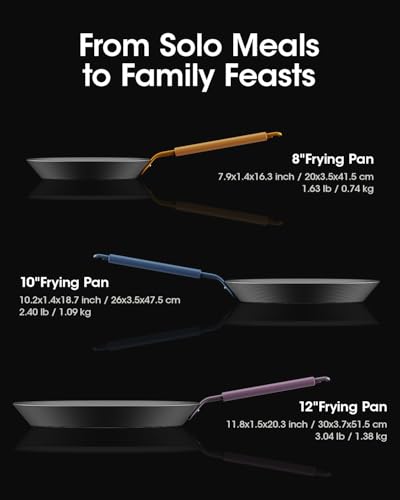
Everyday Stovetop Cooking Set: stackbear Nitrided Carbon Steel Frying Pans
This three-pan carbon steel set covers eggs, everyday meals, and family dishes while its nitrided surface improves rust resistance and long-term durability. It suits cooks who want preseasoned pans in three practical sizes with induction compatibility and oven finishing up to 600°F.
Pros and Cons
Pros
- The 8-, 10-, and 12-inch sizes cover small portions, everyday meals, and larger family cooking.
- Preseasoning means the pans arrive ready to cook, while continued use builds a natural patina.
- Nitrided construction adds resistance to rust and corrosion compared with untreated steel surfaces.
- The pans move from stovetop to oven and work across common cooktop types, including induction.
Cons
- The silicone handle cover must be removed before oven use.
- The product data does not provide pan weights, so buyers sensitive to heavier steel cookware should verify handling comfort.

Armorbear
Family-Size Searing Skillet: Armorbear 12-Inch Auto-Seasoning Carbon Steel Pan
The Armorbear 12-inch carbon steel skillet delivers fast, high-heat searing across a large surface, with its biggest advantage being the extra room for family-size meals. It suits home cooks and professionals who need precise temperature response, durable rust protection, and a pre-seasoned pan without PFAS or PFOA.
Pros and Cons
Pros
- Its large carbon steel surface handles family-size meals and professional-style searing.
- Fast heat response supports precise stovetop temperature control.
- Deep nitriding adds corrosion protection beyond the pre-seasoned finish.
- The wooden handle offers leverage for managing a large skillet.
Cons
- Nitriding improves rust resistance but does not create a nonstick cooking surface.
- The 12-inch size may feel cumbersome on smaller stovetops, and the product data does not list its weight.

OXO
Searing and Stir-Frying Made Easy with the OXO Obsidian 8-Inch Carbon Steel Frying Pan
The OXO Obsidian 8-inch carbon steel skillet delivers fast, even heating and top-tier searing with nonstick-like ease. Buy it if you want a lightweight, pre-seasoned pan that works on induction, in the oven, or on the grill.
Pros and Cons
Pros
- Wirecutter named the OXO Obsidian its 2025 Best Pick for nonstick-like ease, lightweight handling, searing, and value.
- The pre-seasoned carbon steel surface naturally develops a nonstick patina with continued use.
- Its compatibility with induction and all other stovetops adds flexibility to everyday cooking.
- The durable construction combines professional-grade performance with a lightweight feel.
Cons
- Hand washing is required to preserve the carbon steel patina and cooking performance.
- The 8-inch size is better suited to smaller portions than large family meals.
Merten & Storck
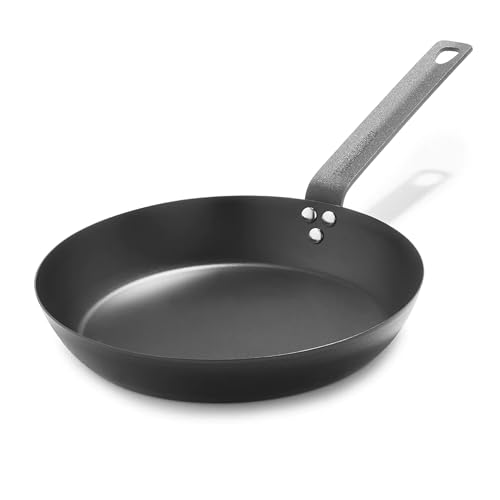
High-Heat Searing Pan: Merten & Storck 10-Inch Pre-Seasoned Carbon Steel Frying Pan
This pre-seasoned carbon steel skillet delivers fast heating, high-heat searing, and natural nonstick cooking while remaining lighter and easier to handle than cast iron. It suits home cooks who want one induction-safe pan for steaks, eggs, fish, frying, oven cooking, and grilling.
Pros and Cons
Pros
- It combines cast iron-style searing and durability with a lighter, more agile carbon steel body.
- The pan arrives pre-seasoned and ready to cook immediately.
- It works across all common cooktops and in ovens, grills, and campfires.
- The triple-riveted handle provides a secure grip for lifting and open-flame cooking.
Cons
- The 10-inch surface may feel limiting when cooking large portions or multiple servings at once.
- Its natural nonstick performance requires more attention to seasoning and cooking technique than a coated nonstick pan.
Yonida
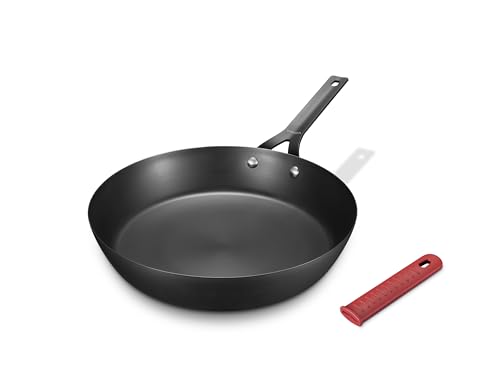
Searing and Everyday Frying: Yonida 10-Inch Carbon Steel Pan
The Yonida 10-inch carbon steel pan delivers even heating and restaurant-style searing while building a naturally easy-release surface with use. It suits cooks who want a durable, coating-free pan that works on the stovetop, in the oven, outdoors, and over a campfire.
Pros and Cons
Pros
- Pre-seasoned carbon steel is ready to use and can develop stronger nonstick performance over time.
- Rapid responsiveness and heat retention support precise searing and sautéing.
- The removable handle holder expands oven and broiler use while improving stovetop handling.
- Its balanced handle and durable construction work for home cooking, grills, and campfires.
Cons
- Carbon steel requires hand washing, thorough drying, and a thin coat of oil after cleaning.
- The silicone handle holder must be removed before oven or broiler use.
Editors' Picks
stackbear Everyday Stovetop Cooking Set: stackbear Nitrided Carbon Steel Frying Pans
stackbear
Everyday Stovetop Cooking Set: stackbear Nitrided Carbon Steel Frying Pans
This three-pan carbon steel set covers eggs, everyday meals, and family dishes while its nitrided surface improves rust resistance and long-term durability. It suits cooks who want preseasoned pans in three practical sizes with induction compatibility and oven finishing up to 600°F.
$62.99 at AmazonEditors' Favorite
Color: Black Size: 8 & 10 & 12 Inch Dimensions: 8.661417314 x 11.81102361 x 1.4566929119 inches Product Group: Kitchen
Shop NowArmorbear Family-Size Searing Skillet: Armorbear 12-Inch Auto-Seasoning Carbon Steel Pan
Armorbear
Family-Size Searing Skillet: Armorbear 12-Inch Auto-Seasoning Carbon Steel Pan
The Armorbear 12-inch carbon steel skillet delivers fast, high-heat searing across a large surface, with its biggest advantage being the extra room for family-size meals. It suits home cooks and professionals who need precise temperature response, durable rust protection, and a pre-seasoned pan without PFAS or PFOA.
$34.99 at AmazonGreat Value
Color: Black Size: 12 inch Dimensions: 8.2 x 12 x 2.1 inches Product Group: Kitchen
Shop NowOXO Searing and Stir-Frying Made Easy with the OXO Obsidian 8-Inch Carbon Steel Frying Pan
OXO
Searing and Stir-Frying Made Easy with the OXO Obsidian 8-Inch Carbon Steel Frying Pan
The OXO Obsidian 8-inch carbon steel skillet delivers fast, even heating and top-tier searing with nonstick-like ease. Buy it if you want a lightweight, pre-seasoned pan that works on induction, in the oven, or on the grill.
$49.99 at AmazonColor: Black Size: 8" Frying Pan Skillet Dimensions: 10 x 5 x 4 inches Weight: 1.91 Pounds Product Group: Kitchen Binding: Kitchen
Shop NowMerten & Storck High-Heat Searing Pan: Merten & Storck 10-Inch Pre-Seasoned Carbon Steel Frying Pan
Merten & Storck
High-Heat Searing Pan: Merten & Storck 10-Inch Pre-Seasoned Carbon Steel Frying Pan
This pre-seasoned carbon steel skillet delivers fast heating, high-heat searing, and natural nonstick cooking while remaining lighter and easier to handle than cast iron. It suits home cooks who want one induction-safe pan for steaks, eggs, fish, frying, oven cooking, and grilling.
$49.99 at AmazonColor: Black Size: 10" Frying Pan Skillet Dimensions: 19.0157480121 x 10.3543306981 x 4.330708657 inches Weight: 2.645547144 Pounds Product Group: Kitchen Binding: Kitchen
Shop NowYonida Searing and Everyday Frying: Yonida 10-Inch Carbon Steel Pan
Yonida
Searing and Everyday Frying: Yonida 10-Inch Carbon Steel Pan
The Yonida 10-inch carbon steel pan delivers even heating and restaurant-style searing while building a naturally easy-release surface with use. It suits cooks who want a durable, coating-free pan that works on the stovetop, in the oven, outdoors, and over a campfire.
$29.99 at AmazonColor: Black Size: 10in Dimensions: 10 x 10 x 2 inches Product Group: Kitchen
Shop NowHow We Evaluated These Picks
This guide is research-based, not a hands-on test. We did not buy, cook with, or measure the products above. What we did compare: manufacturer specifications, materials and construction, capacities and wattages, and the patterns that repeat across large volumes of verified owner reviews — especially the complaints that only surface after weeks of use, like coatings failing, motors weakening, controls drifting, or a design proving awkward to clean and store.
Where this page describes how something performs, it is reporting what the specifications state and what owners consistently report — not a result we produced ourselves. Prices and availability change constantly, so check the current listing before buying. We earn a commission on purchases made through links on this page, which never affects which products we include or how we rank them.
The Two Finalists
The carbon steel pan market has consolidated around two heavyweights: de Buyer Mineral B Pro from France and Made In Carbon Steel from the United States. De Buyer represents the old-world tradition — heavy-gauge French steel, beeswax finish, and a design largely unchanged since the 1830s. Made In is the modern reinterpretation — slightly lighter, sleeker stay-cool handle, and a finish optimized for North American home cooks. The stakes of choosing between them come down to weight, handle ergonomics, and how patient you are with the seasoning curve.
Side by Side: De Buyer Mineral B vs Made In Carbon Steel
Heat Response and Recovery
Both pans use 2.5mm to 3mm carbon steel, but the de Buyer Mineral B runs slightly thicker through the base. That extra mass means it takes about 30 to 45 seconds longer to reach searing temperature, but it also holds heat more stubbornly when you drop in a cold steak or a tray of vegetables. The de Buyer is the pan you want when cooking for four — it will not stall the second a load of chicken thighs hits the surface. Recovery time after adding ingredients is meaningfully better, and the temperature gradient across the cooking surface stays tighter at high heat.
The Made In carbon steel pan responds faster on the way up. It hits screaming-hot temperatures noticeably quicker, which matters if you cook a lot of fast-sear weeknight dinners or single portions. The trade-off is that it loses heat faster too, so a crowded pan of mushrooms or a thick pork chop can pull the surface temperature down further than you would like. For induction users, the Made In couples slightly better because the base is machined flatter out of the box. If you cook on gas with multiple burners, the de Buyer’s mass advantage starts to dominate. This is the criterion where most cooks should let their cooking volume decide — high-volume cooks lean de Buyer, single-serve cooks lean Made In.
Handle Geometry and Comfort
De Buyer uses a riveted French-curve steel handle that angles up and away from the pan body at roughly 30 degrees. It gets hot. There is no way around this, and you will need a side towel or handle sleeve any time the pan has been over heat for more than a few minutes. The handle is also longer and heavier than the Made In equivalent, which combined with the pan’s total weight makes one-handed maneuvering harder for smaller cooks. The flip side is that the long handle gives you excellent leverage for tossing, and the steel construction means the handle will outlast the planet.
Made In’s stainless steel handle is the design point most people latch onto. It is engineered to stay cool longer — not indefinitely, but you can typically saute for five to seven minutes without needing a towel. The handle angle is flatter and the grip diameter is more ergonomic for a wider range of hand sizes. For cooks who have shoulder, wrist, or grip-strength issues, this is the difference between a carbon steel pan you reach for and one that sits in the cabinet. The Made In handle also accommodates oven use to 1200 degrees Fahrenheit without any handle damage, while the de Buyer is rated similarly but transmits heat faster to whatever potholder you grab.
Seasoning Behavior Over Time
The de Buyer Mineral B ships with a beeswax coating that protects the raw steel in transit. Your first job is to scrub that off with hot soapy water, then build seasoning from bare metal. The initial seasoning process is more demanding — most users report needing six to ten oil-and-heat cycles before the surface stops grabbing eggs. Once seasoned, however, the de Buyer develops one of the deepest, blackest patinas in the category. The thick steel and slightly textured surface hold polymerized oil exceptionally well, and at the two-year mark this carbon steel pan often looks more impressive than any cast iron in the kitchen.
Made In ships pre-seasoned with a light factory coat. Out of the box, you can fry an egg with reasonable confidence after one or two reinforcement seasonings at home. This makes the on-ramp dramatically gentler for first-time carbon steel pan owners. The trade-off is that the factory seasoning is thin, and the smoother machined surface takes longer to build a truly thick patina. At six months, the de Buyer typically looks darker and feels more nonstick; at two years, the gap narrows considerably. If you want immediate gratification, Made In wins. If you want a pan that looks like a museum piece in three years, de Buyer wins.
Real-World Durability and Warping
Warping is the single biggest long-term complaint about any carbon steel pan, and the two finalists handle it differently. The de Buyer’s heavier gauge is highly resistant to warping under normal home use. Even with the occasional thermal shock — adding cold liquid to a hot pan, or accidentally running cold water on a screaming-hot surface — the de Buyer typically stays flat. Multiple owners report decade-plus service with no measurable distortion. The riveted handle is also a known weak point on cheaper pans, and de Buyer’s rivets are oversized and seated tightly enough that handle wobble is almost never reported.
The Made In is lighter, and that lightness costs you some warp resistance. Users who routinely cook on max heat over an undersized burner sometimes see a slight crown form in the base, which translates to oil pooling on one side. This is not a defect — it is a physics consequence of thinner steel — but it is a real consideration. The Made In carbon steel pan is also marginally more prone to handle loosening at the rivet junction over many years, though the company’s warranty covers this. For cooks who treat their pans gently, both will outlast the cook. For cooks who run hot and fast and occasionally abuse their gear, the de Buyer has a structural margin of safety that Made In does not match.
What the Other Three Bring
Matfer Bourgeat Black Carbon Steel: Restaurant-Grade Performance
Matfer Bourgeat is what most professional French kitchens reach for, and the Black Carbon Steel line earns that reputation. It is forged from a single piece of black steel with no rivets — the handle is welded directly to the body, which eliminates the most common failure point in any carbon steel pan. This makes Matfer the choice for cooks who want zero food-trapping crevices and easy commercial-grade cleaning. The pan is heavy, the handle gets hot fast, and there is no concession to home-kitchen ergonomics. But the cooking performance is exceptional, the price is competitive with Made In, and the build quality is the kind that gets handed to your kids. For cooks who are sure they want carbon steel and just want the best pure cooking tool without ergonomic frills, Matfer is the answer for serious kitchens.
Lodge Carbon Steel: The Budget-Conscious First-Timer Pick
Lodge brings the cast iron giant’s manufacturing scale to carbon steel, and the result is a pan that costs roughly a third of what the premium options command. The steel is slightly thinner than the de Buyer at about 12 gauge, the handle is a basic riveted loop, and the finish is rougher than the polished Made In surface. None of that matters for the core cooking experience. The Lodge carbon steel pan seasons quickly, holds heat acceptably, and survives abuse that would dent fancier options. For a first-time carbon steel buyer who wants to learn the metal before committing to a premium pan, or for a second pan kept at a cabin or vacation rental, Lodge is the unambiguous value play. The factory pre-seasoning is workable, though most owners report better results after one or two extra home rounds of oil-and-heat cycling.
Mauviel M’Steel: Lightweight French Steel for Smaller Cooks
Mauviel sits in a strange middle ground — French heritage like de Buyer, but lighter construction more like Made In. The M’Steel line uses a slightly thinner gauge that drops several ounces off the de Buyer’s weight while keeping the traditional flared sides and angled handle. For cooks who love the French pan profile but find the de Buyer Mineral B too heavy for daily wrist comfort, Mauviel is the compromise. The seasoning behavior is closer to de Buyer’s — bare steel, beeswax coating, full home seasoning required — but the lighter body makes the learning curve more pleasant. The handle is uncoated and gets hot, so plan on a sleeve. Price sits between Lodge and the two finalists, and the cooking surface develops a respectable patina within two months of regular use.
When You Should Look Outside This List
Carbon steel is not the right answer for every kitchen, and pretending otherwise is the most common mistake in cookware advice. If your cooking is dominated by eggs, delicate fish, pancakes, and crepes — and you have neither the time nor the inclination to build and maintain seasoning — you will be happier with a quality nonstick pan. A modern PFOA-free nonstick from a reputable brand will outperform any new carbon steel pan on egg release for at least the first year, and the maintenance overhead is essentially zero. The right answer for the egg-and-omelet cook is a nonstick pan plus a stainless skillet for everything else, full stop. There is no shame in this, and trying to force a carbon steel pan to be your egg pan will frustrate you for months.
Acidic cooking is the second exclusion zone. Tomato sauces, wine reductions, citrus-heavy braises, and vinegar-based pan sauces will strip seasoning off a carbon steel pan in a single cook. You can absolutely cook these in carbon steel — you just have to accept that you will be re-seasoning regularly, and the patina you spent six months building will go patchy. If 30 percent or more of your cooking involves acidic ingredients, enameled cast iron is the better tool. The enamel coating is non-reactive, requires no seasoning, and handles both searing and slow braising. For broader cookware-fit guidance, our best cookware for gas stove roundup walks through how different surfaces pair with your specific cooktop.
The third case is small kitchens with no storage and cooks who hate maintenance rituals. A carbon steel pan demands that you towel-dry it the moment it comes out of the rinse, wipe a thin film of oil over the surface, and never put it away wet. If that sentence sounds like a chore rather than a small pleasure, the pan will rust, you will get frustrated, and it will end up in a thrift store within a year. Be honest with yourself about your habits before spending real money on a tool that requires an ongoing relationship rather than a one-time purchase.
Questions Readers Ask Most
How does carbon steel compare to cast iron in real cooking?
A carbon steel pan heats up faster, weighs about 30 to 40 percent less, and has a smoother cooking surface than equivalent cast iron. Cast iron holds heat better for long sears and oven work, while carbon steel responds more quickly to burner adjustments. For most everyday stovetop cooking, carbon steel is the more versatile tool. Many serious cooks own both and reach for cast iron when they need thermal mass and carbon steel when they need responsiveness.
Can I use soap on carbon steel?
Yes, modern dish soap is fine for occasional cleaning and will not strip properly polymerized seasoning. The old advice about avoiding soap dates to lye-based soaps that have not been on shelves in decades. What you should avoid is soaking, abrasive scouring pads on the cooking surface, and the dishwasher. A quick wash with hot water and a soft sponge, then immediate towel-drying and a light oil wipe, is the correct routine.
Does carbon steel work on induction?
Every carbon steel pan in this guide works on induction, because the material is naturally ferromagnetic. Performance varies slightly with base flatness — pans that have warped or were never perfectly flat from the factory may couple inefficiently with induction coils. The Made In and Matfer options tend to ship with the flattest bases. If induction is your primary cooktop, prioritize a pan with a machined or ground base rather than a stamped one.
Why does my pan have rust spots already?
Rust spots within the first weeks of ownership almost always mean the pan got put away wet or sat with moisture trapped under the seasoning layer. The fix is straightforward: scrub the rust off with a stainless scrubber, re-season that area with one or two oil-and-heat cycles, and adjust your drying habit. Going forward, towel-dry immediately after rinsing and rub a few drops of high-smoke-point oil over the entire surface before storing.
Related Guides
- Carbon Steel vs Cast Iron Pans
- Cookware Buying Guide
- How to Season Carbon Steel Pan
- What Is a Wok Used for
- What Is Carbon Steel Cookware
The Verdict
For most serious home cooks, the de Buyer Mineral B Pro is the carbon steel pan to buy. The heavier gauge, deeper-developing patina, and structural warp resistance reward the cooks who use it most. The Made In Carbon Steel wins specifically for cooks who prioritize a cooler handle and faster initial seasoning, and it remains an excellent carbon steel pan — just one that trades long-term character for short-term comfort. Either way, you are buying a tool that will outlive most of your other kitchen gear if you treat it right.
- If you cook for a family of four or more and want a carbon steel pan that lasts decades, choose the de Buyer Mineral B Pro.
- If you cook smaller portions, hate hot handles, and want immediate egg-release performance, choose Made In Carbon Steel.
- If budget rules and you want to learn the metal first, start with Lodge Carbon Steel and upgrade later once you know what you actually want.



Write Your Review
No reviews yet. Be the first to share your experience!