

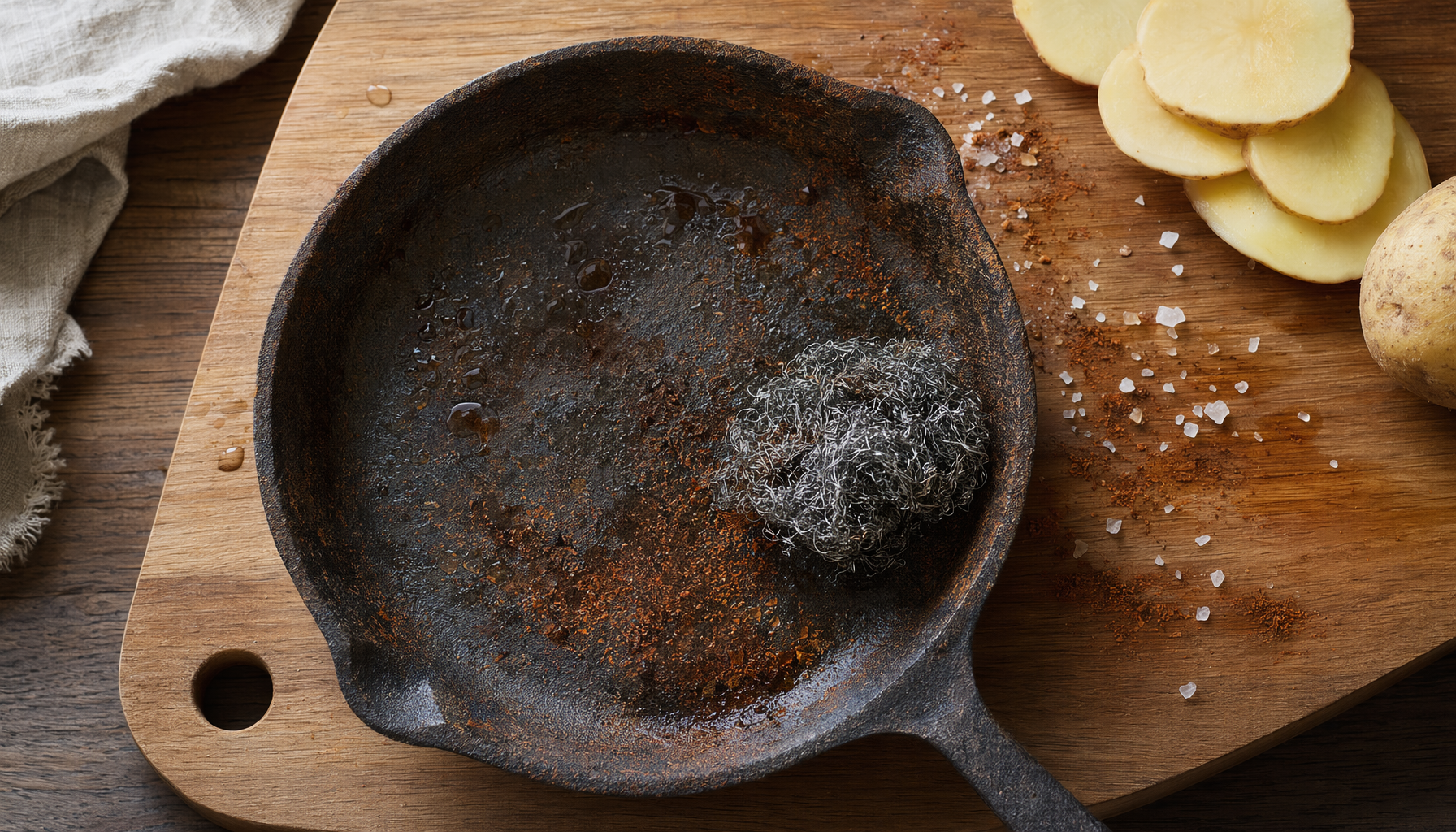
TL;DR — You can almost always rescue a rusty cast iron pan, even one that looks ruined. Light surface rust scrubs off in five minutes with coarse salt, a cut potato, or steel wool. Heavy rust needs a 1:1 white vinegar bath for one hour to eight hours, never longer. Once the iron is clean and bare, you must re-season immediately or rust returns within hours. The 2026 consensus from r/castiron, Lodge, and Stargazer is the same — vinegar works, lye works, electrolysis works, but the seasoning step afterward is what saves the pan.

Deeper Dive: Our Top Picks
Our Top Picks
Evapo-Rust
Restore Cast Iron Cookware with Evapo-Rust Heavy-Duty Rust Remover 32 oz – Acid-Free, No Scrubbing
Evapo-Rust dissolves rust from cast iron skillets, grill grates, and kitchen tools by simple submersion in its water-based, acid-free solution with no scrubbing required. Home cooks and restoration enthusiasts who want to revive neglected cast iron or carbon steel cookware without harsh chemicals will find this the most hands-off option available.
Pros and Cons
Pros
- Acid-free and non-corrosive formulation means it will not pit or weaken metal surfaces during the rust removal process.
- Reusable until the solution turns black, making the 32 oz bottle economical across multiple cast iron and cookware restoration jobs.
- No scrubbing or sanding required reduces effort and eliminates the risk of scratching seasoned surfaces adjacent to rusted spots.
- Water-based composition rinses cleanly from cookware, leaving no oily or chemical film that could affect food seasoning adhesion.
Cons
- Heavily rusted pieces may require extended soak times of 24 hours or more, so it is not a quick fix for same-day cooking.
- The 32 oz bottle may not fully submerge large dutch ovens or grill grates, requiring partial soaks and repositioning.

Wzporzst
Rust Eraser for Cast Iron
The Wzporzst Rust Eraser uses silicon carbide abrasion to strip rust from cast iron skillets, dutch ovens, and knives without scratching seasoned surfaces or leaving chemical residue. Cast iron owners who want a fast, reusable, chemical-free way to rescue neglected pans and blades will get the most value from it.
Pros and Cons
Pros
- Made from rubber and silicon carbide with no toxic chemicals, making it safe for cookware that contacts food.
- Abrasive enough to remove stubborn rust spots yet gentle enough to leave cast iron seasoning intact.
- Versatile across skillets, griddles, dutch ovens, and knives, so one tool handles multiple items in the kitchen.
- Long-lasting construction means infrequent replacement, keeping ongoing maintenance costs low for cast iron collectors.
Cons
- With zero published reviews, real-world durability and performance on heavily rusted surfaces remains unverified.
- Requires manual scrubbing effort, so deeply pitted or large-scale rust may need multiple sessions or additional tools.

Outset
Cast Iron Cleaning and Rust Removal: Outset Cast Iron Soap
Outset Cast Iron Soap cleans cast iron skillets and pots while removing stubborn odors and rust, with plant-based oils designed to be gentle on seasoning. It suits cast iron owners who want a dedicated cleaner for restoring cookware without relying on traditional soaps.
Pros and Cons
Pros
- It targets both odors and rust instead of handling surface residue alone.
- Its plant-based formula is designed to protect cast iron seasoning during cleaning.
- The bottle format makes measured application straightforward.
- It is made specifically for cast iron skillets and pots.
Cons
- The 8-ounce size may require frequent replacement for households that clean cast iron often.
- It is specialized for cast iron care, so it may not replace a general dish soap.

IMPRESA
Cast Iron Rust Remover Erasers
The IMPRESA Cast Iron Rust Remover Erasers scrub away stubborn rust from skillets, griddles, grill grates and other metal cookware, with rounded edges for reaching tight spots. Cast iron owners and cooks restoring metal cookware should buy this two-pack for a dedicated, reusable rust-cleaning tool.
Pros and Cons
Pros
- The two-pack keeps a backup rust eraser available for regular cookware maintenance.
- The XL 4.75 x 2 x 1 inch size provides a substantial surface for scrubbing.
- Black abrasive rubber is designed specifically for rust removal on cast iron and other metal surfaces.
- Rounded edges help clean around tight spots on griddles, grill grates and cookware.
Cons
- The product is intended for rust removal rather than everyday dishwashing.
- Product weight is not listed, so handling and portability cannot be evaluated from the available specifications.

Azitamo
Cast Iron Rust Eraser 2-Pack: Chemical-Free Rust Remover for Knives
The Azitamo Rust Eraser uses rubber and silicon carbide to scrub surface rust and oxidation off cast iron, knives, and metal tools without chemicals or damage to the base material. Home cooks and kitchen enthusiasts who rely on cast iron skillets or carbon steel knives will find this a practical, low-cost way to restore neglected cookware.
Pros and Cons
Pros
- Chemical-free silicon carbide formula removes rust without introducing toxins to food-prep surfaces.
- Works on a wide range of kitchen metal including cast iron cookware, carbon steel knives, and tool accessories.
- Dual-use dry and wet application gives flexibility depending on how stubborn the rust or oxidation is.
- Two erasers included provide backup and extend overall value for ongoing cast iron maintenance.
Cons
- Not compatible with coated or non-stick cookware, as it strips surface finishes down to bare metal.
- Removes seasoning along with rust, so cast iron users must budget time to re-season after every use.
Editors' Picks
Evapo-Rust Restore Cast Iron Cookware with Evapo-Rust Heavy-Duty Rust Remover 32 oz – Acid-Free, No Scrubbing
Evapo-Rust
Restore Cast Iron Cookware with Evapo-Rust Heavy-Duty Rust Remover 32 oz – Acid-Free, No Scrubbing
Evapo-Rust dissolves rust from cast iron skillets, grill grates, and kitchen tools by simple submersion in its water-based, acid-free solution with no scrubbing required. Home cooks and restoration enthusiasts who want to revive neglected cast iron or carbon steel cookware without harsh chemicals will find this the most hands-off option available.
$12.99 at AmazonEditors' Favorite
Color: Clear Size: 31.98 Fl Oz (Pack of 1) Dimensions: 2 x 5 x 7.5 inches Weight: 2.25 Pounds Product Group: Automotive Parts and Accessories Binding: Automotive
Shop NowWzporzst Rust Eraser for Cast Iron
Wzporzst
Rust Eraser for Cast Iron
The Wzporzst Rust Eraser uses silicon carbide abrasion to strip rust from cast iron skillets, dutch ovens, and knives without scratching seasoned surfaces or leaving chemical residue. Cast iron owners who want a fast, reusable, chemical-free way to rescue neglected pans and blades will get the most value from it.
$9.99 at AmazonGreat Value
Color: Black- 1 Pack Dimensions: 3.54 x 0.98 x 0.55 inches Product Group: BISS Binding: Kitchen
Shop NowOutset Cast Iron Cleaning and Rust Removal: Outset Cast Iron Soap
Outset
Cast Iron Cleaning and Rust Removal: Outset Cast Iron Soap
Outset Cast Iron Soap cleans cast iron skillets and pots while removing stubborn odors and rust, with plant-based oils designed to be gentle on seasoning. It suits cast iron owners who want a dedicated cleaner for restoring cookware without relying on traditional soaps.
$9.00 at AmazonSize: 8 Fl Oz (Pack of 1) Weight: 0.6 Pounds Product Group: BISS Binding: Health and Beauty
Shop NowIMPRESA Cast Iron Rust Remover Erasers
IMPRESA
Cast Iron Rust Remover Erasers
The IMPRESA Cast Iron Rust Remover Erasers scrub away stubborn rust from skillets, griddles, grill grates and other metal cookware, with rounded edges for reaching tight spots. Cast iron owners and cooks restoring metal cookware should buy this two-pack for a dedicated, reusable rust-cleaning tool.
$14.99 at AmazonColor: Black Dimensions: 4.75 x 2 x 0.0393700787 inches Weight: 0.72973008722 pounds Product Group: BISS Binding: Office Product
Shop NowAzitamo Cast Iron Rust Eraser 2-Pack: Chemical-Free Rust Remover for Knives
Azitamo
Cast Iron Rust Eraser 2-Pack: Chemical-Free Rust Remover for Knives
The Azitamo Rust Eraser uses rubber and silicon carbide to scrub surface rust and oxidation off cast iron, knives, and metal tools without chemicals or damage to the base material. Home cooks and kitchen enthusiasts who rely on cast iron skillets or carbon steel knives will find this a practical, low-cost way to restore neglected cookware.
$9.90 at AmazonSize: 1.24 Ounce (Pack of 2) Dimensions: 3.62 x 0.98 x 0.51 inches Product Group: Home
Shop NowAbout These Recommendations
The technique above is the point of this guide; the products are here because they help. We have not tested them ourselves — we did not buy or use this gear. The recommendations come from comparing specifications and materials against the patterns in verified owner reviews, so treat them as a shortlist worth researching rather than a verdict from our own kitchen.
Availability and prices change often, so check the current listing before buying. We earn a commission on purchases made through links on this page, which never affects what we recommend.
The Short Answer
To remove rust from cast iron the right way, match the method to the damage. Light surface rust comes off with coarse salt and a cut potato, or steel wool and dish soap. Heavy rust needs a 1:1 white vinegar and water soak for one to eight hours, monitored every 30 minutes. After scrubbing the loosened rust away, neutralize the acid with a baking soda rinse, dry the pan completely on a burner, and re-season with three thin oil coats baked at 450°F. Skip the re-seasoning and rust comes back overnight. For a pan that handles this kind of restoration well, see our guide to the best cast iron skillet for beginners.
Why Cast Iron Rusts
The first step to remove rust from cast iron is understanding why it forms. Cast iron rusts because of basic chemistry. Iron, water, and oxygen combine to form iron oxide — what we call rust. The orange-brown coating you see is just iron giving up electrons to oxygen molecules, with water acting as the catalyst that lets the reaction happen at room temperature. Bare iron exposed to humid air can show rust spots within four to six hours. In a wet sink overnight, the whole cooking surface can turn orange.
The thing that normally stops this reaction is the seasoning layer — the dark, slick patina built up from polymerized oil. Seasoning is not free oil sitting on the surface. It is a hardened plastic-like polymer chemically bonded to the iron, sealing every micro-pore so water and oxygen can’t reach the metal underneath. A well-seasoned pan can sit in a humid kitchen for months without a speck of rust.
When the patina breaks, rust takes over fast. Five things destroy seasoning: long water soaks, dishwasher cycles, acidic foods cooked in a poorly seasoned pan, harsh abrasives like Brillo pads on the cooking surface, and prolonged wet storage with a lid trapping humidity. Any one of these can strip the protective layer in a single event.
Hard water makes it worse. Mineral deposits left behind after evaporation create micro-pits that hold moisture against the iron, accelerating oxidation. That is why pans stored near sinks in mineral-heavy areas rust faster than identical pans in dry pantries. The fix is the same regardless of cause — strip the rust, re-build the seasoning, and store the pan dry.
Assessing the Damage
Before you reach for vinegar or steel wool, look at the pan and decide which category of rust you are dealing with. The wrong method on the wrong damage either wastes time or makes things worse.
Surface rust is the easiest case. It shows up as an orange or reddish film, sometimes patchy, that you can rub off with a paper towel and a little pressure. The iron underneath still feels smooth. The seasoning is thin or worn, but the metal itself is intact. Light methods — salt scrub, steel wool, a quick vinegar wipe — handle this in under ten minutes.
Deep rust looks pitted. Run your finger across the surface and you’ll feel rough texture, like coarse sandpaper. The orange coating is thicker and may flake off in plates. The iron has actually corroded below the original surface line, leaving micro-craters that hold rust. This kind needs a vinegar bath for one to several hours, followed by aggressive scrubbing and full re-seasoning.
Structural damage is the only category you cannot save. Look for visible cracks running across the cooking surface or down the side wall, holes that go through the metal, or pitting so deep the pan wobbles when set on a flat surface. Iron oxide takes up more volume than iron, so severe rusting can warp a skillet or split a thin spot. If you see daylight through a pit or hear a dull thunk instead of a ring when you tap the rim, the pan is done. Recycle it and start over.
For everything between surface and structural — which is 95 percent of rusty pans found in attics, garages, and estate sales — the methods below will remove rust from cast iron and bring the skillet back to daily-driver shape.
Light Rust Removal
For surface damage, you can remove rust from cast iron without any harsh chemicals. The three steps below take about 15 minutes and need only items already in most kitchens.
Step 1: Scour with Coarse Salt and Cut Potato
This is the gentlest method and the most satisfying. Cut a russet potato in half. Pour a tablespoon of kosher or coarse sea salt into the rusty area. Rub the cut face of the potato in firm circles across the rust, using the salt as an abrasive. The oxalic acid naturally present in potatoes reacts with the rust, breaking the bond between oxide and iron. The salt scratches the loosened rust away without damaging healthy iron. Work the entire surface for two to three minutes, adding more salt as it dissolves into orange slurry. Wipe out with paper towels.
Step 2: Steel Wool with Soap and Water
For rust the potato didn’t fully shift, move to fine steel wool — 0000 grade is ideal — with a drop of dish soap and warm water. Scrub in circular motions with moderate pressure across the affected area. Steel wool is aggressive enough to strip surface rust but won’t gouge healthy iron the way a wire brush would. Rinse frequently to see your progress. When the rusty spots turn dull gray instead of orange, you’ve reached bare iron and the rust is gone.
Step 3: Rinse and Dry Thoroughly
Rinse the pan under hot tap water until no orange residue runs off. Towel-dry immediately. Then set the skillet on a burner over medium heat for two to three minutes until every drop of moisture evaporates — bare iron rusts again within hours if left wet. Move straight to re-seasoning (covered below). Never let a freshly de-rusted pan sit overnight before oiling it.
Heavy Rust Restoration (Vinegar Bath)
When surface methods fail, the vinegar bath is the standard rescue. White vinegar contains acetic acid, which dissolves iron oxide while leaving the underlying iron mostly untouched — as long as you watch the clock.
Step 1: 1:1 White Vinegar and Water Soak
Use plain distilled white vinegar from the grocery store, the 5 percent acidity kind. Mix it 50/50 with water in a basin large enough to submerge the entire pan. A plastic storage bin, a deep sink, or a five-gallon bucket all work. Full submersion matters — partial soaks leave a water line that rusts differently from the soaked area, creating a visible ring. Use enough liquid to cover the pan plus an inch above the highest point.
Step 2: Time the Soak (1-8 Hours Max)
This is the most important rule when you remove rust from cast iron with vinegar. Start checking at the one-hour mark. Pull the pan, scrub a small area with steel wool, and look. If the rust shifts easily, the soak is done. If the iron underneath looks etched, dimpled, or chalky white-gray, you’ve soaked too long and the acid is attacking the iron itself. Most pans need two to four hours. Eight hours is the absolute ceiling, and only for the worst flea-market finds with thick rust scales. Never leave a pan in vinegar overnight without checking — by morning, the acid will have eaten measurable iron from the surface.
Step 3: Scrub and Rinse
Pull the pan from the bath wearing dish gloves. The rust will now be soft, almost gel-like. Scrub the entire surface with steel wool or a chainmail scrubber under running water. The orange slurry rinses straight off. Get into the corners where the side wall meets the cooking surface, around the handle base, and inside the helper-handle hole if your pan has one. Anywhere you miss now will flash-rust within hours.
Step 4: Baking Soda Neutralize
Acid left in the iron’s pores will keep etching even after rinsing. Neutralize it. Make a paste of two tablespoons baking soda and a splash of water, smear it across the entire pan, and let it sit for five minutes. Rinse with hot water, scrub once more with a brush, and rinse again. Towel-dry immediately and set the pan on a burner over medium-high heat for five minutes to drive off every last trace of moisture. The surface should look uniformly dull gray — that’s bare, clean iron, ready for seasoning.
Re-Seasoning After Rust Removal
Once you remove rust from cast iron, bare iron is racing the clock. The moment you finish drying, oxygen and humidity start the rust process again. You have a window of a few hours at most before flash rust appears, so re-seasoning is not optional — it is part of the same job.
The why is simple. Stripping rust removes both the oxide layer and any remaining seasoning. The pan is now as defenseless as a brand-new raw casting, except the surface is slightly more porous from the rust damage, which makes it even more rust-prone. A bare iron pan left on a counter overnight in a humid kitchen will have visible orange dots by morning.
The fix is three thin coats of oil baked into polymer. Apply a half-teaspoon of neutral high-smoke-point oil — grapeseed, canola, or flaxseed — across the entire pan, inside and out, handle included. Wipe with a clean paper towel until the surface looks barely damp, almost dry. Excess oil pools and gets sticky during the bake. Place the pan upside down on the middle rack of a 450°F oven with a sheet pan below to catch drips. Bake for one hour, then turn the oven off and let the pan cool inside for another hour. Repeat the oil-and-bake cycle twice more for a total of three coats.
After three rounds the pan will be dark bronze, slick, and protected. For the full walkthrough with troubleshooting, see our guide on how to season cast iron skillet. Skip the seasoning step and every minute you spent stripping rust is wasted.
Common Mistakes
- Leaving the pan in vinegar overnight. This is the single most common way people accidentally destroy a cast iron pan during restoration. Acetic acid keeps working as long as the iron is submerged. After eight hours the surface starts pitting from acid attack instead of rust, and after 24 hours the pan can be permanently roughened or even thinned in spots. Set a kitchen timer at one hour and check every 30 minutes after that.
- Skipping the baking soda neutralize step. Vinegar trapped in pores keeps eating the iron after you rinse. A pan that looks fine after a soak can show fresh pitting a day later if the acid was not neutralized. The baking soda paste takes two minutes and prevents this entirely.
- Re-seasoning over wet iron. Trapped moisture under fresh oil flashes to steam during the bake, blistering the seasoning and leaving bare spots that rust within days. Always burner-dry the pan for at least three minutes before applying oil, even if it feels dry to the touch. Bare iron holds invisible micro-droplets.
- Using a wire brush or grinder on healthy iron. Aggressive power tools strip rust fast but also gouge the cooking surface, creating an uneven cratered texture that takes many seasoning cycles to smooth out. Steel wool, chainmail, and salt are aggressive enough for any home rust job. Save the angle grinder for industrial restoration.
- Soaking in vinegar without watching for the water line. A pan only partially submerged develops a sharp horizontal etch where the liquid surface met the iron. This line stays visible even after re-seasoning. Use enough vinegar-water solution to cover the entire pan with at least an inch to spare, or flip the pan halfway through the soak.
Related Questions
How long can cast iron sit in vinegar?
One hour minimum to loosen heavy rust, eight hours absolute maximum. Check every 30 minutes after the first hour by pulling the pan and scrubbing a test patch. The moment rust shifts easily, the soak is done. Past eight hours the acid attacks the iron itself, leaving permanent pitting.
Will lemon juice remove rust?
Yes, but slowly and only for light surface rust. Lemon juice contains citric acid at roughly 5 percent concentration, similar to vinegar. Rub a cut lemon with salt across rusty spots for several minutes, scrub, and rinse. It is not strong enough for heavy rust — switch to a full vinegar bath for anything beyond a thin orange film.
Can I save a severely rusted pan?
Almost always, yes. A pan with deep pitting but no cracks or holes will clean up with a long vinegar bath (4-8 hours), aggressive scrubbing, and three to four seasoning coats. The cooking surface may feel slightly rougher than before, but normal use smooths it out within a few months. Only structural damage — cracks, holes, severe warping — makes a pan unsaveable.
What if rust comes back fast?
Flash rust within 24 hours of cleaning means the pan was stored wet, dried incompletely, or seasoned over moisture. Strip the new rust, burner-dry for five full minutes, and re-season with three coats. Store the pan uncovered in a dry cabinet, never with a lid on or near a sink.
Is rusty cast iron safe to use after cleaning?
Yes, once the rust is fully removed and the pan is re-seasoned. Iron oxide itself is not toxic — your body actually needs trace iron — but rusty pans cook unevenly and flake orange particles into food. After a proper vinegar strip and three seasoning coats, the pan is chemically identical to a brand-new one and completely food-safe.
Related buying guides: best cookware sets, best moka pot, best instant pot and best carbon steel pan for cooking.
Recommended Tools
Removing rust the right way takes only a handful of items, most of which work for routine cast iron care as well. A bottle of white vinegar, a box of kosher salt, fine steel wool, a chainmail scrubber, and a small jar of high-smoke-point oil cover almost every restoration job. The products below are the ones that show up most often in aggregated reviews from Amazon, Williams Sonoma, and the r/castiron community in 2026, and they pair well with both freshly de-rusted pans and well-seasoned daily-driver skillets.




Write Your Review
No reviews yet. Be the first to share your experience!