

TL;DR — A cutting board and a oven thermometer solve different problems, so the real question is whether you need both, not which wins. For product picks, the closest next steps are best cutting board, best dutch oven for bread baking, and best toaster oven.
Our view is based on product specs, material trade-offs, and repeated owner feedback — not one-off kitchen anecdotes or brand claims. For baking tools, sizing, material, accuracy, cleaning, and storage usually decide whether a tool stays useful or gets replaced.

Qluisio
Oven Thermometer for Accurate Baking Temps: Qluisio Bimetallic 100°F-600°F Dial with Hook and Stand
This bimetallic dial thermometer sits inside a gas or electric oven and shows the real cavity temperature from 100°F to 600°F, exposing the hot and cold spots that ruin cakes and roasts. Buy it if your oven runs off its set point and you want a battery-free reading you can check through the door glass.
Pros and Cons
Pros
- Wide 100°F to 600°F range covers low-and-slow smoking through high-heat pizza and roasting.
- Analog dial with color zones is readable at a glance without opening the oven door.
- No batteries or electronics to fail under sustained heat.
- Two mounting options let one unit move between the oven, grill, and air fryer.
Cons
- Analog bimetallic dials read in increments rather than exact degrees, so it is better for spotting drift than for precise candy or bread work.
- It needs several minutes to stabilize after a temperature change, so quick preheat checks can read low.
Taylor
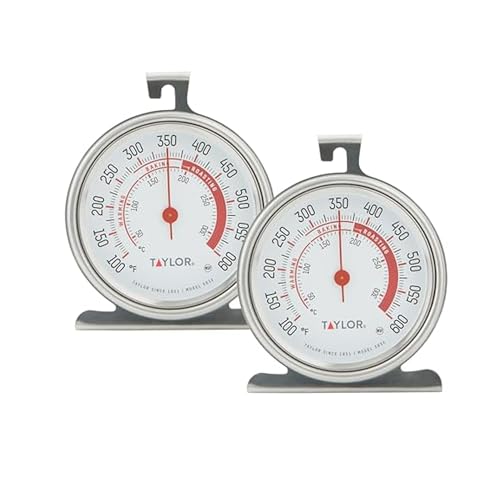
Oven Temperature Accuracy for Baking and Grilling: Taylor 5932 Large Dial Oven Thermometer, 2 Pack, 3.25 Inch Stainless Steel
The Taylor 5932 hangs or stands inside your oven, BBQ, or grill and reads 100°F to 600°F on a 3-1/4 inch dial you can check through the door glass without breaking heat. Buy it if your oven runs hot or cold and your bakes come out inconsistent, and the two-pack means you can leave one in the oven and one on the grill.
Pros and Cons
Pros
- The 3-1/4 inch dial is significantly larger than standard oven thermometers, making it legible from across the kitchen.
- Stainless steel construction and a glass lens hold up to repeated high-heat exposure without warping or clouding quickly.
- The two-pack covers a second oven, a grill, or a spare without a second purchase.
- No batteries or setup required, so it works the moment you put it in the oven.
Cons
- The 600°F ceiling falls short for pizza ovens and high-heat searing setups that run past that mark.
- As an analog gauge, it shows only the current reading with no alarms, logging, or remote monitoring.

TempPro
Oven Thermometer for Gas and Electric Ovens: TempPro 431 Stainless Steel Dial Gauge, 100-600°F
This battery-free dial thermometer sits on a rack or hangs from it to show your oven's true internal temperature across a 100 to 600°F range, exposing the gap between the dial setting and actual heat. Buy it if you bake bread or pizza in a gas oven where uneven cycling ruins crusts and rise times.
Pros and Cons
Pros
- Dual Fahrenheit and Celsius scales cover both American and metric recipes without conversion.
- The 3 x 3 x 1.61 inch body is compact enough for toaster ovens yet readable in a full-size oven.
- Works in gas ovens, electric ovens, convection ovens, grills, and smokers, so one unit covers your whole setup.
- Stainless steel build and battery-free operation mean nothing to replace or recharge.
Cons
- The 600°F ceiling falls short for high-heat pizza ovens and broiler work that push past that mark.
- Analog dials require you to be near the oven door to read them, unlike a probe thermometer with an external display.

CDN
Oven Temperature Monitoring Made Accurate: CDN DOT2 ProAccurate Stainless Steel Oven Thermometer, NSF Certified, 150 to 550°F
The CDN DOT2 sits inside your oven and reads actual cavity temperature from 150 to 550°F, exposing the gap between your dial setting and reality. Buy it if you bake bread, roast meats, or temper chocolate and need to know your oven runs hot, cold, or unevenly before the food tells you.
Pros and Cons
Pros
- Stainless steel body and glass lens handle sustained oven heat without warping or fogging.
- Large dial stays legible through an oven door without opening it and dumping heat.
- No batteries, calibration, or setup required, so it works the moment you put it in.
- Leaving it in during preheat lets the coil settle for a reading that tracks the real cavity temperature.
Cons
- The range stops at 550°F, so it will not cover broiler-level or pizza-steel temperatures above that.
- Analog dials require you to open or peer through the door to read them, with no alarm or remote display.
The Best Deals This Week*
-
Oven Temperature Accuracy for Baking and Grilling
$11.99
($14.94)Save $2.95 -
Oven Thermometer for Gas and Electric Ovens
$7.99
($12.99)Save $5.00
*Deals are selected by our commerce team
Qluisio Oven Thermometer for Accurate Baking Temps: Qluisio Bimetallic 100°F-600°F Dial with Hook and Stand
Qluisio
Oven Thermometer for Accurate Baking Temps: Qluisio Bimetallic 100°F-600°F Dial with Hook and Stand
This bimetallic dial thermometer sits inside a gas or electric oven and shows the real cavity temperature from 100°F to 600°F, exposing the hot and cold spots that ruin cakes and roasts. Buy it if your oven runs off its set point and you want a battery-free reading you can check through the door glass.
Check price on AmazonA mechanical oven thermometer that shows what temperature your oven is actually holding, not what the knob claims. Most ovens drift, and that gap is why bakes fail.
The bimetallic coil covers 100°F to 600°F with blue and red color zones, so you can read it through the door glass mid-bake without releasing heat.
Stainless steel dial and housing, rated to 600°F, light enough to hang from a rack wire or stand on its own base in an air fryer basket.
Analog resolution means you are reading a zone, not an exact degree, and it takes a few minutes to settle after the oven changes temperature.
Best for home bakers who suspect their oven runs hot or cold and want a durable, battery-free way to confirm it.
Calibration check: hang it on the center rack, set the oven to 350°F, wait fifteen minutes past the preheat beep, then note the gap and adjust your dial accordingly.
Baking runs: leave it on the rack during cakes, breads, and cookies so you catch temperature swings from door openings and cycling elements.
Grills and smokers: stand it on the grate near the food to track the cooking zone rather than trusting the lid gauge, which reads the dome instead.
Taylor Oven Temperature Accuracy for Baking and Grilling: Taylor 5932 Large Dial Oven Thermometer, 2 Pack, 3.25 Inch Stainless Steel
Taylor
Oven Temperature Accuracy for Baking and Grilling: Taylor 5932 Large Dial Oven Thermometer, 2 Pack, 3.25 Inch Stainless Steel
The Taylor 5932 hangs or stands inside your oven, BBQ, or grill and reads 100°F to 600°F on a 3-1/4 inch dial you can check through the door glass without breaking heat. Buy it if your oven runs hot or cold and your bakes come out inconsistent, and the two-pack means you can leave one in the oven and one on the grill.
Check price on AmazonMost home ovens drift from their set temperature. This Taylor thermometer sits inside and shows the real number, so your baking times and results stop being a guessing game.
The 3-1/4 inch dial with a bold red pointer reads clearly through oven door glass, letting you verify preheat and monitor a roast without opening the door.
Stainless steel housing with a clear glass lens handles 100°F to 600°F and resists corrosion from steam, grease, and repeated grill use.
The 600°F limit rules out pizza-oven territory, and there are no alerts since it is a purely analog dial.
Best for home bakers and grillers who want an accurate, no-battery temperature check in both the oven and outdoors.
Calibration check: place it on the center rack, preheat, and compare against your oven's setting. Note the difference and adjust your dial accordingly on future bakes.
Hot spot mapping: use both units on opposite corners of the same rack to find uneven zones, then rotate pans mid-bake where readings diverge.
Grill and BBQ monitoring: set one inside the closed lid to track cooking chamber temperature for low-and-slow smoking or high-heat roasting.
TempPro Oven Thermometer for Gas and Electric Ovens: TempPro 431 Stainless Steel Dial Gauge, 100-600°F
TempPro
Oven Thermometer for Gas and Electric Ovens: TempPro 431 Stainless Steel Dial Gauge, 100-600°F
This battery-free dial thermometer sits on a rack or hangs from it to show your oven's true internal temperature across a 100 to 600°F range, exposing the gap between the dial setting and actual heat. Buy it if you bake bread or pizza in a gas oven where uneven cycling ruins crusts and rise times.
Check price on AmazonAn analog oven thermometer that shows what temperature your oven actually reaches, not what the control dial claims. Most ovens drift, and gas ovens cycle widest.
The 100 to 600°F range covers low-and-slow roasting through pizza-stone baking, and the vented housing reacts fast enough to show recovery after you open the door.
Built from 431 stainless steel with tempered glass over a bold, color-zoned face, it measures 3 x 3 x 1.61 inches with two hanging hooks and a wide standing base.
It stops at 600°F, so dedicated high-heat pizza ovens and extended broiling will peg the needle.
Best for home bakers troubleshooting inconsistent results in a gas or older oven.
Calibration check: hang it on the center rack, preheat to 350°F, and wait fifteen minutes. The difference between the dial and the reading is the offset you adjust for on every recipe.
Bread and pizza: watch it during preheat to confirm the oven has truly saturated with heat rather than just hitting the setpoint on the first cycle.
Grills and smokers: clip it to a grate to monitor the cooking zone, which usually runs hotter or cooler than the lid-mounted gauge.
CDN Oven Temperature Monitoring Made Accurate: CDN DOT2 ProAccurate Stainless Steel Oven Thermometer, NSF Certified, 150 to 550°F
CDN
Oven Temperature Monitoring Made Accurate: CDN DOT2 ProAccurate Stainless Steel Oven Thermometer, NSF Certified, 150 to 550°F
The CDN DOT2 sits inside your oven and reads actual cavity temperature from 150 to 550°F, exposing the gap between your dial setting and reality. Buy it if you bake bread, roast meats, or temper chocolate and need to know your oven runs hot, cold, or unevenly before the food tells you.
Check price on AmazonThe CDN DOT2 is an analog oven thermometer that measures the air temperature inside your oven, revealing the difference between the dial setting and what your food actually experiences.
Its 150 to 550°F range covers slow roasting through bread baking. Move it between racks and corners to find the hot and cool spots that cause uneven browning.
The body is stainless steel with a laboratory glass lens that resists cracking through repeated heat cycles. Two-way mounting means it hangs from a rack or stands on one.
It reads only up to 550°F, so broiling and high-heat pizza baking fall outside its usable range.
Best for home bakers and cooks who suspect their oven lies and want to prove it before their next bake.
Place it in the oven during the preheat cycle rather than after. The coil needs to expand and settle with the rising heat to give a reading that matches the true cavity temperature.
To map your oven, run it empty at one setting and move the thermometer through each rack position and corner. Note the differences, then place pans in the zones that match what you are cooking.
Beyond the oven, use it to check freezer temperatures or monitor a chocolate tempering setup, since the range extends down to 70°C.
Cutting board and Oven thermometer: Do You Need Both?
This is not really a versus question. A cutting board and a oven thermometer do different jobs — the cutting board does the actual work, while the oven thermometer supports it. Most cooks who care about results end up using both rather than choosing one. For product picks, compare best cutting board, best dutch oven for bread baking, and best toaster oven.
How They Work Together
Think of the oven thermometer as part of keeping the cutting board performing the way it should. Used together, they make the whole task easier and more consistent; skipping the oven thermometer usually means the cutting board underperforms or wears faster. The two are complements, not competitors.
When You Actually Need the Oven thermometer
You do not always need the oven thermometer on day one, but the more often you use the cutting board, the more it pays off. If you use the cutting board regularly, adding the oven thermometer is a small cost for a real improvement in nesting or storage shape. If you are shopping, our best cutting board and best dutch oven for bread baking guides are the fastest way in.
Bottom Line
If your budget forces a choice, start with the cutting board — it is the tool that does the job. Add the oven thermometer soon after; together they beat either one alone.
Related Product Guides
If this topic is part of a buying decision, these are the HomeWhisk guides most closely tied to it:
- best cutting board
- best dutch oven for bread baking
- best toaster oven
- best baking sheets
- best kitchen scale
- best meat thermometer
- best mixing bowls
Frequently Asked Questions
Do I need both a cutting board and a oven thermometer?
They serve different purposes, so most cooks use both. The cutting board does the work; the oven thermometer supports it. If budget forces a choice, start with the cutting board. See best cutting board and best dutch oven for bread baking for options.
Can a oven thermometer replace a cutting board?
No — they are complements, not substitutes. A oven thermometer does not do the cutting board’s job; it makes the cutting board work better or last longer.
Who is this most useful for?
Mainly anyone scaling recipes by weight, and cooks short on cabinet space. If that is you, treat rim and edge design as a requirement rather than a nice-to-have.
What should I avoid?
Avoid buying by brand alone, ignoring avoiding thermal shock, and oversizing for your space. Each invites rust on bare steel down the line.
What matters most for cutting board?
Focus on rim and edge design, warp resistance, and heat conductivity first. Those decide real performance; the rest is secondary. Compare best cutting board and best dutch oven for bread baking for options that get the basics right.
The Bottom Line
The simplest takeaway: buy for your real routine, not the most impressive feature list. Match the cutting board to your cooking frequency, cleanup habits, and storage, then use best cutting board, best dutch oven for bread baking, and best toaster oven to compare actual products.






Write Your Review
No reviews yet. Be the first to share your experience!