

Most shoppers who land on this category have already shortlisted two machines: the Breville Smart Oven Pro (BOV845BSS) and the Cuisinart Custom Classic Toaster Oven Broiler (TOB-40N). The split isn’t an accident. Those two units sit at opposite ends of the proven-workhorse-versus-feature-rich-premium axis that defines the toaster oven shelf at every major retailer. The Breville packs 10 preset functions, element IQ heat distribution, a 1800-watt convection system, and the kind of LCD interface that justifies its price tag. The Cuisinart does three things — bake, broil, toast — with brushed stainless steel build quality that has barely changed in fifteen years because it didn’t need to. One is engineered. The other is engineered to never break.
For more, see our Air Fryer Buying Guide and Air Fryer vs Deep Fryer guides.
This guide runs the side-by-side comparison most reviews skip. We’ll cover real interior capacity (not the nameplate cubic-foot figure), heating element configuration, convection behavior across small and large loads, and the long-term reliability data that actually predicts which toaster oven you’ll still be using in 2031. If you’re also weighing countertop appliances that overlap with this category, our best air fryer guide covers the basket-style units that compete with toaster oven air-fry modes. Below, the five toaster ovens we’d consider, then the head-to-head breakdown of the two finalists.

Pros & Cons
Pros
- Element iQ system directs power to specific heating zones based on the cooking function, delivering more even results than standard toaster ovens.
- Compact footprint fits under standard cabinets while still accommodating a full 12-inch frozen pizza or small roasting chicken.
- LCD display and preset functions eliminate manual temperature guessing for common kitchen tasks like reheating leftovers or baking cookies.
Cons
- 11-inch interior depth limits you to smaller baking dishes and sheet pans compared to full-size ovens.
- Single rack position during most cooking modes reduces flexibility for multi-level baking.
Details
The Breville BOV450XL is a compact countertop oven that replaces your toaster and handles small-batch baking, roasting, and reheating without firing up a full-size oven.
Element iQ technology distributes 1800 watts across 5 independent quartz heating elements based on your selected function. Toast mode concentrates heat on top elements for even browning, while bake mode balances top and bottom heat for cookies and casseroles.
Brushed stainless steel exterior measures compact enough for apartment kitchens. The 11x10x4 inch interior fits a 12-inch pizza, four toast slices, a 6-cup muffin tin, or a small whole chicken. Included 10×10 inch enamel baking pan handles most tasks.
The LCD only displays function and time, not actual internal temperature. Rack positioning is limited during certain modes, which reduces flexibility for bakers who rotate pans mid-cycle.
Best for singles, couples, or small households who want toaster oven convenience with more precise heating control than basic models offer.
How to Use
Select your function using the dial, then adjust time if needed. The oven calculates temperature automatically for each preset. Orange backlight indicates preheating and active cooking; blue signals completion.
For toast and bagels, use the top rack position for closest proximity to upper elements. For baking and roasting, center rack provides most even heat circulation. Pull the crumb tray from the front weekly to prevent smoke from accumulated debris.
The auto shut-off engages when your cycle completes, but the cavity stays hot for 10-15 minutes. Wait for the blue light before removing items with bare hands. Clean the non-stick interior with a damp cloth after it cools completely.

Pros & Cons
Pros
- 10 cooking functions cover everything from bagels to slow-cooked roasts, eliminating the need for separate toaster ovens and slow cookers.
- Element IQ technology adjusts heat intelligently for each function, preventing common issues like burnt toast edges or undercooked pizza centers.
- 1800 watt power delivers fast preheat times, and the LCD display shows exactly when the oven is ready and counts down cook time.
Cons
- At 18.5 x 16.25 x 11.25 inches, this oven requires significant counter space and may not fit under standard cabinets.
- The 1800 watt draw can trip older kitchen circuits if running simultaneously with other high-power appliances.
Details
The Breville Smart Oven Pro is a countertop convection oven designed to replace multiple kitchen appliances by handling tasks from toasting bread to slow cooking stews.
Element IQ technology uses 5 independent quartz heating elements that adjust power automatically based on your selected function. Convection mode circulates hot air with an internal fan to cook food 30% faster than traditional methods.
The brushed stainless steel housing measures 18.5 x 16.25 x 11.25 inches externally with a 13.5 x 11.5 x 5.5 inch interior. It weighs approximately 22 pounds and includes a removable crumb tray for cleanup.
The oven draws 1800 watts, which may overload circuits in older homes when used with other high-power appliances simultaneously.
Best for home cooks who want restaurant-quality results from a single countertop appliance and have the counter space to accommodate its footprint.
How to Use
Select one of 10 preset functions using the dial, then adjust time and temperature if needed. The LCD screen shows when preheat is complete and counts down remaining cook time.
For convection cooking, reduce standard recipe temperatures by 25°F or check food earlier than usual since it cooks faster. Place food in the center of the rack for even air circulation.
The slow cook function works like a countertop slow cooker: add ingredients to an oven-safe dish, select the function, set time up to 10 hours, and the oven automatically switches to warm when done.

Save $10.00
Pros & Cons
Pros
- Massive 26-quart capacity handles full family meals, from whole roasted chickens to multiple sheet pans at once.
- 24 one-touch presets cover everything from air frying and baking to dehydrating and slow cooking without manual temperature adjustments.
- Rotisserie function with included spit and fetch tool delivers evenly cooked, self-basting meats with crispy skin.
- French door design provides wide access and stays cooler to the touch than traditional drop-down doors.
Cons
- Large footprint requires significant counter space—measure before purchasing if your kitchen is compact.
- Learning curve for optimal rack positioning across different cooking modes may require trial and error initially.
Details
This is a countertop convection oven that air fries, bakes, roasts, broils, dehydrates, and slow cooks—eliminating the need for separate appliances. It solves the problem of limited counter space while expanding cooking methods.
The dual-speed fan and 360° air circulation cook food 30% faster than conventional ovens while using little to no oil. Digital controls and 24 presets remove guesswork from temperature and timing.
Stainless steel construction with French doors and tempered glass. Measures approximately 20 x 16 x 13 inches. Weighs around 25 pounds. Interior fits a 12-inch pizza or 6-pound chicken. Racks adjust to multiple heights.
The size is both an advantage and a limitation—it handles large batches but demands permanent counter real estate. Not ideal for small kitchens or infrequent cooks.
Best for families of four or more who cook daily and want appliance consolidation without sacrificing capacity or function variety.
How to Use
Place the oven on a heat-resistant surface with 4 inches of clearance on all sides. Plug into a grounded outlet. Select a preset or manually set temperature and time using the digital dial.
For air frying, use the included basket on the middle rack. For rotisserie, insert the spit through the center of the meat, secure with forks, and place on the rotisserie supports. The fetch tool removes hot accessories safely.
Preheat when baking or roasting for even results. Toast mode automatically shuts off when the timer ends—no need to monitor. Wipe interior and accessories after each use; removable crumb tray catches drips.

Save $21.78
Pros & Cons
Pros
- Always Even Shade Control adjusts cooking time in real time based on cavity temperature, delivering consistent toast darkness across multiple batches.
- 0.5 cubic foot capacity accommodates 6 slices or an 11-inch pizza, enough for small families without monopolizing counter space.
- Auto-slide rack extends when the door opens, eliminating the need to reach into a hot oven to pull out food.
- Non-stick interior and removable crumb tray simplify cleanup after baking or broiling greasy foods.
Cons
- No convection fan, so baking times run longer and heat distribution is less uniform than convection models in the same price range.
- Manual dial controls lack a digital timer with automatic shutoff, requiring you to monitor cooking progress or use a separate timer.
Details
The Cuisinart TOB-40N is a non-convection toaster oven that toasts, bakes, broils, and warms food in a 0.5 cubic foot cavity. It solves the problem of inconsistent toast color by using Always Even Shade Control, which monitors internal temperature and adjusts timing automatically.
The 1800-watt heating elements deliver enough power for broiling and baking, though without a convection fan, heat circulates passively. The auto-slide rack extends when you open the door, so you never reach into the hot interior to remove food.
Brushed stainless steel exterior with black accents measures compact enough for most countertops. The non-stick interior resists baked-on residue, and the front-mounted crumb tray slides out for emptying without moving the unit.
Manual dial controls are simple but lack a countdown timer with auto-shutoff, so you need to track cooking time yourself or use an external timer. The oven shuts off automatically only after the toast cycle completes.
Best for households that prioritize consistent toast quality and straightforward operation over convection speed or digital programming.
How to Use
Preheat for 5 minutes before baking or broiling to stabilize cavity temperature. For toast and bagels, skip preheating and select your shade setting; the Always Even Shade Control will adjust timing based on starting temperature.
Use the wire rack for toast and the baking pan for anything that drips. The broiling rack elevates food closer to the top element for faster browning. Position racks before turning the oven on to avoid burns.
Clean the crumb tray after every few uses to prevent smoke from accumulated debris. Wipe the non-stick interior with a damp cloth once cool; avoid abrasive scrubbers that damage the coating.

Pros & Cons
Pros
- EvenToast Technology delivers consistent browning edge to edge, solving the common problem of unevenly toasted bread in budget toaster ovens.
- The included baking and broiler pan fits the interior perfectly, eliminating the guesswork of finding compatible cookware.
- Natural convection airflow speeds up cooking and produces crispier results than traditional toaster ovens without convection.
- Simple manual dials require no learning curve and work reliably without the failure points of digital controls.
Cons
- Outer surfaces become very hot during use, requiring oven mitts and careful placement away from walls or cabinets.
- The 30-minute maximum timer requires resetting for longer baking tasks like roasting chicken or slow-cooking casseroles.
Details
The BLACK+DECKER TO1313SBD is a compact countertop toaster oven that solves the problem of heating a full-size oven for small meals. It handles breakfast toast, reheated pizza, and broiled sandwiches without wasting energy or counter space.
EvenToast Technology is the standout feature, using reflective interior surfaces to distribute heat toward the center and eliminate the burnt edges and pale centers that plague standard toaster ovens. The built-in convection heating circulates air for faster, crispier results on everything from frozen fries to roasted vegetables.
The stainless steel exterior measures 14.5 x 10.8 x 8.8 inches and weighs under 10 pounds. The curved interior accommodates a 9-inch pizza or four bread slices. The removable crumb tray and included baking pan simplify cleanup and eliminate the need to hunt for compatible cookware.
The outer shell gets hot during use, so placement requires clearance from walls and cabinets. The 30-minute timer works for most tasks but requires resetting for longer roasts or bakes.
Best for apartment renters, dorm residents, and anyone with limited counter space who wants reliable toasting and small-batch baking without a full-size oven.
How to Use
Preheat for 10 minutes before baking or broiling to ensure even heat distribution and consistent results. Place food at least 1.5 inches from the top heating elements to prevent burning and allow proper air circulation.
Use the included baking pan for pizzas, casseroles, and roasted vegetables. The rack alone works for toast, bagels, and open-faced sandwiches. Adjust the temperature dial up to 450°F and set the timer, or select stay-on for longer tasks that exceed 30 minutes.
Clean the removable crumb tray after every few uses to prevent smoke and maintain heating efficiency. Wipe the interior with a damp cloth once cooled, and avoid abrasive cleaners that can damage the reflective surfaces responsible for EvenToast Technology.

Pros & Cons
Pros
- The CHEF iQ App's chef-tested presets and real-time temperature tracking reduce the learning curve for less experienced cooks.
- Compatibility with the iQ Sense Smart Thermometer allows the oven to auto-adjust cooking parameters based on actual internal food temperature.
- A 25-quart interior fits a 13-inch pizza or six toast slices, making it genuinely useful for family meals rather than single servings.
- The three-year limited warranty is longer than most competing countertop ovens, which typically offer one year.
Cons
- At $599.99, it is priced significantly above most air fryer toaster oven combos, making it a harder sell for buyers who only need basic functions.
- Smart features like app control and thermometer sync require Wi-Fi setup and a compatible smartphone, which adds friction for users who prefer simple appliances.
Details
The CHEF iQ MiniOven is a 1750W countertop convection oven that consolidates 11 cooking functions into one unit, solving the problem of managing multiple appliances for everyday cooking tasks.
Its 3200 RPM DC motor with variable fan speeds enables faster, more even cooking than single-speed air fryers, and the 70–500°F range covers everything from proofing dough to high-heat broiling.
The unit holds a 25-quart capacity and includes six accessories: wire rack, ceramic PFAS-free baking pan, air fry basket, egg tray, drip tray, and glide rack — all ready to use out of the box.
App-dependent features like remote monitoring and smart thermometer sync require a stable Wi-Fi connection; buyers without reliable home Wi-Fi will lose access to the product’s most differentiating capabilities.
Best for busy households that cook frequently, want centralized smart control over meal prep, and are replacing two or more separate countertop appliances.
How to Use
Download the free CHEF iQ App and connect the MiniOven to your home Wi-Fi during first setup. Use Cook Control to select a function or pick from the built-in chef-tested presets for common meals.
Check the rack indicator lights before cooking — they activate automatically with presets and certain functions to show the correct rack position for optimal airflow and browning results.
For precision cooking, pair the MiniOven with the iQ Sense Smart Thermometer inserted into your protein. The oven reads the probe data and adjusts time and temperature automatically until the target internal temperature is reached.

Pros & Cons
Pros
- The 5-fan speed system paired with precise temperature control delivers consistent, even results across all nine cooking modes.
- PFAS-free ceramic coating addresses a growing health concern that standard nonstick coatings raise for frequent users.
- The included recipe book with cooking charts, developed by in-house chefs and registered dietitians, gives new users a practical starting point.
- A customizable preheat function lets you optimize results when time allows or skip it entirely for faster, no-fuss cooking.
Cons
- At 6 quarts the unit has a larger countertop footprint, which may be a constraint in smaller kitchens with limited counter space.
- With zero published user reviews at launch, long-term durability of the ceramic coating under daily use remains unverified.
Details
The Cosori TurboBlaze is a 9-in-1 countertop air fryer that replaces your deep fryer, dehydrator, and toaster oven for everyday family cooking.
TurboBlaze Technology combines a 3600 rpm fan with five adjustable speeds and a 90–450°F range, producing consistently crispy exteriors and moist interiors across all cooking modes.
The 6-quart square basket uses a PFAS-free ceramic nonstick coating, is dishwasher-safe, and runs under 53dB — quieter than most comparable models at full power.
No published user reviews yet means real-world coating longevity and durability claims cannot be independently confirmed at this stage.
Best for families of three to five who want a single appliance handling everything from frozen snacks to slow-proofed bread dough.
How to Use
Select one of the nine presets — Air Fry, Roast, Bake, Broil, Dry, Frozen, Proof, Reheat, or Keep Warm — then set your temperature between 90°F and 450°F using the five fan speed options to match your recipe’s texture target.
Use the Preheat function when cooking proteins or battered foods for a crispier finish; skip it for reheating leftovers or proofing dough where a gradual temperature rise is preferable.
After cooking, remove the ceramic basket and crisper tray and place both directly in the dishwasher — no soaking or hand-scrubbing required for standard residue.

Pros & Cons
Pros
- The 1750-watt power supports fast everyday cooking and crisping.
- The 5-quart capacity accommodates substantial portions of fries or chicken wings.
- Air Fry, Roast, Reheat, and Dehydrate functions cover several common kitchen tasks.
- Frozen foods can reach an extra-crispy finish in just minutes.
Cons
- The 5-quart basket may require multiple batches when preparing more food than its stated capacity.
- The provided specifications do not list the appliance's weight or dishwasher-safe components.
Details
The Ninja Air Fryer Pro AF141 replaces several countertop cooking steps with one appliance for crisping, roasting, reheating, and dehydrating foods.
Its 1750-watt system circulates 400℉ superheated air, helping frozen foods cook quickly and finish crisp with little to no oil.
The 5-quart nonstick basket and crisper plate fit up to 4 pounds of fries or 5 pounds of chicken wings. Weight is not provided.
Its capacity is substantial but may require multiple batches for meals exceeding the stated basket limits.
Verdict: best for households wanting versatile, lower-oil countertop cooking in manageable family-size portions.
How to Use
Place food in the 5-quart basket without exceeding the stated capacity, then choose Air Fry, Roast, Reheat, or Dehydrate.
Use Air Fry for frozen foods and crispy results, relying on the 400℉ superheated air system to reduce the need for oil.
Use Roast for cooked dishes, Reheat for leftovers, and Dehydrate for foods that benefit from extended low-moisture cooking.

Save $30.00
Pros & Cons
Pros
- Hi-Fry mode at 450°F produces noticeably crispier results than standard air fryers capped at 400°F.
- Eight-quart capacity fits a full bag of frozen fries or two pounds of wings in one batch, reducing cook time for families.
- Shake alert takes the guesswork out of flipping, especially useful for beginners or multitasking cooks.
Cons
- The touchscreen interface can be slow to respond when fingers are wet or greasy, requiring a wipe-down mid-cook.
- At 1700 watts, it may trip older kitchen circuits if used alongside high-draw appliances like toasters or electric kettles.
Details
This is a countertop air fryer that replaces deep fryers and speeds up oven cooking by circulating superheated air around food. It solves the problem of greasy, calorie-heavy fried meals without sacrificing texture.
The standout feature is the 450°F Hi-Fry button, which adds a final two-minute blast of heat to crisp up surfaces that would otherwise stay soft. The shake notification alerts you midway through cooking so fries and wings brown evenly without manual timers.
The 8-quart nonstick basket is top-rack dishwasher safe, and the stainless steel housing resists fingerprints. The redesigned frame reduces the outer footprint while keeping full interior capacity. At 1700 watts, it heats quickly but draws significant power.
The touchscreen can lag when touched with wet hands, and the unit lacks preset buttons for specific foods beyond the four main modes. You will need to reference a time and temperature guide for best results with new recipes.
Best for families of three to five who cook frozen appetizers, chicken, or vegetables multiple times per week and want faster, lower-fat results than traditional frying or baking.
How to Use
Preheat for three minutes at your target temperature before adding food. This ensures even cooking from the start and prevents soggy exteriors. Skip preheating only when using the Frozen function, which handles defrosting automatically.
Load the basket in a single layer with space between pieces. Overcrowding traps steam and prevents crisping. When the shake alert sounds, pull the basket and toss contents quickly, then slide it back without pausing the cycle.
Press Hi-Fry during the final two minutes for extra browning on potatoes, chicken skin, or breaded items. This works best on foods with natural or added fat. Lean proteins like shrimp may dry out, so reserve Hi-Fry for heartier ingredients.
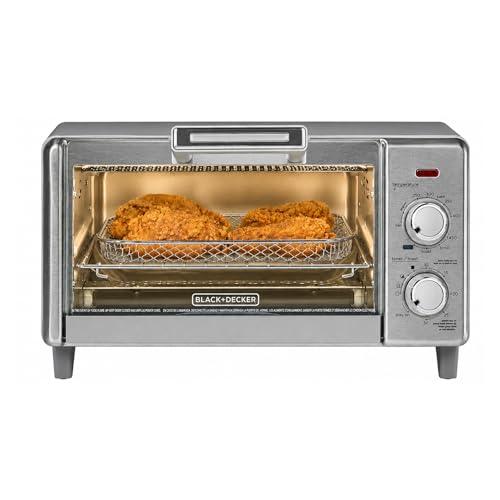
Pros & Cons
Pros
- Air Fry, Bake, Broil, Toast, and Keep Warm settings cover common breakfast, snack, and small-meal tasks.
- The compact 11.5 by 15.5 by 8.2-inch footprint is easier to place in kitchens with limited worktop space.
- EvenToast technology is designed to provide consistent browning without concentrated hot spots.
- At 9.14 pounds, the oven is manageable to reposition when counter space is needed.
Cons
- The 9-inch pizza and four-slice capacity may be too limited for larger families or full-size meals.
- The 30-minute timer may need to be reset when preparing recipes that require longer cooking times.
Details
This compact 5-in-1 oven handles air frying, baking, broiling, toasting, and warming, reducing the need for multiple small appliances in a crowded kitchen.
Air frying uses little to no oil for crisp foods, while EvenToast technology helps four bread slices brown consistently without noticeable hot spots.
Its stainless-steel color, 11.5 by 15.5 by 8.2-inch dimensions, and 9.14-pound weight suit daily countertop use and occasional repositioning.
The medium interior fits only a 9-inch pizza or four bread slices, so it is not intended for large-batch cooking.
Best for small households, apartment kitchens, and cooks preparing compact meals or snacks.
How to Use
Select Air Fry, Bake, Broil, Toast, or Keep Warm based on the food, then set the 30-minute timer and monitor doneness through the oven door.
Use the mesh tray for air frying, the bake pan for baked foods, and the wire rack for toast or dishes needing direct heat circulation.
Keep food clear of the heating element, use the drip tray while cooking, and remove crumbs or drippings after the oven cools.

Pros & Cons
Pros
- Compact construction fits kitchens where counter space is limited.
- Adjustable temperature controls provide more cooking flexibility than a basic toaster.
- The included wire rack and non-stick back pan support different foods and cooking tasks.
- A 15-minute timer suits quick breakfast items, snacks, and reheating.
Cons
- The 15-minute timer may require resetting for foods that need longer cooking.
- The 650-watt output is suited to compact tasks rather than high-volume cooking.
Details
The Elite Gourmet ETO236 is a compact 2-slice toaster oven for kitchens that need to toast, warm, or bake without using a full-size oven.
Its 200°F to 450°F temperature range handles more than basic toasting, while the 15-minute timer supports quick snacks and breakfast items.
The compact body, wire rack, and non-stick back pan suit daily countertop use and provide flexible food placement.
The short 15-minute timer limits longer cooking sessions and may require repeated settings.
Best for small-kitchen buyers who want a compact oven for quick, low-volume cooking.
How to Use
Place food on the wire rack or non-stick back pan, then select a temperature between 200°F and 450°F.
Set the timer for up to 15 minutes and monitor food as it toasts, warms, or bakes.
Use the included pan for foods that may drip, and allow the oven to cool before cleaning.

Pros & Cons
Pros
- Five cooking functions replace multiple appliances, saving counter space in smaller kitchens.
- Large capacity accommodates meal prep and family portions without requiring batch cooking.
- Air fry basket produces crispy results on frozen foods and breaded items with minimal oil.
Cons
- 60-minute timer requires monitoring for longer recipes like roasts or slow-baked dishes.
- Glass door can accumulate grease splatter during air frying, requiring regular wiping between uses.
Details
The BLACK+DECKER Crisp ‘N Bake solves the problem of wanting crispy fried food without deep frying or heating a full oven.
Air fry technology circulates high-intensity hot air around food, creating a crispy exterior with little to no oil. The convection fan ensures even browning across the entire cooking surface, important for batch cooking fries or chicken wings.
Stainless steel exterior resists fingerprints and kitchen grime. The 6-slice interior capacity means less batch cooking for families. Countertop footprint fits standard kitchen spaces without requiring dedicated cabinet installation.
The 60-minute timer works for most recipes but requires resetting for longer bakes like casseroles or roasts.
Best for households that want healthier frying options and a compact alternative to full-size convection ovens.
How to Use
For air frying, preheat the unit for 3 minutes, place food in the air fry basket in a single layer, and set temperature between 350-400°F. Shake the basket halfway through cooking for even crisping.
For toasting, use the toast setting dial to select shade level. Position bread directly on the wire rack for best results. Watch through the glass door as darker settings can brown quickly.
Clean the crumb tray after every few uses by sliding it out from the bottom. Wipe the glass door and interior with a damp cloth once cooled. The air fry basket and accessories are hand-wash recommended to preserve nonstick coating.
How We Evaluated These Picks
This guide is research-based, not a hands-on test. We did not buy, cook with, or measure the products above. What we did compare: manufacturer specifications, materials and construction, capacities and wattages, and the patterns that repeat across large volumes of verified owner reviews — especially the complaints that only surface after weeks of use, like coatings failing, motors weakening, controls drifting, or a design proving awkward to clean and store.
Where this page describes how something performs, it is reporting what the specifications state and what owners consistently report — not a result we produced ourselves. Prices and availability change constantly, so check the current listing before buying. We earn a commission on purchases made through links on this page, which never affects which products we include or how we rank them.
The Two Finalists
The Breville Smart Oven Pro (B00XBOXVIA) and the Cuisinart Custom Classic (B00GGFHH4U) share an 1800-watt power rating, a comparable mid-size cavity, and the same fundamental quartz-element architecture. They diverge sharply on everything else. The Breville layers convection, ten preset cooking functions, an interior light, and Element IQ heat-management software onto a feature-rich premium chassis. The Cuisinart strips the toaster oven back to three core functions in a non-stick interior built for decade-scale reliability. The question isn’t which is “better.” It’s which design serves the way you actually cook.
Side by Side: Breville Smart Oven vs Cuisinart TOA-60
Cavity Size and Real Capacity
The Breville Smart Oven Pro lists a 0.8 cubic-foot interior, which translates to fitting a 13-inch pizza, a 9×13 baking pan, or six slices of bread across two racks. That’s the spec sheet figure. In practice, useable depth runs about 11.5 inches once you account for the rear element shroud, and the front-to-back clearance on the upper rack drops to roughly 10 inches because of the heating coil drop. Six slices of bread is accurate. Eight is not, despite what some retailer pages claim. A whole 4-pound chicken fits with about half an inch of head clearance, which is enough for skin crisping but tight enough that you can’t add foil-tented stages.
The Cuisinart Custom Classic posts a 0.6 cubic-foot interior, but the geometry is different. The cavity is squatter and wider, which sounds worse but fits a 12-inch pizza, four slices of bread, and a 9×9 square pan comfortably. The 4-pound chicken does not fit. A 3-pound bird does, barely. The real distinction shows up in casserole work. The Cuisinart’s wider stance handles a 9×13 dish that’s been swapped for a similar-volume oval ceramic, while the Breville’s depth handles taller items like Dutch oven-shaped baking vessels that the Cuisinart can’t accommodate. For a household of two cooking weeknight portions, either is sufficient toaster oven capacity. For a household of four cooking sheet-pan dinners, the Breville’s extra depth becomes the deciding factor.
Heating Elements and Even Browning
The Breville Smart Oven Pro runs five quartz heating elements managed by what the company calls Element IQ — a control algorithm that pulses individual elements rather than running them all at full draw. The result is meaningful for two specific tasks. First, toast browning consistency across all six slots improves visibly compared to a four-element toaster oven; corner slots brown within roughly 8% of center slots rather than the typical 20-30% lighter you’d see on cheaper units. Second, the top elements throttle independently for broiling, which prevents the surface-scorching-while-center-stays-cold problem that haunts most countertop ovens. The trade-off is preheat time. The pulsed-element approach takes about 4.5 minutes to hit 400°F from cold start. A simpler four-element design does it in 3.
The Cuisinart Custom Classic uses four quartz elements on a fixed-power circuit. Toast distribution is honest — slot-to-slot variance runs about 18-22% darker on the rear positions versus the front, which most owners learn to manage by rotating slices. Where the Cuisinart actually excels is broil intensity. Both top elements run at full 900-watt draw simultaneously, which produces a tighter, hotter broil zone for tasks like cheese melting and quick reverse sears. Preheat to 400°F lands at about 3 minutes flat. For everyday toast and bake work, the Cuisinart is faster to operating temperature; for picky toast distribution or low-temperature controlled baking, the Breville’s pulsed elements pull ahead. Neither toaster oven matches a true full-size convection range, but both clear the bar for countertop work.
Convection and Air-Fry Performance
The Breville Smart Oven Pro has a true convection fan mounted in the rear wall, drawing air across the elements and circulating it through the cavity at roughly 350 CFM. Convection mode adds about 20-25°F of effective temperature, which most preset functions automatically compensate for. Real-world impact: a tray of frozen fries hits visible crisping in about 14 minutes versus 22 minutes in static mode. Roasted vegetables develop browning on all sides instead of only the top. The fan is moderately loud at speeds above 70%, which sits around 58 dB at three feet — not enough to interrupt conversation, but noticeable.
The Cuisinart Custom Classic has no convection fan. This is the single biggest functional gap between the two finalists, and it’s deliberate. Cuisinart bracketed this toaster oven as a no-frills broiler-toaster-baker, which means tasks like air-fried wings, evenly browned cookies, or large-batch roasting will run noticeably slower and less evenly than they do in the Breville. For owners who only bake, toast, and broil, that gap is irrelevant. For owners who saw “air fry” on the Breville feature list and got interested, the difference is the entire reason to spend the extra money. Note that the Breville Smart Oven Pro itself doesn’t have an explicit “air fry” preset — that feature appears on the Breville Smart Oven Air Fryer (BOV860BSS), a different model. If basket-style air frying is the priority over an oven cavity, that’s a separate appliance decision worth examining.
Build Quality and Long-Term Reliability
The Breville Smart Oven Pro uses a die-cast aluminum housing wrapped in brushed stainless steel, with an enamel-coated interior cavity. The door is double-pane glass with a magnetic auto-eject rack hook that pulls the middle rack forward when you open the door. Aggregated long-term reviews across major retailers show a consistent failure pattern: the LCD interface or one of the control electronics tends to fail somewhere between years 4 and 7, while the heating elements themselves typically outlast the controls. Authorized service exists, and replacement boards run about $80-110 plus labor. Owners who don’t repair tend to replace rather than fix, which depresses resale value below what you’d expect from the price tag.
The Cuisinart Custom Classic uses a brushed stainless steel exterior over a non-stick interior cavity. Build complexity is lower — no LCD, no convection fan, no preset memory — and that simplicity is the entire reliability argument. Failure data across the same retailer aggregations shows units lasting 8-12 years in regular weekly use before the heating elements drift out of calibration enough to require replacement. There’s no electronics layer to fail because there is no electronics layer. The non-stick interior does wear over time, and aggressive scrubbing removes it within 3-4 years, which becomes a cleaning annoyance rather than a functional issue. For a toaster oven you want to install once and forget about, the Cuisinart’s simpler architecture genuinely wins. For a toaster oven you want to use as a small primary oven, the Breville’s feature set justifies the higher failure rate.
What the Other Three Bring
Breville BOV450XL Mini Smart Oven: Compact Pick for Apartment Counters
The Breville Mini Smart Oven (B006CVVA7I) is the small-cavity sibling to the Smart Oven Pro, designed for kitchens where counter depth is genuinely tight. The 0.4 cubic-foot interior fits a 12-inch pizza or four slices of bread, but won’t accept a 9×13 pan. The 1800-watt rating is the same as the Pro, which means it heats fast and broils aggressively for its size; the chassis dimensions just won’t let it scale up to family-of-four sheet-pan dinners. Element IQ pulse-control technology carries over, so toast browning consistency stays strong across the smaller bread positions, and the LCD interface preserves the eight preset functions including bagel, bake, and reheat. What you lose besides volume: convection, the slow-cook function, and the dehydrate preset. The trade-off makes sense in studio apartments and RVs where every counter inch matters and you weren’t planning to roast a chicken in your countertop oven anyway. Pricing typically sits about 40% below the Pro despite preserving most of the user-facing intelligence, which is why this toaster oven keeps showing up on small-kitchen recommendation lists year after year.
Emeril Lagasse French Door 360: XL Combo for Households That Cook Volume
The Emeril Lagasse French Door Air Fryer Oven (B09B7SB46R) sits in a different category from the other four toaster ovens on this list. The 26-quart interior — roughly 1.0 cubic-foot when converted — fits a 14-inch pizza, a full 9×13 pan with handles, and a 6-pound chicken with room to spare. The dual French doors open outward together with a single pull, which removes the swing-arc footprint that single-door toaster ovens demand. Twenty-four preset cooking functions span air fry, dehydrate, slow cook, rotisserie, pizza, and reheat modes, with a digital control panel that handles temperature in 25°F increments up to 450°F. Build quality is honest mid-tier; the chassis is stamped steel rather than die-cast, and the door hinges show some flex under load. Long-term reliability data is shorter (the model line is newer than the Breville or Cuisinart competitors), but two-year ownership reports cluster around solid satisfaction for users who actually wanted a small primary oven replacement rather than a supplementary toaster oven. Choose this if your full-size oven is broken, doesn’t get used, or your kitchen layout makes pulling out the oven door inconvenient. Skip it if your countertop is under 18 inches deep, because this unit takes the space.
Black+Decker TO1313SBD: Budget Pick for Light Daily Use
The Black+Decker TO1313SBD (B004JMZGM2) is the budget toaster oven that owners actually keep instead of upgrading away from. The 0.4 cubic-foot interior fits four slices of bread and a 9-inch pizza, which is enough for the breakfast-and-snack use case that most households actually run their countertop oven for. The 1150-watt power rating is lower than the others on this list, which means preheat takes about 6 minutes and high-heat broiling is genuinely weaker than what the Breville or Cuisinart can produce. Where this toaster oven wins is the price-to-reliability ratio. The mechanical dial controls have no electronics to fail, the cavity is large enough for daily toast-and-reheat work, and the build quality is good enough that two to three years of weekly use is realistic. Beyond year three, the heating elements drift and the timer dial gets sticky, but at the price point that’s an acceptable depreciation curve. Buy this if your toaster oven needs are toast, frozen pizza, and occasional reheating, and you don’t want to spend more than you’d spend on a quality basic kettle. Skip it if you plan to bake from scratch or cook anything that needs precise temperature control.
When You Should Look Outside This List
A toaster oven isn’t the right answer for every kitchen, and the buyer profile where it pays off is narrower than the retailer marketing implies. Skip the toaster oven category entirely if you have a full-size convection oven you actually use. The full-size oven outperforms every countertop toaster oven on every metric except preheat speed and energy efficiency for tiny loads. The toaster oven’s case rests on the assumption that you’d otherwise run a 5-cubic-foot full-size oven to bake four cookies, which is wasteful, slow, and heats your kitchen during summer. If you already cook three or more meals a week in your built-in oven, the toaster oven becomes a redundant footprint rather than a useful supplement. The 1.5 square feet of counter space it claims would be better spent on a cutting board.
Skip the toaster oven if your countertop space is under 14 inches deep. The Breville Smart Oven Pro is 16.5 inches deep with about 4 inches of rear clearance required for ventilation, which puts the minimum counter requirement at 20.5 inches. Anything shallower forces the oven to stick out past the counter edge, which is both a tipping hazard and an ergonomic problem when you try to load a hot pan into it. The Breville Mini Smart Oven cuts the depth to 14.5 inches and is the right answer if your counter is tight, but even it needs about 3 inches of rear clearance. RV kitchens, narrow galley apartments, and tiny-home builds need to measure twice before committing to any toaster oven larger than the Breville Mini.
Skip the toaster oven if you primarily want air-fried food rather than baked or roasted food. Basket-style air fryers move air at significantly higher velocities than a toaster oven convection fan can manage, which produces tighter crisping on smaller volumes of food at the cost of giving up the bake-and-roast capabilities. If 80% of what you’d cook in the appliance is frozen fries, wings, and reheated leftovers, a dedicated basket air fryer outperforms even the Breville’s convection mode at half the counter footprint.
Skip the toaster oven if you don’t drink coffee or tea daily — a counter slot is precious, and a best electric kettle often delivers more weekly utility per square inch than a second oven that duplicates your existing range. The toaster oven’s value proposition is volume-cooking-without-firing-up-the-big-oven, not toast and reheating, both of which are solved more cheaply by a pop-up toaster and a microwave. Match the appliance to the actual cooking pattern.
Questions Readers Ask Most
How is a toaster oven different from an air fryer combo?
A toaster oven is built around a rectangular cavity with horizontal heating elements optimized for baking, broiling, and toasting flat items. An air fryer combo adds an aggressive convection fan and a perforated basket to that cavity, which produces basket-style crisping in addition to the baking functions. The Breville Smart Oven Pro is a toaster oven without explicit air-fry presets. The Emeril French Door is a toaster oven plus a strong convection-fry mode. The Cuisinart Custom Classic is a pure toaster oven with no fan.
Do convection elements really matter for toast?
For toast specifically, no. Toast browning is driven by direct radiant heat from the top and bottom elements, not by air circulation. Convection helps with bake-and-roast tasks where even browning across a tray matters. Element distribution and individual element-pulse control (like the Breville’s Element IQ) matter for toast consistency more than convection ever will. A four-element non-convection toaster oven can produce excellent toast if the element placement is right.
How much counter space do these really need?
Plan on at least 20 inches of counter depth and 18 inches of width for any mid-size toaster oven, plus 4 inches of rear ventilation clearance and 6 inches of overhead clearance to safely vent steam from the door. The Breville Mini fits in tighter quarters at about 16 inches deep total, but anything labeled “Pro,” “XL,” or “Smart Oven” above the Mini tier is going to demand a dedicated counter zone. Measure first.
Why are some toaster ovens twice the price?
The price gap is driven by three things: convection (adds a fan and the controls to manage it), preset functions (each preset is a calibrated thermal curve, not just a label), and element-management software like Element IQ that pulses individual elements rather than running them at fixed power. Premium toaster ovens also use double-pane glass doors, die-cast aluminum chassis, and longer-warranty electronics. Whether those features justify the price depends on whether you’d actually use the convection and presets weekly. Most owners don’t, and a $90 toaster oven serves them as well as a $300 one.
Related Guides
- Air Fryer Buying Guide
- Air Fryer vs Deep Fryer
- Air Fryer vs Toaster Oven
- How to Clean a Toaster Oven
- How to Clean an Air Fryer
- How to Cook Frozen Food in an Air Fryer
The Verdict
For households that bake, roast, and broil weekly and want a small primary oven that can stand in for the full-size range, the Breville Smart Oven Pro is the right toaster oven. The convection, the preset library, and the Element IQ heat distribution genuinely pay back the higher price across cooking patterns where evenness matters. For households that want a toaster oven that does toast-bake-broil for fifteen years without thinking about it, the Cuisinart Custom Classic is the right answer at roughly a third of the price. The Breville Mini is the compact-counter pick that preserves the smart features in a smaller footprint. The Emeril French Door is the volume-cooking pick for households whose full-size oven sits unused. The Black+Decker is the budget pick for light daily toast-and-reheat duty.
- If you cook varied recipes weekly and want convection, buy the Breville Smart Oven Pro.
- If you want a no-frills toaster oven that’ll outlast everything else on your counter, buy the Cuisinart Custom Classic.
- If your counter is under 16 inches deep or you live in a small apartment, the Breville Mini is the right toaster oven.





Write Your Review
No reviews yet. Be the first to share your experience!