

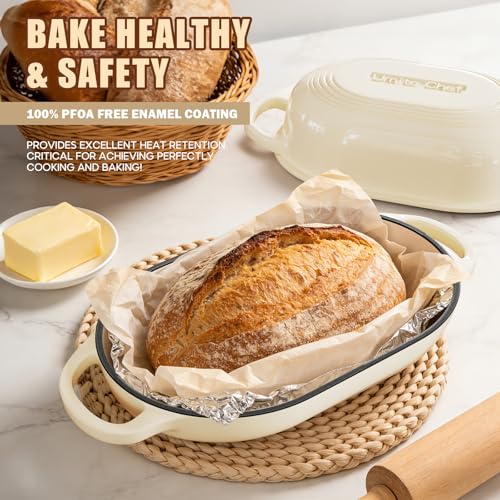
Remember the no-knead recipe everyone tried during the 2020 lockdowns? The one Mark Bittman popularized, where you mix flour, water, salt, and a pinch of yeast in a bowl the night before, then bake it in a covered pot the next morning? Half the home cooks who attempted it ended up with the same disappointing result — a flat, dense loaf with a leathery crust and a tight, gummy crumb. The recipe promised bakery-style bread with virtually no effort. The reality, baked in a thin-walled stockpot or a borrowed enameled saucepan, was a hockey puck. The problem wasn’t the recipe. The problem was the vessel. A regular pot doesn’t trap steam the way a real bread-baking environment needs to, and once you understand that, the choice of the right dutch oven for bread baking becomes the single most important decision you make as a home baker. If you’re rebuilding your kitchen from scratch, you might also want to look at best cookware sets to anchor the rest of your cooking. Why does a dutch oven work where a stockpot fails? It comes down to physics. When dough enters a 475-500°F oven inside a sealed, preheated cast iron vessel, the moisture released by the loaf is trapped against the dough’s surface. That steam keeps the crust soft and flexible for the first 20-25 minutes, allowing the loaf to expand fully — what bakers call “oven spring.” Then, when you remove the lid for the final 20 minutes, the now-dry oven air caramelizes the surface into the dark, crackly crust that defines a great country loaf. A dutch oven for bread baking essentially turns your home oven into a steam-injected hearth oven, which is exactly the equipment professional bakeries use to produce the loaves you’ve been trying to replicate at home.

For more, see our Baking Essentials Buying Guide and Cookware Buying Guide guides.
The Best Deals This Week*
-
Bread Baking and Braising Dutch Oven
$29.99
($34.99)Save $5.00 -
Bread Baking Dutch Oven: CRUSTLOVE 5 QT
$59.99
($69.99)Save $10.00
*Deals are selected by our commerce team
Deeper Dive: Our Top Picks
Our Top Picks
Umite Chef
Sourdough Bread Baking Dutch Oven Kit: Umite Chef 5QT Enameled Cast Iron Bread Oven
The Umite Chef 5QT enameled cast iron bread oven traps steam for crisp crusts and soft, airy sourdough while including the tools needed from proofing through cleanup. It suits beginners and home bakers who want an all-in-one bread setup that also handles stews, braises, vegetables, pasta, and meatloaf.
Pros and Cons
Pros
- The 9-in-1 kit covers preparation, proofing, scoring, baking, handling, and cleanup.
- The enameled cast iron works on induction and other cooktops and is oven-safe to 500°F.
- The pot supports both artisan bread baking and everyday cooking such as sauces, pasta, and braises.
- The included stainless steel tools are food-grade and rust-resistant.
Cons
- Cast iron is inherently heavy, and the product listing does not provide the set's total weight.
- The 5QT capacity may limit bakers who regularly make very large loaves or multiple loaves at once.

AIVIKI
Bread Baking and Braising Dutch Oven: AIVIKI 5QT Enameled Cast Iron Pot With Lid
The AIVIKI 5-quart enameled cast iron Dutch oven retains and distributes heat for bread baking, braising, stews, and roasting, while its lid helps keep food moist. It suits cooks serving four to six people who want versatile oven-to-table cookware with an enamel finish that handles acidic foods.
Pros and Cons
Pros
- Oven safe up to 500°F for bread baking, roasting, broiling, and other high-heat recipes.
- Enamel coating provides a lighter interior that makes browning and bread development easier to monitor.
- Wide-looped handles and included cotton potholders support more convenient handling.
- The cast iron body distributes heat evenly and maintains a steady cooking temperature.
Cons
- Cast iron is heavy, and the product data does not specify its exact weight.
- Hand washing is recommended, and the pot should not be used on a grill or over an open flame.

CRUSTLOVE
Bread Baking Dutch Oven: CRUSTLOVE 5 QT Pre-Seasoned Cast Iron Oven with Baking Kit
The CRUSTLOVE 5-quart pre-seasoned cast iron Dutch oven uses even heat to help produce bread with a crisp crust, while including tools for mixing, proofing, scoring, and baking. It suits home bakers making sourdough or whole-grain bread who want a ready-to-bake starter kit with recipes.
Pros and Cons
Pros
- The 5-quart Dutch oven is designed specifically for bread baking.
- The kit includes a proofing basket, silicone bead sling, scoring lame, dough whisk, and recipes.
- Pre-seasoned cast iron provides even heat for artisan-style bread baking.
- The included tools and ready-to-gift presentation make it a convenient bread-baking gift.
Cons
- The 5-quart capacity may not suit buyers who regularly bake larger loaves.
- The product listing does not provide the cast iron oven's weight, which matters when moving it between storage and the oven.
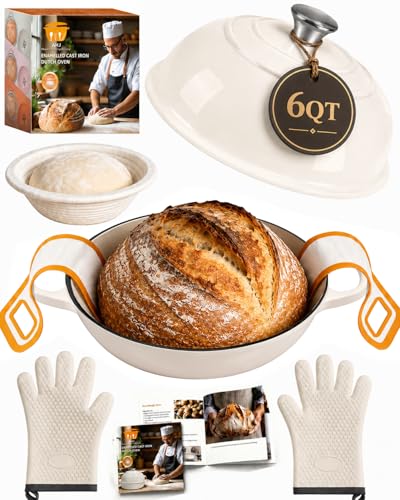
AHJ
Sourdough Bread Baking Dutch Oven: AHJ 6QT Enameled Cast Iron Bread Oven Set
The AHJ 6QT Dutch oven bakes sourdough and crusty loaves with steam-trapping dome-lid circulation and even heat distribution. It suits beginners and experienced home bakers who want a bread-baking set with a proofing basket, sling, and silicone mitts included.
Pros and Cons
Pros
- The 6QT cast iron design and dome lid are tailored to artisan-style bread baking.
- The set includes a proofing basket, liner, silicone sling, mitts, and instruction manual.
- The triple-layer enamel coating resists rust and helps simplify cleanup.
- The pot is oven-safe to 500°F and works on gas, induction, and electric stovetops.
Cons
- The product data does not provide the pot's weight, which matters when lifting hot cast iron.
- The listed rating has no accompanying review details, so long-term user experience is not yet established.

Northriver Casting
Sourdough Bread Baking Dutch Oven: Northriver Casting 5 Qt Enameled Oval Bread Pot
The Northriver Casting enameled cast iron oval Dutch oven creates a steam chamber for tall sourdough loaves, with its biggest advantage being a deep lid and shallow base that can be used together or separately. Home bakers who want bakery-style crusts and a versatile 5-quart pot should consider it for bread, slow cooking, and everyday meals.
Pros and Cons
Pros
- The two-piece enamel design can function as a Dutch oven or a dedicated bread-baking setup.
- The 500°F oven-safe construction supports high-heat sourdough baking.
- The enamel coating resists stains, odors, and rust without regular seasoning.
- The oval 12 x 8-inch shape accommodates artisan loaves while remaining useful for family meals.
Cons
- The 500°F maximum temperature limits use in recipes requiring higher heat.
- The 12 x 8-inch oval format may be less suitable for unusually large or round loaves.
Editors' Picks
Umite Chef Sourdough Bread Baking Dutch Oven Kit: Umite Chef 5QT Enameled Cast Iron Bread Oven
Umite Chef
Sourdough Bread Baking Dutch Oven Kit: Umite Chef 5QT Enameled Cast Iron Bread Oven
The Umite Chef 5QT enameled cast iron bread oven traps steam for crisp crusts and soft, airy sourdough while including the tools needed from proofing through cleanup. It suits beginners and home bakers who want an all-in-one bread setup that also handles stews, braises, vegetables, pasta, and meatloaf.
$54.99 at AmazonEditors' Favorite
Color: Cream White Size: 5qt Dimensions: 1 x 1 x 1 inches Weight: 13.34017147362 pounds Product Group: Kitchen Binding: Unknown Binding
Shop NowAIVIKI Bread Baking and Braising Dutch Oven: AIVIKI 5QT Enameled Cast Iron Pot With Lid
AIVIKI
Bread Baking and Braising Dutch Oven: AIVIKI 5QT Enameled Cast Iron Pot With Lid
The AIVIKI 5-quart enameled cast iron Dutch oven retains and distributes heat for bread baking, braising, stews, and roasting, while its lid helps keep food moist. It suits cooks serving four to six people who want versatile oven-to-table cookware with an enamel finish that handles acidic foods.
$29.99 at AmazonGreat Value
Color: Cream White Size: 5 quarts Dimensions: 1 x 1 x 1 inches Weight: 14.109584768 pounds Product Group: Kitchen
Shop NowCRUSTLOVE Bread Baking Dutch Oven: CRUSTLOVE 5 QT Pre-Seasoned Cast Iron Oven with Baking Kit
CRUSTLOVE
Bread Baking Dutch Oven: CRUSTLOVE 5 QT Pre-Seasoned Cast Iron Oven with Baking Kit
The CRUSTLOVE 5-quart pre-seasoned cast iron Dutch oven uses even heat to help produce bread with a crisp crust, while including tools for mixing, proofing, scoring, and baking. It suits home bakers making sourdough or whole-grain bread who want a ready-to-bake starter kit with recipes.
$59.99 at AmazonColor: Cast Iron Size: 5QT Dutch Oven Dimensions: 10 x 10 x 4.5 Inches Product Group: Kitchen Binding: Kitchen
Shop NowAHJ Sourdough Bread Baking Dutch Oven: AHJ 6QT Enameled Cast Iron Bread Oven Set
AHJ
Sourdough Bread Baking Dutch Oven: AHJ 6QT Enameled Cast Iron Bread Oven Set
The AHJ 6QT Dutch oven bakes sourdough and crusty loaves with steam-trapping dome-lid circulation and even heat distribution. It suits beginners and experienced home bakers who want a bread-baking set with a proofing basket, sling, and silicone mitts included.
$39.99 at AmazonColor: Ivory white Dimensions: 10.5 x 10.5 x 6 inches Weight: 13 Pounds Product Group: Kitchen Binding: Kitchen
Shop NowNorthriver Casting Sourdough Bread Baking Dutch Oven: Northriver Casting 5 Qt Enameled Oval Bread Pot
Northriver Casting
Sourdough Bread Baking Dutch Oven: Northriver Casting 5 Qt Enameled Oval Bread Pot
The Northriver Casting enameled cast iron oval Dutch oven creates a steam chamber for tall sourdough loaves, with its biggest advantage being a deep lid and shallow base that can be used together or separately. Home bakers who want bakery-style crusts and a versatile 5-quart pot should consider it for bread, slow cooking, and everyday meals.
$42.99 at AmazonColor: 12"×8" Oval Blue Size: 12×8 5QT Dimensions: 15 x 8.2 x 5.7 inches Product Group: Kitchen Binding: Unknown Binding
Shop NowHow We Evaluated These Picks
This guide is research-based, not a hands-on test. We did not buy, cook with, or measure the products above. What we did compare: manufacturer specifications, materials and construction, capacities and wattages, and the patterns that repeat across large volumes of verified owner reviews — especially the complaints that only surface after weeks of use, like coatings failing, motors weakening, controls drifting, or a design proving awkward to clean and store.
Where this page describes how something performs, it is reporting what the specifications state and what owners consistently report — not a result we produced ourselves. Prices and availability change constantly, so check the current listing before buying. We earn a commission on purchases made through links on this page, which never affects which products we include or how we rank them.
The Picks
| Dutch Oven | Best For | Capacity | Material |
|---|---|---|---|
| Lodge 6-Quart Enameled Cast Iron | All-around weekly baking | 6 qt | Enameled cast iron |
| Cuisinart Chef’s Classic Enameled | Budget-conscious bakers | 7 qt | Enameled cast iron |
| Le Creuset Signature Round | Heirloom-quality investment | 5.5 qt | Enameled cast iron |
| Lodge Bare Cast Iron Combo Cooker | Open-bake, batard shapes | 3.2 qt | Bare cast iron |
| Lodge L8DOL3 Pre-Seasoned | High-heat sourdough at 500°F+ | 5 qt | Bare cast iron |
What Goes Wrong With Dutch Oven Bread Baking
The most common failure mode isn’t dough — it’s hardware. The black plastic or phenolic knob on the lid of many entry-level enameled dutch ovens is rated to about 375 to 400 degrees Fahrenheit. Bread bakes at 475 to 500, sometimes higher for the first ten minutes when you’re trying to drive maximum oven spring. The knob softens, browns, and over enough bakes it warps or detaches entirely. Some bakers swap in a stainless steel replacement knob from the manufacturer; others remove the original and leave the hole open, which defeats the steam-trapping purpose. Before buying any dutch oven for bread baking, you need to confirm the knob’s temperature rating. If it’s not stainless or solid metal, expect to replace it within the first few weeks of regular baking.
The second failure is lid fit. A heavy dutch oven lid sits on a precision-machined rim, and on a well-made pot the seal is nearly airtight at baking temperatures. On cheap dutch ovens, the rim is rough, the lid rocks slightly, and steam escapes through visible gaps within the first few minutes. You can see this happen if you bake with the oven light on — wisps of vapor leaking out, a sure sign that your loaf isn’t getting the steam bath it needs. The result is exactly what frustrated the 2020 bakers: a pale, tight crust that doesn’t bloom. A dutch oven for bread baking only works if the lid actually seals against the pot rim under the weight of its own cast iron.
The third trouble area is shape and size. A 6-quart round dutch oven is wide enough to accommodate a 700 to 900 gram boule, but a 4-quart round constrains the loaf, forcing it to grow upward into the lid and producing a domed, mushroom-shaped bake. Loading hot bread dough into a tall, narrow vessel is also genuinely dangerous — you’re leaning over a 500-degree pot trying to lower a sticky, slack ball of dough without burning your knuckles. Many home bakers have learned the hard way that the round shape they bought for stews is the wrong tool when bread becomes a weekly habit. The right dutch oven for bread baking has a wide enough mouth that you can drop a loaf in cleanly with the help of parchment paper, and the diameter to let the dough spread without trapping itself against the walls.
What You Actually Need
Shape and Loaf Proportions
The shape of your dutch oven for bread baking determines the shape of your finished loaf. Round dutch ovens produce classic boules — the dome-shaped country loaves you see on bakery shelves. Oval dutch ovens produce batards, the longer, log-shaped loaves better suited to slicing for sandwiches. Most home bakers start with round because it’s the more versatile vessel for cooking other things, but if your goal is sandwich bread, an oval saves you the awkward step of shaping a round loaf into a rectangle. Capacity matters more than people realize. A 5.5 to 6 quart round comfortably holds a 750 to 900 gram boule with room to bloom. A 4-quart round is fine for smaller test batches but will compress a full-size loaf. If you bake larger loaves — a 1 kilogram country sourdough, for instance — step up to a 7-quart. Conversely, a 9-quart is overkill and the empty space allows steam to dissipate too quickly. The classic Lodge combo cooker, a shallow skillet that doubles as a lid for a deeper base, is a clever exception: you bake the loaf in the shallow half, then invert the deep half as the dome, which makes loading much safer. For a single dutch oven for bread baking that handles 80 percent of recipes, 5.5 to 6 quarts round is the sweet spot.
Lid Fit and Steam Retention
Steam is the entire reason a dutch oven for bread baking outperforms a baking stone or sheet pan. The first 20 to 25 minutes of the bake, with the lid on, create a closed humid chamber where the dough surface stays moist and pliable. That moisture is what allows the loaf to expand fully before the crust sets. If steam leaks out through a poorly fitted lid, the surface dries within 5 to 10 minutes and the dough can no longer rise — the crust hardens prematurely, the interior stops expanding, and you get a small, dense loaf. Check lid fit by placing the lid on a cool pot and rotating it. A good lid sits flush with minimal wobble and won’t slide off if you tilt the pot 15 degrees. Better lids have a small recessed flange that locks into the rim. Le Creuset and Staub both engineer their lids with a slightly heavier weight than competitors, which presses down on the steam and creates a tighter seal at temperature. Bare cast iron dutch ovens often have looser-fitting lids than enameled, which is one reason the Lodge combo cooker design — where the “lid” is actually a heavy skillet bottom — works so well. The weight forces the seal closed even without precision machining of the rim.
Knob and Handle Heat Tolerance
This is the single most common reason bakers replace their first dutch oven. Bread bakes hotter than almost anything else home cooks do — most recipes call for preheating the pot to 500 degrees empty, then baking the loaf at 475. Plastic or phenolic resin knobs are rated 375 to 400 degrees and will degrade quickly at bread temperatures. Some discolor and harden; others soften and warp; a few outright melt and release a chemical smell. Before buying any dutch oven for bread baking, look at the spec sheet for “knob material” or “max oven temperature.” Stainless steel knobs are oven-safe to 500 degrees and beyond indefinitely. Cast iron lid handles, the integrated loop-style handles on Lodge bare cast iron, are oven-safe to any temperature your oven can produce. Le Creuset sells a stainless replacement knob for around 15 to 20 dollars that fits most of their models, and the upgrade is worth doing immediately if you bought a dutch oven with a plastic knob. The side handles matter too — they need to be wide enough that you can grip them firmly with thick oven mitts, since a fully loaded preheated dutch oven for bread baking weighs 10 to 13 pounds and you do not want to fumble it onto a hot stovetop.
Material — Enameled vs Bare Cast Iron
Enameled cast iron — Le Creuset, Staub, Lodge enamel, Cuisinart, Tramontina — has a vitreous porcelain coating fused to the iron. The advantages for a dutch oven for bread baking are cleanliness (the enamel doesn’t react with sourdough’s acidity, doesn’t require seasoning, and wipes clean), aesthetics (you can take it from oven to table), and durability against rust. The disadvantages are weight (slightly heavier than bare cast iron of equivalent volume), cost (Le Creuset 5.5-quart is 400 dollars and up, Lodge enamel is 80 to 100, Cuisinart is 60 to 80), and the risk of chipping the enamel if you bang it or thermal-shock it by adding cold dough to a screaming-hot pot. Bare cast iron — the Lodge L-series, Field Company, Smithey — is unglazed iron that requires seasoning, a baked-on layer of polymerized oil. The advantages are price (a Lodge L8DOL3 5-quart is 35 to 50 dollars), tolerance for extreme heat (no enamel to crack at 550 degrees and above), and the natural non-stick character that develops over years of use. The disadvantages are maintenance (you cannot leave a wet loaf in it; you must dry and re-oil after washing) and the risk of rust if neglected. For most home bakers, enameled is the right call. For high-heat sourdough at 500 degrees and up, or for anyone who already maintains a cast iron skillet collection, bare iron is excellent and dramatically cheaper.
Choosing for Your Setup
If you bake a loaf every week: Get the 6-quart enameled cast iron. The Lodge enameled 6-quart at 80 to 100 dollars is the workhorse of weekly bakers — wide enough for a generous boule, deep enough that the lid never bumps the loaf, and an enamel coating that survives years of acidic sourdough without etching. Replace the knob with a stainless one if it ships with plastic. You will use this dutch oven for bread baking 50 or more times a year and also for braises, soups, and stews. The investment pays back in months versus buying separate vessels for each task, and the same pot will serve as the centerpiece of your Sunday cooking for the next decade.
If you bake occasionally and want one all-purpose pot: The Cuisinart 7-quart enameled is the budget pick that punches well above its price. At around 60 to 80 dollars it’s the cheapest enameled dutch oven worth owning, the 7-quart capacity gives you room for a large boule plus a Sunday pot roast, and the lid fit is genuinely good — not Le Creuset-tight but well within the range where steam retention works as intended. The trade-off is the plastic knob, which you should plan to swap. For a baker who’s still deciding how serious they are about bread, this is the lowest-risk entry point into using a dutch oven for bread baking on a regular schedule.
If you’ve outgrown a 4-qt dutch oven: Step up to either a 6-quart enameled or the Lodge combo cooker for safer loading. The combo cooker is a clever piece of design — a 3.2-quart skillet bottom plus a 10.25-inch deep skillet that inverts as the “lid.” Because you bake the loaf in the shallow half, there’s no awkward drop into a hot, deep pot; you place the dough on the skillet, score it, and lower the inverted deep pan over the top. It also fits batards better than any round dutch oven. If you’ve been wrestling with the dangerous loading step of a tall pot, this geometry will change your bread life. Round it out with a best cast iron skillet for beginners for the daily searing and frying tasks that a dutch oven isn’t ideal for.
Quick Answers
Why does my dutch oven lose steam during bake?
The lid fit is too loose, or the knob has a vent hole, or the lid is rocking on a warped rim. Check by listening — a properly sealed dutch oven should be nearly silent for the first ten minutes. Hissing or visible vapor at the seam means steam is escaping. Try rotating the lid to find the tightest seal position.
Can I bake bread in a stainless dutch oven?
You can, but the results are inferior. Stainless lacks the thermal mass of cast iron, so it doesn’t hold the screaming-hot temperature needed for oven spring. The crust will be thinner and the loaf will rise less. If stainless is what you have, preheat it 15 minutes longer than a cast iron recipe specifies and expect a paler crust.
How do I keep the knob from melting at high temp?
Replace the plastic knob with a stainless steel replacement, available from most manufacturers for 15 to 20 dollars. Some bakers simply unscrew the knob and bake with the open hole covered by a small piece of foil. Never bake bread at 475 degrees and above with a phenolic knob — even one bake at that temperature can warp it permanently.
What size dutch oven for a 700g loaf?
A 5.5 to 6-quart round is ideal. The loaf needs about 1.5 times its diameter in pot width to bloom fully without hitting the walls. A 4-quart will compress the loaf into a mushroom shape; a 7-quart works fine but the larger air volume cools faster when the lid comes off.
Does enameled coating crack from preheating?
Modern enamel from reputable brands (Lodge, Cuisinart, Le Creuset, Staub) is rated to 500 degrees empty and tolerates preheating without cracking. Cheaper off-brand enamel can craze or chip. Avoid thermal shock — never add cold dough to a screaming pot and then douse with cold water, and never plunge a hot enameled pot into cold water to clean it.
Related Guides
- Baking Essentials Buying Guide
- Cookware Buying Guide
- Enameled vs Bare Cast Iron
- How to Clean a Dutch Oven
- How to Line a Baking Sheet
- Lodge vs Le Creuset Dutch Oven
Final Verdict
A dutch oven for bread baking is the single most consequential piece of equipment you’ll buy as a home baker, and the difference between a good one and a poor one shows up in every single loaf you produce. The Lodge 6-quart enameled is the smart default — wide enough, deep enough, well-sealed, and affordable enough that it’s the pot most working bakers actually recommend to friends. Step up to Le Creuset if heirloom durability matters to you, or step sideways to the Lodge combo cooker if you bake batards or want the safest loading geometry available. Whatever you pick, replace any plastic knob immediately and confirm the lid seals tight before you commit to a weekly bake schedule. Bread baking rewards the right tools, and the dutch oven for bread baking that fits your habits will outlast you.
- If you bake weekly and want one pot to do it all, the Lodge 6-quart enameled cast iron is the answer.
- If you’re on a tight budget, the Cuisinart 7-quart delivers 90 percent of the performance at half the price.
- If you bake oval batards or have struggled with dangerous loaf-loading, the Lodge combo cooker reshapes the workflow entirely.




Write Your Review
No reviews yet. Be the first to share your experience!