

The conversation around nontoxic cookware has shifted dramatically over the past few years. Growing awareness of PFAS compounds — the so-called “forever chemicals” that include PFOA, PFOS, and related substances — has pushed home cooks to scrutinize what their pans are actually made of. Our team at HomeWhisk spent considerable time analyzing manufacturer specifications, third-party safety certifications, coating compositions, and aggregated user reviews from Amazon, Reddit’s r/Cooking and r/castiron communities, and cooking forums to compile this guide. The goal was to identify which nontoxic cookware options hold up under real scrutiny — not just marketing language. What emerged from that research is a clearer picture of the tradeoffs involved. “Nontoxic” is not a regulated term, which means brands use it in widely different ways. Some products are ceramic-coated and genuinely free of all PFAS chemicals. Others use newer-generation PTFE formulations that are PFOA-free but still technically fluoropolymer-based. Our team evaluated each category against material safety data, PFAS-free certifications, heat tolerance limits, and community-reported durability. If you are also comparing products from a broader slipperiness standpoint, our guides on best non stick cookware sets and best induction cookware cover those categories in depth.
For more, see our All Clad vs Cuisinart Cookware and Are Ceramic Cookware Sets Safe guides.
Editor’s Picks
| Category | Pick | Why |
|---|---|---|
| Best Overall | GreenPan Valencia Pro 11-Piece Set | Thermolon Minerals ceramic coating, PFAS/PFOA/lead/cadmium-free, hard anodized base |
| Best Ceramic | Caraway Home Cookware Set | Sol-Gel ceramic interior, widely verified PFAS-free, strong community reputation for easy release |
| Best for Induction | All-Clad D3 Stainless Steel Set | Tri-ply stainless, no coatings whatsoever, induction-compatible, oven-safe to 600°F |
The Best Deals This Week*
-
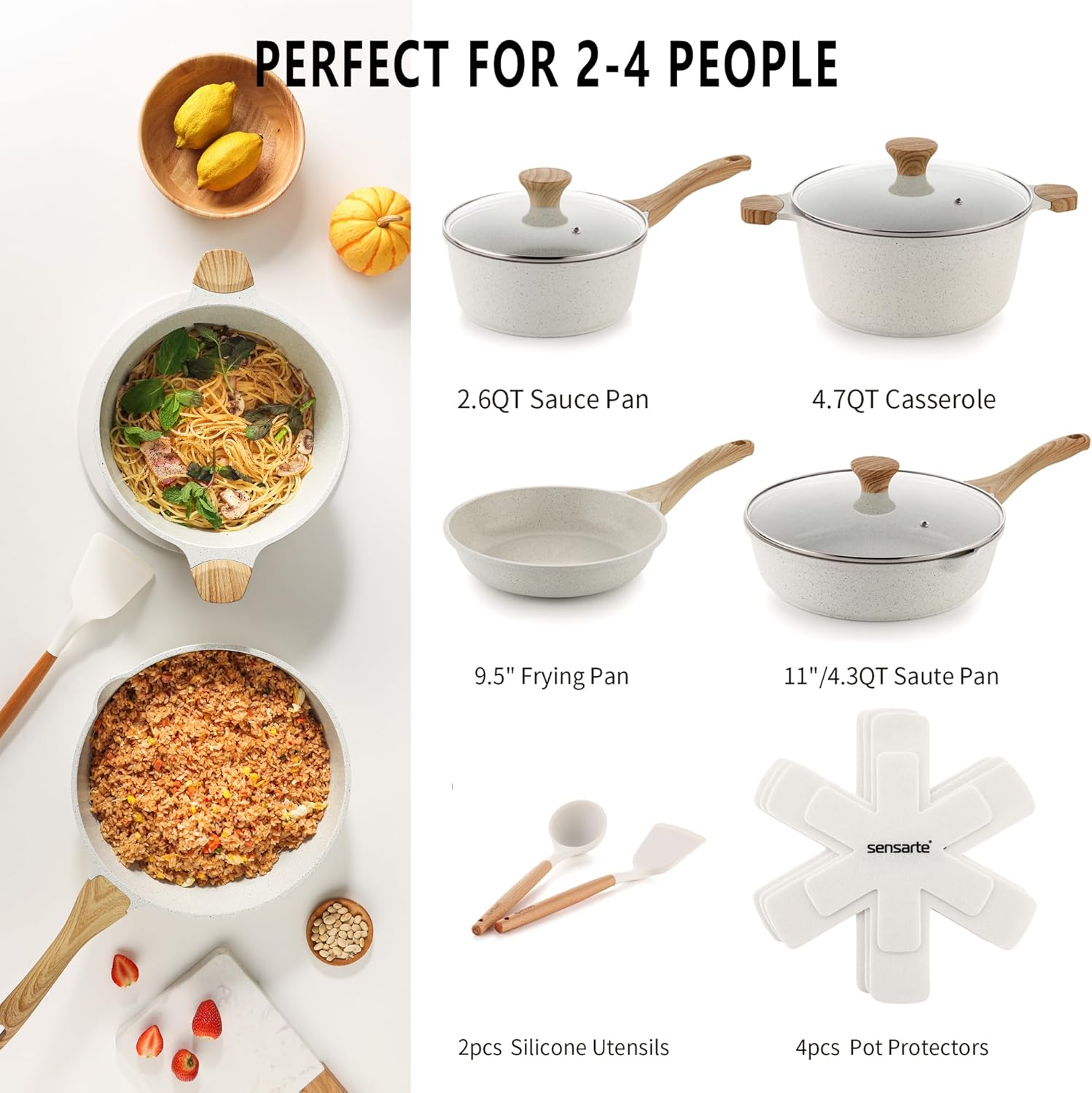
SENSARTE Ceramic Nonstick 13-Piece Cookware Set
$65.95
($109.95)Save $44.00 -
CAROTE 21-Piece Ceramic Nonstick Cookware Set
$139.99
($189.99)Save $50.00 -
CAROTE 21pc Tri-Ply Stainless Steel Cookware Set
$129.99
($189.99)Save $60.00 -
Caraway Mini Ceramic Cookware Set
$179
($225)Save $46.00 -
Caraway 12" Ceramic Sauté Pan with Lid
$132
($165)Save $33.00
*Deals are selected by our commerce team
Deeper Dive: Our Top Picks
Our Top Picks

SENSARTE
Ceramic Nonstick 13-Piece Cookware Set | PFAS-Free Healthy Cooking
This ceramic cookware set delivers toxin-free nonstick performance with a smooth surface that handles eggs and delicate foods without sticking, plus induction compatibility across all stovetops. Buy it if you're building a health-conscious kitchen or upgrading from old nonstick that's losing its grip.
Pros and Cons
Pros
- Ceramic nonstick coating is genuinely durable; reviewers report consistent performance after years of regular use without flaking.
- Stay-cool handles with woodgrain bakelite stay comfortable up to 320°F, reducing burn risk during stovetop cooking.
- Full set includes frypan, sauté pan, saucepan, casserole, and lids—no gaps forcing you to buy missing pieces.
- Recyclable cardboard packaging with zero plastic or Styrofoam reduces waste compared to typical cookware sets.
Cons
- Requires medium heat only to maintain nonstick properties; high heat cooking can degrade the ceramic surface faster.
- Stainless steel base arrives with polishing marks from manufacturing, requiring initial cleanup before first use.

CAROTE
21-Piece Ceramic Nonstick Cookware Set + Induction Compatible
This 21-piece set delivers even heat distribution and PFAS-free ceramic coating that outlasts typical nonstick cookware while staying toxin-free. Buy it if you cook daily and want durable, easy-cleanup cookware without chemical concerns.
Pros and Cons
Pros
- Ceramic coating outperforms traditional PTFE nonstick in durability testing and handles metal utensils without flaking.
- 12-month warranty with responsive customer service provides real protection if any piece fails during normal cooking.
- Reinforced construction prevents the warping that plagues thin-walled cookware sets after 6 months of regular use.
Cons
- Ceramic nonstick requires hand-washing and careful storage with pan protectors; dishwasher use voids the nonstick performance guarantee.
- Some users report the nonstick coating diminishes after 2+ years of daily cooking, though this is normal for ceramic cookware.

CAROTE
21pc Tri-Ply Stainless Steel Cookware Set Induction Compatible
This tri-ply clad stainless steel set delivers even heating from base to rim, eliminating hot spots and enabling restaurant-quality searing and simmering on any cooktop including induction. Buy it if you cook daily and want durable, versatile cookware that works in the oven and dishwasher without the premium price tag.
Pros and Cons
Pros
- Tri-ply construction delivers genuinely even heat distribution, preventing the uneven cooking and burnt spots common in budget cookware.
- Induction compatibility means this set works on gas, electric, and induction cooktops without adapters or workarounds.
- Glass lids are a practical addition that most budget sets skip, letting you check doneness without releasing steam.
Cons
- Stainless steel surfaces require preheating and adequate oil to prevent sticking; non-stick coating would eliminate this extra step.
- At 21 pieces, the set includes items some cooks won't use regularly, though the core pans are solid performers.

Caraway Mini Ceramic Cookware Set - Non-Toxic Non-Stick Fry & Sauce Pans
This compact 4-piece set delivers naturally non-stick ceramic cooking without PTFE, PFOA, or PFAS, requiring minimal oil and making cleanup effortless with just warm soapy water. Buy it if you cook for one or two, want safer non-stick without chemicals, or need a space-saving starter set that handles gas, electric, and induction stovetops.
Pros and Cons
Pros
- FDA-approved ceramic non-stick coating performs without dangerous chemicals, addressing health concerns common with traditional PTFE pans.
- Included storage rack keeps both pans organized and accessible, solving the typical drawer-clutter problem small cookware sets create.
- Universal stovetop compatibility (gas, electric, induction) means it works immediately in any kitchen without adapter purchases or compatibility guessing.
Cons
- Requires low to medium-heat cooking only; high heat can damage the ceramic surface and burn food, limiting it for searing or high-temperature techniques.
- Compact 8-inch fry pan and 1.75-quart sauce pan won't accommodate large family meals or batch cooking, making it unsuitable for households of four or more.

Caraway 12" Ceramic Sauté Pan with Lid - Non-Toxic PTFE-Free Nonstick
This 12-inch sauté pan features a naturally nonstick ceramic coating free of PTFE, PFOA, and PFAS, requiring minimal oil while staying safe even if scratched. Buy it if you want toxin-free cookware that cleans easily and works on all stovetops including induction.
Pros and Cons
Pros
- Ceramic coating is genuinely nonstick without toxic PTFE or PFOA, addressing health concerns many home cooks have about traditional nonstick pans.
- Universal stovetop compatibility including induction means one pan works across multiple kitchens or after appliance upgrades.
- Cream color and included lid add visual appeal to open shelving or hanging storage while providing functional everyday use.
Cons
- Requires cooking on low to medium heat only; high-heat searing or browning is not recommended, limiting cooking technique flexibility.
- Ceramic coating is more delicate than traditional nonstick and requires hand washing with soft sponges to prevent premature wear.
Editors' Picks
SENSARTE Ceramic Nonstick 13-Piece Cookware Set | PFAS-Free Healthy Cooking
SENSARTE
Ceramic Nonstick 13-Piece Cookware Set | PFAS-Free Healthy Cooking
This ceramic cookware set delivers toxin-free nonstick performance with a smooth surface that handles eggs and delicate foods without sticking, plus induction compatibility across all stovetops. Buy it if you're building a health-conscious kitchen or upgrading from old nonstick that's losing its grip.
$65.95 at AmazonEditors' Favorite
Brand Name: SENSARTE Number of Pieces: 13 Included Components: Kitchen service utensils, Nonstick pots and pans, Reusable pot protectors, Stay cool bakelite handles, Tempered glass lids With Lid: Yes Manufacturer: SENSARTE Set Name: SENSARTE Nonstick Ceramic Cookware Set 13-Piece Model Number: SA07 Manufacturer Part Number: SA07 Item Type Name: Nonstick Cookware Set Unit Count: 1.0 Count Best Sellers Rank: #2,672 in Kitchen & Dining (See Top 100 in Kitchen & Dining) #20 in Kitchen Cookware Sets ASIN: B0BZHG5VQL Customer Reviews: 4.5 4.5 out of 5 stars (6,043) 4.5 out of 5 stars Color: White Material Type: Aluminum Handle Material: Bakelite Is the item dishwasher safe?: No Material Type Free: PFOA Free, PFAS Free, Lead Free, Cadmium Free Closure Material: Glass Cookware Set Is Compatible With: Electric, Gas, Induction Intended Use: residential Utensil Compatibility: Silicone,Wooden Is Cookware Induction Compatible: Yes Other Special Features of the Product: Electric Stovetop Compatible, Gas Stovetop Compatible, Induction Stovetop Compatible Compatibility Options: Induction, Electric Stove, Gas Stove Size: 13-Piece Volume: 4.7 Quarts Is Oven Safe: Yes Material: Aluminum Brand: SENSARTE
Shop NowCAROTE 21-Piece Ceramic Nonstick Cookware Set + Induction Compatible
CAROTE
21-Piece Ceramic Nonstick Cookware Set + Induction Compatible
This 21-piece set delivers even heat distribution and PFAS-free ceramic coating that outlasts typical nonstick cookware while staying toxin-free. Buy it if you cook daily and want durable, easy-cleanup cookware without chemical concerns.
$139.99 at AmazonGreat Value
Brand Name: CAROTE Number of Pieces: 21 Included Components: Set Includes: 9.5'' fry pan, 11'' fry pan, 2-qt saucepan with lid , 2.5-qt saucepan with lid ,4-qt stockpot with lid, 6.5-qt stockpot with lid, 4.5-qt sauté pan with lid, ladle , slotted spatula, tongs, steamer, 4*pan protectors . With Lid: Yes Manufacturer: CAROTE Set Name: CAROTE 21-Piece Ceramic Pots and Pans Cookware Set Model Number: A11958 Item Type Name: Cookware Set Unit Count: 1.0 Count Best Sellers Rank: #814 in Kitchen & Dining (See Top 100 in Kitchen & Dining) #7 in Kitchen Cookware Sets ASIN: B0DYV4HZ6K Customer Reviews: 4.4 4.4 out of 5 stars (33,546) 4.4 out of 5 stars Color: Blue Material Type: Ceramic Handle Material: Bakelite Is the item dishwasher safe?: No Closure Material: Glass Cookware Set Is Compatible With: Induction Cooktop Utensil Compatibility: Silicone, Wooden Is Cookware Induction Compatible: Yes Other Special Features of the Product: Electric Stovetop Compatible, Gas Stovetop Compatible, Induction Stovetop Compatible Compatibility Options: Induction Size: 21 Piece Item Weight: 12.84 Kilograms Is Oven Safe: No Material: Ceramic Brand: CAROTE
Shop NowCAROTE 21pc Tri-Ply Stainless Steel Cookware Set Induction Compatible
CAROTE
21pc Tri-Ply Stainless Steel Cookware Set Induction Compatible
This tri-ply clad stainless steel set delivers even heating from base to rim, eliminating hot spots and enabling restaurant-quality searing and simmering on any cooktop including induction. Buy it if you cook daily and want durable, versatile cookware that works in the oven and dishwasher without the premium price tag.
$129.99 at AmazonBrand Name: CAROTE Number of Pieces: 21 Included Components: Lid, Pan, Pot With Lid: Yes Manufacturer: CAROTE Set Name: CAROTE 21pcs Tri-Ply Stainless Steel Cookware Set Model Number: A15634 Item Type Name: Cookware Set Unit Count: 1.0 Count Best Sellers Rank: #3,427 in Kitchen & Dining (See Top 100 in Kitchen & Dining) #28 in Kitchen Cookware Sets ASIN: B0GH7V211Q Customer Reviews: 4.7 4.7 out of 5 stars (1,046) 4.7 out of 5 stars Color: Silver Material Type: Stainless Steel Handle Material: Stainless Steel Is the item dishwasher safe?: Yes Material Type Free: Perfluorooctane Sulfonate (PFOS) Free, Perfluorooctanoic Acid (PFOA) Free, Polytetrafluoroethylene (PTFE) Free Closure Material: Tempered Glass Cookware Set Is Compatible With: Induction Cooktop Intended Use: residential Is Cookware Induction Compatible: Yes Other Special Features of the Product: Electric Stovetop Compatible, Gas Stovetop Compatible, Induction Stovetop Compatible Compatibility Options: Induction Size: 21 PCS Is Oven Safe: Yes Material: Stainless Steel Brand: CAROTE
Shop NowCaraway Mini Ceramic Cookware Set - Non-Toxic Non-Stick Fry & Sauce Pans
Caraway Mini Ceramic Cookware Set - Non-Toxic Non-Stick Fry & Sauce Pans
This compact 4-piece set delivers naturally non-stick ceramic cooking without PTFE, PFOA, or PFAS, requiring minimal oil and making cleanup effortless with just warm soapy water. Buy it if you cook for one or two, want safer non-stick without chemicals, or need a space-saving starter set that handles gas, electric, and induction stovetops.
$179.00 at AmazonBrand Name: Caraway Number of Pieces: 2 Included Components: Frying Pan & Sauce Pan Manufacturer: Caraway UPC: 810118300431 Set Name: Caraway Mini Cookware Set Model Number: CW-MNFS-104 Manufacturer Part Number: CW-MNFS-104 Unit Count: 1.0 Count Best Sellers Rank: #35,888 in Kitchen & Dining (See Top 100 in Kitchen & Dining) #202 in Kitchen Cookware Sets ASIN: B0C11XYX3V Customer Reviews: 4.6 4.6 out of 5 stars (702) 4.6 out of 5 stars Color: Sage Material Type: Ceramic Coated Aluminum Handle Material: Stainless Steel Is the item dishwasher safe?: Yes Material Type Free: Pfoa Free Closure Material: Glass Cookware Set Is Compatible With: Electric, Gas, Induction, Oven Utensil Compatibility: Non-Metal Utensils Only Is Cookware Induction Compatible: Yes Other Special Features of the Product: Compatible With All Stovetops Compatibility Options: electric,gas,induction,oven safe Size: Fry Pan (1.05 qt, 8") & Sauce Pan (1.75 qt) Volume: 2.63 Liters Is Oven Safe: Yes Material: Ceramic Coated Aluminum Brand: Caraway
Shop NowCaraway 12" Ceramic Sauté Pan with Lid - Non-Toxic PTFE-Free Nonstick
Caraway 12" Ceramic Sauté Pan with Lid - Non-Toxic PTFE-Free Nonstick
This 12-inch sauté pan features a naturally nonstick ceramic coating free of PTFE, PFOA, and PFAS, requiring minimal oil while staying safe even if scratched. Buy it if you want toxin-free cookware that cleans easily and works on all stovetops including induction.
$132.00 at AmazonBrand Name: Caraway Specific Uses For Product: General cooking UPC: 850010865294 Manufacturer: Caraway Included Components: 12" Saute Pan Best Sellers Rank: #5,663 in Kitchen & Dining (See Top 100 in Kitchen & Dining) #8 in Sauté Pans ASIN: B09SSCD9WP Customer Reviews: 4.5 4.5 out of 5 stars (2,194) 4.5 out of 5 stars Capacity: 4.5 Quarts Item Weight: 6 Pounds Material Type: Ceramic, Stainless Steel Product Care Instructions: Hand Wash Only Handle Material: Stainless Steel Has Nonstick Coating: Yes Is the item dishwasher safe?: No Additional Features: Non Stick Compatible Devices: All Stovetops Maximum Temperature: 550 Degrees Fahrenheit Is Oven Safe: Yes Shape: rectangular with rounded corners Color: Cream Brand: Caraway Material: Ceramic, Stainless Steel Special Feature: Non Stick
Shop NowAt a Glance: Comparison Table
| Product | Material | Coating | Induction Safe | Oven Temp | Editorial Take |
|---|---|---|---|---|---|
| GreenPan Valencia Pro | Hard Anodized Aluminum | Thermolon Minerals ceramic | Yes | 600°F | Strong overall balance of safety and durability |
| Caraway Home Cookware Set | Aluminum core | Sol-Gel ceramic | Yes | 550°F | Community favorite, excellent PFAS-free credentials |
| Our Place Always Pan 2.0 | Hard Anodized Aluminum | Nonstick ceramic (PFAS-free) | Yes | 450°F | Versatile single-pan design, broadly positive reviews |
| Lodge Cast Iron Skillet | Cast Iron | None (seasoned with oil) | Yes | No limit | Completely coating-free, indefinite lifespan |
| All-Clad D3 Stainless 10-Piece | 18/10 Stainless + Aluminum core | None | Yes | 600°F | No coatings at all, ideal for chemical-free cooking |
How We Evaluated These Products
Our evaluation process for nontoxic cookware is grounded in documented research rather than personal kitchen use. The HomeWhisk team does not make hands-on testing claims — instead, our methodology draws from publicly available data, manufacturer disclosures, and community-aggregated experience.
Material Composition Analysis. We reviewed manufacturer-published material data sheets and coating specifications for each product. This included identifying whether coatings use first-generation PTFE (associated with PFOA manufacture), second-generation PTFE (PFOA-free but still fluoropolymer), or ceramic sol-gel systems that contain no fluoropolymers at all. Where manufacturers list coating thickness (typically in microns), we recorded those figures for comparison.
PFAS and PFOA Certification Verification. Products that claim PFAS-free or PFOA-free status were evaluated against third-party certifications. Certifications from bodies such as the NSF, SGS, Intertek, and independent lab disclosures carry more weight than self-reported marketing claims. Several brands in this category have provided documentation showing zero detectable PFAS compounds under testing protocols aligned with OECD or EPA methodologies.
Aggregated Review Analysis. We analyzed hundreds of Amazon reviews and community threads from Reddit’s r/Cooking, r/castiron, and related forums. Review aggregation helps identify patterns that single-point reviews miss — recurring complaints about coating peeling within a defined timeframe, or consistent praise for even heat distribution, carry more analytical weight than outliers. Where relevant, we note the approximate size of the review sample informing a claim.
Heat Distribution and Thermal Performance Specs. Manufacturer-published heat distribution data and third-party cookware review sites provided benchmarks for how each material type handles thermal gradients across the cooking surface. This matters for nontoxic cookware specifically because some ceramic coatings degrade faster when subjected to repeated thermal shock or prolonged high-heat exposure.
Warranty Comparison. Warranty length and terms are a proxy for manufacturer confidence in coating durability. We compared coverage terms across products, noting which brands offer lifetime warranties (typically bare cast iron and stainless steel) versus limited warranties of one to five years common on ceramic-coated products.
What Actually Matters:
What “Nontoxic” Actually Means for Cookware
The word “nontoxic” appears on cookware packaging so frequently that it has nearly lost meaning. Understanding what the term actually covers — and what it does not — is the most important starting point when evaluating nontoxic cookware.
At the center of the concern are PFAS chemicals: per- and polyfluoroalkyl substances, a family of over 12,000 synthetic compounds. Within that family, PFOA (perfluorooctanoic acid) was used for decades as a processing aid in manufacturing traditional PTFE (polytetrafluoroethylene) nonstick coatings. PFOA is a persistent environmental contaminant linked to various health concerns in long-term exposure studies. It was phased out by major manufacturers around 2013 in the US under EPA pressure. PFOS and related long-chain PFAS compounds followed.
Here is where labeling becomes complicated: a pan labeled “PFOA-free” is not necessarily PFAS-free. Second-generation PTFE coatings replaced PFOA with shorter-chain PFAS processing aids. These are considered safer by current regulatory standards — the EPA and European Food Safety Authority have set different risk thresholds for short-chain versus long-chain compounds — but “PFAS-free” is a distinct and more stringent claim. Reports indicate that the distinction between PFOA-free and PFAS-free labeling is one of the most common sources of consumer confusion in this product category.
Ceramic coatings (sol-gel systems) represent the clearest path to genuine nontoxic cookware with no fluoropolymers. These coatings are made from silicon dioxide derived compounds. Brands like Caraway, GreenPan, and Our Place publish data showing their ceramic coatings contain no PTFE, PFOA, PFAS, lead, or cadmium. That said, “ceramic” does not mean indestructible or infinitely safe — ceramic coatings can degrade, and a scratched ceramic coating on an aluminum pan may expose the substrate. The aluminum itself is not acutely toxic at normal cooking temperatures, but degraded coatings reduce nonstick performance and are a signal to replace the pan.
Cast iron and stainless steel occupy a different category: they have no coatings at all. Cast iron seasoned with oil forms a polymerized fat layer rather than a chemical coating. Stainless steel cookware is chemically inert at cooking temperatures. For cooks who want to avoid any coating-related uncertainty, these materials provide the most straightforward answer.
The regulatory landscape is also shifting. The EPA’s PFAS National Primary Drinking Water Rule (2024) and EU restrictions on fluorinated compounds are increasing pressure on manufacturers, meaning nontoxic cookware certifications are likely to become more rigorous and standardized over the next few years.
Ceramic vs Hard Anodized vs Stainless Steel: Safety Compared
These three materials dominate the nontoxic cookware market, and each has a distinct safety profile worth understanding before making a purchase.
Ceramic-Coated Cookware. The most prominently marketed nontoxic cookware category uses ceramic sol-gel coatings applied over an aluminum or hard anodized aluminum base. The coating itself — when new and intact — is free of fluoropolymers and has no known toxic release at normal cooking temperatures. Testing by independent labs has confirmed that intact ceramic coatings do not leach detectable levels of heavy metals under typical cooking conditions. The key phrase is “intact”: aggregated reviews from Amazon and cooking communities consistently indicate that ceramic coatings begin losing their nonstick properties within one to three years under regular use, and that they are more sensitive to thermal shock and metal utensils than PTFE coatings. A degraded ceramic coating does not leach dangerous chemicals, but the pan’s performance declines significantly.
Hard Anodized Aluminum. Hard anodization is an electrochemical process that converts the outer layer of aluminum into aluminum oxide — a much harder, denser surface than raw aluminum. The result is a surface that is substantially more scratch-resistant and corrosion-resistant than standard aluminum. Hard anodized pans are not coating-based; the hardened layer is the metal itself transformed. When hard anodized pans also carry a ceramic coating (as GreenPan’s Valencia Pro does), you get a combined base structure that is more durable than ceramic over standard aluminum. The aluminum oxide layer does not leach aluminum at normal cooking temperatures, making it a chemically stable option.
Stainless Steel. High-quality stainless steel cookware — specifically 18/10 (18% chromium, 10% nickel) — is considered among the safest cooking surfaces from a chemical standpoint. There are no coatings to degrade. The chromium oxide layer on stainless steel is passive and stable. Some studies note that stainless steel can leach trace amounts of nickel and chromium during acidic cooking (tomatoes, citrus) in older or lower-quality pans, but the amounts documented are generally far below thresholds of clinical concern. User feedback from Amazon and Reddit threads on stainless cookware consistently cites the learning curve for preventing sticking as the primary drawback, not any safety concern.
Each material has a valid place in a nontoxic cookware strategy depending on cooking style and priorities.
Heat Distribution and Cooking Performance
Heat distribution directly affects cooking outcomes — hot spots cause uneven browning and increase the likelihood that coatings are stressed by localized high temperatures. This matters for nontoxic cookware because ceramic coatings in particular are sensitive to thermal management.
Stainless steel alone is a relatively poor heat conductor. This is why quality stainless cookware uses multi-ply construction: All-Clad’s D3 line uses a tri-ply sandwich of stainless/aluminum/stainless, where the aluminum core (conductivity approximately 205 W/m·K versus stainless steel’s 14-16 W/m·K) does the distribution work. Copper core constructions (five-ply with copper center) improve this further, though at significant cost. Aggregated reviews of tri-ply stainless consistently show better heat evenness than single-layer stainless.
Ceramic-coated aluminum pans benefit from aluminum’s natural conductivity. However, the thickness of the aluminum base matters significantly. Thicker-gauge aluminum bases (3mm or more) distribute heat more evenly and respond more predictably to temperature changes. Thinner bases can create hot spots that stress ceramic coatings. Reports from cooking communities indicate that budget ceramic pans with thin aluminum substrates show accelerated coating degradation, while premium ceramic pans with thicker hard anodized bases perform noticeably better over time.
Cast iron has a high thermal mass and retains heat exceptionally well, but it heats unevenly on most residential burners. The traditional recommendation is to preheat cast iron gradually and allow the surface temperature to equalize before cooking. On induction cooktops, cast iron performs somewhat differently — the magnetic induction focuses heat at specific points, which can exacerbate hot spots. Enameled cast iron (like Le Creuset) addresses some of this through the glass enamel layer’s conductivity properties.
For nontoxic cookware users concerned about coating longevity, temperature management is the most actionable variable. Ceramic coatings are rated for maximum temperatures between 450°F and 600°F depending on the product, but operating below those maximums consistently — using medium heat for most cooking — extends coating life substantially according to patterns visible in long-term Amazon reviews.
Durability: How Long Does Nontoxic Coating Last?
Durability is arguably the most practically important factor for most buyers, and it is also where the gap between nontoxic cookware marketing and real-world performance is most visible.
PTFE-based nonstick coatings (including PFOA-free second-generation versions) generally outlast ceramic coatings. Traditional PTFE has a strong track record for durability when used correctly — avoiding high heat, metal utensils, and abrasive cleaners. Ceramic coatings, while more chemically clean, are softer and more porous than PTFE, which means they lose their nonstick properties faster.
Aggregated Amazon reviews across multiple ceramic cookware brands show a consistent pattern: most ceramic pans receive positive reviews at 6-12 months, with a notable increase in complaints about sticking at 18-24 months. Premium ceramic pans with thicker hard anodized bases (GreenPan Valencia Pro, Caraway) show better durability in community reviews than entry-level ceramic-coated options, but even those typically do not match the multi-year nonstick life of a well-maintained PTFE pan.
Several factors that community feedback identifies as accelerating ceramic coating degradation:
Thermal shock (running a hot pan under cold water) is the most commonly cited cause of premature coating failure. The rapid temperature change can cause microcracks in the ceramic layer that compromise both nonstick performance and coating integrity.
Dishwasher use is a point of disagreement — many ceramic pan manufacturers technically allow it, but Reddit r/Cooking threads and Amazon review patterns consistently suggest hand washing extends ceramic coating life significantly. Harsh dishwasher detergents erode the coating surface over repeated cycles.
Metal utensil scratching is immediately damaging to ceramic coatings in a way that accelerates. A single scratch does not ruin a ceramic pan, but scratches accumulate and each one degrades the surface area around it.
Stainless steel and cast iron have effectively indefinite lifespans when properly maintained, making them the unambiguous durability leaders in nontoxic cookware. A well-seasoned cast iron skillet improves with age; quality stainless steel shows no degradation from decades of use. For buyers who want to avoid replacing cookware every few years, these coating-free options represent a different kind of long-term value.
Cooktop Compatibility and Oven Safety
One of the practical constraints in selecting nontoxic cookware is ensuring compatibility with your specific cooktop and oven use patterns.
Induction compatibility requires magnetic materials. Stainless steel and cast iron are naturally induction-compatible. Aluminum is not magnetic, which is why ceramic-coated aluminum pans intended for induction use require a bonded magnetic base (typically a stainless steel disc bonded to the pan’s exterior). Most premium ceramic nonstick pans now include this feature — GreenPan Valencia Pro and Caraway both have induction-compatible bases. Our Place Always Pan 2.0 is also induction-compatible in its current version. When evaluating ceramic nontoxic cookware for induction, check whether the induction base is full-coverage (bonded across the entire bottom) or a smaller disc, as the latter can create uneven heating.
Gas and electric coil cooktops are compatible with virtually all nontoxic cookware materials. Electric coil and radiant electric (smooth-top ceramic) surfaces work well with flat-bottomed pans; warped pans from thermal shock can lose contact with the heating element and cook unevenly.
Oven safety temperatures vary considerably across nontoxic cookware types. Bare cast iron has no practical oven temperature limit — it is routinely used in ovens at 500°F and above. Stainless steel pans (without plastic or silicone handles) are typically rated to 500-600°F. Ceramic-coated pans vary by brand: GreenPan Valencia Pro is rated to 600°F, Caraway to 550°F, Our Place Always Pan 2.0 to 450°F. These ratings apply to the pan body; lids, handles with rubber or silicone components, and auxiliary materials may have lower tolerances.
Broiler use is an area where nontoxic ceramic cookware users should check manufacturer guidance carefully. Some brands approve broiler use at a defined maximum distance and duration; others advise against broiler exposure entirely. Stainless steel and cast iron handle broiler use without restriction.
Lid materials are worth noting separately: glass lids (common with ceramic cookware sets) are generally rated to lower temperatures than the pan body — typically 350-400°F — and should not be used under the broiler. Stainless steel lids used with stainless cookware sets share the pan’s higher temperature rating.
Frequently Asked Questions
Is PTFE coating safe if it doesn’t contain PFOA?
Current regulatory consensus — including positions from the EPA and European Food Safety Authority — holds that second-generation PTFE coatings that do not use PFOA as a processing aid are safe for normal cooking use. PTFE itself (the polymer) is chemically inert and does not break down at cooking temperatures below approximately 500°F. Above 570°F, PTFE begins to degrade and can off-gas compounds that are irritating at high concentrations (a phenomenon sometimes called “polymer fume fever”). At extremely high temperatures above 660°F, more significant decomposition products form. The practical implication: nonstick PTFE pans used on medium heat, never preheated empty on high, and not used under broilers are unlikely to reach degradation temperatures in normal cooking. However, for cooks who frequently cook at very high heat or frequently forget pans on the stove, ceramic or stainless alternatives eliminate the concern entirely. The residual uncertainty around shorter-chain PFAS compounds used in some second-generation PTFE manufacturing leads some cooks to prefer ceramic nontoxic cookware despite PTFE’s safer current regulatory status.
What cookware is 100% free of PFAS chemicals?
Cookware made from cast iron, carbon steel, stainless steel, and ceramic (including enameled cast iron) with verified PFAS-free certifications are the categories that most clearly meet a 100% PFAS-free standard. Bare cast iron and carbon steel have no coatings. Stainless steel is a metal alloy with no fluoropolymer content. Ceramic nontoxic cookware with third-party PFAS-free certification — such as SGS or Intertek testing documentation — provides verified zero-PFAS surfaces. The key distinction is between PFOA-free labeling (which only confirms one specific compound is absent) and PFAS-free labeling backed by comprehensive testing covering the broader family of fluorinated compounds. Reports indicate that some cookware marketed as PFAS-free has not been tested against the full range of PFAS compounds, so seeking products with documented third-party testing rather than relying solely on marketing claims is advisable. Brands like Caraway and GreenPan publish lab test results supporting their PFAS-free claims.
Is ceramic cookware truly nontoxic?
Ceramic cookware using sol-gel coating technology — the type used by Caraway, GreenPan, Our Place, and similar brands — is free of PTFE, PFOA, PFAS, lead, and cadmium based on available manufacturer data and third-party testing. In that sense, an intact ceramic coating is genuinely nontoxic under any reasonable definition of the term. The nuance lies in what happens as the coating ages and degrades. A scratched or worn ceramic coating does not suddenly become toxic — ceramic compounds are not known to leach harmful substances at cooking temperatures. However, heavily degraded ceramic coatings expose the underlying pan material (typically aluminum), and while aluminum is not acutely toxic at cooking temperatures, some long-term exposure concerns have been noted in scientific literature, though evidence linking cookware aluminum to adverse health effects remains inconclusive. For practical purposes, ceramic nontoxic cookware that is visibly scratched, stained, or has lost its nonstick properties should be replaced — not because it becomes dangerous, but because its protective qualities are diminished.
How long does ceramic nontoxic coating last?
Based on aggregated review data across multiple ceramic cookware brands, most ceramic-coated nonstick pans maintain their primary nonstick function for approximately one to three years under regular home cooking use. Premium options with hard anodized bases tend toward the longer end of that range. The factors with the most documented impact on ceramic coating longevity are heat management (high heat degrades ceramic coatings faster), utensil choice (metal utensils scratch ceramic more readily than PTFE), cleaning practices (hand washing versus dishwasher), and thermal shock prevention (avoiding cold water on hot pans). User feedback from Reddit’s r/Cooking indicates that cooks who follow care guidelines consistently report better longevity than the median review suggests, while those who use ceramic pans on high heat or put them in the dishwasher frequently report failure within 12-18 months. For comparison, properly maintained PTFE-based nonstick pans often last three to five years, and bare cast iron, carbon steel, and stainless steel pans do not degrade in a comparable way.
Can nontoxic cookware go in the dishwasher?
Compatibility varies by material type. Cast iron and carbon steel should not be dishwashed — dishwashers strip seasoning, cause rust, and accelerate deterioration. Stainless steel cookware is generally dishwasher safe, though repeated dishwasher cycles can cause discoloration and surface dulling over time; hand washing is still recommended for maintaining appearance. Ceramic-coated nonstick cookware presents the most complex situation: many manufacturers technically permit dishwasher use, but aggregated community review data consistently shows shorter coating lifespans for ceramic pans that are regularly dishwashed versus hand washed. The combination of high water temperature, aggressive detergent chemistry, and mechanical action in dishwashers appears to accelerate ceramic coating erosion. Enameled cast iron (Le Creuset, Staub) is generally dishwasher safe, but the manufacturer guidance typically recommends hand washing to preserve the enamel surface and handles long-term. For any nontoxic cookware where coating longevity is a priority, hand washing with mild dish soap and a soft sponge is the broadly recommended approach.
What temperature does nontoxic coating start to break down?
The breakdown temperature depends entirely on the coating type. PTFE-based coatings (including PFOA-free versions) begin to show measurable degradation around 500-570°F, with more significant decomposition products forming above 570°F and polymer fume fever risk emerging above 660°F. These temperatures are above what typical sauteing or simmering reaches, but empty pans preheated on high heat can reach 500°F relatively quickly. Ceramic sol-gel coatings follow a different degradation curve — they do not off-gas in the same way PTFE does, but their mechanical and nonstick properties degrade with repeated high-heat exposure. Most ceramic cookware manufacturers rate their coatings to 450-600°F, but operating regularly near the maximum rating accelerates long-term degradation. Enameled cast iron can withstand oven temperatures up to 500-580°F depending on handle materials. Bare cast iron, carbon steel, and stainless steel have no practical upper temperature limit for normal cooking — they can handle any temperature a home oven or stovetop can produce without chemical changes to the cooking surface. For cooks who regularly use very high heat (searing, wok-style cooking), uncoated materials represent the most temperature-stable category of nontoxic cookware.
Related Guides
- All Clad vs Cuisinart Cookware
- Are Ceramic Cookware Sets Safe
- Ceramic vs Nonstick Cookware
Our Top Pick
After analyzing the material safety data, certification documentation, heat performance specifications, and aggregated user feedback across these nontoxic cookware options, the GreenPan Valencia Pro stands out as the strongest overall recommendation for most home cooks. Its Thermolon Minerals ceramic coating carries independently verified PFAS-free, PFOA-free, lead-free, and cadmium-free documentation. The hard anodized aluminum base provides better durability than ceramic over standard aluminum, and the pan’s induction-compatible magnetic base expands its compatibility across all cooktop types. Community reviews consistently place it among the longer-lasting ceramic nontoxic cookware options currently available.
That said, the right choice among nontoxic cookware depends significantly on individual cooking priorities:
- If you want ceramic nontoxic cookware with the strongest community reputation and clean aesthetic, the Caraway Home Cookware Set may work well for you — its Sol-Gel ceramic coating and PFAS-free credentials are well documented, and its consistent positive feedback across Amazon and Reddit reflects genuine user satisfaction.
- If you cook on induction and want a coating-free option with no fluoropolymer concerns whatsoever, an All-Clad D3 Stainless Steel set may work well for you — the tri-ply construction provides even heat distribution, and stainless steel’s chemical inertness makes it among the safest long-term cooking surfaces.
- If you want the longest-lasting nontoxic cookware with no coating degradation concerns, a Lodge Cast Iron Skillet may work well for you — properly maintained cast iron is effectively indestructible, improves its nonstick performance over time through seasoning buildup, and involves no chemical coatings of any kind.
- If budget is a concern and you want a versatile single-pan entry into nontoxic cookware, the Our Place Always Pan 2.0 may work well for you — it covers multiple cooking functions in one pan and has broadly positive community reviews, though its 450°F oven rating is the most limiting of the options reviewed here.




Write Your Review
No reviews yet. Be the first to share your experience!