

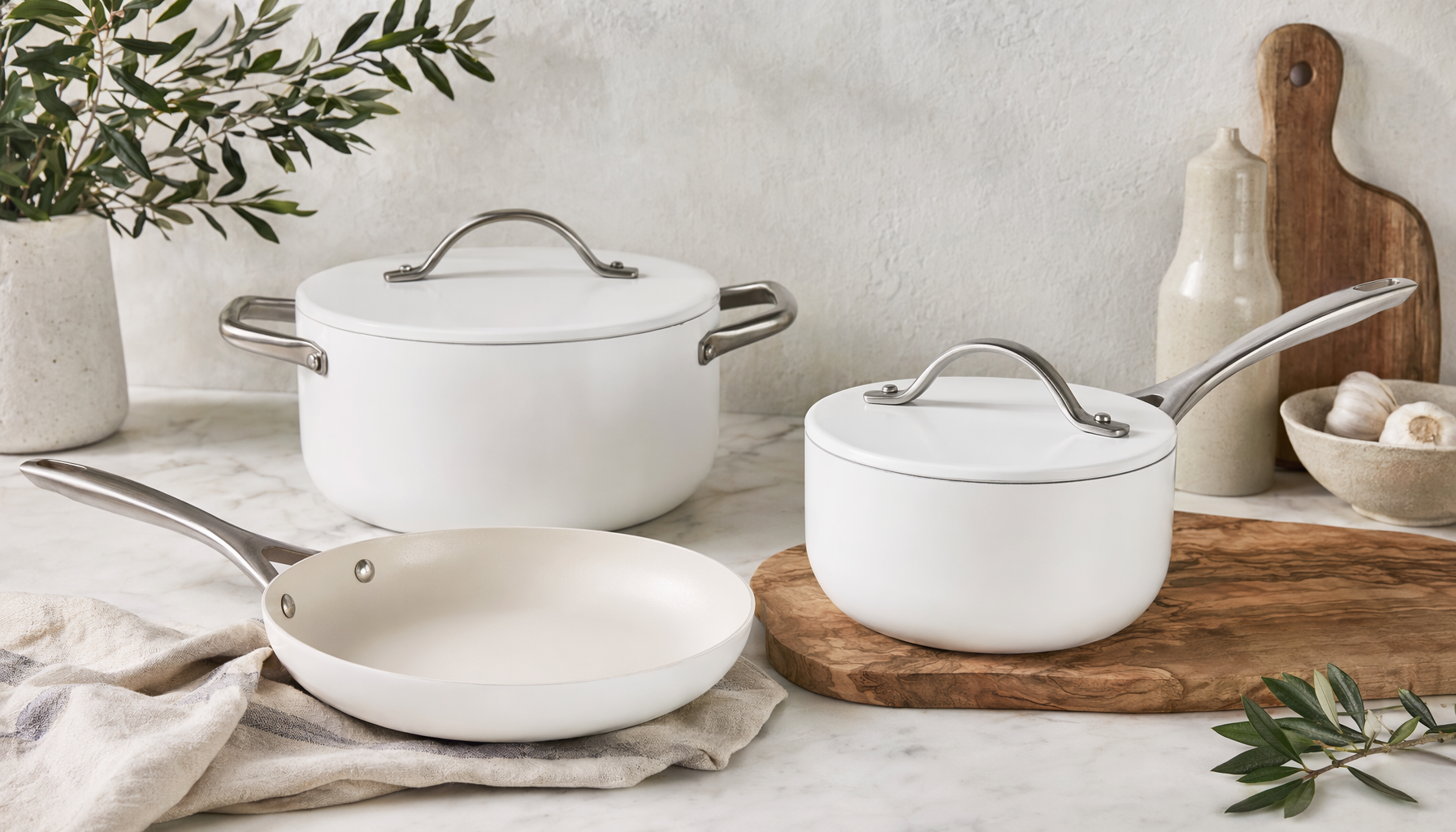
TL;DR — Modern ceramic cookware sets safe enough to replace old Teflon are free of PFOA, PFAS, PTFE, and the off-gassing risk that built Teflon’s bad reputation. The catch is lifespan. A ceramic coating typically lasts one to three years of regular cooking before it loses its release properties, far shorter than older PTFE pans. Inside its 500°F heat ceiling and washed by hand, a ceramic set delivers a clean, non-toxic cooking surface — it just won’t last a decade like older Teflon could.


Pros & Cons
Pros
- Thermo-Spot technology removes temperature guessing, ensuring eggs fry evenly and sauces reduce at the right pace without burning.
- Hard anodized construction resists warping and denting from daily family cooking, maintaining even heat distribution across the cooking surface.
- Includes both 1-quart and 3-quart saucepans plus a 5.6-quart dutch oven, covering everything from sauces to batch cooking without buying additional pieces.
Cons
- Not compatible with induction cooktops, limiting use if you have or plan to upgrade to induction cooking.
- Hand washing required to preserve nonstick performance, adding extra care steps compared to dishwasher-safe cookware alternatives.
Details
This 12-piece ceramic cookware set solves the problem of buying individual pans and pots separately while hoping they heat evenly and last through years of family cooking.
Thermo-Spot heat indicator technology signals when pans reach optimal cooking temperature, delivering consistent results. InoCeram Glide ceramic coating resists scratching from daily metal utensil use better than basic ceramic nonstick.
Hard anodized aluminum exterior provides durability comparable to commercial cookware, with riveted silicone handles and glass lids included. The set includes 8-inch and 10.5-inch frypans, 12-inch covered frypan, 1-quart and 3-quart saucepans, 5.6-quart dutch oven, plus slotted spatula and solid spoon.
Hand washing is required to maintain nonstick performance, and the set is not compatible with induction cooktops.
Best for home cooks who prepare daily meals and want one complete cookware set that handles frying, simmering, braising, and oven-finished dishes without replacing pans.
Cooking Tips
Use the Thermo-Spot indicator to preheat frypans for 2-3 minutes before cooking eggs or pancakes. This ensures even browning without sticking and prevents the frustration of undercooked centers and burnt edges.
The 5.6-quart dutch oven handles batch cooking soups, stews, and chili efficiently. Start on the stovetop to sear meat, then transfer directly to a 350-400°F oven to finish, using the glass lid to monitor doneness without lifting and losing heat.
Pouring edges on saucepans make reducing sauces cleaner. Tilt slightly to pour thickened sauce onto plates without dripping on cookware exterior or stovetop.

Save $25.00
Pros & Cons
Pros
- The set includes five useful cooking vessels plus three glass lids for broad meal coverage.
- PFAS-, lead-, cadmium-, and BPA-free construction supports buyers seeking cookware made without those materials.
- Heat-resistant stainless steel handles and a lightweight aluminum core make daily handling easier.
- The ceramic coating is dishwasher-safe, while hand washing can help extend its service life.
Cons
- Hand washing is recommended to extend the life of the nonstick coating, adding maintenance after cooking.
- The oven-safe limit is 450°F, so it may not suit recipes requiring higher temperatures.
Details
This set replaces several separate pans with fry, grill, deep-fry, sauce, and stock-pot options for everyday stovetop cooking.
The dual-layer ceramic coating supports easier food release, while the aluminum core heats quickly for responsive cooking.
Lightweight aluminum construction and heat-resistant stainless steel handles make the pieces easier to carry and manage.
Hand washing is recommended to help preserve the ceramic nonstick coating, even though the cookware is dishwasher-safe.
Best for cooks building an induction-compatible cookware collection for varied daily meals.
Cooking Tips
Use low to medium heat when possible to protect the ceramic coating and take advantage of the fast-heating aluminum core.
Choose the glass-lidded saucepan for sauces and the deep fry pan for larger sautéed meals while monitoring progress without lifting the lid.
Hand wash after cooking to help extend the nonstick coating’s useful life, and keep oven temperatures at or below 450°F.

Save $50.00
Pros & Cons
Pros
- Ceramic coating outperforms traditional PTFE nonstick in durability testing and handles metal utensils without flaking.
- 12-month warranty with responsive customer service provides real protection if any piece fails during normal cooking.
- Reinforced construction prevents the warping that plagues thin-walled cookware sets after 6 months of regular use.
Cons
- Ceramic nonstick requires hand-washing and careful storage with pan protectors; dishwasher use voids the nonstick performance guarantee.
- Some users report the nonstick coating diminishes after 2+ years of daily cooking, though this is normal for ceramic cookware.
Details
A 21-piece cookware system designed for home cooks who prioritize health and durability over budget brands that shed coating within months.
The ceramic nonstick coating eliminates PFOA and PFOS chemicals found in traditional nonstick, addressing health concerns for families cooking multiple meals daily. Even heat distribution prevents the hot spots that burn garlic or curdle sauces.
Die-cast aluminum body with reinforced handles resists warping. Includes two fry pans (9.5″ and 11″), four saucepans and stockpots ranging 2-6.5 quarts, plus sauté pan, utensils, and pan protectors. Induction-compatible on all cooktop types.
The ceramic coating requires hand-washing and careful storage; dishwasher use degrades nonstick performance over time. Coating durability typically spans 2-3 years with daily cooking, which is standard for ceramic cookware.
Best for health-conscious home cooks who prepare 5+ meals weekly and want durable, chemical-free cookware that cleans fast.
Cooking Tips
Use medium to medium-high heat for most cooking. The even heat distribution means you need less temperature than traditional pans to achieve the same browning. Preheat for 2-3 minutes before adding oil or food to activate the ceramic coating’s full nonstick potential.
For proteins and vegetables, a light coating of oil prevents sticking and extends coating life. Avoid metal utensils on the cooking surface; use wood or silicone instead. The coating handles occasional metal contact but repeated scraping accelerates wear.
Clean immediately after cooking with warm soapy water and a soft sponge. Store with included pan protectors between pots to prevent the ceramic from chipping against metal rims. Hand-washing preserves the nonstick performance that dishwasher cycles degrade.

Save $40.00
Pros & Cons
Pros
- The locking removable handle provides a stable grip during cooking while enabling flat nesting that dramatically reduces storage footprint.
- Ceramic nonstick coating is free from PFOA and harmful chemicals, making it a safer daily-use option for health-conscious cooks.
- Multi-hob compatibility including induction makes this set genuinely portable and useful across different kitchens and cooking setups.
- 23 pieces at this price point covers a full cooking range without needing supplemental pans for common tasks.
Cons
- With zero verified reviews available, long-term durability of the ceramic coating and handle locking mechanism under daily use is unconfirmed.
- Aluminum bodies without stainless cladding may show wear or warping faster than heavier tri-ply cookware under high-heat conditions.
Details
The Astercook 23-piece set solves the storage problem in small kitchens and RVs by replacing fixed handles with a secure detachable system that lets every piece stack flat.
The PFOA-free ceramic nonstick surface releases food without oil buildup and cleans with a single wipe, making it practical for daily stovetop cooking.
Built from aluminum with induction-compatible bases, the set heats evenly across gas, ceramic, and induction hobs without switching cookware between setups.
Buyers should note this is aluminum construction, not stainless or clad, so it is lighter and more affordable but less suited to high-heat searing over time.
Best for compact kitchen dwellers, RV owners, and anyone who wants a complete, space-saving cookware system without investing in heavy-duty professional sets.
Cooking Tips
Use medium heat on ceramic nonstick to extend coating life. These pans reach cooking temperature faster than stainless, so high heat is rarely necessary and can degrade the surface over time.
Always confirm the handle is fully locked before lifting a full pot. The locking mechanism clicks into place, and a slight tug before use takes two seconds but prevents drops.
For oven use, remove the detachable handle before placing the pan inside. The cookware body is oven safe, but always verify your specific handle rating in the included documentation before exceeding moderate oven temperatures.

Pros & Cons
Pros
- The 15-piece collection includes useful cookware sizes plus a steamer insert and two Italian olive wood tools.
- Supreme Fusion Technology is described as 10 times stronger than standard ceramic nonstick coating.
- The cookware is dishwasher safe, though hand-washing is recommended to preserve the finish.
- One tree is planted for every set sold through Bloomhouse's One Tree Planted partnership.
Cons
- Hand-washing is recommended if you want to preserve the exterior and ceramic finish.
- The glass-lidded pieces have a lower oven limit of 400°F than the uncovered cookware.
Details
This coordinated set replaces mismatched cookware with pans for frying, simmering, steaming, braising, baking, and serving.
Heavy-gauge aluminum promotes even heating, while the ceramic nonstick surface helps food release cleanly and reduces cleanup.
It includes 8-inch and 10-inch fry pans, two saucepans, a 6-quart everyday pan, a 6-quart Dutch oven, steamer insert, tray, lids, and olive wood tools.
Hand-washing is recommended to preserve the finish, and glass lids are oven safe only to 400°F.
Best for home cooks seeking a complete, design-focused cookware collection with non-toxic ceramic nonstick surfaces.
Cooking Tips
Use the smaller fry pan for eggs and individual portions, then move to the 10-inch pan for larger servings and recipes that need a lid.
Choose the 6-quart everyday pan for one-pan meals and the Dutch oven with steamer insert for larger batches or layered cooking.
For longer finish life, follow the recommended hand-washing guidance and avoid exceeding 400°F when using glass lids.
About These Recommendations
The technique above is the point of this guide; the products are here because they help. We have not tested them ourselves — we did not buy or use this gear. The recommendations come from comparing specifications and materials against the patterns in verified owner reviews, so treat them as a shortlist worth researching rather than a verdict from our own kitchen.
Availability and prices change often, so check the current listing before buying. We earn a commission on purchases made through links on this page, which never affects what we recommend.
The Short Answer
Yes, ceramic cookware sets safe for daily cooking exist and are widely available in 2026. The sol-gel silica coating used on modern ceramic pans doesn’t contain PFOA, PFAS, PTFE, lead, or cadmium, and it doesn’t release toxic fumes when overheated the way old Teflon could. The trade-off is durability — ceramic coatings wear out in one to three years even with careful use. For shoppers prioritizing health over longevity, ceramic cookware sets safe by every chemical metric remain the default pick. Our best ceramic cookware set non toxic guide breaks down the top 2026 sets that pass third-party safety verification.
What “Ceramic Cookware” Actually Means
Here’s where buyers lose $200 to confusion. The phrase “ceramic cookware” describes two completely different products. One is genuine ceramic — fired clay pottery like Le Creuset’s stoneware or Emile Henry casseroles. The other is “ceramic-coated” cookware, which is what almost every Amazon listing actually sells. These two categories share a name and nothing else.
Ceramic-coated cookware starts as a regular aluminum or stainless steel pan. The base gets sandblasted, then sprayed with a sol-gel solution — a liquid suspension of silica (sand-derived silicon dioxide) and other inorganic compounds. The wet coating gets cured at high temperatures, leaving a hard, glassy layer roughly 30 microns thick. That’s the “ceramic.” It’s actually a glass-like inorganic coating, not pottery clay.
This matters because the marketing photos on the box show smooth white pans that look identical to genuine ceramic. They aren’t. Drop a ceramic-coated frying pan and the aluminum dents; drop a stoneware Dutch oven and it cracks. The thermal behavior, the weight, the heat retention, and the lifespan all differ wildly between the two product types.
Why does the industry use the same word? Sol-gel silica coatings genuinely share some chemistry with traditional ceramics — both are inorganic, both contain silica, both cure under heat. But pottery and a spray-on coating are not the same thing in any meaningful kitchen-use sense. When this article talks about “ceramic cookware sets,” it means the sprayed sol-gel kind, because that’s what 95% of the market actually sells.
The Safety Comparison vs PTFE
PTFE (polytetrafluoroethylene, sold as Teflon) is a fluoropolymer. Old formulations used PFOA as a manufacturing aid — and PFOA is a documented “forever chemical” linked to cancer, thyroid disease, and developmental issues. Most major brands phased out PFOA by 2015, but other PFAS compounds in the same family stuck around. Modern PTFE pans are PFOA-free; they aren’t necessarily PFAS-free.
Sol-gel ceramic coatings are fundamentally different chemistry. They contain no fluorine, no PFOA, no PFAS, and no PTFE. The silica-based film is inert at cooking temperatures and doesn’t break down into fluorinated byproducts. That’s the main reason health-conscious shoppers gravitate toward ceramic — there’s no fluoropolymer family tree to worry about.
The off-gassing question matters too. PTFE starts to degrade above 500°F, releasing fluorinated fumes that are toxic to birds at very low concentrations and can cause flu-like symptoms (polymer fume fever) in humans at higher exposures. Ceramic coatings don’t off-gas in the same way. The silica matrix can degrade at extreme heat — above 700°F or so — but the breakdown products are inorganic dust, not fluorinated gas. Cook on high, sear a steak, leave the pan empty on the burner by accident: a ceramic set won’t poison the air the way an overheated Teflon pan might.
What ceramic doesn’t fix is heavy-metal contamination from cheap aluminum bases. A few budget brands have been flagged for lead in the underlying metal — not the coating itself. Sticking to sets that publish third-party heavy-metal results (Caraway, Our Place, GreenPan’s newer lines) sidesteps that risk entirely.
The trade-off is honest: ceramic wins on every chemical-safety metric and loses on durability. PTFE pans can last five to seven years; ceramic coatings rarely make it past three. Net-net, ceramic cookware sets safe enough to outclass PTFE chemically still come up shorter mechanically — which framing matters depends on what you value.
Heat and Lifespan Reality
Ceramic coatings have a published heat ceiling around 500°F. The number isn’t a fume threshold — it’s a coating-integrity threshold. Push a sol-gel layer past 500°F regularly and the silica matrix starts to micro-crack, food bonds to the freshly exposed valleys, and the non-stick release drops off. Within a few months, eggs that used to slide are now sticking and tearing.
The real-world lifespan numbers are sobering. Independent reviewers and manufacturer warranty data both peg ceramic-coated pans at 12 to 36 months of useful non-stick performance under normal home use. Heavier daily cooking, especially at high heat, cuts that to about a year. The coating doesn’t peel like old Teflon — instead, it gradually loses its release properties as microscopic cracks fill with cooked-on residue.
The dishwasher accelerates everything. High-temperature wash cycles and harsh alkaline detergents both attack the silica matrix. A pan that might last three years under hand-washing often degrades inside 12 months when it goes through the dishwasher twice a week. Almost every ceramic manufacturer either bans dishwashing outright in fine print or voids the warranty when you do it.
About those “lifetime warranties.” Read the actual document. Most cover manufacturing defects (warped base, handle separating from the pan) — not coating wear from normal use. Loss of non-stick performance is explicitly excluded by almost every brand, because every brand knows the coating will fail before the customer dies. The lifetime label markets the body, not the surface you actually cook on. Compared against PTFE alternatives in our best non toxic cookware roundup, ceramic gives you cleaner chemistry at the cost of replacement frequency.
When to Replace a Ceramic Pan
Three signals tell you the coating is done. The first is visual: a once-uniform white or cream surface develops gray or brown patches where the ceramic has worn down to bare aluminum. Those patches aren’t just cosmetic. They’re chemically reactive metal touching your food.
The second signal is functional. Eggs that used to release at low heat start dragging across the pan, even with butter or oil. A fresh ceramic surface releases scrambled eggs almost cleanly; a worn surface holds onto everything. When you’re scraping every meal off, the coating has lost the non-stick function you bought it for.
The third is structural. Scratches deeper than the coating layer expose the aluminum underneath. Light scratches from a wooden spoon don’t matter, but a deep groove from a metal spatula or a knife is a write-off. The exposed aluminum will leach into acidic foods — tomato sauce, citrus, wine reductions — and the surrounding ceramic will continue to chip outward from the scratch line.
Once you spot any of these, the pan is past its useful life. Tossing it isn’t optional if you bought ceramic specifically for the safety profile. The whole point was to avoid bare metal contact with food.
Common Mistakes
- Preheating empty on high. Sol-gel ceramic doesn’t tolerate dry, high-heat preheating well. The thermal shock micro-cracks the coating faster than anything else. Add a teaspoon of oil before the pan goes on the burner, then heat to medium. Never crank an empty ceramic pan to high and walk away.
- Using metal utensils. Even “metal utensil safe” claims on the box have limits. A stainless spatula edge concentrates pressure into a tiny point, and that point will eventually scratch through the coating. Silicone, wood, or nylon tools dramatically extend the life of a ceramic set.
- Cold-water rinsing a hot pan. Thermal shock again. The temperature differential cracks the silica matrix from the inside even when nothing visible changes on the surface. Let the pan cool on the stove before it touches the sink.
- Stacking sets without protection. Pan-to-pan contact in a cabinet grinds tiny chips off the coating every time you pull the bottom one out. Felt pan protectors or a paper towel between each piece costs almost nothing and adds a year to the set’s life.
- Skipping the seasoning step. Most ceramic manufacturers recommend a one-time seasoning — wipe the cooking surface with a thin coat of neutral oil before first use. It’s not the same as cast iron seasoning, but it does fill microscopic pores and improves release noticeably. Buyers who skip this step often complain their pan never really worked.
Related Questions
Are all ceramic cookware sets really non-toxic?
Most ceramic cookware sets safe-labeled at major retailers genuinely are non-toxic, but not all. The reputable brands absolutely are. Brands that publish third-party heavy-metal and PFAS results (Caraway, GreenPan, Our Place, Xtrema) are genuinely free of the bad-actor chemicals. Cheap unbranded ceramic sets from generic marketplaces sometimes contain lead or cadmium in the base metal — not in the coating itself, but exposed when the coating wears. Stick to brands that publish certifications.
How is sol-gel ceramic different from clay?
Sol-gel ceramic is a silica-based liquid coating sprayed onto metal cookware and cured under heat. Traditional clay ceramic — stoneware, earthenware, porcelain — is fired pottery made from natural mineral clays. The first is a thin coating on aluminum; the second is the entire vessel. They share the word “ceramic” and share roughly zero practical properties in the kitchen.
Can ceramic pans go in the dishwasher?
Technically yes on most “dishwasher safe” models, but practically no. The alkaline detergents and high-temperature wash cycle both degrade the silica matrix faster than hand washing. A pan that survives three years of hand washing often fails inside one year of dishwasher use. Almost every manufacturer’s fine print quietly excludes dishwasher damage from the warranty.
What heat damages ceramic coatings?
Anything sustained above 500°F. The silica matrix starts to micro-crack under prolonged high heat, which is why ceramic isn’t a great pick for ripping-hot steakhouse sears or wok cooking. For everyday eggs, sautés, sauces, and weeknight proteins at medium-high, it handles the load fine. Just don’t crank it to max and leave it.
Why do some ceramic sets cost $400+?
Three things. Heavier-gauge aluminum or stainless bases that resist warping. Multi-coat ceramic application (some brands lay down four or five sprayed layers instead of one) for longer non-stick life. And actual third-party verification — which costs the brand real money — proving the absence of PFAS, lead, cadmium, and other contaminants. The cheap sets skip all three. You’re paying for documented safety, not just the white finish.
Related buying guides: best cookware sets, best copper cookware and best nonstick cookware set.
Recommended Tools
The ceramic cookware sets safe enough to recommend in 2026 share a few traits — published heavy-metal testing, multi-layer sol-gel application, heavier-gauge bases that resist warping, and an honest warranty that covers manufacturing rather than promising “lifetime” non-stick. The picks below cover that range, from a budget starter set to a flagship lineup with documented PFAS-free results. None are perfect, but each one tells you exactly what you’re getting.



Write Your Review
No reviews yet. Be the first to share your experience!