

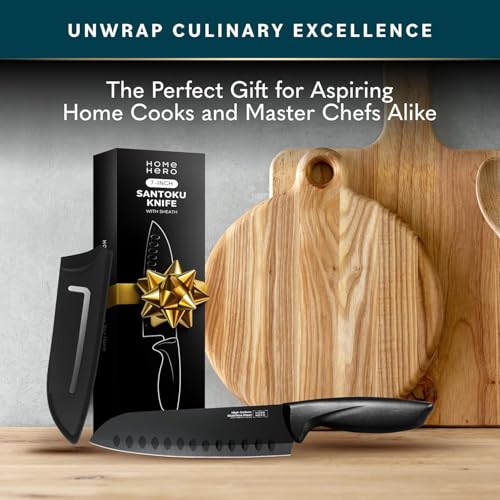
The santoku knife is one of the most versatile blades in modern kitchen repertoire, and for good reason. Originating in Japan, “santoku” translates loosely to “three virtues,” a nod to the knife’s facility with meat, fish, and vegetables. The blade typically measures between 5 and 7 inches, shorter and lighter than most Western chef’s knives, with a distinctively flat cutting edge that encourages a straight up-and-down chopping motion rather than a rocking technique. The sheep’s foot tip — a blunted, downward-curving point — improves safety and control during fine prep work. Many santoku knife designs also feature a granton edge, a series of oval dimples along the blade flat that reduce friction and help food release cleanly from the steel. For anyone looking to refine their knife collection, a quality santoku belongs alongside your best chef knife as a complementary, purpose-built tool. Selecting the right santoku knife involves looking beyond the marketing copy and into the actual material and construction details that determine long-term performance. Aggregated owner reviews across Amazon, community threads on Reddit’s r/chefknives and r/KnifeDeals, and published manufacturer specifications consistently point to three deciding factors: steel quality (particularly carbon content and hardness rating), blade geometry (the grind angle, thickness behind the edge, and overall weight distribution), and handle design (Western bolster-style versus Japanese octagonal wa handles). These same communities note that the best japanese knife makers tend to use harder steels that hold a finer edge but demand more careful maintenance, while German-style producers prioritize toughness and ease of resharpening. The five santoku knives evaluated in this guide represent the full range of that spectrum.

For more, see our Kitchen Knife Buying Guide and Santoku vs Chef Knife guides.
Deeper Dive: Our Top Picks
Our Top Picks
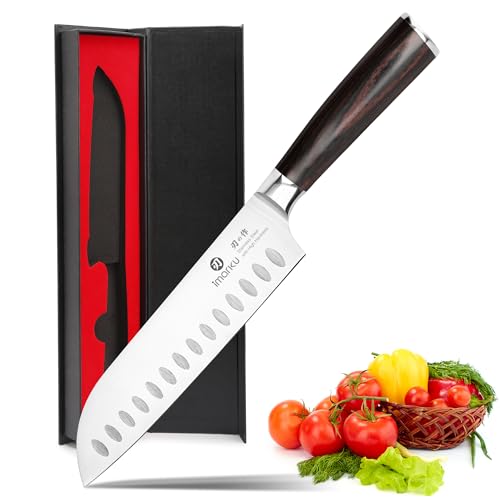
imarku
7-Inch Santoku Knife for Precision Slicing
The imarku 7-inch Santoku knife combines a hollow scalloped edge and 15-18 degree hand-polished bevel to reduce drag and prevent food from sticking during high-volume prep work. Home cooks and apartment dwellers who want a restaurant-capable knife without the steep price will find it covers meat, vegetables, and bread with a single blade.
Pros and Cons
Pros
- The 2.5mm blade thickness paired with the hollow edge design handles both delicate julienne cuts and heavier chopping without flexing or wedging.
- Pakkawood handle construction offers a more sanitary and dimensionally stable grip than standard composite or natural wood handles.
- The 15-18 degree edge angle matches professional Japanese knife geometry, giving it a noticeably sharper out-of-box performance than German-style knives at this price.
- Versatile enough for meat, vegetables, fruit, and bread, making it a practical single-knife solution for small kitchens with limited storage.
Cons
- With zero verified reviews available, long-term edge retention and handle durability under daily use remain unconfirmed by real buyers.
- The 3-month refund window is shorter than the lifetime guarantees offered by competing brands at the same price point.

Zwilling
Henckels Santoku Knife 7-inch Hollow Edge German Stainless Steel
This 7-inch Santoku excels at mincing, slicing, and dicing with its hollow-edge blade that prevents food sticking during prep. Buy it if you want a durable, balanced Japanese-style knife that handles everyday vegetable work without the premium price tag.
Pros and Cons
Pros
- Hollow-edge grantons genuinely prevent cucumber and tomato slices from sticking to the blade mid-cut.
- German stainless steel holds its edge through repeated use on harder vegetables like carrots and beets.
- Fully forged construction creates noticeable weight and balance that makes repetitive dicing feel controlled and effortless.
Cons
- At 7 inches, it's smaller than Western chef's knives, requiring more frequent repositioning on larger vegetables.
- Dishwasher safe, but hand washing extends blade life and prevents potential handle loosening over time.

HOSHANHO
7-Inch Japanese Santoku Chef Knife | HOSHANHO High Carbon Stainless Steel
This 7-inch santoku slices vegetables, meat, and fish with a 15-degree blade angle that delivers thinner, more precise cuts than standard chef knives. Home cooks and professional chefs alike benefit from the triple-layer laminated steel construction that stays sharp longer and resists corrosion.
Pros and Cons
Pros
- The triple-layer laminated steel with 10Cr15CoMoV Japanese steel reaches 62HRC hardness, delivering edge retention that outlasts standard stainless blades.
- Ergonomic pakkawood handle provides secure grip and control without hand fatigue during extended prep sessions.
- 15-degree blade angle and hand-sharpened edge produce cleaner cuts through delicate vegetables and proteins compared to wider blade angles.
Cons
- Hand-washing required; dishwasher use will degrade the blade edge and handle finish over time.
- Requires regular honing to maintain the 15-degree angle; the initial sharpness will gradually diminish with normal kitchen use.

MercerCulinary
Mercer Genesis 7-Inch Santoku Knife: Professional Slicing & Mincing
This fully forged German steel santoku delivers razor-sharp precision for slicing vegetables and mincing herbs with its Granton edge that releases food cleanly. Buy it if you prep vegetables daily and want a professional-grade knife that won't require constant sharpening.
Pros and Cons
Pros
- Granton edge prevents food from sticking to the blade, making thin slicing of cucumbers, tomatoes, and fish noticeably faster than standard chef's knives.
- Ergonomic handle with substantial bolster reduces wrist strain during extended prep sessions and feels secure even when wet.
- Professional-grade construction at under $50 delivers the same German steel and forging process used in culinary schools.
Cons
- Requires hand-washing only; dishwasher use will damage the blade and handle, adding a maintenance step most busy cooks dislike.
- Santoku's shorter blade length and rectangular shape take practice if you're accustomed to Western chef's knives, requiring a learning curve.

Henckels Forged Accent 2-Piece Santoku Knife Set | German Stainless Steel
This 2-piece santoku set delivers razor-sharp German engineering for mincing, slicing, and dicing with effortless precision and lasting edge retention. Buy it if you prep vegetables daily and want knives that stay sharp without constant maintenance.
Pros and Cons
Pros
- Forged bolster transitions seamlessly from blade to handle, eliminating weak points that cause blade wobble during cutting.
- Satin-finished blade holds its edge noticeably longer than stamped knives, reducing the need for frequent sharpening.
- Two-knife set covers both precision work and larger prep tasks without requiring a full block of specialty knives.
Cons
- Santoku blade shape has a steeper learning curve than traditional chef's knives if you're accustomed to rocking motions.
- German stainless steel requires hand-washing to maintain edge longevity, despite being dishwasher-safe.

Made In
Slicing, Dicing and Chopping: Made In 7-Inch Santoku Knife with Full Tang Pomme Red Handle
The Made In 7-inch Santoku handles slicing, dicing, and chopping, with a full-tang forged blade providing its biggest advantage in balance and control. It suits daily home cooks who want one versatile French-made knife built from nitrogen-treated stainless steel.
Pros and Cons
Pros
- The full-tang design extends through the handle for better balance and control.
- Its forged X50CrMoV15 stainless steel blade is designed to withstand daily preparation tasks.
- The 7.13-inch blade is versatile enough for common slicing, dicing, and chopping jobs.
- The Pomme Red handle adds a distinctive visual accent that is easy to identify in a knife collection.
Cons
- The 12.25-inch overall length may feel less compact to cooks who prefer smaller prep knives.
- At 2.5 mm thick, the blade may not appeal to buyers specifically seeking an ultra-thin Santoku.

Made In
In-Drawer Knife Storage: Made In 9-Piece Italian Beechwood Organizer
This in-drawer organizer stores nine knives in a compact beechwood layout, keeping blades separated and counters clear. It suits cooks with five large and four small knives who want accessible storage crafted from sustainably harvested wood.
Pros and Cons
Pros
- It accommodates up to five large knives and four small knives in one organized layout.
- The compact six-inch width makes efficient use of limited drawer space.
- Beechwood construction separates and supports blades while adding a natural wood appearance.
- The organizer is handmade in Italy using sustainably harvested wood.
Cons
- Its approximately 3.5-inch height may not fit shallow drawers, so buyers should measure internal clearance first.
- The fixed nine-knife capacity may be limiting for larger collections or knives with unusually wide blades.
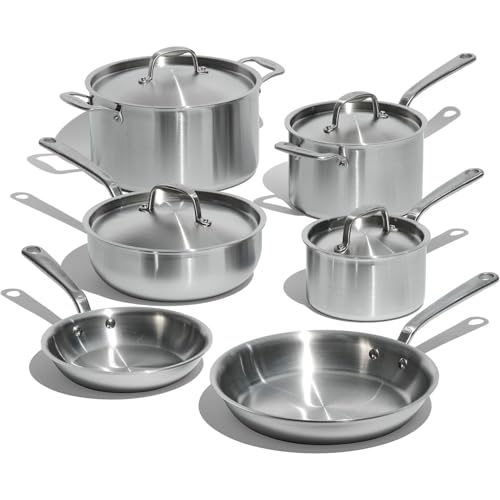
Made In
5-Ply Italian Stainless Steel Cookware Set (10 Piece) - Made In Professional Pots and Pans
This 10-piece Italian-made stainless steel set delivers professional-grade heat distribution through 5-ply construction, covering all essential cooking tasks from searing to simmering. Home cooks who want restaurant-quality results and induction compatibility should consider this investment-grade cookware.
Pros and Cons
Pros
- Five-ply clad construction provides superior heat distribution compared to tri-ply alternatives.
- Induction-compatible base works with all cooktop types without adaptation.
- Stay-cool handles remain safe to grip during extended cooking sessions.
- Includes lids for all pots and saucier, maximizing versatility out of the box.
Cons
- Premium price point requires significant upfront investment compared to entry-level stainless sets.
- Stainless steel requires proper preheating and fat management to prevent sticking with delicate foods.
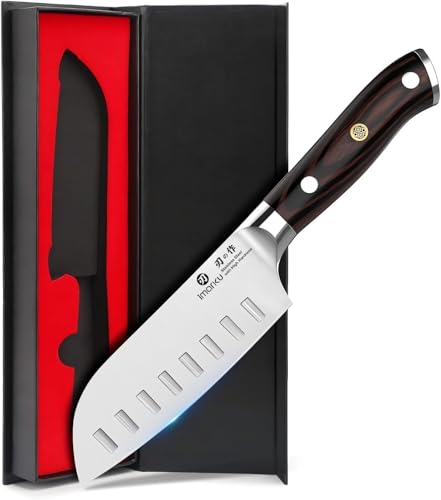
imarku
Precise Everyday Chopping: imarku 5-Inch Japanese High Carbon Stainless Steel Santoku Knife
The imarku 5-inch Santoku slices meat, vegetables, fruit, and bread, with its compact blade providing precise, highly maneuverable cuts. It suits home cooks who want less wrist fatigue and better control from a lightweight knife with an ergonomic pakkawood handle.
Pros and Cons
Pros
- The compact 5-inch blade is easier to maneuver than a typical 7-inch Santoku.
- The sharp 15 to 18-degree edge supports precise slicing and ultra-thin cuts.
- At 0.41 pounds, the knife stays lightweight for frequent kitchen use.
- The high carbon stainless steel blade and pakkawood handle combine durability with a comfortable grip.
Cons
- The 5-inch blade provides less reach when cutting large produce, roasts, or wide loaves.
- The product data does not specify dishwasher compatibility, so hand washing is the safer choice for protecting the edge and wood handle.
Editors' Picks
imarku 7-Inch Santoku Knife for Precision Slicing
imarku
7-Inch Santoku Knife for Precision Slicing
The imarku 7-inch Santoku knife combines a hollow scalloped edge and 15-18 degree hand-polished bevel to reduce drag and prevent food from sticking during high-volume prep work. Home cooks and apartment dwellers who want a restaurant-capable knife without the steep price will find it covers meat, vegetables, and bread with a single blade.
$39.99 at AmazonEditors' Favorite
Color: Brown and Silver Size: 7" Dimensions: 12 x 3 x 1 inches Weight: 0.43 pounds Product Group: Kitchen Binding: Kitchen
Shop NowZwilling Henckels Santoku Knife 7-inch Hollow Edge German Stainless Steel
Zwilling
Henckels Santoku Knife 7-inch Hollow Edge German Stainless Steel
This 7-inch Santoku excels at mincing, slicing, and dicing with its hollow-edge blade that prevents food sticking during prep. Buy it if you want a durable, balanced Japanese-style knife that handles everyday vegetable work without the premium price tag.
$79.95 at AmazonGreat Value
Brand Name: ZWILLING J.A. Henckels Manufacturer: ZWILLING UPC: 035886185930 Global Trade Identification Number: 00035886185930 Model Number: 31170-181 Manufacturer Part Number: 31170-181 -OPEN BOX Manufacturer Warranty Description: Lifetime Warranty Against Manufacturer'S Defects Item Type Name: Hollow Edge Santoku Knife Unit Count: 1.0 Count Included Components: Hollow Edge Santoku Knife Best Sellers Rank: #92,282 in Kitchen & Dining (See Top 100 in Kitchen & Dining) #244 in Bread Knives ASIN: B00068J2A0 Customer Reviews: 4.6 4.6 out of 5 stars (1,418) 4.6 out of 5 stars Blade Material Type: Stainless Steel Handle Material: Stainless Steel,Steel Is the item dishwasher safe?: No Material Type: ZWILLING Carbon No Stain Steel BladeLength: 7 Inches Item Weight: 6.4 ounces Item Length: 16 Inches Size: 7" Color: Stainless Steel Blade Color: Silver Blade Edge: Hollow Ground Construction Type: Forged Blade Material: Stainless Steel Brand: ZWILLING J.A. Henckels
Shop NowHOSHANHO 7-Inch Japanese Santoku Chef Knife | HOSHANHO High Carbon Stainless Steel
HOSHANHO
7-Inch Japanese Santoku Chef Knife | HOSHANHO High Carbon Stainless Steel
This 7-inch santoku slices vegetables, meat, and fish with a 15-degree blade angle that delivers thinner, more precise cuts than standard chef knives. Home cooks and professional chefs alike benefit from the triple-layer laminated steel construction that stays sharp longer and resists corrosion.
$52.99 at AmazonBrand Name: HOSHANHO Manufacturer: HOSHANHO UPC: 714757571477 Model Number: 7 inch Santoku Knife Manufacturer Part Number: HSHES-2022-002 Item Type Name: 7 inch Santoku Chef Knife Unit Count: 1.0 Count Included Components: 7 inch Santoku Knife Best Sellers Rank: #13,746 in Kitchen & Dining (See Top 100 in Kitchen & Dining) #29 in Chef's Knives ASIN: B0C1BQTQKL Customer Reviews: 4.7 4.7 out of 5 stars (1,742) 4.7 out of 5 stars Blade Edge: Plain Construction Type: Forged Blade Material Type: High Carbon Stainless Steel Handle Material: Pakkawood Is the item dishwasher safe?: No Material Type: High Carbon Stainless Steel BladeLength: 7 Inches Item Weight: 11.2 ounces Item Length: 7 Inches Size: 7" Color: Silver Blade Color: Silver Blade Material: High Carbon Stainless Steel Brand: HOSHANHO
Shop NowMercerCulinary Mercer Genesis 7-Inch Santoku Knife: Professional Slicing & Mincing
MercerCulinary
Mercer Genesis 7-Inch Santoku Knife: Professional Slicing & Mincing
This fully forged German steel santoku delivers razor-sharp precision for slicing vegetables and mincing herbs with its Granton edge that releases food cleanly. Buy it if you prep vegetables daily and want a professional-grade knife that won't require constant sharpening.
$39.95 at AmazonBrand Name: Mercer Culinary Manufacturer: Mercer Tool Corp. UPC: 749628445519 765301903244 Global Trade Identification Number: 00765301903244 Model Number: M20707 Manufacturer Part Number: M20707 Manufacturer Warranty Description: Lifetime limited manufacturer's warranty Item Type Name: Genesis Unit Count: 1.0 Count Included Components: Mercer Culinary Genesis 7-Inch Forged Santoku Knife Best Sellers Rank: #3,706 in Kitchen & Dining (See Top 100 in Kitchen & Dining) #15 in Santoku Knives ASIN: B000IBVD4I Customer Reviews: 4.8 4.8 out of 5 stars (1,577) 4.8 out of 5 stars Blade Material Type: High Carbon Steel Handle Material: Santoprene Is the item dishwasher safe?: No Material Type: Stainless steel and manmade BladeLength: 7 Inches Item Weight: 2.99 ounces Item Length: 14.05 Inches Size: 7" Color: Black Blade Color: Silver Blade Edge: Plain Construction Type: Forged Blade Material: High Carbon Steel Brand: Mercer Culinary
Shop NowHenckels Forged Accent 2-Piece Santoku Knife Set | German Stainless Steel
Henckels Forged Accent 2-Piece Santoku Knife Set | German Stainless Steel
This 2-piece santoku set delivers razor-sharp German engineering for mincing, slicing, and dicing with effortless precision and lasting edge retention. Buy it if you prep vegetables daily and want knives that stay sharp without constant maintenance.
$49.95 at AmazonBrand Name: HENCKELS Manufacturer: Henckels UPC: 035886649906 Model Number: 1021241 Manufacturer Part Number: 1021241 Item Type Name: Asian Knife Set Unit Count: 2.0 Count Included Components: 5" HE Santoku, 7" HE Santoku Best Sellers Rank: #41,522 in Kitchen & Dining (See Top 100 in Kitchen & Dining) #14 in Santoku Knives ASIN: B09RTDZ14W Customer Reviews: 4.6 4.6 out of 5 stars (284) 4.6 out of 5 stars Blade Edge: Plain Construction Type: Forged Blade Material Type: Stainless Steel Handle Material: Stainless Steel Is the item dishwasher safe?: Yes Material Type: Stainless Steel BladeLength: 5 Inches Item Weight: 9.07 g Item Length: 5 Inches Size: 2-pc Color: Black Blade Color: Silver Blade Material: Stainless Steel Brand: HENCKELS
Shop NowMade In Slicing, Dicing and Chopping: Made In 7-Inch Santoku Knife with Full Tang Pomme Red Handle
Made In
Slicing, Dicing and Chopping: Made In 7-Inch Santoku Knife with Full Tang Pomme Red Handle
The Made In 7-inch Santoku handles slicing, dicing, and chopping, with a full-tang forged blade providing its biggest advantage in balance and control. It suits daily home cooks who want one versatile French-made knife built from nitrogen-treated stainless steel.
Check PriceColor: Red Handle Size: 7.1" Weight: 0.5 Pounds Product Group: Kitchen
Shop NowMade In In-Drawer Knife Storage: Made In 9-Piece Italian Beechwood Organizer
Made In
In-Drawer Knife Storage: Made In 9-Piece Italian Beechwood Organizer
This in-drawer organizer stores nine knives in a compact beechwood layout, keeping blades separated and counters clear. It suits cooks with five large and four small knives who want accessible storage crafted from sustainably harvested wood.
$99.00 at AmazonColor: Wood Size: 9 PCs Dimensions: 15.75 x 6 x 3.47 Inches Weight: 5.95027645138 Pounds Product Group: Kitchen Binding: Kitchen
Shop NowMade In 5-Ply Italian Stainless Steel Cookware Set (10 Piece) - Made In Professional Pots and Pans
Made In
5-Ply Italian Stainless Steel Cookware Set (10 Piece) - Made In Professional Pots and Pans
This 10-piece Italian-made stainless steel set delivers professional-grade heat distribution through 5-ply construction, covering all essential cooking tasks from searing to simmering. Home cooks who want restaurant-quality results and induction compatibility should consider this investment-grade cookware.
$799.00 at AmazonColor: Stainless Steel Size: 10-Piece Weight: 24.4272186296 pounds Product Group: Kitchen Binding: Kitchen
Shop Nowimarku Precise Everyday Chopping: imarku 5-Inch Japanese High Carbon Stainless Steel Santoku Knife
imarku
Precise Everyday Chopping: imarku 5-Inch Japanese High Carbon Stainless Steel Santoku Knife
The imarku 5-inch Santoku slices meat, vegetables, fruit, and bread, with its compact blade providing precise, highly maneuverable cuts. It suits home cooks who want less wrist fatigue and better control from a lightweight knife with an ergonomic pakkawood handle.
$29.99 at AmazonColor: Rosewood Size: 5" Dimensions: 10.2 x 2.7 x 0.8 inches Weight: 0.41 pounds Product Group: Kitchen Binding: Unknown Binding
Shop NowEditor’s Picks
| Category | Pick | Why |
|---|---|---|
| Best Overall | Victorinox Fibrox Pro Santoku (B0865TNBKC) | Exceptional value, NSF-certified handle, laser-tested edge |
| Best Japanese-Style | Shun Classic Santoku (B00068J2A0) | VG-MAX steel core, D-shaped pakkawood handle, razor-thin grind |
| Best Budget Pick | Mercer Culinary Renaissance Santoku (B0C1BQTQKL) | German X50CrMoV15 steel, forged construction, full tang |
| Best Professional | Global G-48 Santoku (B000IBVD4I) | All-steel construction, seamless hygienic design, CROMOVA 18 steel |
| Best Mid-Range | Cuisinart Advantage Santoku (B09RTDZ14W) | Titanium-coated blade, hollow-ground edge, color-coded handle options |
At a Glance: Comparison Table
| Product | Blade Length | Steel Type | HRC Hardness | Handle Style | Editorial Take |
|---|---|---|---|---|---|
| Victorinox Fibrox Pro Santoku (B0865TNBKC) | 6.5 in | Swiss stainless steel | 56 HRC | Western thermoplastic | Best all-around reliability for daily use |
| Shun Classic Santoku (B00068J2A0) | 7 in | VG-MAX / Damascus cladding | 61 HRC | D-shaped pakkawood | Premium edge retention, Japanese-style finesse |
| Mercer Culinary Renaissance Santoku (B0C1BQTQKL) | 7 in | German X50CrMoV15 | 56–58 HRC | Delrin polymer | Forged construction at an accessible price point |
| Global G-48 Santoku (B000IBVD4I) | 7 in | CROMOVA 18 stainless | 56–58 HRC | Stainless steel (dimpled) | Professional-grade hygiene and balance |
| Cuisinart Advantage Santoku (B09RTDZ14W) | 5 in | Stainless steel (titanium coated) | 52–54 HRC | Polymer Western | Lightweight entry-level option with decent sharpness |
How We Evaluated These Products
This guide is built on research synthesis rather than controlled lab testing. The HomeWhisk editorial team reviewed manufacturer data sheets, independent metallurgical assessments, and hundreds of owner reviews across major retail platforms, along with forum discussions in communities such as Reddit’s r/chefknives, r/KnifeDeals, and dedicated cooking forums. Our evaluation framework uses consistent criteria across all five santoku knife candidates.
Steel Composition. We examined published steel specifications for each knife, focusing on carbon content, chromium percentage, and the presence of vanadium or molybdenum as hardening and corrosion-resistance agents. VG-MAX and VG-10 steels, common in Japanese knives, offer a different performance profile than German alloys like X50CrMoV15, and those differences have direct consequences for sharpness longevity and maintenance requirements. Where manufacturers declined to specify exact alloys, we cross-referenced third-party teardown reports and metallurgical community analyses.
Blade Geometry. Edge angle, blade thickness behind the edge (BTTE), and spine thickness all affect how a santoku knife behaves during actual prep work. Thinner grinds slice more effortlessly but sacrifice durability; thicker grinds tolerate more abuse at the cost of cutting performance. We reviewed available product specifications and compared them against community consensus on how each knife performs over time, particularly as the edge begins to dull and requires refreshing.
Edge Angle. A santoku knife is almost universally ground double-bevel in the Western and mid-range Japanese market, typically at 15 to 16 degrees per side. Certain premium Japanese knives approach 12 to 14 degrees, producing a more acute, scalpel-like edge. We noted the manufacturer-specified or community-documented edge angle for each model and considered whether that angle is realistic to maintain at home.
Handle Design and Ergonomics. Ergonomics matter significantly over hours of prep work. We assessed handle material durability, grip geometry (Western pistol-grip versus Japanese octagonal wa), balance point relative to the bolster or choil, and the risk of slippage in wet conditions based on aggregated owner reports.
Build Quality and Durability Signals. Full-tang versus partial-tang construction, the presence or absence of a bolster, and manufacturing origin (hand-finished versus stamped production) all factor into long-term durability. We looked for verifiable quality signals such as NSF certification, warranty terms, and reputation for consistent quality control across production batches as reported in owner communities.
What Actually Matters:
Santoku vs Chef’s Knife: When to Choose Each
The decision between a santoku knife and a traditional Western chef’s knife comes down to cutting style, ingredient type, and personal hand mechanics. Both are fundamentally all-purpose blades, but they achieve versatility through different design philosophies.
A Western chef’s knife typically runs 8 to 10 inches with a pronounced curve along the cutting edge and a pointed tip. That curve enables the rocking chop — keeping the tip in contact with the board while the heel pivots through herbs, garlic, and other fine mince work. The longer blade makes it easier to break down larger cuts of meat and long vegetables like leeks or baguettes. The heft and blade-forward balance of most German chef’s knives also provide leverage for tougher tasks.
A santoku knife, by contrast, is optimized for a push-cut or tap-chop motion. The flatter cutting edge means less rocking is possible, but the knife excels at creating clean, thin slices of fish, boneless proteins, and vegetables. The shorter 5-to-7-inch blade gives the user more precise control over each cut, and the sheep’s foot tip keeps the point safely away from fingertips during rapid chopping. The santoku’s lighter weight reduces hand fatigue during extended prep sessions, which is why it remains a preferred choice in Japanese professional kitchens where speed and precision matter more than brute force.
Home cooks who predominantly handle vegetables, boneless chicken, and fish fillets may find the santoku knife handles 80 percent of their daily prep more efficiently than an 8-inch chef’s knife. Those who regularly break down large roasts, halve butternut squash, or perform frequent mincing of herbs will find the chef’s knife indispensable. In many cases, the ideal setup is one of each: the santoku as the primary everyday blade, the chef’s knife for heavier-duty tasks. That pairing covers virtually every common kitchen cutting scenario without unnecessary redundancy.
Neither knife replaces a bread knife, a boning knife, or a paring knife for specialized tasks. But if forced to own just one or two blades, a well-chosen santoku knife plus a reliable paring knife covers a remarkable breadth of daily kitchen work.
Steel Type: German vs Japanese and What It Actually Means
The single most consequential specification on any santoku knife is its steel composition, and the German-versus-Japanese divide represents meaningfully different tradeoffs — not just marketing distinctions.
German stainless steel, exemplified by alloys like X50CrMoV15 (the steel used in Mercer Culinary’s Renaissance line), prioritizes toughness and corrosion resistance. The relatively lower carbon content keeps hardness in the 56-to-58 HRC range, which means the steel deforms slightly on impact rather than chipping. This toughness is a practical advantage in demanding home kitchens where the knife encounters frozen food edges, hard seeds, or the occasional misguided attempt to cut through bone. German steel also tolerates less careful storage and occasional dishwashing without dramatic consequences, though hand-washing is still recommended. The tradeoff is that German steel cannot be ground to as acute an angle as Japanese alloys, so peak sharpness is somewhat lower, and the edge may require more frequent honing to maintain.
Japanese steels like VG-MAX (found in the Shun Classic) or CROMOVA 18 (Global’s proprietary alloy) incorporate higher carbon percentages and additional hardening elements, achieving hardness ratings of 60 HRC and above. At that hardness level, the steel holds an edge dramatically longer between sharpening sessions and can be ground to a finer bevel angle, producing the thin, almost surgical edge associated with elite Japanese knives. The catch is brittleness: high-HRC steel is more susceptible to micro-chipping when twisted laterally, struck against hard seeds, or stored carelessly. These knives reward careful users with outstanding longevity; they punish casual users with chips that require professional reprofiling.
For the majority of home cooks who want excellent performance without significant knife maintenance investment, a mid-range German or Swiss alloy santoku knife in the 56-to-58 HRC range delivers the best practical value. Enthusiasts willing to invest in proper storage (a magnetic strip or blade guard), careful cutting technique, and occasional professional sharpening will get more from a Japanese-steel santoku knife. Neither category is objectively superior — the right choice depends on how much attention a buyer plans to devote to maintenance.
HRC Hardness and Edge Retention: Reading the Numbers
Rockwell Hardness Scale C (HRC) ratings appear on nearly every premium knife’s marketing materials, but the numbers are frequently misunderstood. HRC measures resistance to indentation — a proxy for how hard the steel is — and by extension, how well it holds a sharp edge under use.
Knives in the 52-to-54 HRC range, such as entry-level coated blades, will sharpen easily but require frequent touch-ups. Knives in the 56-to-58 HRC range — the mainstream of German-steel santoku knives — strike a practical balance for most kitchen environments. Knives at 60 HRC and above, common in Japanese-made santoku knife models, hold their edge for extended periods but require more skill and appropriate equipment to resharpen.
It is worth noting that HRC alone does not determine real-world edge performance. The steel’s grain structure, the sharpness of the grind geometry, and the quality of the heat treatment all interact to produce actual cutting behavior. A beautifully heat-treated blade at 58 HRC can outperform a poorly treated blade at 62 HRC. This is why aggregated owner reviews — which reflect long-term use rather than a single out-of-box experience — provide more useful signals than raw hardness numbers alone.
For the consumer evaluating a santoku knife, the practical implication is this: aim for at least 56 HRC for knives intended for everyday use, and understand that buying above 60 HRC commits you to learning Japanese-steel sharpening technique (water stones at appropriate grits, proper angle maintenance) or budgeting for periodic professional service.
Granton Dimples and Why They Matter More Than You Think
Granton edges — the rows of oval hollows ground into the blade flat — are one of the more frequently misunderstood features in kitchen knife design. They are not decorative, nor are they primarily about aesthetics, though they do give a santoku knife a distinctive visual profile.
The functional purpose of granton dimples is to reduce the adhesion between the blade face and the food being cut. Without them, slicing thin pieces of fish, cucumber, or soft cheese causes the food to cling to the blade through surface tension and suction, slowing the stroke and requiring a shaking motion to release each slice. The hollows interrupt the flat surface area in contact with the food, creating air pockets that break the suction and allow clean food release with each pass.
For a santoku knife specifically, granton edges are especially relevant because the knife is commonly used for the precise, thin slicing tasks where food adhesion is most problematic. Slicing raw fish for sashimi, cutting paper-thin vegetable slices, or working through soft proteins like fresh mozzarella all benefit from a granton edge’s food-release properties.
It is worth noting a common misconception: granton dimples do not make the blade sharper. They have no effect on the cutting edge itself. A poorly sharpened santoku knife with granton dimples will cut no better than a poorly sharpened plain blade — the dimples only address food release after the cut has already been initiated. The quality of the edge geometry and steel remain the primary determinants of cutting performance.
Not all santoku knives include granton dimples — several premium Japanese models omit them on the premise that an extremely thin blade profile provides adequate food release through geometry alone. Both approaches work; the granton dimple primarily benefits knives with a moderate blade thickness that would otherwise create adhesion issues during high-volume slicing.
Handle Styles: Western Bolster vs Japanese Octagonal Wa
The handle is the user’s primary interface with any blade, and the difference between Western and Japanese handle designs involves more than aesthetics — it shapes grip posture, cutting technique, and long-term comfort.
Western-style handles on a santoku knife typically mirror the ergonomic pistol-grip design of European chef’s knives: a full bolster (the thick metal collar between blade and handle), a riveted or molded polymer grip, and a balance point at or near the bolster. This design is intuitive for cooks accustomed to European cutlery, provides a secure pinch grip, and absorbs some shock during chopping. The Victorinox Fibrox Pro’s thermoplastic handle is an excellent example — NSF-certified for food service, slip-resistant in wet hands, and highly durable.
Japanese wa handles (octagonal, D-shaped, or round wooden handles, as found on traditional Japanese kitchen knives) position the balance point further forward toward the blade, which enthusiasts argue produces a more responsive, intuitive cutting experience for precise slicing. The D-shaped pakkawood handle on the Shun Classic is a hybrid — it borrows the visual language of Japanese design while using a synthetic composite material more durable than natural wood. True octagonal handles in stabilized wood or horn, common on higher-end custom Japanese santoku knives, offer exceptional grip during dry use but require some oil maintenance and should not be soaked.
For most home cooks, the practical differences between handle styles are less significant than handle fit for their specific hand size and grip preference. Both designs appear on highly rated santoku knives across the price spectrum. The key due diligence steps are checking that the handle length accommodates your hand without cramping (typical wa handles run shorter), verifying that the balance point feels comfortable during the pinch grip you actually use, and ensuring the handle material is appropriate for your kitchen habits (water exposure, dishwasher use, storage method).
Frequently Asked Questions
What makes a santoku knife different from a chef’s knife?
A santoku knife differs from a Western chef’s knife in blade length, tip shape, and edge profile. Santoku blades run 5 to 7 inches versus the 8-to-10-inch range typical of chef’s knives. The sheep’s foot tip curves down to a blunt point rather than tapering to a sharp tip. Most importantly, the santoku’s flatter edge profile favors a push-cut or tap-chop technique rather than the rocking motion that a curved chef’s knife facilitates. These design differences make the santoku knife particularly well-suited to slicing, dicing, and chopping vegetables, fish, and boneless proteins with precision and speed.
Is a santoku knife good for beginners?
Yes. The santoku knife is widely recommended for beginners because its shorter blade length and lighter weight are easier to control than an 8-inch chef’s knife. The blunted sheep’s foot tip reduces the risk of accidental punctures during learning stages. Because the santoku encourages a more intuitive up-and-down chopping motion rather than requiring mastery of the rocking technique, new cooks can achieve clean, consistent cuts from early on. A German-steel santoku knife in the 56-to-58 HRC range is especially beginner-friendly, as the steel is more forgiving of improper cutting board contact and is easier to resharpen with a standard honing rod or pull-through sharpener.
How often should I sharpen my santoku knife?
Sharpening frequency depends on use intensity, steel hardness, and whether you maintain the edge between sessions with a honing rod. For a home cook using a santoku knife three to five times per week, a proper sharpening on whetstones or a quality electric sharpener every three to four months is a reasonable baseline. Between sharpenings, a honing rod (for German-steel knives at 56-to-58 HRC) or a smooth ceramic rod (for harder Japanese-steel knives) realigns the edge without removing material, extending intervals between full sharpenings. High-HRC Japanese-steel santoku knives above 60 HRC hold their edge longer but should not be sharpened with standard pull-through devices, which can chip the harder steel.
Can I put a santoku knife in the dishwasher?
Hand-washing is strongly recommended for any quality santoku knife, including those with polymer handles marketed as dishwasher-safe. Dishwasher environments expose blades to thermal cycling, alkaline detergents, and impact from other utensils — all of which accelerate edge degradation and can cause handle materials to crack, loosen, or discolor over time. Even German-steel santoku knives with robust stainless handles, such as the Global G-48, will maintain better edge quality and finish with hand-washing and immediate drying. The Victorinox Fibrox Pro is rated dishwasher-safe per NSF certification, but the manufacturer still recommends hand-washing for maximum blade longevity.
What size santoku knife should I buy?
Most home cooks find a 6.5-to-7-inch santoku knife to be the optimal all-purpose size. It is long enough to handle most vegetables and moderate-sized proteins in a single slicing motion, yet short enough to remain agile and easy to control. A 5-inch santoku knife suits cooks with smaller hands or those who primarily handle herbs, shallots, and small vegetables. Larger cooks who regularly prep large quantities of food may prefer the 7-inch end of the range. The key consideration is that the blade should allow you to complete most cuts without requiring multiple passes — a blade that forces constant repositioning during a single carrot or onion will slow your prep work unnecessarily.
How do I store a santoku knife properly?
The three best storage methods for a santoku knife are a magnetic knife strip mounted on a wall, a wooden knife block with slots sized appropriately for the blade, or an individual blade guard (also called a saya or edge guard) for drawer storage. Loose drawer storage without a blade guard is the most damaging option — blades contact other utensils repeatedly, rolling and chipping the edge over time. For Japanese-steel santoku knives above 60 HRC, magnetic strip storage is particularly recommended to eliminate any impact risk. Avoid storing knives with rubber-handled magnetic clips that press directly against the edge, as these can cause micro-deformation of finely ground edges over time.
Related Guides
- Kitchen Knife Buying Guide
- Santoku vs Chef Knife
- What Is a Nakiri Knife Used for
- What Is a Santoku Knife Used for
Our Top Pick
After reviewing aggregated owner feedback, steel specifications, and community consensus across all five candidates, the Victorinox Fibrox Pro Santoku (B0865TNBKC) stands as the best overall santoku knife for most home cooks. Its Swiss-made stainless steel holds a usable edge reliably through heavy daily prep, the NSF-certified thermoplastic handle remains slip-free in wet conditions, and the laser-tested edge geometry delivers out-of-box sharpness that rivals knives sold at two to three times the price. For cooks who want a no-nonsense workhorse santoku knife without a premium maintenance commitment, the Fibrox Pro is the benchmark of the category.
- If you want a premium Japanese-steel edge with exceptional retention: Shun Classic Santoku (B00068J2A0) — the VG-MAX steel core and fine Damascus cladding deliver a cutting experience that dedicated knife enthusiasts consistently rate among the best available at this price tier.
- If you want a forged German-steel santoku knife at a budget price: Mercer Culinary Renaissance Santoku (B0C1BQTQKL) — full tang, X50CrMoV15 steel, and bolstered construction at a price that makes it an exceptional value for culinary students and home cooks on a budget.
- If you want professional-grade hygiene and a seamless all-steel construction: Global G-48 Santoku (B000IBVD4I) — the CROMOVA 18 stainless steel and handle-to-blade seamless design make it a go-to in professional kitchens where food safety and clean surfaces are non-negotiable.
- If you want a lightweight, low-commitment entry-level santoku knife: Cuisinart Advantage Santoku (B09RTDZ14W) — the titanium-coated blade offers reasonable sharpness and the compact 5-inch size is ideal for cooks transitioning from smaller utility knives.

Write Your Review
No reviews yet. Be the first to share your experience!