

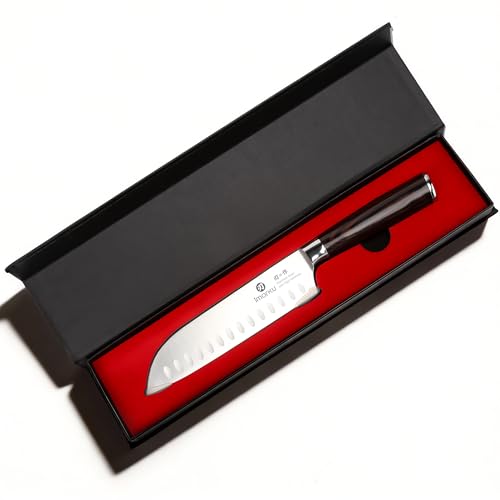
TL;DR — A santoku is a compact Japanese all-purpose knife (usually 5-7 inches) used for slicing, dicing, and mincing vegetables, meat, and fish. Its shorter, lighter blade with a flatter edge suits precise push-cutting, and the dimpled “granton” edge helps release sticky foods. Think of it as a nimbler, more precise alternative to a Western chef’s knife. The HomeWhisk team compared its design and use against aggregated cook feedback. For picks, see our best santoku knife guide.
The HomeWhisk editorial team researches kitchen equipment by analyzing manufacturer specifications, blade geometry, and aggregated user reviews from major retailers and cooking communities. Our recommendations are based on what the products actually deliver, not what brands promise.
The santoku is the most popular Japanese knife in Western kitchens, often bought as an alternative or companion to a chef’s knife. Here’s what it does, how it differs, and who it suits.
What a Santoku Is
The santoku is a Japanese general-purpose knife, and its name tells you its purpose. “Santoku” means “three virtues” or “three uses” — referring to its skill at the three main cutting tasks: slicing, dicing, and mincing.
Its defining features:
- Shorter and lighter than a typical Western chef’s knife (usually 5-7 inches vs 8+), making it nimble and easy to control.
- A flatter edge with less curve than a chef’s knife, and a “sheepsfoot” tip that curves down to a rounded point rather than a sharp pointed tip.
- Often a “granton” edge — the row of dimples (scallops) along the blade — which creates air pockets so food (like potato or cucumber slices) releases instead of sticking.
- A thin, sharp blade, frequently in harder Japanese steel that takes a fine edge.
The flatter profile means the santoku favors an up-and-down or push-cutting motion rather than the rocking of a chef’s knife. It’s a versatile everyday knife, sized and balanced for precise, controlled cutting.
What It’s Used For
The santoku handles the same broad range as a chef’s knife, with a style suited to precision. Here’s what it does well.
Slicing — vegetables, boneless meat, and fish into clean, thin, even pieces. The thin blade and fine edge make precise slices, and the granton dimples help slices fall away rather than cling.
Dicing — onions, peppers, and other vegetables, using its flat edge in a push-down motion. The shorter blade gives good control for uniform dice.
Mincing — garlic, ginger, herbs. While it can’t rock as fully as a chef’s knife, its flat edge minces well with a straight chopping motion.
Everyday all-purpose tasks — as a compact do-everything knife, it’s the one many cooks reach for most, especially those who find a full chef’s knife large or unwieldy.
Its technique: because of the flatter edge, you push-cut (down and forward) or chop straight down rather than rocking. Cooks used to rocking a chef’s knife adapt quickly.
Where it’s less ideal: carving large roasts (shorter blade), cutting through bones (thin blade, will chip), and detail/piercing work needing a fine pointed tip (the sheepsfoot tip is rounded). For those, a chef’s knife, carving knife, or boning knife is better. But for daily slicing, dicing, and mincing, the santoku is a superb generalist.
Santoku vs Chef’s Knife
Since the santoku is most often compared to a Western chef’s knife, understanding the differences helps you choose.
Size and weight: the santoku is shorter (5-7″) and lighter; the chef’s knife is longer (8″+) and often heavier. The santoku feels nimbler and more controllable, especially for smaller hands or those who find a chef’s knife bulky; the chef’s knife covers more with each stroke and handles larger items.
Edge shape and motion: the chef’s knife has a curved belly built for rocking cuts; the santoku has a flatter edge built for push-cutting and straight chopping. This is the core difference — your preferred cutting motion determines which feels natural. If you rock, chef’s knife; if you push-cut or chop straight down, santoku.
Tip: the chef’s knife has a sharp pointed tip for detail and piercing; the santoku has a rounded sheepsfoot tip, less suited to detail work but safe and simple.
Versatility: both are all-purpose. The chef’s knife edges ahead for large tasks and detail work; the santoku edges ahead for nimble control and (with the granton edge) releasing sticky slices. Honestly, for most home cooking, either serves as a primary knife — it comes down to size and cutting-style preference.
Which to choose: if you want one main knife and prefer a rocking motion or cut large items, get a best chef knife. If you prefer a lighter, nimbler knife and a push-cut/chop motion, get a santoku. Many cooks own both and reach for whichever suits the task.
Is a Santoku Right for You?
Deciding whether a santoku should be your main knife or an addition depends on your preferences.
A santoku suits you if you prefer a lighter, shorter, more maneuverable knife, you have smaller hands or find a chef’s knife unwieldy, you naturally push-cut or chop straight down rather than rocking, or you want a nimble everyday knife for lots of slicing and dicing. It’s an excellent primary knife for these cooks, and a great first Japanese knife.
A chef’s knife might suit you better if you rock-chop, regularly cut large items or carve, want a longer blade, or do detail work needing a pointed tip.
You don’t need both, but many cooks own a santoku and a chef’s knife and enjoy switching — the santoku for nimble everyday prep, the chef’s knife for bigger jobs. As a first knife, either works; the santoku is a particularly friendly choice for newer cooks who like its control and lighter feel.
Care: like most Japanese knives, a santoku is thin and often hard steel — cut on wood or soft plastic (never glass), hand-wash and dry immediately, avoid bones and frozen food, and hone/sharpen regularly to keep its fine edge. See our honing guide for maintenance. Our best santoku knife guide covers options across budgets.
Frequently Asked Questions
What is a santoku knife used for?
A santoku is a Japanese all-purpose knife used for slicing, dicing, and mincing vegetables, boneless meat, and fish — its name means “three virtues” for those three tasks. Its shorter, lighter blade with a flatter edge suits push-cutting and straight chopping, and the dimpled granton edge helps sticky foods release. It’s a versatile everyday knife, like a nimbler chef’s knife, ideal for daily prep. It’s less suited to carving roasts, cutting bones, or detail piercing work.
What’s the difference between a santoku and a chef’s knife?
Size, edge shape, and cutting motion. A santoku is shorter (5-7″), lighter, with a flatter edge and rounded tip built for push-cutting and straight chopping. A chef’s knife is longer (8″+), often heavier, with a curved belly for rocking cuts and a pointed tip for detail work. The santoku feels nimbler and more controllable; the chef’s knife covers more per stroke and handles larger items and detail. Choose by preferred cutting motion — rocking favors the chef’s knife, push-cutting favors the santoku.
Is a santoku knife good for beginners?
Yes, it’s a friendly beginner knife. Its shorter, lighter blade is easy to control, the flatter edge suits the simple straight up-and-down chopping many beginners find natural (no rocking technique to learn), and the rounded tip is a bit more forgiving than a sharp point. It handles the everyday slicing, dicing, and mincing most cooking requires. A santoku or a chef’s knife is an excellent first knife; the santoku appeals especially to those who want a nimble, controllable blade.
Can a santoku knife cut meat?
Yes, boneless meat and fish — it slices raw or cooked boneless cuts cleanly with its thin, sharp edge. What it can’t do well is cut through bones (the thin blade can chip), carve large roasts (the short blade is limiting), or do fine detail work needing a pointed tip. For those, use a chef’s knife, carving knife, or boning knife. For everyday boneless meat, fish, and all vegetable prep, the santoku handles it well.
What is the granton edge (dimples) on a santoku for?
The granton edge — the row of oval dimples or scallops along the blade — creates small air pockets between the blade and the food. This reduces suction and friction, so thin slices of sticky foods like potato, cucumber, or cheese release from the blade instead of clinging to it. It’s a practical feature for clean, efficient slicing, though not all santokus have it. It doesn’t affect sharpness; it just helps food fall away as you cut.
Do I need both a santoku and a chef’s knife?
No — either can be your single main knife, since both are versatile all-rounders. Owning both is nice but optional: many cooks keep a santoku for nimble everyday slicing and dicing and a chef’s knife for larger items, carving, and detail work, switching by task. If buying one, choose by cutting style and size preference — push-cutters and those wanting a lighter knife pick the santoku; rockers and those wanting a longer blade pick the chef’s knife. See our best santoku knife and best chef knife guides.
Related buying guides: best knife sets, best bread knife and best boning knife.
The Bottom Line
A santoku is a compact, lightweight Japanese all-purpose knife — its name means “three virtues” for slicing, dicing, and mincing — that handles vegetables, boneless meat, and fish with a flatter edge suited to push-cutting and straight chopping. The granton dimples help sticky foods release. It’s a nimbler, more controllable alternative to a Western chef’s knife, excellent as a primary knife for cooks who prefer a shorter blade and don’t rock-chop. It’s less ideal for carving, bones, or detail work. As a first or everyday knife it’s a superb, beginner-friendly choice. See our best santoku knife and best chef knife guides to decide.
Save $30.00
Pros & Cons
Pros
- The 2.5mm blade thickness paired with the hollow edge design handles both delicate julienne cuts and heavier chopping without flexing or wedging.
- Pakkawood handle construction offers a more sanitary and dimensionally stable grip than standard composite or natural wood handles.
- The 15-18 degree edge angle matches professional Japanese knife geometry, giving it a noticeably sharper out-of-box performance than German-style knives at this price.
- Versatile enough for meat, vegetables, fruit, and bread, making it a practical single-knife solution for small kitchens with limited storage.
Cons
- With zero verified reviews available, long-term edge retention and handle durability under daily use remain unconfirmed by real buyers.
- The 3-month refund window is shorter than the lifetime guarantees offered by competing brands at the same price point.
Details
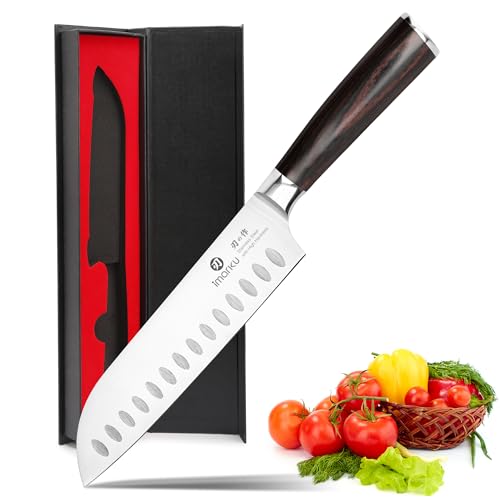
The imarku Santoku solves the sticking problem common with flat-edge knives by using a hollow scalloped blade that keeps sliced food from clinging during fast prep.
Its 15-18 degree hand-polished edge cuts with less force than wider-angle Western knives, which matters most when processing large volumes of vegetables or thin-sliced proteins.
Built from high carbon stainless steel at 2.5mm thickness with a Pakkawood handle, it balances rigidity and grip comfort across different hand sizes.
The brand upgrade notice means packaging and minor cosmetics may vary from product photos, though materials and construction are stated to be unchanged.
Best for home cooks who want one capable, low-maintenance knife that handles daily prep without occupying much counter or drawer space.
Care Guide
Hand-wash with warm soapy water immediately after use and dry thoroughly before storage. Dishwasher cycles degrade the Pakkawood handle and accelerate edge micro-chipping on high carbon steel.
Hone the blade on a ceramic rod every 3-4 uses to maintain the 15-18 degree edge angle. Sharpen on a whetstone at the same angle when honing no longer restores bite.
Store on a magnetic strip or in a knife block. Loose drawer storage causes edge-on-edge contact that dulls the blade faster than actual cooking use.

Pros & Cons
Pros
- Hollow-edge grantons genuinely prevent cucumber and tomato slices from sticking to the blade mid-cut.
- German stainless steel holds its edge through repeated use on harder vegetables like carrots and beets.
- Fully forged construction creates noticeable weight and balance that makes repetitive dicing feel controlled and effortless.
Cons
- At 7 inches, it's smaller than Western chef's knives, requiring more frequent repositioning on larger vegetables.
- Dishwasher safe, but hand washing extends blade life and prevents potential handle loosening over time.
Details
A Japanese-style Santoku designed for mincing, slicing, and dicing. Solves the problem of food sticking to the blade during repetitive vegetable prep.
The hollow-edge blade with grantons prevents adhesion on wet vegetables. The fully forged German stainless steel maintains sharpness through extended use without frequent honing.
7-inch blade, triple-rivet handle, satin finish. Fully forged construction means the blade and handle are one piece, creating superior balance and durability compared to stamped knives.
The smaller 7-inch size requires more hand repositioning on large vegetables compared to 8-inch Western chef’s knives.
Best for home cooks who prep vegetables daily and want a balanced, durable knife that handles garlic, onions, and cucumbers without constant blade cleaning.
Care Guide
Hand wash immediately after use under warm water with mild soap. Dry the blade right away to prevent water spots on the satin finish. Store blade-down in a knife block or with a blade guard to protect the edge.
Hone the blade every 2-3 months using a honing steel to realign the edge. This maintains sharpness between professional sharpenings, which you’ll need every 1-2 years depending on use frequency.
Never soak in water or place in the dishwasher regularly, as repeated moisture exposure can loosen the triple-rivet handle over time. Avoid cutting on glass, marble, or ceramic surfaces; use wood or plastic cutting boards only.

Pros & Cons
Pros
- The triple-layer laminated steel with 10Cr15CoMoV Japanese steel reaches 62HRC hardness, delivering edge retention that outlasts standard stainless blades.
- Ergonomic pakkawood handle provides secure grip and control without hand fatigue during extended prep sessions.
- 15-degree blade angle and hand-sharpened edge produce cleaner cuts through delicate vegetables and proteins compared to wider blade angles.
Cons
- Hand-washing required; dishwasher use will degrade the blade edge and handle finish over time.
- Requires regular honing to maintain the 15-degree angle; the initial sharpness will gradually diminish with normal kitchen use.
Details
A 7-inch Japanese santoku knife engineered for precise slicing, dicing, and chopping across vegetables, fruits, and proteins. The triple-layer laminated steel with 62HRC hardness solves the problem of dull blades that require frequent sharpening.
The 15-degree blade angle and double-side groove design reduce cutting resistance and prevent food sticking, delivering cleaner cuts in fewer strokes. The frosted polishing finish combined with 0.9% carbon content creates a blade twice as hard as comparable knives.
Made from high-end Japanese 10Cr15CoMoV steel, forged through 40+ production processes including heat treatment and precision grinding. The ergonomic African pakkawood handle resists thermal expansion and maintains durability through years of daily use.
Hand-washing is required to preserve the blade edge and handle integrity; dishwasher use will degrade both.
Best for home cooks and professional chefs who prioritize precision cutting and blade longevity over convenience.
Care Guide
Hand-wash immediately after use with warm soapy water and dry thoroughly. Store in a knife block or with blade guards to prevent edge damage and protect your hands during storage.
Hone the blade regularly using a honing steel to maintain the 15-degree angle and edge alignment. Professional sharpening every 6-12 months preserves the factory edge and extends blade life significantly.
Avoid cutting on glass, ceramic, or marble surfaces; use wood or plastic cutting boards to protect the blade. Never soak the knife or expose the pakkawood handle to prolonged moisture to prevent warping.

Pros & Cons
Pros
- Granton edge prevents food from sticking to the blade, making thin slicing of cucumbers, tomatoes, and fish noticeably faster than standard chef's knives.
- Ergonomic handle with substantial bolster reduces wrist strain during extended prep sessions and feels secure even when wet.
- Professional-grade construction at under $50 delivers the same German steel and forging process used in culinary schools.
Cons
- Requires hand-washing only; dishwasher use will damage the blade and handle, adding a maintenance step most busy cooks dislike.
- Santoku's shorter blade length and rectangular shape take practice if you're accustomed to Western chef's knives, requiring a learning curve.
Details
A 7-inch Japanese-style santoku knife designed for precision slicing, mincing, and dicing vegetables. Solves the problem of food sticking to the blade during thin slicing and reduces hand fatigue during repetitive chopping.
The Granton edge (shallow ground shallows) creates air pockets that release thin slices cleanly. The taper-ground blade concentrates cutting force, making mincing faster and more controlled than standard knives.
Fully forged from high-carbon German steel with a nonslip Santoprene handle and substantial bolster for balance. The 7-inch blade is shorter and wider than Western chef’s knives, optimized for the rocking and push-cut motions of vegetable prep.
Requires hand-washing only; dishwasher use will degrade the blade and handle. The learning curve is real if you’ve only used Western chef’s knives.
Best for home cooks who prep vegetables daily and want professional durability without professional pricing.
Care Guide
Hand-wash immediately after use with warm water and mild soap. Rinse thoroughly and dry completely with a soft towel before storing. Never submerge for extended periods or place in the dishwasher, as moisture and heat will damage the blade and handle.
Store the blade in a knife block or on a magnetic strip to protect the edge and prevent accidents. Avoid cutting on glass, marble, or ceramic surfaces; use wood or plastic cutting boards only.
Hone the blade regularly with a honing steel to maintain sharpness between uses. Professional sharpening every 6–12 months (depending on use frequency) will restore the taper-ground edge if it dulls.

Pros & Cons
Pros
- Forged bolster transitions seamlessly from blade to handle, eliminating weak points that cause blade wobble during cutting.
- Satin-finished blade holds its edge noticeably longer than stamped knives, reducing the need for frequent sharpening.
- Two-knife set covers both precision work and larger prep tasks without requiring a full block of specialty knives.
Cons
- Santoku blade shape has a steeper learning curve than traditional chef's knives if you're accustomed to rocking motions.
- German stainless steel requires hand-washing to maintain edge longevity, despite being dishwasher-safe.
Details
This 2-piece santoku set combines a 7-inch all-purpose knife and 5-inch precision knife, solving the common problem of owning too many specialty knives or too few to handle varied prep tasks efficiently.
The forged bolster construction ensures the blade transitions seamlessly to the handle, eliminating flex during cuts. The satin-finished blade holds its edge significantly longer than stamped alternatives, meaning fewer sharpening sessions between uses.
Both knives are fabricated from high-quality German stainless steel with triple-riveted handles and stainless-steel endcaps. The set is compact enough for small kitchens but substantial enough for serious home cooks.
One limitation: santoku knives require a pushing or slicing motion rather than the rocking motion of traditional chef’s knives, which may require technique adjustment if you’ve only used Western-style blades.
Best for home cooks who prep vegetables daily and want durable, low-maintenance knives that stay sharp without constant honing.
Care Guide
Hand-wash both knives immediately after use with warm soapy water and a soft cloth. Dry thoroughly before storing to prevent water spots. While dishwasher-safe, hand-washing preserves the edge and prevents blade dulling from contact with other utensils.
Store knives in a knife block, on a magnetic strip, or with blade guards to protect the edge. Never leave blades loose in drawers where they’ll strike other metal objects and lose sharpness.
The stainless-steel construction resists rust naturally, but occasional hand-drying prevents mineral deposits. Hone blades every 2-3 weeks of regular use with a honing steel to realign the edge and maintain sharpness between professional sharpenings.
About These Recommendations
The technique above is the point of this guide; the products are here because they help. We have not tested them ourselves — we did not buy or use this gear. The recommendations come from comparing specifications and materials against the patterns in verified owner reviews, so treat them as a shortlist worth researching rather than a verdict from our own kitchen.
Availability and prices change often, so check the current listing before buying. We earn a commission on purchases made through links on this page, which never affects what we recommend.

Write Your Review
No reviews yet. Be the first to share your experience!