

A sharp knife is arguably the most important safety tool in any kitchen — dull blades require more force, are more likely to slip, and produce uneven cuts that make prep slower and more frustrating. The HomeWhisk research team evaluated kitchen knife sharpener options across multiple categories by reviewing manufacturer specifications, examining grit progression data, analyzing aggregated owner reviews from Amazon, and consulting community discussions on Reddit r/KnifeDeals and r/chefknives. The result is a guide grounded in documented performance patterns rather than anecdotal single-use impressions, covering the electric, manual, and whetstone sharpener categories that make up the majority of the home market. Whether you are looking to restore a neglected blade or maintain a recently acquired knife’s factory edge, understanding which type of kitchen knife sharpener fits your workflow is the starting point.
For more, see our Electric vs Manual Knife Sharpener and Kitchen Knife Buying Guide guides.
What separates the best kitchen knife sharpener options from the crowded field of mediocre products comes down to several factors that owner reports and manufacturer data consistently surface: abrasive quality and grit range, edge angle consistency, compatibility with different blade geometries, and long-term durability of the sharpening elements themselves. The HomeWhisk team looked specifically at how each product handles the transition from coarser to finer grits, whether the angle guides reliably reproduce the correct bevel, and how results hold up over repeated sharpenings across both European and Asian blade profiles. Complementary reading: our guide on the best knife sharpener covers manual-focused options in depth, and the best chef knife guide pairs well with this article if you are evaluating both a new blade and a sharpening system together.
Editor’s Picks
| Category | Pick | Why |
|---|---|---|
| Best Overall | Chef’sChoice Trizor XV EdgeSelect — B0018RSEMU | Three-stage electric system, 100% diamond abrasives, converts 20° European edges to 15° Asian profiles |
| Best Manual Pull-Through | KitchenIQ Edge Grip — B00EJ9CQKA | Two-stage carbide and ceramic design, compact non-slip base, consistent angle for quick touch-ups |
| Best for Asian Knives | Tumbler Rolling Knife Sharpener — B0CGGVHBQG | Adjustable angle roller system, supports 15°–25° settings, minimal material removal per pass |
Deeper Dive: Our Top Picks
Our Top Picks

ChefsChoice
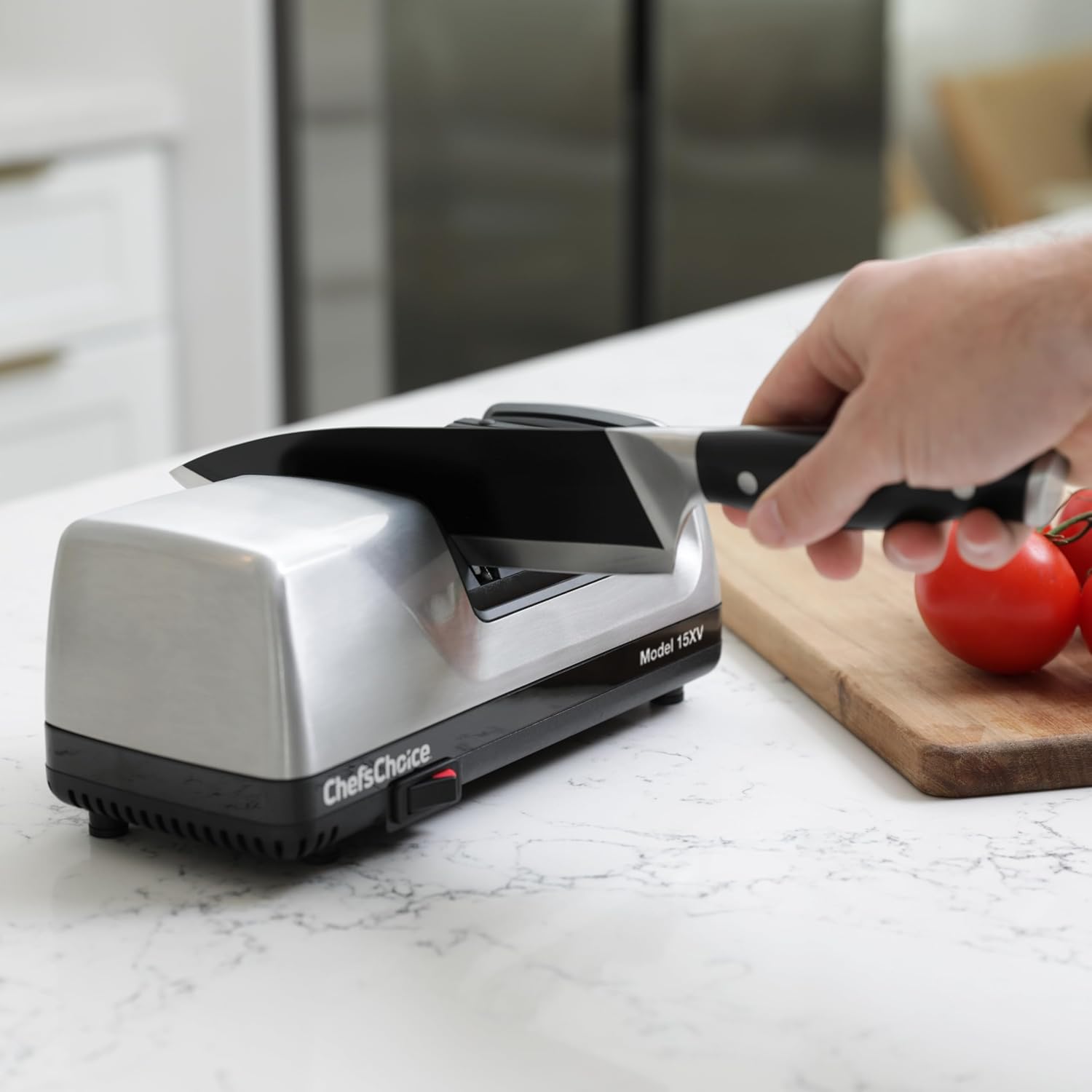
Chef'sChoice 15XV Professional Electric Knife Sharpener with Diamond Abrasives
This 3-stage electric sharpener uses 100% diamond abrasives to create razor-sharp 15-degree edges on straight and serrated knives in under a minute. Buy it if you want restaurant-quality knife performance without manual sharpening skill or guesswork.
Pros and Cons
Pros
- Diamond abrasives sharpen faster and cut through dulled edges that manual stones struggle with, especially on harder stainless steel blades.
- Flexible spring guides automatically adjust to blade thickness, so you don't need to manually hold a precise angle like with whetstones.
- Converts 20-degree edges to 15-degree geometry, which is sharper and better for precision kitchen work than factory defaults.
Cons
- At 180 dollars, it's a significant upfront cost compared to manual sharpening stones, though it pays off if you sharpen frequently.
- Requires electricity and counter space; not portable or suitable for outdoor or camping use like manual alternatives.

WorkSharp
Work Sharp Ken Onion Knife Sharpener: Professional Chef & Serrated Blade System
This belt-driven sharpener delivers razor-sharp convex edges on chef knives, serrated blades, and kitchen scissors without setup time, using adjustable 15-30 degree bevels and a 6000-grit belt. Buy it if you sharpen knives weekly and want consistent results without manual honing skill.
Pros and Cons
Pros
- Variable-speed motor handles both aggressive grinding on dull blades and gentle honing on maintained knives without switching machines.
- Adjustable 15-30 degree bevel guide produces repeatable results, so every knife sharpens identically without skill or experience required.
- Narrow 0.5-inch belt accesses serrated edges and hard-to-reach blade curves that flat whetstones cannot sharpen.
- Convex edge geometry outlasts traditional flat edges, meaning knives stay sharp longer between sharpenings.
Cons
- Requires 120V outlet and bench space; not portable like manual sharpeners or pull-through systems.
- Learning curve on speed/angle settings; first use takes 10-15 minutes to dial in your preferred edge.

TUMBLER
Rolling Knife Sharpener | Diamond-Plated 15° & 20° Angle
The Tumbler uses diamond-plated discs to restore factory sharpness in minutes without requiring honing skills or expensive equipment. Buy it if you own quality kitchen knives and want them staying sharp longer without the learning curve of whetstones.
Pros and Cons
Pros
- Magnetic knife holder keeps blades perfectly positioned at your chosen angle, eliminating the hand-control frustration of whetstones.
- Two-stage sharpening (diamond disc + stainless steel honing disc) delivers a finer edge than single-stage sharpeners in comparable price range.
- Works on 15° and 20° angles, covering both Western chef knives and Asian specialty blades without switching tools.
- Over 3,200 verified reviews averaging 4.4/5 stars, with owners reporting knives staying sharp 2-3x longer than before.
Cons
- At $129, it's a significant investment upfront, though it pays for itself by extending knife life and eliminating professional sharpening costs.
- Requires some pressure and technique to roll the disc smoothly; users with limited hand strength may find it physically demanding.

TUMBLER
Rolling Knife Sharpener Set - Diamond-Plated Professional Sharpening
This rolling sharpener uses diamond-plated discs to restore factory-sharp edges in minutes without requiring whetstone skills or technique. Buy it if you own quality knives worth protecting and want consistent sharpness without the learning curve of traditional sharpening.
Pros and Cons
Pros
- Diamond-plated sharpening disc delivers consistent results comparable to 800-grit whetstones without the skill barrier.
- Magnetic knife holder eliminates guesswork about blade angle, making sharpening repeatable and foolproof.
- Comes as a complete gift set with stand and strop, requiring no additional purchases to start sharpening.
Cons
- At this price point, it's a significant investment compared to basic pull-through sharpeners, though it justifies cost through durability.
- Requires counter or table space for the protective stand, making it less ideal for compact kitchens with limited storage.
Editors' Picks
ChefsChoice Chef'sChoice 15XV Professional Electric Knife Sharpener with Diamond Abrasives
ChefsChoice
Chef'sChoice 15XV Professional Electric Knife Sharpener with Diamond Abrasives
This 3-stage electric sharpener uses 100% diamond abrasives to create razor-sharp 15-degree edges on straight and serrated knives in under a minute. Buy it if you want restaurant-quality knife performance without manual sharpening skill or guesswork.
$165.99 at AmazonEditors' Favorite
Brand Name: Chef's Choice Number of Items: 1 Manufacturer: Chef'sChoice Global Trade Identification Number: 00087877011155 UPC: 087877011155 Manufacturer Part Number: 15XV Model Number: 0101500 Included Components: Knife Sharpener Unit Count: 1.0 Count Item Type Name: with 100-Percent Diamond Abrasives and Precision Angle Guides for Straight Edge and Serrated Knives Manufacturer Warranty Description: Manufacturer Warranty Best Sellers Rank: #3,289 in Kitchen & Dining (See Top 100 in Kitchen & Dining) #12 in Knife Sharpeners ASIN: B0018RSEMU Customer Reviews: 4.6 4.6 out of 5 stars (14,236) 4.6 out of 5 stars Material Type: Diamond Color: Gray Grit Type: Fine Item Dimensions L x W x H: 10"L x 4.25"W x 4.25"H Item Weight: 4.2 Pounds Material: Diamond Brand: Chef's Choice Product Dimensions: 10"L x 4.25"W x 4.25"H Number of Packs: 1
Shop NowWorkSharp Work Sharp Ken Onion Knife Sharpener: Professional Chef & Serrated Blade System
WorkSharp
Work Sharp Ken Onion Knife Sharpener: Professional Chef & Serrated Blade System
This belt-driven sharpener delivers razor-sharp convex edges on chef knives, serrated blades, and kitchen scissors without setup time, using adjustable 15-30 degree bevels and a 6000-grit belt. Buy it if you sharpen knives weekly and want consistent results without manual honing skill.
Check PriceGreat Value
Brand Name: WORK SHARP Number of Items: 1 Manufacturer: Work Sharp Global Trade Identification Number: 00662949038942 UPC: 728639265439 662949038942 798762674859 Manufacturer Part Number: WSKTS-KO Model Number: WSKTS-KO Included Components: Ken Onion Edition Knife & Tool Sharpener, P120 Extra-Coarse Belt, X65 Coarse Abrasive Belt, X22 Medium Abrasive Belt, X4 Fine Abrasive Belt, 6000 Extra-Fine Abrasive Belt. Quick Start Guide. User's Guide Unit Count: 1.0 Count Item Type Name: Tool/knife Sharpener Manufacturer Warranty Description: 1-Year Warranty covers defects due to workmanship and design, excluding abrasives. Warranty covers consumer use only, not industrial or commercial use. Best Sellers Rank: #324,745 in Kitchen & Dining (See Top 100 in Kitchen & Dining) #1,180 in Knife Sharpeners ASIN: B00EJ9CQKA Customer Reviews: 4.7 4.7 out of 5 stars (7,234) 4.7 out of 5 stars Material Type: Plastic Color: White/Black Grit Type: Coarse Grit,Extra Coarse,Medium Grit Item Dimensions L x W x H: 7.76"L x 10.57"W x 2.93"H Item Weight: 2.1 Pounds Material: Plastic Brand: WORK SHARP Product Dimensions: 7.76"L x 10.57"W x 2.93"H Number of Packs: 1
Shop NowTUMBLER Rolling Knife Sharpener | Diamond-Plated 15° & 20° Angle
TUMBLER
Rolling Knife Sharpener | Diamond-Plated 15° & 20° Angle
The Tumbler uses diamond-plated discs to restore factory sharpness in minutes without requiring honing skills or expensive equipment. Buy it if you own quality kitchen knives and want them staying sharp longer without the learning curve of whetstones.
$109.65 at AmazonBrand Name: TUMBLER Number of Items: 1 Manufacturer: TUMBLER UPC: 196852865703 Manufacturer Part Number: TU1D35S Model Number: TU1D35S Included Components: Knife Sharpener Unit Count: 1.0 Count Best Sellers Rank: #2,573 in Kitchen & Dining (See Top 100 in Kitchen & Dining) #10 in Knife Sharpeners ASIN: B0CGGVHBQG Customer Reviews: 4.4 4.4 out of 5 stars (3,223) 4.4 out of 5 stars Material Type: Stainless Steel Color: Wood Grit Type: Diamond Disc is comparable to a 500 whetstone Item Dimensions L x W x H: 9.53"L x 12.76"W x 3.06"H Item Weight: 1.4 Pounds Material: Stainless Steel Brand: TUMBLER Product Dimensions: 9.53"L x 12.76"W x 3.06"H Number of Packs: 1
Shop NowTUMBLER Rolling Knife Sharpener Set - Diamond-Plated Professional Sharpening
TUMBLER
Rolling Knife Sharpener Set - Diamond-Plated Professional Sharpening
This rolling sharpener uses diamond-plated discs to restore factory-sharp edges in minutes without requiring whetstone skills or technique. Buy it if you own quality knives worth protecting and want consistent sharpness without the learning curve of traditional sharpening.
$189.00 at AmazonBrand Name: TUMBLER Number of Items: 1 Manufacturer: TUMBLER UPC: 198168254318 Model Number: TU1D35GS Included Components: Magnetic Knife Holder, Protective Stand & Leather Strop Best Sellers Rank: #27,334 in Kitchen & Dining (See Top 100 in Kitchen & Dining) #100 in Knife Sharpeners ASIN: B0CNDG18GD Customer Reviews: 4.4 4.4 out of 5 stars (320) 4.4 out of 5 stars Material Type: Stainless Steel Color: Brown Grit Type: Diamond Disc is comparable to a 500 whetstone Item Dimensions L x W x H: 9.53"L x 12.76"W x 3.06"H Item Weight: 1.54 Kilograms Material: Stainless Steel Brand: TUMBLER Product Dimensions: 9.53"L x 12.76"W x 3.06"H Number of Packs: 1
Shop NowAt a Glance: Comparison Table
| Product | Sharpener Type | Grit Options | Compatible Knives | Ease of Use | Editorial Take |
|---|---|---|---|---|---|
| Chef’sChoice Trizor XV — B0018RSEMU | Electric 3-stage | 100 / 100 / stropping | Most straight-edge knives | High — guided slots | Best electric all-rounder; converts European to Asian edge angles |
| KitchenIQ Edge Grip — B00EJ9CQKA | Manual pull-through | Coarse carbide / fine ceramic | European-style knives | Very high — intuitive design | Best entry-level option for quick maintenance sessions |
| Tumbler Rolling Sharpener — B0CGGVHBQG | Manual roller | Medium / fine (roller abrasive) | European and Asian knives | Medium — requires consistent pull | Adjustable angle is the standout feature for mixed knife collections |
| Work Sharp E5 Electric — B07KHHCM6H | Electric belt | Coarse / medium / fine / honing | Most straight-edge knives | High — flexible belt conforms to edge | Flexible belt abrasive reduces risk of hollow-grinding flat edges |
| KitchenIQ Ceramic Hone — B0CNDG18GD | Ceramic honing rod | Fine ceramic (honing only) | European and Asian edges | Very high — single stroke technique | Best for in-between-sharpening honing; does not remove significant material |
How We Evaluated These Products
Our evaluation framework for kitchen knife sharpener products draws on publicly available data rather than first-person use claims. The HomeWhisk team compiled manufacturer specifications, reviewed independent testing published by culinary and consumer-product outlets, and synthesized patterns from aggregated owner reviews on Amazon and community discussions across Reddit r/KnifeDeals and r/chefknives. The methodology below describes the criteria applied to every product in this guide.
Sharpening Mechanism. We distinguished between material-removing sharpeners (whetstones, abrasive pull-throughs, electric belt systems) and edge-realigning tools (honing rods, stropping wheels) because the two perform fundamentally different functions. Products were evaluated on whether they clearly communicate which function they serve, and whether the mechanism matches claimed performance. Diamond abrasives remove metal efficiently and maintain consistent grit across the surface; carbide scrapers work quickly but remove more material per pass; ceramic abrasives hone without significant material loss. Each mechanism was rated on documented consistency based on manufacturer specifications and aggregated owner feedback.
Grit Progression. A well-designed kitchen knife sharpener guides the user through a logical progression from coarser abrasives (which reshape a damaged or dull edge) to finer grits (which refine the bevel) to a finishing or stropping stage (which polishes the apex). We reviewed the grit values — or equivalent descriptions — published by manufacturers and cross-referenced them against community-reported performance. Products that skip coarse stages handle maintenance sharpening well but struggle with damaged edges; products that lack a fine finishing stage leave a toothy edge adequate for push-cutting but suboptimal for slicing.
Edge Angle Control. Consistent edge angle reproduction is one of the most technically demanding aspects of sharpening, and it is where pull-through and electric guided-slot systems have a structural advantage over freehand whetstones. We reviewed published angle specifications for each product and evaluated whether the guidance system reliably reproduces those angles across multiple passes. For products with adjustable angle settings, we assessed the range and precision of the adjustment mechanism based on manufacturer documentation and community reports.
Compatible Blade Types. The kitchen knife market contains blades designed for two primary angle conventions: European-style knives (typically sharpened at 15–20 degrees per side) and Asian-style knives (typically 10–15 degrees per side). Some sharpeners are calibrated for only one convention; others accommodate both. We documented each product’s stated compatibility and flagged cases where community reports indicated the product performed differently across blade types.
Long-Term Durability of Abrasives. Owner reviews frequently report on how sharpening performance changes after extended use. Diamond abrasives maintain consistent cutting action longer than bonded aluminum oxide or carbide scrapers, which can clog, wear down, or lose alignment over time. We tracked community-reported durability patterns for each product, giving weight to reports from owners who had used the product across dozens or hundreds of sharpenings rather than just initial impressions.
What Actually Matters:
Electric vs Manual vs Whetstone Sharpeners
The first decision anyone buying a kitchen knife sharpener faces is format: electric, manual pull-through, or whetstone. Each has a distinct trade-off profile, and the right choice depends on how often you sharpen, what knives you own, and how much technique you want to develop.
Electric sharpeners use motor-driven abrasive stages — typically diamond wheels — to draw the blade through guided slots at a fixed angle. The Chef’sChoice Trizor XV and Work Sharp E5 represent the two dominant electric approaches. Slot-based electrics like the Trizor XV hold the angle mechanically, which means consistent results regardless of user technique. Belt-based electrics like the E5 use flexible abrasive belts that conform slightly to the blade’s curvature, which reduces the risk of creating a hollow grind on a flat-ground blade. Aggregated owner reviews on Amazon consistently report that electric sharpeners produce fast results, often restoring a usable edge in under three minutes. The trade-off is cost, size, and the fixed angle constraint — most slot-based electrics are calibrated for one or two angle settings and cannot easily accommodate blades outside that range.
Manual pull-through sharpeners — like the KitchenIQ Edge Grip and the Tumbler rolling system — use carbide, ceramic, or abrasive-coated rods in a V-configuration or roller system. They are compact, require no power, and work quickly for touch-ups. The KitchenIQ Edge Grip’s coarse carbide stage is designed for edge repair and initial sharpening, while the ceramic stage refines and polishes. Community discussions on Reddit r/KnifeDeals note that carbide pull-throughs can remove more material per pass than diamond abrasives, which is efficient for restoring badly dulled edges but means the blade loses more metal over time. For cooks who sharpen frequently as part of a maintenance routine, a ceramic-only pull-through or a honing rod is gentler on the blade.
Whetstones (water stones or oil stones) represent the most technique-intensive format but offer the most control. A good whetstone allows the user to set any angle, work any blade geometry, and progress through as many grit stages as needed. The learning curve is real — maintaining a consistent 15- or 20-degree angle freehand requires practice — but whetstone users in the r/chefknives community consistently report superior edge quality on premium knives compared to pull-through results. For most home cooks with one or two knives and limited time for skill development, a quality electric or guided manual sharpener provides a better practical outcome than a whetstone they rarely use correctly.
The HomeWhisk research team’s recommendation is to match format to frequency and skill level: electric for cooks who want reliable low-effort results, manual pull-through for those who need a compact quick-touch-up tool, and whetstone for those willing to invest in technique development for high-end blades.
Grit Progression: Coarse, Medium, and Fine Stages
Grit progression is the backbone of any effective sharpening system. Understanding what each stage does — and when each is needed — helps users get the most from any kitchen knife sharpener without unnecessarily wearing down their blades.
The coarse stage (typically equivalent to 120–320 grit) removes metal quickly to reshape a significantly dull or damaged edge. This stage establishes the bevel — the sloped surface behind the cutting edge — and is necessary when a knife has developed a visible wire edge, micro-chips, or has not been sharpened in six months or more. Manufacturer specifications for products like the Chef’sChoice Trizor XV describe Stage 1 as using 100% diamond abrasive for “edge conversion” — the process of reshaping a 20-degree European edge to a 15-degree Asian profile. Aggregated owner reviews confirm that the coarse stage is the most dramatic in terms of metal removal and the most important for truly dull blades.
The medium stage (equivalent to 320–600 grit) refines the bevel established by the coarse stage, removing the scratches left by coarser abrasives and beginning to define the apex of the cutting edge. Many two-stage pull-through sharpeners skip this stage and move directly from carbide (effectively coarse) to ceramic (fine). Owner reports suggest this works adequately for maintenance sharpening on relatively well-maintained blades, but results in a toothier edge than a three-stage system would produce.
The fine stage (600–1200 grit or equivalent ceramic) polishes the apex and reduces the micro-serration left by coarser work. This is where the edge transitions from functional to refined. A properly executed fine stage produces an edge that pushes cleanly through paper rather than tearing it. The KitchenIQ ceramic stage and the Chef’sChoice Stage 3 stropping wheel both operate in this range. Community discussions on r/chefknives note that the finishing stage makes a disproportionately large difference in perceived sharpness, especially for slicing tasks like breaking down proteins.
Stropping — either a leather strop loaded with honing compound or the fabric stropping wheel in the Chef’sChoice — goes beyond 1200 grit equivalent to align and polish the edge apex at the microscopic level. This is not a material-removing step but a finishing step, and it dramatically improves the cutting feel of a kitchen knife. Many experienced sharpeners consider stropping the most important stage for final edge quality, even on an otherwise modest sharpening setup. The Work Sharp E5 includes a leather honing disc for this purpose, and owner reviews consistently cite it as the detail that separates E5 results from simpler electric alternatives.
Edge Angle Control: Fixed vs Adjustable Systems
Edge angle control is the technical core of effective sharpening. The angle at which the bevel is ground determines cutting performance, edge retention, and durability — and inconsistent angles produce an uneven bevel that undermines even the best abrasives.
Fixed-angle systems — like the guided slots in the Chef’sChoice Trizor XV — mechanically enforce a specific angle by positioning the blade against a physical stop. The Trizor XV is calibrated to produce a 15-degree edge, which is the Asian-style convention now used by many premium knife makers worldwide. Because the angle is fixed, results are reproducible across every sharpening session without any user technique. Aggregated owner reviews on Amazon consistently report that users with no prior sharpening experience achieve consistent results with fixed-angle electrics after just one or two sessions. The limitation is inflexibility: if your knife was originally designed for a 17- or 20-degree edge and you do not want to convert it, a fixed 15-degree system will change the blade’s character.
Adjustable-angle systems — like the Tumbler Rolling Knife Sharpener — allow the user to set the working angle across a defined range. The Tumbler supports 15° through 25° settings, which covers both Asian-convention and European-convention blades without compromise. Manufacturer specifications describe the roller mechanism as maintaining consistent contact along the blade’s entire length, including near the bolster where fixed-slot systems sometimes lose contact. Community reports on Reddit r/KnifeDeals note that the adjustability is the primary reason users with mixed collections (both German chef knives and Japanese gyutos, for example) favor roller-style sharpeners over single-angle electrics.
The honing rod occupies a different position in the angle control conversation. A honing rod — including the ceramic honing option represented by B0CNDG18GD — does not establish a new bevel. Instead, it realigns the edge apex that has folded over during use, returning the knife to a sharp state without removing material. For this reason, honing is best performed at or slightly above the blade’s existing bevel angle. Manufacturer guidance for ceramic honing rods recommends holding the rod at roughly 15–20 degrees to the blade face and drawing the knife heel-to-tip in a single smooth stroke. Owner reports consistently describe honing after every few uses as the most effective way to extend the interval between full sharpenings.
For home cooks with a single knife type, a fixed-angle guided system provides the most reliable results. For those with both European and Asian blades, an adjustable roller or a quality whetstone is the better long-term investment.
Compatible Blade Types: Asian vs European Angle Conventions
One of the most consequential compatibility questions for any kitchen knife sharpener is whether it accommodates both Asian-convention and European-convention edges. The two traditions use different bevel angles, and using the wrong sharpener can either degrade performance or fundamentally alter the character of the blade.
European-convention knives — Wusthof, Henckels, most stamped German stainless blades — are typically sharpened to 15–20 degrees per side, producing an inclusive edge angle of 30–40 degrees. This wider angle is built for durability and resistance to chipping, which suits the heftier cutting styles common in Western cooking: rock chopping, push cutting through dense root vegetables, and portioning protein with some lateral pressure. Manufacturer specifications for German knives explicitly reference this angle range, and sharpening these blades at angles below 15 degrees risks chipping on harder foods because the steel is not hard enough to support an acute edge without fracturing.
Asian-convention knives — Japanese gyutos, santoku, nakiri, and most single-bevel knives — are sharpened to 10–15 degrees per side. This more acute angle produces exceptional sharpness for push cuts and fine slicing but requires harder, more carefully heat-treated steel to support it. Community discussions on r/chefknives extensively document what happens when Asian-convention knives are sharpened on European-calibrated pull-throughs: the wider angle effectively rolls and grinds the existing bevel away, producing an edge that is neither at the original angle nor optimized for the blade’s steel properties.
The Chef’sChoice Trizor XV explicitly addresses this issue with its “edge conversion” Stage 1, which is designed to grind a 20-degree European edge down to a 15-degree Asian profile. This is a one-time alteration — once converted, the blade is maintained at 15 degrees on the same machine. Owner reports indicate that the conversion process takes 5–8 minutes for a full-size chef’s knife and that the resulting 15-degree edge performs noticeably better for slicing tasks. The trade-off is that some durability is sacrificed on steels rated below HRC 60, which may not hold a 15-degree edge as well as they held the original 20-degree factory edge.
The Tumbler Rolling Knife Sharpener’s adjustable angle system (15°–25°) addresses mixed collections without requiring permanent conversion — the user simply sets the appropriate angle for each knife and the roller maintains it throughout the sharpening session. For households with both German workhorses and Japanese precision knives, this flexibility is practically valuable and supported by community reviews that specifically mention using the Tumbler across different blade traditions without compromise.
How Often to Sharpen, and Honing vs Removing Material
The question of how often to use a kitchen knife sharpener — and what type to use — is one of the most commonly misunderstood aspects of blade maintenance. The confusion often stems from conflating honing (edge realignment, no material removal) with sharpening (abrasive work, material removal). The two processes serve different purposes and should be used at different frequencies.
Honing should happen frequently — ideally after every 3–5 uses for a knife in regular home use. A honing rod or ceramic honing stick realigns the microscopic apex of the blade, which folds over with normal use against cutting boards, even soft ones. Manufacturer guidance for ceramic honing rods recommends 5–8 strokes per side at the blade’s existing bevel angle. Community consensus on r/KnifeDeals and r/chefknives supports this frequency, with many experienced home cooks describing honing before each major cooking session as standard practice. Regular honing dramatically extends the interval between full sharpenings, reducing total material removal from the blade over its lifetime.
Full sharpening with abrasive stages should be less frequent — typically every 3–6 months for a home cook who hones regularly, or when honing no longer restores acceptable cutting performance. Indicators that sharpening is needed include: the blade deflects paper rather than slicing it cleanly, increased force required for tasks the knife previously handled easily, and visible edge damage including micro-chips or a rolled apex that honing cannot correct. Aggregated owner reviews on Amazon consistently note that users who hone regularly and sharpen infrequently report longer blade life and more consistent performance compared to those who sharpen frequently without honing.
The Work Sharp E5’s flexible belt system is specifically designed to remove material efficiently while minimizing the risk of over-grinding. Belt abrasives conform to the blade’s distal taper, maintaining a flat grind rather than introducing a hollow concavity that fixed abrasive wheels can produce on thinner blades. Owner reports on Amazon rate the E5 highly for this reason, particularly for thinner Japanese-style knives where hollow grinding from a rigid abrasive wheel would compromise the blade’s geometry.
For maintaining a kitchen knife sharpener itself, periodic inspection of abrasive condition is important. Diamond abrasives maintain performance longest; carbide V-pulls wear unevenly and may need replacement after 2–3 years of regular use. Community reports note that quality pull-through sharpeners often offer replacement cartridge systems, which extend the tool’s useful life significantly.
Frequently Asked Questions
What is the difference between a knife sharpener and a honing rod?
A kitchen knife sharpener uses abrasive material to remove metal from the blade and create a new bevel — this is actual sharpening, and it should be done relatively infrequently. A honing rod (including ceramic honing rods) realigns the blade’s existing edge without removing significant material. Honing is for regular maintenance; sharpening is for restoration. Using an abrasive sharpener too frequently wears away the blade faster than necessary, shortening the knife’s overall lifespan.
Can I use an electric sharpener on Japanese knives?
It depends on the sharpener. Most standard electric pull-through sharpeners are calibrated to European angles (15–20 degrees per side) and will alter the edge angle of a Japanese knife sharpened at 10–15 degrees. The Chef’sChoice Trizor XV is an exception — it is designed to convert European edges to 15-degree Asian profiles, and it handles Japanese knives in maintenance mode at that angle. For knives sharpened at angles below 15 degrees, a whetstone or adjustable-angle manual system like the Tumbler is a better fit. Community discussions on r/chefknives strongly advise against using standard carbide pull-through sharpeners on high-hardness Japanese steel because the aggressive material removal can chip brittle steel.
How do I know when my knife needs sharpening vs honing?
The paper test is the most common field method: hold a sheet of printer paper and draw the blade downward and forward. A sharp knife slices cleanly with minimal sound; a dull knife tears and deflects. If the knife passes the paper test but feels slightly rough or catches, honing is likely all that is needed. If the knife fails the paper test even after honing, or if there are visible chips, rolling, or a shiny reflective line along the edge apex (indicating a fully rolled edge), sharpening is required. Manufacturer guidance for most kitchen knife sharpeners includes some version of this test as an initial diagnostic step.
Is a manual or electric kitchen knife sharpener better for beginners?
For beginners, an electric guided-slot sharpener or a quality manual pull-through sharpener produces more consistent results with less skill required than a whetstone. The Chef’sChoice Trizor XV is frequently recommended in beginner-oriented discussions on r/KnifeDeals because the guided slots remove angle control as a variable. The KitchenIQ Edge Grip is a strong option for users who want a compact, low-cost entry point for basic maintenance. Whetstones require practice to use well, and beginner results are often inconsistent — community reports suggest that a poorly used whetstone can leave an edge worse than when it started if the user cannot maintain a consistent angle freehand.
How many grit stages do I actually need?
For maintenance sharpening on a reasonably well-maintained blade, two stages — a medium abrasive and a fine finishing abrasive — are typically sufficient. A coarse stage becomes necessary for significantly damaged or neglected edges, blades with micro-chips, or the initial angle conversion process. Most home cooks find a three-stage system covers all realistic scenarios: coarse for restoration, fine for maintenance, and stropping or honing for between-session touch-ups. Pull-through sharpeners like the KitchenIQ Edge Grip handle the maintenance case well with two stages; the Chef’sChoice three-stage system and the Work Sharp E5 cover restoration and maintenance in a single tool.
Can I sharpen serrated knives with these sharpeners?
None of the five products reviewed here are optimized for serrated knives. Serrated edges require a tapered round rod or a specially shaped abrasive that can work within each individual scallop, and most pull-through and belt-based sharpeners cannot do this effectively. The Chef’sChoice line includes separate serrated knife sharpeners, and some of the company’s more expensive models have dedicated serration slots. For standard serrated bread knives or utility knives with partial serration, most culinary professionals and community discussions recommend against attempting home sharpening and instead suggest professional sharpening services when the serrations have dulled significantly.
Related Guides
- Electric vs Manual Knife Sharpener
- Kitchen Knife Buying Guide
- Butcher Knife vs Cleaver
Our Top Pick
After reviewing manufacturer specifications, grit progression data, edge angle documentation, and aggregated owner feedback across hundreds of reviews, the Chef’sChoice Trizor XV EdgeSelect (B0018RSEMU) stands as the best overall kitchen knife sharpener for home cooks who want reliable, repeatable results without developing freehand technique. Its three-stage 100% diamond abrasive system, ability to convert European-convention edges to 15-degree Asian profiles, and consistent angle reproduction make it the most complete single tool in this category. It is not the cheapest option, but owner reports consistently describe it as the last kitchen knife sharpener most home cooks will need to buy.
- If you want a comprehensive electric system for all your knives: → Chef’sChoice Trizor XV EdgeSelect (B0018RSEMU)
- If you want a compact, no-fuss manual tool for quick touch-ups: → KitchenIQ Edge Grip (B00EJ9CQKA)
- If you have both Asian and European knives and need adjustable angle control: → Tumbler Rolling Knife Sharpener (B0CGGVHBQG)
- If you want an electric belt sharpener that minimizes hollow-grinding risk on thinner blades: → Work Sharp E5 Electric (B07KHHCM6H)


Write Your Review
No reviews yet. Be the first to share your experience!