

TL;DR — Mixing bowls warp because their material was pushed past what it tolerates, and the cause depends on what the bowl is made of. Thin stainless and aluminum bowls dent and go out-of-round from drops and dishwasher heat. Plastic and melamine bowls soften and deform under hot food, dishwasher heat, or microwaving. Glass and ceramic bowls do not truly “warp” but crack from thermal shock, and pottery bowls warp in the kiln, not your kitchen. Match the bowl material to how you use it, avoid extreme heat swings, and hand-wash thin metal. For durable picks, see our best mixing bowls guide.
The HomeWhisk editorial team researches kitchen equipment by analyzing material properties, manufacturer specifications, and aggregated user reviews from major retailers and communities like Reddit r/Baking and r/Cooking. “Warping” means different things for different bowl materials, so the first step is identifying what your bowl is made of. Once you know that, the cause and the fix are usually obvious.
A warped mixing bowl is annoying in a specific way: it rocks on the counter, will not sit flat under a stand mixer, no longer nests with its set, or a lid stops sealing. Whether it can be prevented or fixed depends entirely on the material, because metal, plastic, glass, and ceramic each fail in their own way. Below is a material-by-material breakdown. If yours is beyond help, our best mixing bowls and best food storage containers guides cover sturdier options.
Stainless Steel and Metal Bowls: Dents and Heat
Metal mixing bowls do not warp from normal mixing; they deform from impact and, less obviously, from heat. Thin-gauge stainless and aluminum bowls, the lightweight nesting sets sold cheaply, have little structural rigidity. Drop one on a hard floor or knock the rim and it goes out-of-round, so it wobbles and no longer nests cleanly with the rest of the set.
Heat plays a role too. The dishwasher’s high-temperature dry cycle, combined with a thin base, can cause a flat-bottomed metal bowl to lose its true, flat footprint over repeated cycles, especially if it is wedged against the heating element or other items. Using a metal bowl directly on a burner or under a broiler will also buckle a thin base. The fix for prevention is straightforward: choose a heavier-gauge bowl, hand-wash thin ones, and never put a lightweight metal bowl on direct heat. Minor dents in ductile metal can sometimes be tapped back gently, but a badly bent thin bowl rarely returns to true.
Plastic and Melamine Bowls: Heat Deformation
Plastic is the material most people mean when they say a bowl “warped,” and the culprit is almost always heat. Common bowl plastics soften near their glass-transition or heat-deflection temperature, and once soft they slump under their own weight or the weight of contents, then cool into a permanently deformed shape. The usual triggers:
- The dishwasher. The heated dry cycle routinely exceeds the safe temperature for many plastics, particularly on the bottom rack near the element. This is the single most common cause of warped plastic bowls and lids that no longer seal.
- Hot food and liquids. Pouring boiling water, hot syrup, or just-cooked food into a plastic bowl not rated for it can soften and buckle the walls.
- Microwaving. Microwaving a plastic bowl not labeled microwave-safe, or overheating food in one, deforms it and can leach material.
- Sun and storage heat. Bowls left in a hot car, on a windowsill, or stacked while still warm can slowly slump.
Melamine bowls resist heat better than soft plastics but are not microwave- or oven-safe and will scorch or craze under high heat. The fix is to check the temperature rating, keep plastic bowls on the top dishwasher rack (or hand-wash), and never microwave or pour boiling liquid into non-rated plastic. Once a plastic bowl has warped from heat, it is permanent. For prep bowls that take heat, glass or stainless is the safer pick, covered in our best mixing bowls guide.
Glass and Ceramic Bowls: Thermal Shock, Not Warping
Glass and glazed ceramic bowls do not physically warp in a home kitchen; they are rigid until they fail suddenly. What people interpret as “warping” is usually thermal shock cracking. When one part of a glass or ceramic bowl heats or cools much faster than another, the uneven expansion creates internal stress that fractures the bowl, sometimes explosively. Taking a bowl from the freezer or fridge straight into a hot oven, pouring boiling liquid into a cold glass bowl, or setting a hot bowl on a cold wet counter can all cause it.
Tempered glass (such as borosilicate or heat-treated soda-lime) resists thermal shock far better than ordinary glass, which is why quality glass mixing bowls are worth the premium if you use them for hot tasks. To prevent failure, avoid extreme temperature swings, let bowls come toward room temperature before heating or chilling, and never subject a bowl to direct flame. A cracked glass or ceramic bowl cannot be repaired and should be discarded for safety. Our best dutch oven for bread baking guide covers dedicated high-heat bakeware so you are not asking a mixing bowl to do an oven’s job.
Pottery and Handmade Ceramic Bowls: Warped in the Kiln
If you searched about mixing bowls warping in the context of pottery or ceramics, the mechanism is entirely different and happens during firing, not use. When clay is fired to its maturing temperature, it goes through pyroplastic deformation: at peak heat the clay body softens and can slump or bow under its own weight, especially if the shape is wide and shallow, the walls are thin, the base is broad, or the clay is over-fired past its rated cone. Wide bowl shapes are notoriously prone to this because the flat base and open rim give gravity a lot of leverage on softened clay.
Potters reduce warping by using a clay body rated for the firing temperature (not pushing a low-fire clay to cone 6), keeping walls an even thickness, firing on a flat, well-supported kiln shelf, and sometimes using setters or firing upside down. Porcelain warps more than stoneware because it vitrifies closer to slumping. If your finished, food-safe ceramic mixing bowl is warping in your kitchen rather than a kiln, it is thermal-shock damage, not pyroplastic warping. For sturdy everyday mixing, our best mixing bowls guide leans toward stainless and tempered glass.
How to Prevent Bowl Warping, Whatever the Material
The universal rules: match the material to the task, and avoid extreme or uneven temperature changes. Buy heavier-gauge metal bowls and hand-wash thin ones. Keep plastic on the top dishwasher rack, check its heat rating, and never microwave or fill it with boiling liquid unless it is labeled for that. Let glass and ceramic bowls warm up or cool down gradually and keep them off direct heat. Store bowls so they nest without being forced, and do not stack warm bowls. Use the right tool for hot work: a heatproof glass bowl for a double boiler, real bakeware for the oven. Weigh ingredients in a stable bowl on a flat surface for accuracy, which our best kitchen scale guide pairs with, and reserve your mixing bowls for mixing. Prep tools like a good best cutting board and quality best baking sheets round out a set that lasts.
Frequently Asked Questions
Why did my plastic mixing bowl warp in the dishwasher?
The dishwasher’s heated dry cycle often exceeds the safe temperature for common bowl plastics, and the bottom rack sits closest to the heating element. When the plastic reaches its heat-deflection temperature it softens, slumps under its own weight, and cools into a deformed shape. Lids warp the same way and stop sealing. To prevent it, place plastic on the top rack, select a no-heat or air-dry option, or hand-wash. Once a plastic bowl has warped from heat the change is permanent, so replacing it with stainless or tempered glass is the durable fix.
Can a warped metal mixing bowl be fixed?
Sometimes, partially. Ductile metals like aluminum and stainless can occasionally be tapped back toward round using a soft mallet over a rounded form, working slowly from the dent outward, but a thin bowl that has gone significantly out-of-round rarely returns to a true, flat-sitting shape. Prevention is more reliable than repair: choose heavier-gauge bowls, hand-wash thin ones instead of dishwashing, and avoid dropping them or putting them on direct heat. If a bowl no longer nests or sits flat under a mixer, replacement is usually the practical choice.
Do glass and ceramic mixing bowls warp?
No, not in the way metal or plastic does. Glass and glazed ceramic stay rigid until they fail, and what looks like warping is almost always a crack from thermal shock, uneven, rapid temperature change causing internal stress. Moving a bowl straight from the freezer to a hot oven, or pouring boiling liquid into a cold bowl, can crack or shatter it. Tempered and borosilicate glass resist this much better. Let these bowls change temperature gradually, keep them off direct heat, and discard any that crack, since a compromised glass or ceramic bowl is a safety hazard.
Why does my pottery bowl warp when I fire it?
That is pyroplastic deformation, which happens at peak firing temperature when the clay body softens and slumps under gravity. Wide, shallow bowl shapes with broad flat bases are especially prone because gravity has more leverage on the softened clay, and over-firing past the clay’s rated cone makes it worse. Porcelain warps more than stoneware because it matures close to its slumping point. Use a clay rated for your firing temperature, keep walls an even thickness, fire on a flat, well-supported shelf, and avoid over-firing. This is a kiln issue, not something that happens during normal kitchen use.
Is a warped mixing bowl still safe to use?
A warped metal or plastic bowl is safe to use for mixing as long as the material itself is intact; the problem is functional, since it wobbles, will not nest, or will not sit flat under a mixer. A plastic bowl that warped from overheating in the microwave is a different matter, because heat abuse can degrade the plastic, so retire those. Cracked glass or ceramic is never safe; discard it. If a bowl no longer serves its purpose or shows material damage, replace it rather than working around it.
What mixing bowl material is least likely to warp?
Heavy-gauge stainless steel is the most forgiving for everyday mixing: it resists dents better than thin metal, tolerates the dishwasher, and shrugs off temperature changes that crack glass or soften plastic. Tempered or borosilicate glass is the best choice when you need a heatproof bowl for tasks like melting chocolate over a double boiler, since it handles heat without deforming, though it can still crack under severe thermal shock. Soft plastics are the most warp-prone due to heat. For a set that lasts, prioritize thick stainless and quality tempered glass.
The Bottom Line
Mixing bowls “warp” for material-specific reasons, so the fix starts with knowing what yours is made of. Thin metal dents and goes out-of-round from drops and dishwasher heat; plastic and melamine soften and deform under hot food, microwaving, or the heated dry cycle; glass and ceramic do not warp but crack from thermal shock; and pottery warps in the kiln during firing, not in your kitchen. The through-line is that heat and impact are the enemies, and matching the bowl material to the task plus avoiding extreme temperature swings prevents nearly all of it. When a bowl is beyond fixing, our best mixing bowls, best baking sheets, and best kitchen scale guides cover durable, long-lasting replacements.

COOK WITH COLOR
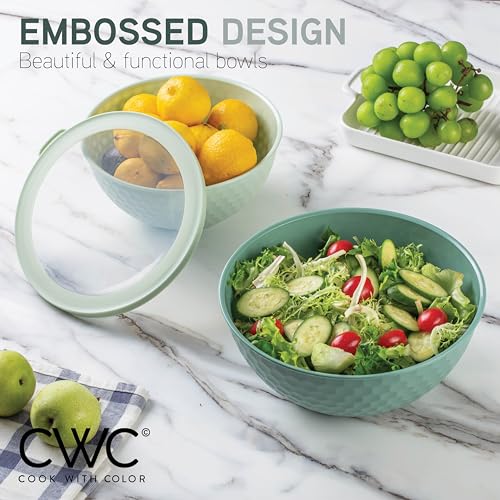
Food Prep and Storage Mixing Bowls with Lids, COOK WITH COLOR Sage Embossed Set
This COOK WITH COLOR set handles food prep, serving, and storage while nesting bowls and tight-fitting lids reduce cabinet clutter and simplify transport. It suits home cooks who want microwave-safe, freezer-safe plastic bowls for fruit, salads, snacks, and leftovers.
Pros and Cons
Pros
- The set combines six plastic bowls with six lids for prep, serving, storage, and transport.
- BPA-free polypropylene provides a food-safe material for regular kitchen use.
- Microwave, freezer, and top-rack dishwasher compatibility adds practical versatility.
- Nesting storage and a sage embossed finish keep the set organized and visually coordinated.
Cons
- The bowls are plastic rather than glass or metal, which may not suit buyers seeking heavier cookware.
- The product data lists five capacities even though the set includes six bowls, so size selection is not fully clear.

Nuogo
Extra Large 8 Qt Stainless Steel Mixing Bowls for Big Batch Baking and Holiday Meal Prep (Set of 4)
This set of four 13.4-inch stainless steel bowls gives you 8 quarts of mixing space per bowl, enough for large bread dough batches, family-sized salads, and holiday fillings without spills. Best for home bakers and cooks who regularly prepare food for gatherings or need bowls that won't slide during heavy mixing.
Pros and Cons
Pros
- 8-quart capacity handles large recipes that smaller bowls can't accommodate, confirmed by buyers using them for bread dough and batch cooking.
- Heavy gauge stainless steel stays put during mixing without needing a non-slip base, according to reviewer feedback.
- Mirror finish resists staining from tomato sauces and turmeric-based marinades better than matte stainless steel.
Cons
- Some units arrive with sharp unpolished edges in hidden spots like the rim underside, requiring careful inspection before first use.
- 13.4-inch diameter may not fit inside standard refrigerator shelves if you need to chill mixed ingredients overnight.

COOK WITH COLOR
Mixing and Baking Prep: COOK WITH COLOR 6-Piece Nesting Plastic Bowl Set with Pour Spouts
This six-piece plastic mixing bowl set supports cooking and baking with non-slip bases, handles, pour spouts, and interior measurement markings, while nesting saves storage space. It suits home cooks who want easy measuring, controlled pouring, and top-rack dishwasher cleanup in one organized set.
Pros and Cons
Pros
- Six bowls provide multiple sizes for mixing, measuring, and ingredient preparation.
- Handles, pour spouts, and non-slip construction improve control during everyday use.
- Interior measurement markings add convenient measuring directly inside each bowl.
- The plastic set is freezer safe and top-rack dishwasher safe for practical kitchen use.
Cons
- The bowls are specified for top-rack dishwasher cleaning, not unrestricted dishwasher use.
- Exact bowl dimensions and individual weights are not provided in the product data.

Cuisinart
3-Piece Stainless Steel Nesting Mixing Bowl Set for Baking, Cooking & Food Prep (1.5, 3, 5 Qt)
This three-bowl stainless steel set handles everyday mixing, prepping, and storage with dishwasher-safe cleanup and refrigerator-freezer compatibility. Home bakers and meal preppers who need durable, space-saving bowls that go from counter to fridge without transferring containers should consider this set.
Pros and Cons
Pros
- High-quality stainless steel withstands daily use without denting or rusting, maintaining a clean appearance over time.
- Three versatile sizes cover most home cooking and baking tasks, from whisking eggs to tossing large salads.
- Dishwasher-safe construction and smooth surface make cleanup faster than textured or coated bowls.
Cons
- Lacks non-slip bases or handles, so bowls may slide on smooth countertops during vigorous mixing.
- No lids included, requiring separate plastic wrap or covers for refrigerator storage.
COOK WITH COLOR Food Prep and Storage Mixing Bowls with Lids, COOK WITH COLOR Sage Embossed Set
COOK WITH COLOR
Food Prep and Storage Mixing Bowls with Lids, COOK WITH COLOR Sage Embossed Set
This COOK WITH COLOR set handles food prep, serving, and storage while nesting bowls and tight-fitting lids reduce cabinet clutter and simplify transport. It suits home cooks who want microwave-safe, freezer-safe plastic bowls for fruit, salads, snacks, and leftovers.
Check PriceEditors' Favorite
Color: Sage Embossed Size: 12 Pc. Dimensions: 12 x 12 x 5.5 inches Product Group: Kitchen Binding: Kitchen
Shop NowNuogo Extra Large 8 Qt Stainless Steel Mixing Bowls for Big Batch Baking and Holiday Meal Prep (Set of 4)
Nuogo
Extra Large 8 Qt Stainless Steel Mixing Bowls for Big Batch Baking and Holiday Meal Prep (Set of 4)
This set of four 13.4-inch stainless steel bowls gives you 8 quarts of mixing space per bowl, enough for large bread dough batches, family-sized salads, and holiday fillings without spills. Best for home bakers and cooks who regularly prepare food for gatherings or need bowls that won't slide during heavy mixing.
$37.99 at AmazonGreat Value
Number of Pieces: 4 Brand Name: Nuogo Specific Uses For Product: Salad, Pasta, Dinner, Pasta, Soup, Noodle, Dessert, Cereal, Snack, Ice Cream, Rice, Beans, Chili, Stews, Risotto, Casserole, Appetizers Set Name: 4 Manufacturer: Nuogo Model Number: AO-Nuogo-4638 Manufacturer Part Number: AO-Nuogo-4638 Item Weight: 3.45 Pounds Best Sellers Rank: #21,541 in Kitchen & Dining (See Top 100 in Kitchen & Dining) #111 in Mixing Bowls ASIN: B0D7LN13MC Customer Reviews: 4.2 4.2 out of 5 stars (242) 4.2 out of 5 stars Other Special Features of the Product: Dishwasher Safe, Durable Color: Silver Product Style: Classic Shape: Round Pattern: Solid Bowl Material: Stainless Steel Product Care Instructions: Dishwasher Safe Is the item dishwasher safe?: Yes Is the item microwaveable?: No Material Type: Stainless Steel Capacity: 8 Quarts Item Dimensions W x H: 12.99"W x 4.13"H Size: 13 Inch (8 Qt) Brand: Nuogo Style: Classic
Shop NowCOOK WITH COLOR Mixing and Baking Prep: COOK WITH COLOR 6-Piece Nesting Plastic Bowl Set with Pour Spouts
COOK WITH COLOR
Mixing and Baking Prep: COOK WITH COLOR 6-Piece Nesting Plastic Bowl Set with Pour Spouts
This six-piece plastic mixing bowl set supports cooking and baking with non-slip bases, handles, pour spouts, and interior measurement markings, while nesting saves storage space. It suits home cooks who want easy measuring, controlled pouring, and top-rack dishwasher cleanup in one organized set.
Check PriceColor: Mint Size: 6 Piece Non-Slip Dimensions: 11 x 11 x 7.28 inches Product Group: Kitchen Binding: Kitchen
Shop NowCuisinart 3-Piece Stainless Steel Nesting Mixing Bowl Set for Baking, Cooking & Food Prep (1.5, 3, 5 Qt)
Cuisinart
3-Piece Stainless Steel Nesting Mixing Bowl Set for Baking, Cooking & Food Prep (1.5, 3, 5 Qt)
This three-bowl stainless steel set handles everyday mixing, prepping, and storage with dishwasher-safe cleanup and refrigerator-freezer compatibility. Home bakers and meal preppers who need durable, space-saving bowls that go from counter to fridge without transferring containers should consider this set.
$39.99 at AmazonNumber of Pieces: 6 Brand Name: Cuisinart Specific Uses For Product: 5 Quart Bowl Lid, Baking, Cooking, Food Prep, Serving Included Components: 1.5 Quart Bowl, 3 Quart Bowl, 5 Quart Bowl, Lid Global Trade Identification Number: 00086279039842, 10086279039849 Recommended Uses For Product: Baking, Cooking, Food Prep Unit Count: 1.0 Count Set Name: 3-Piece Nesting Bowl Set Manufacturer: Cuisinart UPC: 086279274229 086279039842 Model Number: CTG-00-SMB Manufacturer Part Number: CTG-00-SMB Item Type Name: 3-Piece Nesting Bowl Set Item Weight: 3.9 Pounds Best Sellers Rank: #2,308 in Kitchen & Dining (See Top 100 in Kitchen & Dining) #17 in Mixing Bowls ASIN: B004YZEO9K Color: Stainless Steel Product Style: 3-Piece Nesting Bowl Set Shape: Bowl Theme: Kitchen and Dining"}"/oriquez"Kitchen and Dining Pattern: Solid Occasion: kitchen Bowl Material: Stainless Steel Product Care Instructions: Dishwasher Safe Is the item dishwasher safe?: Yes Is the item microwaveable?: No Material Type: Stainless Steel Capacity: 5 Quarts Item Dimensions W x H: 10.5"W x 10.5"H Size: 3-Piece Nesting Bowl Set Other Special Features of the Product: Dishwasher Safe, Freezer Safe, Stackable, Stainless Steel Construction Brand: Cuisinart Style: 3-Piece Nesting Bowl Set
Shop Now


Write Your Review
No reviews yet. Be the first to share your experience!