

TL;DR — A carbon steel chef knife is a knife whose blade is made from a high-carbon iron alloy with little or no chromium, so it takes a keener edge and holds it longer than typical stainless — but it will rust, stain, and develop a patina unless you keep it clean and dry. Traditional carbon steel (like Japanese white and blue paper steels or French Sabatier-style carbon) is beloved by serious cooks for its sharpness and easy sharpening; the trade-off is real maintenance. “High-carbon stainless” is a separate, low-maintenance category that adds chromium. For picks, see our best chef knife guide.
The HomeWhisk editorial team researches kitchen equipment by analyzing steel metallurgy, blade geometry, and aggregated owner reviews from major retailers and communities like Reddit r/chefknives and r/cooking. This explainer clears up what “carbon steel” actually means on a knife, how it differs from stainless, and whether the maintenance is worth it for you.
Carbon steel knives have a devoted following among chefs and home cooks who chase the sharpest possible edge, and an equally strong group of people who tried one, watched it rust, and went back to stainless. Both reactions come from the same underlying facts about the metal. Understanding what carbon steel is — and what “high-carbon stainless” means, which is a frequent point of confusion — tells you whether this knife belongs in your kitchen.
What “Carbon Steel” Actually Means
All steel is iron alloyed with carbon. What defines carbon steel in the knife world is a high carbon content (often 0.6–1.5%) with little or no chromium. Chromium is the element that makes steel “stainless” — it forms a passive oxide layer that resists rust. Remove or minimize the chromium, and you get a steel that hardens beautifully and takes a razor edge, but has no built-in rust protection.
That single compositional choice drives everything about a carbon steel knife:
- Hardness: Carbon steels can be heat-treated to high hardness (often 60–65+ on the Rockwell C scale), which lets the blade be ground to a very thin, acute edge that stays sharp.
- Fine grain and easy sharpening: Without large chromium carbides, the steel has a fine, homogeneous structure that sharpens quickly to a keen edge on a whetstone and feels “grabby” and precise when cutting.
- Reactivity: With no chromium shield, the blade reacts with air, water, and acidic foods — it rusts if left wet, and it forms a patina over time.
Well-known carbon steels include Japanese Shirogami (White) and Aogami (Blue) “paper steels” used in traditional gyuto and santoku knives, and Western carbon steels used in French Sabatier-style knives. These are the classic materials behind the sharpest kitchen blades. Our best japanese chef knife guide covers the carbon-steel gyuto in depth.
Carbon Steel vs Stainless (and the “High-Carbon Stainless” Confusion)
This is where most buyers get tangled, because marketing uses “high-carbon” loosely.
Traditional stainless steel contains enough chromium (typically 13%+) to resist rust. Older or cheaper stainless was softer and harder to sharpen to a truly keen edge, which gave stainless its reputation for being “duller” — though modern stainless has improved dramatically.
Traditional carbon steel has minimal chromium: sharper, easier to sharpen, but rust-prone.
“High-carbon stainless steel” is a third thing, and the source of confusion: it is stainless steel (it has chromium, so it resists rust) that also has an elevated carbon content for better edge-holding. Steels like VG-10, AUS-10, or German X50CrMoV15 fall here. These knives give you most of the sharpness benefits with none of the rust maintenance — which is why many “best of both worlds” chef knives are high-carbon stainless. So when a listing says “high-carbon,” check whether it means true carbon steel (will rust) or high-carbon stainless (won’t). If low maintenance matters to you, high-carbon stainless from our best chef knife under 100 guide is often the smarter buy.
The Patina: Why Carbon Steel Changes Color
One thing that alarms new carbon steel owners is that the blade changes color — going grey, blue, or even mottled brown within days of use. This is a patina, and it is normal and mostly beneficial.
A patina is a thin layer of iron oxide (and, from acidic foods, iron reacting with the food) that forms on the surface. Unlike red rust, a stable patina is a protective layer: it passivates the surface and slows further corrosion, much like seasoning on a cast iron pan. Cooks often speed it along deliberately — cutting an apple or onion, or wiping the blade with vinegar — to build an even grey patina that then resists rust better than bare steel.
The distinction to learn is patina (good) versus red rust (bad). A grey-blue patina is stable and protective. Orange-red, flaky rust is active corrosion that pits the steel and must be scrubbed off. The line between them is moisture: a patina forms from normal use and drying; red rust forms when the blade sits wet. This is the same iron-chemistry logic behind a well-seasoned carbon steel pan, which our best carbon steel pan for cooking guide covers.
How to Care for a Carbon Steel Knife
Carbon steel is not fragile, but it is unforgiving of neglect. The routine is simple and takes seconds, but it is non-negotiable:
- Wipe the blade dry after every use, and especially between cutting acidic or wet foods (tomatoes, citrus, onions). Do not let it air-dry in a rack.
- Never put it in the dishwasher — the heat, moisture, and detergent will rust and pit it fast. Hand-wash and dry immediately.
- Do not leave it soaking in the sink or sitting on a wet board.
- For long storage, wipe a thin film of food-safe mineral oil (or camellia oil) on the blade to block moisture.
- If red rust appears, remove it promptly with a soft abrasive (a wine cork with a little cleanser, or fine steel wool) and re-oil.
Do this and a carbon steel knife rewards you with an edge stainless struggles to match, and it is very easy to bring back to hair-splitting sharpness on a whetstone. Skip it, and you will get rust. That trade — a few seconds of care for a superior edge — is the entire decision. If it sounds like too much, that is a legitimate reason to choose high-carbon stainless from our best chef knife set or best knife sets guides instead.
Frequently Asked Questions
Is a carbon steel chef knife better than stainless?
Better at some things, worse at others. Carbon steel takes a keener edge, holds it well, and is easier to sharpen to a truly fine edge, which is why many professionals and enthusiasts prefer it. The cost is maintenance: it rusts and stains without prompt drying and cannot go in the dishwasher. Modern high-carbon stainless closes much of the sharpness gap while resisting rust, so for many home cooks stainless is the more practical choice. If you enjoy maintaining tools and want maximum edge performance, carbon steel wins. See our best chef knife guide for both.
Why does my carbon steel knife turn black or grey?
That discoloration is a patina — a thin, stable oxide layer that forms as the bare steel reacts with air and food. It is normal, expected, and actually protective: a well-developed grey-blue patina slows further corrosion, similar to seasoning on cast iron. It is different from red rust, which is orange, flaky, and harmful. Many owners deliberately build a patina by cutting acidic foods or wiping the blade with vinegar. Do not scrub a healthy patina off; only remove active red rust.
How do you sharpen a carbon steel knife?
Carbon steel is one of the easiest steels to sharpen because its fine grain and lack of hard chromium carbides let it respond quickly to abrasives. Use whetstones: a medium grit (around 1000) to set the edge, then a finer stone (3000–6000) to refine it, holding a consistent angle (often 15 degrees per side on Japanese knives, closer to 20 on Western). Finish by stropping to remove the burr. Because it sharpens so readily, carbon steel is forgiving to learn on and easy to keep scary-sharp.
Will a carbon steel knife rust, and how do I prevent it?
Yes — with little or no chromium, carbon steel will rust if left wet, because it has no built-in corrosion barrier. Prevention is straightforward: wipe the blade dry immediately after use, hand-wash only (never the dishwasher), do not let it soak, and oil the blade with food-safe mineral or camellia oil for long storage. A protective patina, built through normal use, also helps resist rust. If red rust does appear, scrub it off promptly with a fine abrasive and re-oil. A few seconds of drying after each use prevents nearly all problems.
What is the difference between carbon steel and high-carbon stainless?
Carbon steel has minimal chromium, so it takes a superb edge but rusts and needs careful drying. High-carbon stainless has enough chromium to resist rust plus extra carbon for good edge-holding — steels like VG-10 or German X50CrMoV15. So high-carbon stainless is low-maintenance and rust-resistant while still holding a sharp edge, whereas true carbon steel offers a slightly finer edge at the price of upkeep. The marketing term “high-carbon” is ambiguous, so check whether a knife is actually carbon steel or high-carbon stainless before buying. See our best chef knife under 100 guide.
Is carbon steel safe for food and does it affect taste?
Carbon steel is food-safe. The main quirk is that a new, unpatinated blade can impart a faint metallic taste to very acidic foods and can discolor them briefly, because the bare iron reacts. Once a patina develops, this largely stops. Some cooks avoid slicing lots of citrus or tomatoes with a brand-new carbon blade until the patina forms. The iron is not harmful, and unlike red rust (which you should remove before use), a stable patina is inert and protective. Keep the blade clean and dry and it stays hygienic.
The Bottom Line
A carbon steel chef knife is defined by high carbon and little chromium, which is exactly why it takes a keener, longer-lasting edge and sharpens more easily than typical stainless — and exactly why it rusts and develops a patina if you neglect it. Traditional carbon steel (Japanese paper steels, French Sabatier carbon) is the enthusiast’s choice for edge performance and the feel of the cut, provided you are willing to wipe it dry after every use and keep it out of the dishwasher. If that upkeep sounds like a chore, high-carbon stainless gives you most of the sharpness with none of the rust worry. Choose based on how much maintenance you genuinely want to do. For our researched picks across both types, see the best chef knife, best japanese chef knife, and best chef knife set guides.

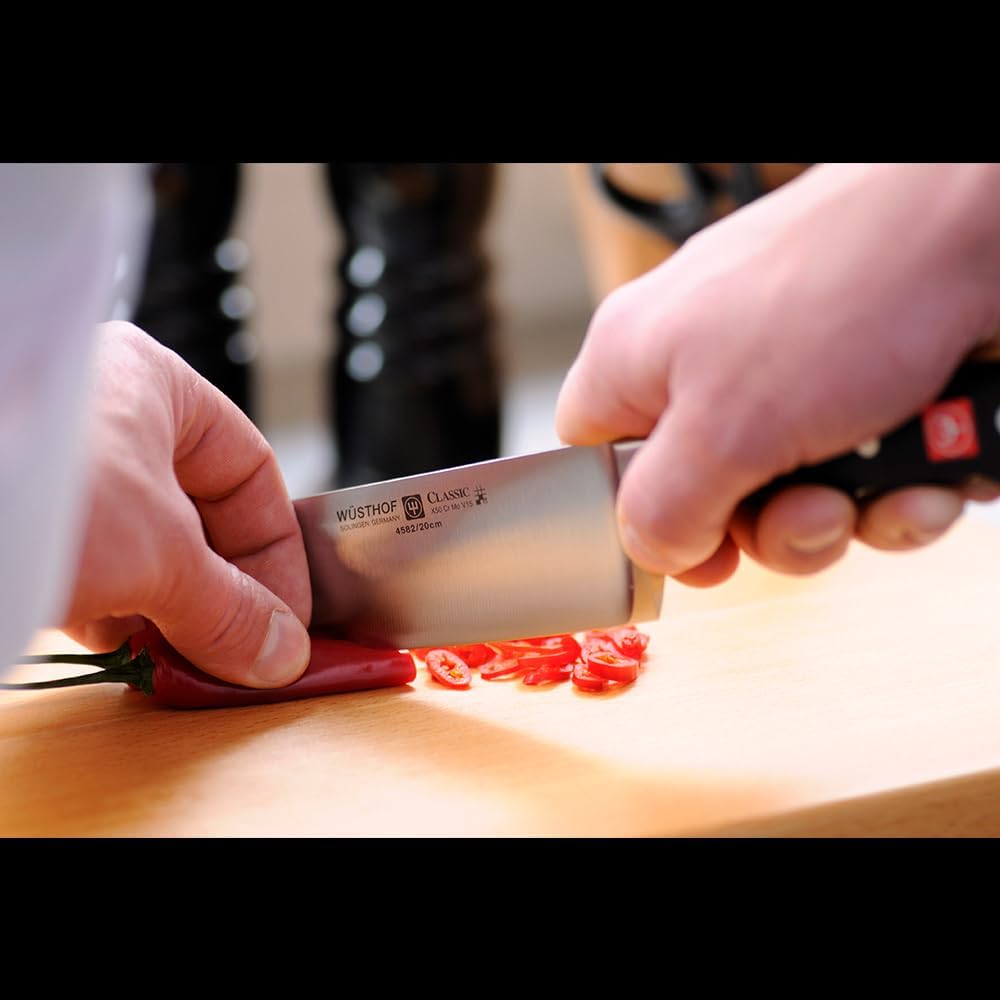
WÜSTHOF Classic 8-Inch Chef's Knife - Precision Forged German Steel for Professional Home Cooking
This precision-forged German chef's knife delivers 20% sharper cuts and twice the edge retention of previous models, making it ideal for daily chopping, mincing, and slicing tasks. Home cooks and professional chefs who want a reliable, balanced workhorse knife that holds its edge through heavy use should invest in this Classic series blade.
Pros and Cons
Pros
- German precision forging creates superior edge retention that stays sharp through months of regular kitchen use.
- The 8.5-ounce weight and ergonomic handle design reduce hand fatigue during extended meal prep.
- Backed by over 200 years of Solingen craftsmanship and strict German quality standards.
Cons
- The full bolster prevents sharpening the entire blade length on a standard whetstone without professional thinning.
- At 8.5 ounces, some cooks with smaller hands may find it heavier than Japanese-style chef's knives.

Zwilling
10-Inch Honing Steel for Kitchen Knife Maintenance and Edge Realignment
This honing steel uses an oval rod design that realigns knife edges with fewer strokes than traditional round rods, keeping your kitchen knives sharp between professional sharpening sessions. Home cooks who want to maintain their knife performance without learning complex sharpening techniques should consider this tool.
Pros and Cons
Pros
- Oval rod design requires fewer passes than traditional round honing steels to achieve the same edge realignment.
- Durable steel construction at 62 Rockwell hardness withstands regular contact with quality kitchen knives without deteriorating.
- Plastic handle with hanging hole makes storage simple in compact kitchens with limited drawer space.
Cons
- The product description contains a typo referring to the plastic handle, which may reflect less attention to quality control details.
- At this price point, some users may prefer a combination sharpening system that both hones and grinds rather than a honing-only tool.

Global Star Software
Mahjongg for Palm OS - Classic Tile Matching Game by Global Star Software for PC
This is a PC software product for installing Mahjongg solitaire on Palm OS handheld devices, not a kitchen product. It offers customizable tile sets and multiple difficulty levels for portable gaming on Palm-powered handhelds.
Pros and Cons
Pros
- Authentic mahjong solitaire experience optimized for Palm OS handhelds.
- Customizable graphics including tile sets and backgrounds for visual variety.
- Compatible with both color and grayscale Palm devices.
Cons
- Requires legacy Palm OS hardware that is no longer manufactured or widely supported.
- Not a kitchen product and provides no culinary functionality whatsoever.
WÜSTHOF Classic 8-Inch Chef's Knife - Precision Forged German Steel for Professional Home Cooking
WÜSTHOF Classic 8-Inch Chef's Knife - Precision Forged German Steel for Professional Home Cooking
This precision-forged German chef's knife delivers 20% sharper cuts and twice the edge retention of previous models, making it ideal for daily chopping, mincing, and slicing tasks. Home cooks and professional chefs who want a reliable, balanced workhorse knife that holds its edge through heavy use should invest in this Classic series blade.
$170.00 at AmazonEditors' Favorite
Brand Name: Wüsthof Set Name: Classic Manufacturer: Wüsthof UPC: 769194038526 670023145356 022934582438 Global Trade Identification Number: 00022934582438, 04002293158242, 40022931582422 Model Number: 4582-7/20 Manufacturer Part Number: 4582/20 Manufacturer Warranty Description: Lifetime warranty Item Type Name: Chef's Knives Unit Count: 16.0 Ounce Included Components: Cook's Knife Best Sellers Rank: #35,094 in Kitchen & Dining (See Top 100 in Kitchen & Dining) #103 in Chef's Knives ASIN: B00009ZK08 Blade Material Type: Stainless Steel Handle Material: Composite Is the item dishwasher safe?: No Material Type: Stainless Steel BladeLength: 8 Inches Item Weight: 0.24 Kilograms Item Length: 14 Inches Size: 8" Color: Black Blade Color: Silver Blade Edge: Chef's Knife Construction Type: Forged Blade Material: Stainless Steel Brand: Wüsthof
Shop NowZwilling 10-Inch Honing Steel for Kitchen Knife Maintenance and Edge Realignment
Zwilling
10-Inch Honing Steel for Kitchen Knife Maintenance and Edge Realignment
This honing steel uses an oval rod design that realigns knife edges with fewer strokes than traditional round rods, keeping your kitchen knives sharp between professional sharpening sessions. Home cooks who want to maintain their knife performance without learning complex sharpening techniques should consider this tool.
$59.95 at AmazonGreat Value
Material: Stainless Steel Brand: ZWILLING Color: Black/Stainless Steel Product Dimensions: 17"L x 9.8"W x 5.5"H Item Weight: 0.32 Kilograms Grit Type: Extra Fine Number of Items: 1 Manufacturer: ZWILLING J.A. HENCKELS Number of Packs: 1 Unit Count: 1.0 Count
Shop NowGlobal Star Software Mahjongg for Palm OS - Classic Tile Matching Game by Global Star Software for PC
Global Star Software
Mahjongg for Palm OS - Classic Tile Matching Game by Global Star Software for PC
This is a PC software product for installing Mahjongg solitaire on Palm OS handheld devices, not a kitchen product. It offers customizable tile sets and multiple difficulty levels for portable gaming on Palm-powered handhelds.
Check PriceASIN: B00005OL39 Customer Reviews: 4.0 4.0 out of 5 stars (6) 4.0 out of 5 stars Package Dimensions: 8.3 x 5.7 x 0.5 inches; 4.8 ounces Type of item: Video Game Rated: Everyone Item model number: GLS99509 Item Weight: 4.8 ounces Manufacturer: Global Star Software Date First Available: July 12, 2002
Shop Now



Write Your Review
No reviews yet. Be the first to share your experience!