

TL;DR — Glass bakeware is safe to bake with as long as you respect one rule: avoid sudden temperature changes. Tempered borosilicate or soda-lime glass (Pyrex, Anchor Hocking) is non-toxic, non-reactive, and won’t leach anything into food. The real risk is thermal shock — moving glass from freezer to hot oven, adding cold liquid to a hot dish, or setting a hot dish on a wet counter can shatter it. Note that a true flat “baking sheet” is almost always metal; glass is used for dishes, pans, and trays, not thin cookie sheets. For picks, see our best baking sheets guide.
The HomeWhisk editorial team researches kitchen equipment by analyzing material properties, manufacturer use-and-care guidance, and aggregated owner reviews from major retailers and communities like Reddit r/Baking and r/AskCulinary. Glass bakeware sits in a lot of kitchens, and questions about its safety are usually really questions about when and why it breaks. Here is the full picture.

First, a clarification that matters: there is essentially no such thing as a flat, rimless glass “cookie sheet.” Cookie sheets are thin metal because they need to conduct heat fast and stay rigid. What people call a “glass baking sheet” is almost always a glass baking dish, tray, or pan — a rimmed vessel for casseroles, roasts, bars, and 9×13 bakes. Understanding that difference explains both what glass is good at and where its limits are.
Generic
Lasagna and Casserole Baking Dish: Generic 9 x 13 Tempered Glass Baker, 3 Quart, Oven to Freezer Safe
This 3-quart tempered glass baker covers the standard 9 by 13 recipes and moves straight from a preheated oven to the fridge, freezer, or microwave without transferring food to a second container. Buy it if you want one everyday dish that handles lasagna, casseroles, roasted vegetables, and meal prep leftovers.
Pros and Cons
Pros
- Tempered glass covers oven, microwave, fridge, freezer, and dishwasher duty in a single piece of bakeware.
- Pure glass will not hold garlic or tomato odors between uses.
- Standard 9 by 13 size fits common oven racks, fridge shelves, and casserole carriers.
- Simple one-dish purchase with no lids or accessories taking up cabinet space.
Cons
- The 425 degree oven ceiling rules out broiling and high-heat roasting that a metal pan would handle.
- No lid is included, so leftovers need foil or wrap before the dish goes in the fridge.

HONGBAKE
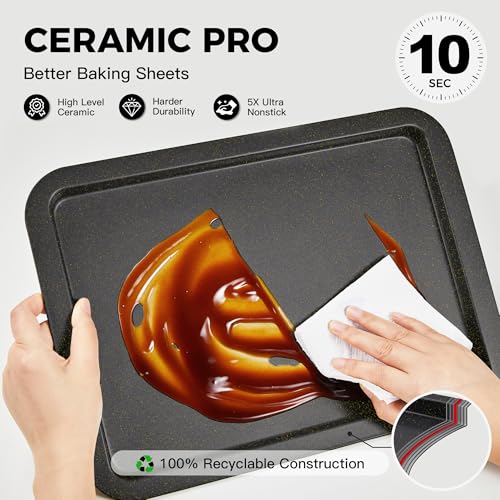
3-Piece Ceramic Nonstick Baking Sheet Set for Oven - Quarter, Jelly Roll & Half Pan
This carbon steel baking sheet set includes three sizes with Whitford ceramic nonstick coating that handles up to 450°F without warping, backed by 99.99% anti-warp testing. Home bakers who need stackable, dishwasher-safe pans for cookies, roasted vegetables, and sheet pan dinners should consider this affordable trio.
Pros and Cons
Pros
- Tested to resist warping at 450°F, addressing the most common failure point in budget baking sheets.
- Three sizes cover most home baking tasks from small cookie batches to full sheet pan meals.
- Dishwasher-safe ceramic coating simplifies cleanup compared to bare metal or silicone mats.
Cons
- Zero verified customer reviews make it impossible to confirm real-world nonstick performance and longevity claims.
- Dark gray coating may brown baked goods faster than lighter finishes, requiring temperature adjustments for delicate cookies.

GoodCook
Large Cookie and Sheet Pan Baking: GoodCook Everyday 17 x 11-Inch Nonstick Steel Baking Sheet
This 17 x 11-inch GoodCook baking sheet supports cookies, desserts, and sheet pan dinners while its nonstick coating simplifies food release and cleanup. It suits home bakers who need a versatile, durable steel sheet with dishwasher-safe convenience.
Pros and Cons
Pros
- The large 17 x 11-inch format handles both baking and sheet pan meals.
- Scratch-resistant nonstick coating supports easy release and dishwasher cleanup.
- Metal spatula safety allows serving baked goods directly from the sheet.
- Heavy-duty steel construction is designed to resist warping.
Cons
- The large footprint may be inconvenient for compact ovens or limited storage.
- The product listing does not specify the sheet's weight.
Generic Lasagna and Casserole Baking Dish: Generic 9 x 13 Tempered Glass Baker, 3 Quart, Oven to Freezer Safe
Generic
Lasagna and Casserole Baking Dish: Generic 9 x 13 Tempered Glass Baker, 3 Quart, Oven to Freezer Safe
This 3-quart tempered glass baker covers the standard 9 by 13 recipes and moves straight from a preheated oven to the fridge, freezer, or microwave without transferring food to a second container. Buy it if you want one everyday dish that handles lasagna, casseroles, roasted vegetables, and meal prep leftovers.
Check price on AmazonA 3-quart rectangular glass baker in the standard 9 by 13 footprint, sized to the pan most casserole, lasagna, and sheet cake recipes assume you own.
Tempered glass moves from a preheated oven to the microwave and freezer, so one dish bakes dinner, stores what is left, and reheats it the next day.
Pure glass construction resists odors and staining from tomato sauce or spices, and baked-on cheese releases after a soak before the dishwasher.
The oven limit is 425 degrees, so broiler finishes and high-heat roasting recipes still need a metal pan.
Best for home cooks who want one affordable everyday baker for weeknight casseroles and batch meal prep.
HONGBAKE 3-Piece Ceramic Nonstick Baking Sheet Set for Oven - Quarter, Jelly Roll & Half Pan
HONGBAKE
3-Piece Ceramic Nonstick Baking Sheet Set for Oven - Quarter, Jelly Roll & Half Pan
This carbon steel baking sheet set includes three sizes with Whitford ceramic nonstick coating that handles up to 450°F without warping, backed by 99.99% anti-warp testing. Home bakers who need stackable, dishwasher-safe pans for cookies, roasted vegetables, and sheet pan dinners should consider this affordable trio.
Check price on AmazonThis three-pan set solves the single-size problem most home bakers face by including quarter, jelly roll, and half sheet dimensions for batch flexibility.
The carbon steel core with Whitford ceramic coating resists warping up to 450°F according to manufacturer testing, while rounded corners and seamless construction prevent sharp edges and trapped food residue.
Pans measure 13x9, 15x10.5, and 17x11.5 inches outer dimensions with raised edges from 0.7 to 0.8 inches. Stackable design and wider grip handles add storage efficiency and safer oven handling.
The dark gray finish may accelerate browning on pale doughs, requiring lower temperatures or parchment paper for delicate bakes.
Best for home cooks who want dishwasher-safe versatility across multiple pan sizes without spending on commercial-grade bakeware.
GoodCook Large Cookie and Sheet Pan Baking: GoodCook Everyday 17 x 11-Inch Nonstick Steel Baking Sheet
GoodCook
Large Cookie and Sheet Pan Baking: GoodCook Everyday 17 x 11-Inch Nonstick Steel Baking Sheet
This 17 x 11-inch GoodCook baking sheet supports cookies, desserts, and sheet pan dinners while its nonstick coating simplifies food release and cleanup. It suits home bakers who need a versatile, durable steel sheet with dishwasher-safe convenience.
Check price on AmazonThe GoodCook Everyday is a 17 x 11-inch nonstick steel baking sheet for cookies, desserts, and sheet pan dinners, solving the need for one versatile oven tray.
Even heat distribution supports thorough baking, while the nonstick coating helps food release and makes cleanup quicker.
Heavy-duty gauge steel resists warping, and the wider lip improves handling. The sheet measures 17 x 11 inches; its weight is not specified.
Its large footprint may not suit compact ovens or kitchens with limited storage space.
Best for home bakers who want one durable, easy-clean sheet for baking and everyday oven meals.
What Glass Bakeware Is Made Of
Two types of glass dominate the market, and the distinction affects how they handle heat.
Borosilicate glass contains boron oxide, which gives it a very low coefficient of thermal expansion — it barely changes size when heated, so it resists thermal shock well. This is what classic Pyrex was made from for decades, and what most European “Pyrex” (made by a different company) still uses. It tolerates larger temperature swings before cracking.
Soda-lime glass is ordinary glass strengthened by tempering — rapid cooling that puts the surface under compression so it resists cracking and, when it does fail, breaks into smaller pieces. Most U.S.-made Pyrex and Anchor Hocking switched to tempered soda-lime around the late 1990s. It is perfectly safe and durable for normal baking, but it has a higher thermal expansion than borosilicate, which means it is somewhat more sensitive to abrupt temperature changes.
Either way, the material itself is inert. Glass does not react with acidic foods, does not absorb odors or stains, contains no coatings, PFAS, or heavy metals, and is dishwasher- and microwave-safe. That non-reactivity is glass’s biggest advantage over metal for tomato-based, citrus, or wine-braised dishes. Our best baking sheets guide covers where metal still wins for browning.
The Real Risk: Thermal Shock
Glass is safe chemically; the safety conversation is entirely about mechanical failure from thermal shock. Thermal shock happens when one part of the glass expands or contracts faster than another, creating internal stress that fractures it — sometimes explosively, scattering fragments across the oven or counter.
The situations that cause it are predictable and avoidable:
- Freezer or fridge straight into a hot oven. A cold dish hitting 400 degrees F stresses the glass badly. Let it come toward room temperature first.
- Adding cold liquid to a hot dish (deglazing a hot glass pan, pouring cold water over a roasting dish).
- Setting a hot dish on a cold or wet surface — a granite counter, a metal trivet, a damp towel, or a wet stovetop. Always rest hot glass on a dry cloth or wood.
- Placing glass directly on a burner, under a broiler, or on a grill. Glass bakeware is for the oven’s ambient heat, not direct flame or the intense radiant heat of a broiler.
Follow those rules and glass rarely fails. Ignore them and even tempered glass can shatter, which is the source of most alarming “my Pyrex exploded” stories. It is a handling issue, not a manufacturing defect. If you bake a lot of bread and want maximum thermal robustness and browning, a cast-iron vessel is more forgiving — see our best dutch oven for bread baking guide.
How Glass Bakes Differently From Metal
Beyond safety, glass behaves differently in the oven, and knowing how helps you use it well.
Glass is a poor conductor but good at radiant heat retention. It heats up slowly and holds that heat, so it browns the bottom and sides of food more gently and evenly, and keeps a dish hot at the table. That makes it excellent for custards, casseroles, gratins, bread puddings, and bar cookies, where you want steady, even cooking and a browned base.
The flip side: because glass heats slowly and retains heat, foods can over-brown on the bottom if you use the same temperature and time as a metal recipe. A common recommendation is to reduce oven temperature by about 25 degrees F when a recipe written for metal calls for glass, and to check for doneness a little early. Glass also will not give you the crisp, fast browning that a thin metal sheet gives cookies and roasted vegetables, which is another reason true cookie sheets are metal.
Glass is heavier and can chip or crack if dropped or knocked, so handle it with dry oven mitts and avoid banging it against the sink. For portioning bakes and following recipes precisely, a scale helps — see our best kitchen scale guide.
How to Tell If Your Glass Is Oven-Safe
Not all glass is oven-safe, and using the wrong kind is the main way people get hurt.
Look for an “oven-safe” or temperature marking on the bottom or in the manufacturer’s documentation. Dedicated bakeware brands (Pyrex, Anchor Hocking, OXO, Libbey) state a maximum temperature, commonly around 425-450 degrees F for the dish itself.
Drinking glasses, storage glass, and decorative glass are not oven-safe. A tumbler or a thin storage container has no tempering rated for oven heat and can shatter. Only use vessels sold specifically as bakeware.
Check for existing damage. Any chip, crack, or deep scratch is a stress concentration point that makes thermal-shock failure far more likely. Retire damaged glass bakeware rather than risk it.
Lids are usually not oven-safe. The glass or plastic lids that come with storage-style baking dishes are for the fridge and microwave, not the oven — bake uncovered or use foil. When in doubt, treat unmarked glass as not oven-safe. If you cook on a smooth cooktop and are choosing vessels for it, our best cookware for glass top stove and best cookware for glass top stoves guide cover which materials work best on that surface.
Frequently Asked Questions
Is glass good for baking?
Yes, for the right things. Glass heats slowly and retains heat, giving even, gentle cooking and good bottom browning, which suits casseroles, custards, gratins, bread pudding, and bar cookies. It is non-reactive, so it handles acidic dishes without any metallic taste, and it goes from oven to table attractively. Where glass falls short is fast, crisp browning — cookies and roasted vegetables do better on thin metal. It is also heavier and more sensitive to temperature swings. For everyday one-dish baking, glass is a strong, safe choice.
How can I tell if a glass dish is oven-safe?
Check the bottom of the dish or the manufacturer’s information for an “oven-safe” label and a maximum temperature, usually around 425-450 degrees F. Bakeware from brands like Pyrex, Anchor Hocking, OXO, and Libbey is designed for the oven; drinking glasses, storage containers, and decorative glass are not and can shatter. Also inspect for chips or cracks, which dramatically raise the risk of breakage. Lids are usually not oven-safe. If a piece has no oven rating, do not use it for baking.
Why did my glass baking dish shatter or explode?
Almost always thermal shock — a rapid temperature change that stresses the glass until it fractures. Common triggers are moving the dish from freezer or fridge into a hot oven, adding cold liquid to a hot dish, setting a hot dish on a wet or cold surface, or exposing it to a broiler or burner. Pre-existing chips and cracks make it far worse. It is a handling issue rather than a defect. Let glass warm up before baking, and rest hot dishes on a dry towel or wood.
Can you put a glass baking dish under the broiler?
No. Broilers produce intense, direct radiant heat that concentrates on the glass surface and can easily cause thermal shock and shattering, even with tempered or borosilicate glass. Glass bakeware is designed for the oven’s surrounding ambient heat, not direct flame or broiler heat. If a recipe calls for broiling or a final blast of top heat to brown a surface, transfer the food to a metal pan or use a broiler-safe dish. The same applies to stovetop burners and grills.
Should I lower the oven temperature when baking in glass?
Usually yes. Because glass heats slowly and retains heat, it can over-brown the bottom of a bake if you follow a recipe written for metal at the same setting. A common adjustment is to reduce the oven temperature by about 25 degrees F and check for doneness a little early. This is most relevant for cakes, brownies, and anything prone to a dark base. For casseroles and custards, glass’s even heat is an advantage and less adjustment is needed.
Is old Pyrex safer than new Pyrex?
Both are safe when used correctly, but they differ. Older U.S. Pyrex (pre-late-1990s) and most European Pyrex are borosilicate glass, which resists thermal shock better. Newer U.S. Pyrex is tempered soda-lime glass, which is strong and shatters into smaller pieces when it fails, but is a bit more sensitive to abrupt temperature swings. Neither is toxic or unsafe; the newer glass simply requires a little more care about temperature changes. Following the no-thermal-shock rules keeps either type safe.
The Bottom Line
Glass bakeware is safe, non-toxic, and non-reactive, and for casseroles, custards, gratins, and bar bakes it is genuinely excellent — even heat, a nicely browned base, and oven-to-table looks with no metallic taste on acidic foods. The one thing you must respect is thermal shock: no freezer-to-oven jumps, no cold liquid into hot glass, no hot dish on a wet or cold surface, and never the broiler or a burner. Use only glass marked as oven-safe, retire any chipped piece, and drop the temperature about 25 degrees when converting a metal recipe. Just remember that flat cookie sheets are a metal job; glass is for dishes and pans. For thin-sheet baking and roasting, see our best baking sheets guide, and for related tools our best kitchen scale and best mixing bowls guides.


Write Your Review
No reviews yet. Be the first to share your experience!