

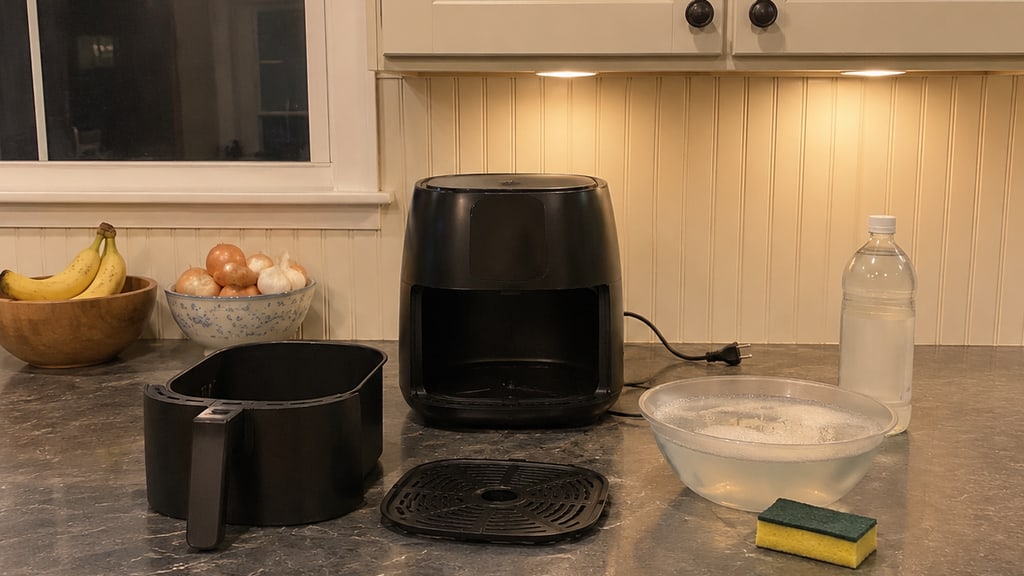
TL;DR — To clean an air fryer with vinegar, unplug and cool the unit, remove the basket, and soak it in a solution of equal parts white vinegar and warm water with a squirt of dish soap for 15–30 minutes to loosen baked-on grease. Scrub with a soft brush or sponge, wipe the interior and the heating element with a vinegar-dampened cloth, and dry everything fully before reassembling. Vinegar’s acetic acid cuts grease and deodorizes without harsh chemicals. For picks, see our best air fryer guide.
The HomeWhisk editorial team researches kitchen equipment and cleaning methods by analyzing manufacturer care instructions, material behavior, and aggregated owner feedback from major retailers and communities such as Reddit’s r/airfryer and r/Cooking. This guide explains exactly how to use vinegar to clean an air fryer, why it works, and where it does — and does not — belong.

Roobi
Air Fryer Deep Cleaner for Baked-On Grease, Roobi 6-Sachet Powder Kit with Brush
Roobi dissolves baked-on air fryer grease with heated cleaning solution, reducing the need for abrasive scrubbing and helping protect non-stick coatings. It suits air fryer owners who want a pre-portioned, coating-safe deep-clean routine for baskets and crisper plates.
Pros and Cons
Pros
- The heated water routine targets stubborn grease without abrasive scrubbing.
- The formula is food-contact safe, vegan, BPA-free, and free from bleach and harsh oven-cleaner ingredients.
- Pre-portioned sachets make each cleaning cycle simple and consistent.
- The included brush reaches textured and corner areas after the main cleaning cycle.
Cons
- Each deep-clean requires heating the dissolved solution, pouring it out, and rinsing the parts afterward.
- It does not clean the heating element, fan, or coil, so those components require a separate cleaner.
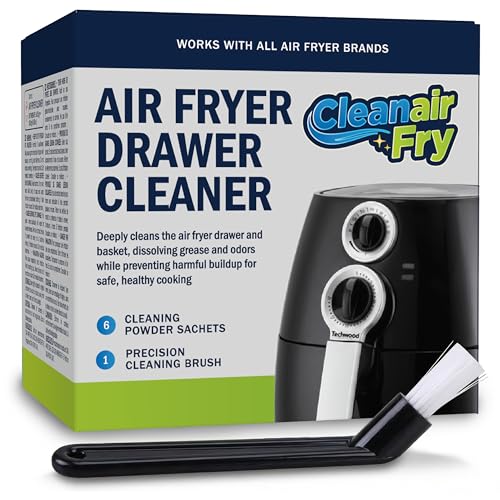
Cleanair-Fry
Air Fryer Basket and Drawer Degreaser Sachets: Cleanair-Fry 6-Pack with Scrub Brush, Nonstick Safe
Cleanair-Fry dissolves baked-on grease and burnt food from air fryer baskets, drawers, grill inserts and crisper plates using a powder sachet you simply run in 1L of water for 8 minutes. It suits anyone who cooks in a basket-style air fryer weekly and wants stuck-on residue gone without scraping away the nonstick coating.
Pros and Cons
Pros
- The soak-and-heat method does the work while you leave the kitchen, requiring no scrubbing for most buildup.
- Safe on nonstick surfaces, so regular use will not strip the coating that keeps food from sticking.
- Pre-measured sachets mean no pouring, diluting or measuring powder.
- Compatible with most basket-style models including Ninja, Cosori, Instant Vortex, PowerXL, Gourmia, Philips and Breville.
Cons
- The 1L water method only works with basket and drawer air fryers, so oven-style and rotisserie units are not covered.
- Six sachets is a finite supply, and heavy weekly cooking will burn through the box quickly.

Mistifi
Air Fryer Oil Misting Without the Pooling: Mistifi 150ml Dark Green Glass Fine Mist Oil Spray Bottle, 2-Pack
Mistifi's fan-shaped atomizing nozzle turns olive, avocado or vegetable oil into an even fine mist that coats air fryer baskets, roasting trays and salads at roughly one gram per press. Buy it if you cook by portion and want measured oil on every batch, with a second bottle free for vinegar.
Pros and Cons
Pros
- The fan-shaped nozzle spreads oil evenly instead of firing a single wet jet at one spot.
- Spray pattern responds to how hard you press, covering both broad trays and small targets.
- Refillable and rated for olive, avocado and vegetable oils plus vinegar, so nothing is locked to one liquid.
- The two-bottle set means you can dedicate one to cooking oil and one to dressing acid.
Cons
- The listing describes glass bottles while the materials note covers BPA-free plastic parts, so confirm which components are glass if that matters to you.
- Cold or thick oil atomizes poorly; the maker advises spraying near 68F and priming the pump several times before first use.
Roobi Air Fryer Deep Cleaner for Baked-On Grease, Roobi 6-Sachet Powder Kit with Brush
Roobi
Air Fryer Deep Cleaner for Baked-On Grease, Roobi 6-Sachet Powder Kit with Brush
Roobi dissolves baked-on air fryer grease with heated cleaning solution, reducing the need for abrasive scrubbing and helping protect non-stick coatings. It suits air fryer owners who want a pre-portioned, coating-safe deep-clean routine for baskets and crisper plates.
$22.99 at AmazonEditors' Favorite
Size: 180 Ounce (Pack of 1) Dimensions: 4.1338582635 x 3.3464566895 x 4.330708657 inches Product Group: Home
Shop NowCleanair-Fry Air Fryer Basket and Drawer Degreaser Sachets: Cleanair-Fry 6-Pack with Scrub Brush, Nonstick Safe
Cleanair-Fry
Air Fryer Basket and Drawer Degreaser Sachets: Cleanair-Fry 6-Pack with Scrub Brush, Nonstick Safe
Cleanair-Fry dissolves baked-on grease and burnt food from air fryer baskets, drawers, grill inserts and crisper plates using a powder sachet you simply run in 1L of water for 8 minutes. It suits anyone who cooks in a basket-style air fryer weekly and wants stuck-on residue gone without scraping away the nonstick coating.
$22.99 at AmazonGreat Value
Size: 360 Ounce (Pack of 1) Dimensions: 4.1338582635 x 3.3464566895 x 4.330708657 Inches Weight: 0.5070632026 Pounds Product Group: Home
Shop NowMistifi Air Fryer Oil Misting Without the Pooling: Mistifi 150ml Dark Green Glass Fine Mist Oil Spray Bottle, 2-Pack
Mistifi
Air Fryer Oil Misting Without the Pooling: Mistifi 150ml Dark Green Glass Fine Mist Oil Spray Bottle, 2-Pack
Mistifi's fan-shaped atomizing nozzle turns olive, avocado or vegetable oil into an even fine mist that coats air fryer baskets, roasting trays and salads at roughly one gram per press. Buy it if you cook by portion and want measured oil on every batch, with a second bottle free for vinegar.
$39.99 at AmazonColor: Green Size: 5.1 Ounces Dimensions: 2.36 x 2.36 x 7.87 inches Weight: 0.625 Pounds Product Group: Kitchen
Shop NowWhy Vinegar Works on Air Fryer Grease
White distilled vinegar is roughly a 5% solution of acetic acid, and that mild acidity is what makes it useful on an air fryer. Acetic acid softens and breaks down the sticky, oxidized fat that bakes onto baskets and heating elements at the 350°F–400°F temperatures air fryers run at. It also neutralizes odor-causing residues, which is why a fryer smells fresher after a vinegar wipe.
The important thing to understand is that vinegar is a degreaser and deodorizer, not an abrasive. It loosens the bond between grease and metal so a soft brush can lift it away, rather than scouring the surface. That makes it safe for the nonstick coating found on most air fryer baskets, which harsh scrubbing pads and metal utensils would scratch. For heavier, carbonized deposits, vinegar is often paired with baking soda — a mild alkaline abrasive — so the two attack the mess from both directions.
If your fryer’s basket coating is already scratched or flaking, no cleaning method will save it; that is usually a sign to look at a new unit in our best air fryer guide.
What You Will Need
- White distilled vinegar (plain, not a flavored or wine vinegar)
- Warm water
- A few drops of dish soap
- A soft-bristled brush, a non-scratch sponge, or an old toothbrush for corners
- A microfiber cloth
- Optional: baking soda for baked-on spots
- Optional: a soft cloth and a bowl for the soak
Avoid steel wool, scouring powders, and abrasive pads — they strip nonstick coatings and can expose bare metal.
Step-by-Step: Cleaning the Basket and Drawer with Vinegar
1. Unplug the air fryer and let it cool completely. Never clean around a hot heating element or a plugged-in unit. Give it at least 30 minutes after use. 2. Remove the basket, drawer, and any crisper plate or tray. These are the parts that hold most of the grease and are usually the only components safe to submerge. 3. Mix a cleaning solution. Combine equal parts white vinegar and warm water — about one cup of each is plenty — and add a few drops of dish soap. The soap emulsifies grease while the vinegar breaks it down. 4. Soak the removable parts. Submerge the basket, drawer, and plate for 15–30 minutes. For stubborn, baked-on residue, extend the soak or make a paste of baking soda and a little water, spread it on the spots, then spray or drizzle vinegar over it and let it fizz for a few minutes. 5. Scrub gently. Use the soft brush or non-scratch sponge to lift the loosened grease. The toothbrush handles the mesh, corners, and the underside of the crisper plate where fat collects. 6. Rinse thoroughly. Vinegar residue left on parts can taint the taste of the next batch, so rinse under warm running water until the surfaces feel clean and smell neutral. 7. Dry completely. Wipe every part with a microfiber cloth and let them air-dry fully. Trapped moisture around electrical components is a hazard and can cause odors.
Cleaning the Interior and Heating Element (Without Taking It Apart)
Most of the fryer’s body and the heating coil can’t be submerged, but they still collect a film of grease and smoke residue. This is the part people most often ask about because you can’t just drop it in the sink.
- Wipe the interior walls and floor with a microfiber cloth dampened in the vinegar-and-water solution. Wring the cloth well — it should be damp, not dripping, so no liquid runs into the electronics.
- Clean the heating element at the top of the chamber, which is usually the source of smoke and lingering smells. With the unit unplugged and cool, gently wipe the coil with a vinegar-dampened cloth or a soft brush. For baked-on splatter, dab a little baking soda paste on the spot with a toothbrush, then wipe it away with a vinegar cloth. Do not soak the element or spray liquid directly onto it.
- Address the “cleaning the inside top” problem by tipping the unit back (once cool and unplugged) so you can reach up to the element and the underside of the lid. This is where grease drips upward as steam and re-condenses.
- Finish with a plain-water wipe to remove any vinegar residue, then dry with a clean cloth.
If odors persist after cleaning, running the empty fryer at a low temperature for a couple of minutes helps evaporate remaining moisture and dissipate smells.
A Vinegar-and-Lemon Steam Method for Stubborn Odors
For a fryer that smells strongly of fish or fried food, a steam treatment adds deodorizing power. Add a few tablespoons of vinegar and a squeeze of lemon juice to a heatproof, air-fryer-safe dish (or directly to the drawer of a basket-style model with a little water), then run the unit at around 300°F for 3–5 minutes. The vinegar-lemon steam loosens residue on the walls and element and cuts odor. Let it cool, then wipe down as above. Lemon’s citric acid works on the same principle as the acetic acid in vinegar, and its oils leave a fresher scent.
Preventing Buildup So You Clean Less Often
The easiest air fryer to clean is one that never gets badly dirty. A few habits keep grease from baking on in the first place:
- Wipe the basket after each use once it has cooled. A quick pass removes fresh grease before it oxidizes and hardens.
- Don’t overload the basket. Overcrowding blocks airflow, drips more fat, and forces food against the walls, creating more mess and worse browning.
- Manage excess fat from fatty foods. Adding a tablespoon of water to the drawer beneath the basket when cooking bacon, sausage, or other greasy foods stops the dripping fat from smoking and hardening. A slice of bread in the bottom drawer absorbs excess grease the same way.
- Line strategically, and only when safe. Perforated parchment or a silicone liner can catch crumbs, but never add a liner to a preheating empty fryer, where loose paper can lift into the element and burn.
Cutting down on greasy loads also means turning to other appliances for certain jobs — a best deep fryer for large batches, a best instant pot for braises, a best toaster oven for wider trays, a best stand mixer for baking, or a best blender for sauces and batters — so your air fryer stays cleaner longer.
Frequently Asked Questions
Can you clean an air fryer with vinegar and baking soda together?
Yes, and it is one of the most effective combinations for baked-on grease. Spread a paste of baking soda and a little water over the stubborn spots, then drizzle or spray vinegar over the paste. The two react and fizz, and that mild mechanical action plus the baking soda’s gentle abrasiveness lifts carbonized residue that vinegar alone can’t. Let it sit a few minutes, scrub with a soft brush, then rinse thoroughly and dry. Use this on the basket and interior, not directly soaking the heating element.
How do you clean an air fryer heating element with vinegar?
With the unit unplugged and fully cool, dampen a soft cloth or brush with a vinegar-and-water solution and gently wipe the element to remove grease and smoke residue. For baked-on splatter, dab a small amount of baking soda paste on the spot, scrub lightly with a toothbrush, then wipe clean with the vinegar cloth. Never soak the element, pour liquid onto it, or use metal tools that could damage the coil. Finish with a plain-water wipe and let it dry completely before use.
How do you clean an air fryer without taking it apart?
Focus on the fixed interior. After unplugging and cooling the unit, wipe the walls, floor, and heating element with a well-wrung cloth dampened in a vinegar-and-water solution, tipping the fryer back to reach the top and element. Use a toothbrush with a little baking soda paste on baked-on spots, then wipe residue away with a vinegar cloth and follow with plain water. For odors, run the empty fryer briefly at a low temperature afterward to dry it out and clear smells.
Can you put dish soap and water in your air fryer to clean it?
On the removable parts, yes — warm water with a few drops of dish soap is the standard way to clean the basket, drawer, and crisper plate, and adding vinegar boosts its grease-cutting power. Do not, however, fill the fryer’s main body with soapy water or submerge the unit, since water around the electronics and heating element is unsafe. Always rinse soap off thoroughly, because leftover residue can taste unpleasant in the next batch, and dry every part completely before reassembling.
Will vinegar damage the nonstick coating on the basket?
No. Vinegar is a mild acid that loosens grease chemically rather than scouring it, so it is safe on the nonstick coatings used in most air fryer baskets. What damages those coatings is abrasive cleaning — steel wool, scouring powder, harsh pads, and metal utensils — not vinegar. Stick to soft brushes and non-scratch sponges, rinse the vinegar off after cleaning, and the coating will last. If a basket is already scratched or peeling, it should be replaced regardless of how you clean it.
How often should you clean an air fryer with vinegar?
Wipe or wash the basket and crisper plate after every use to prevent grease from baking on, using warm soapy water or a quick vinegar wipe. Do a deeper vinegar cleaning of the interior and heating element every week or two with regular use, or immediately after cooking anything especially greasy, fishy, or smoky. Letting grease accumulate leads to smoking, off smells, and eventually a sticky film that is much harder to remove, so light, frequent cleaning beats occasional deep scrubbing.
The Bottom Line
Vinegar is a genuinely good air fryer cleaner because its acetic acid dissolves baked-on grease and neutralizes odors without the abrasiveness that ruins nonstick baskets. The method is straightforward: cool and unplug the unit, soak and gently scrub the removable parts in a vinegar, water, and dish soap solution, wipe the interior and heating element with a damp vinegar cloth, rinse away residue, and dry everything completely. Pair vinegar with baking soda for carbonized spots, and prevent buildup by wiping after each use and not overloading the basket. Handled this way, an air fryer stays clean, odor-free, and long-lasting. For current models, see our best air fryer guide, and consider a best toaster oven or best instant pot for the jobs an air fryer handles less well.




Write Your Review
No reviews yet. Be the first to share your experience!