

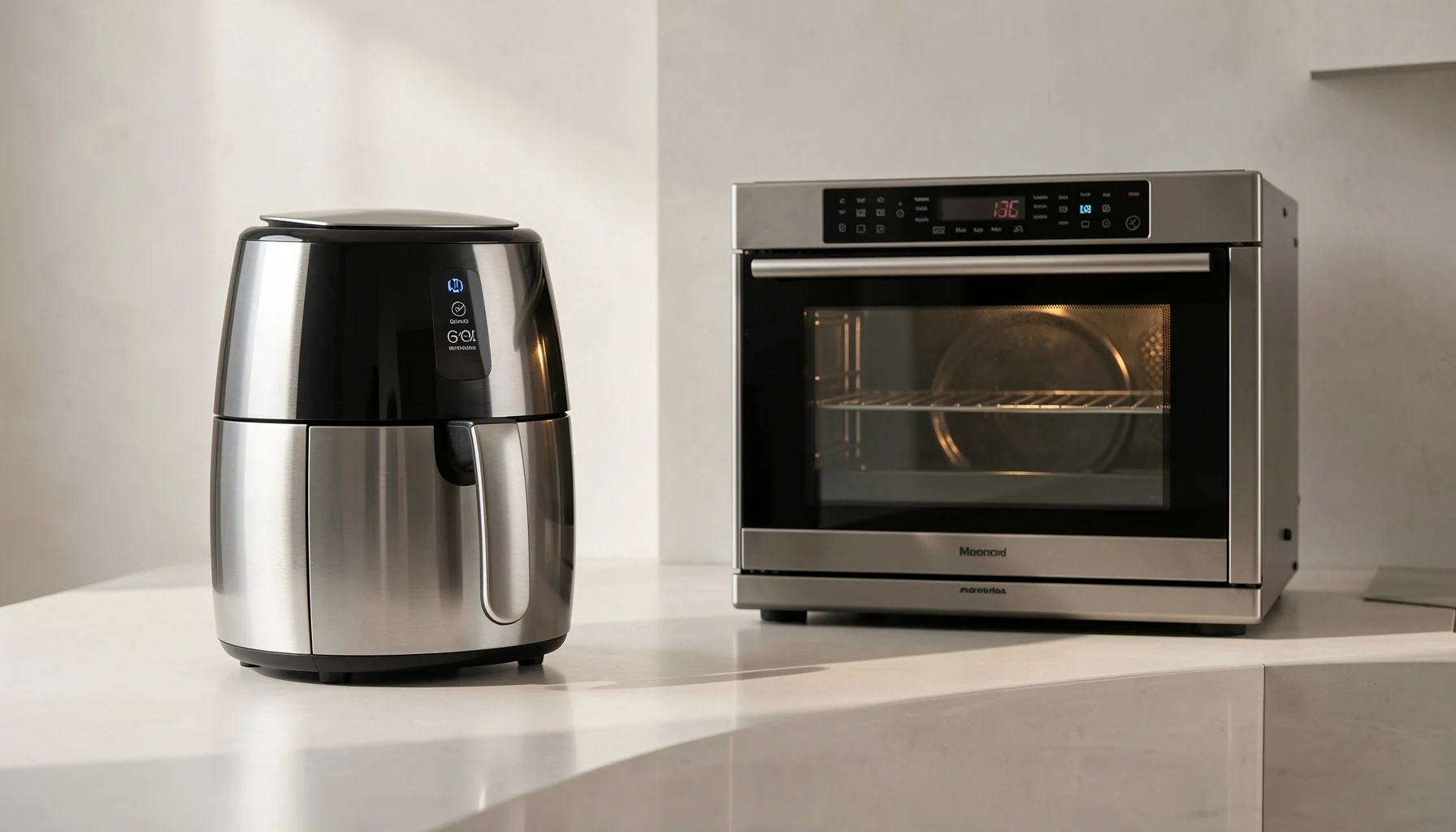
For small, quick bakes, an air fryer is usually the better choice: it heats quickly, uses less energy for small batches, and browns food fast. For bread, delicate pastries, large cakes, or several trays at once, a convection oven is the stronger baking tool because its larger cavity and gentler airflow support more even results. Your best option depends on what you bake and how much at a time.
Air Fryer vs. Convection Oven for Baking: The Core Difference
An air fryer is a compact, high-powered convection appliance; a convection oven circulates hot air through a larger cavity. The key difference is how forcefully air moves relative to the cooking space, which affects browning, capacity, and how forgiving each appliance is with delicate batters.
How their designs affect baking
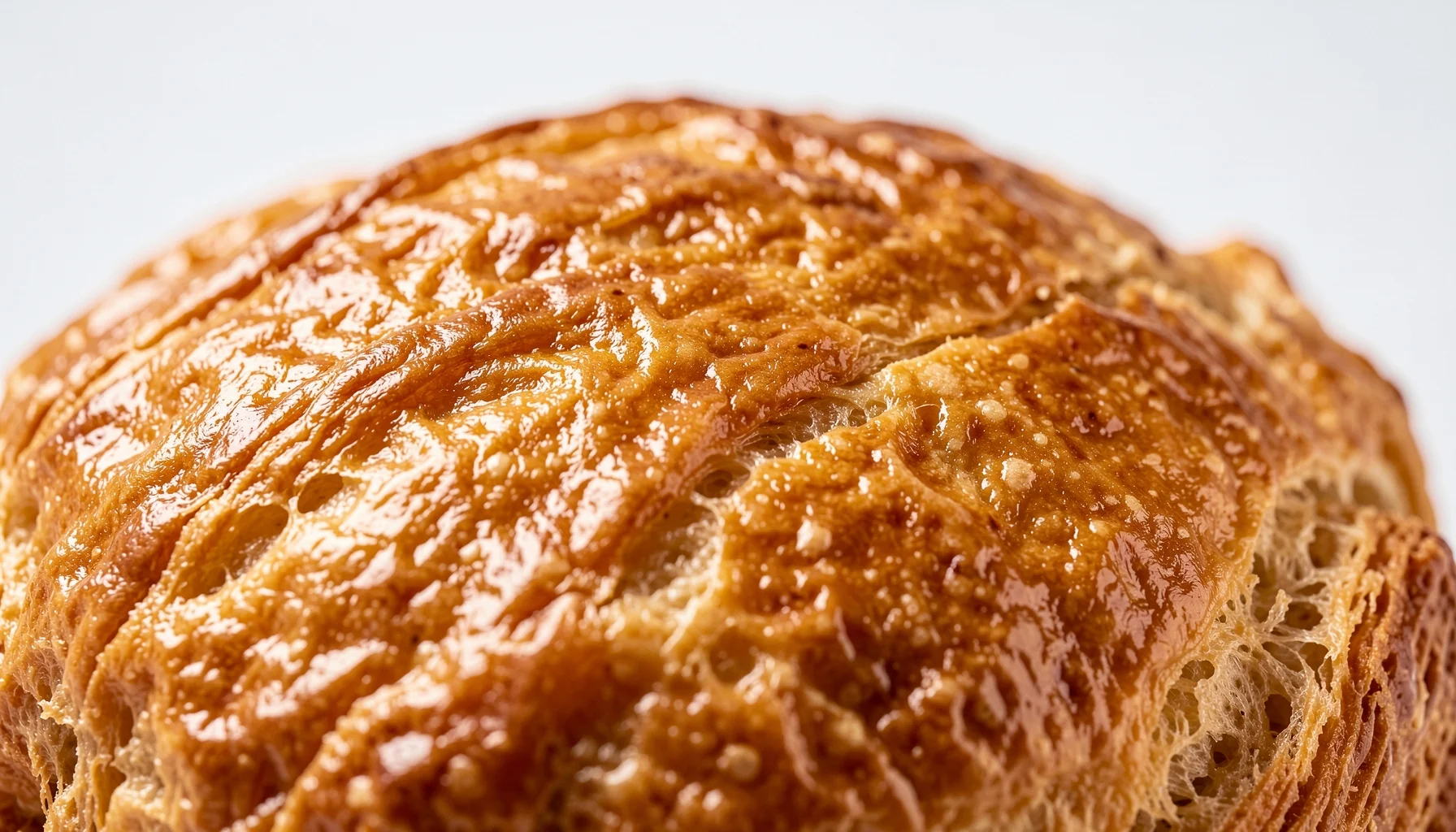
An air fryer’s small chamber and powerful fan move hot air quickly around food. This helps dry and brown surfaces, making the appliance useful for crisp edges and fast small-batch baking. But the heating element is close to the food, and the strong airflow can brown the top before the center has finished baking.
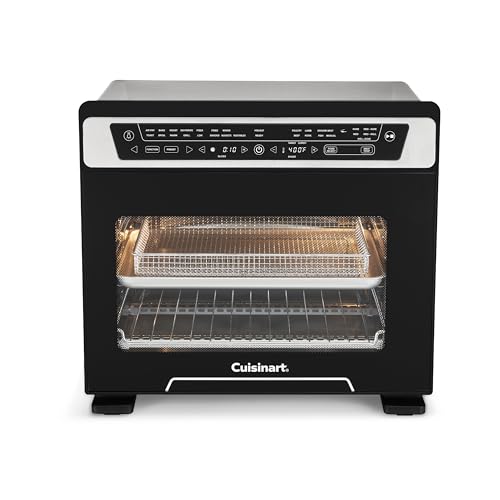
A convection oven uses a fan and exhaust system to circulate air through a roomier cavity. The movement helps distribute heat and remove the cooler layer of air surrounding food, supporting faster browning than a conventional oven. Its larger space and gentler circulation are generally better suited to baking multiple items or recipes that need a more controlled rise.
Head-to-head comparison matrix
| Comparison criterion in English | air fryer vs convection oven for baking | convection oven for baking | Verdict in English |
|---|---|---|---|
| Appliance design | Compact chamber; powerful fan relative to its size | Larger cavity with fan and exhaust system | Air fryer for compact convenience; convection oven for space |
| Airflow | High-velocity, focused circulation | More even circulation across the cavity | Convection oven is typically gentler on delicate batters |
| Preheat time | Usually 0–3 minutes | Often 10–20 minutes, depending on size | Air fryer for quick, small bakes |
| Batch capacity | Best for a single small batch, such as 4–6 muffins or one small cake pan | Can fit larger pans and support multi-rack baking | Convection oven for families and batch baking |
| Browning | Fast, strong surface browning and crisping | Even browning; useful for crusts and pastries | Depends on whether speed or uniformity matters more |
| Delicate baking | Top may brown before the center sets; airflow may disturb light batters | Generally more suitable, though some recipes benefit from fan-off baking | Convection oven, especially with fan controls |
| Recipe adjustments | Start about 25°F lower and reduce time by 20–30% compared with standard oven instructions | For conventional recipes, reduce temperature by about 25°F; check early | Both need monitoring and recipe-specific adjustment |
| Energy use | More efficient for small quantities because it heats a small space | Faster and lower-temperature cooking can save energy versus a radiant oven | Air fryer for small portions; no universal winner for every load |
| Best examples | Small brownies, muffins, individual cookies, pastry reheating | Bread, large cookie batches, pastries, and multi-rack baking | Choose according to your usual recipes |
| Price information | No verified price or model-specific running-cost data provided | No verified price or model-specific running-cost data provided | Compare current models and local energy costs before buying |
Which appliance fits the way you bake?
Choose based on your typical bake, not just the appliance label. An air fryer’s compact chamber can make a small dessert practical when heating a full oven would be unnecessary. A convection oven is more versatile when the recipe needs room, consistent circulation, or more than one tray.
Neither appliance guarantees a perfect result without adjustments. Pan size, placement, batter depth, and airflow all matter. For either appliance, avoid blocking circulation, and check doneness rather than relying on the recipe time alone.
Performance: Browning, Rise, and Bake Consistency
For baking performance, a convection oven is usually the more dependable all-purpose choice, while an air fryer excels at quick browning in small portions. The better result depends on whether the recipe needs a crisp surface or even cooking throughout a larger item.
Why an air fryer browns so quickly
The air fryer’s high-velocity airflow strips away the layer of cooler air around food, speeding surface heat transfer. This can help produce browned edges and crisp tops, but it also creates a narrower window between “golden” and overdone. A cake or thick brownie may look finished on top while the middle still needs time.
The close heating element and strong fan also make air fryers less forgiving with light mixtures. Airflow can shift cupcake batter in its liners or create rippling on a cake’s surface. These are not reasons to avoid baking in an air fryer; they are reasons to use a correctly sized pan, leave room for circulation, and begin checking early.
Where a convection oven has the edge
A convection oven’s larger cavity and more even circulation make it a better fit for items where uniformity matters. It is well suited to large batches of cookies, breads, and pastries, and some models offer a fan-off option for delicate bakes such as soufflés, cheesecakes, and certain custards.
The fan can also speed browning and crisping. For bread, though, the oven’s exhaust and airflow can affect moisture; models with steam injection offer an additional tool for bread baking. For croissants and puff pastry, rapid heat transfer can help activate the layers. Results still depend on the recipe and the oven’s settings.
What to adjust for reliable results
Use these starting points, then treat doneness as the final guide:
- Air fryer: Reduce the recipe temperature by about 25°F and the baking time by roughly 20–30% compared with standard oven directions. Check around five minutes before the adjusted time.
- Convection oven: For a recipe written for a conventional oven, reduce the temperature by about 25°F. Begin checking doneness early; the exact timing depends on the food and appliance.
- Either appliance: Keep pans from blocking airflow, and use a toothpick or other recipe-appropriate test to check the center.
Pros and cons of each option
Air fryer pros
- Heats quickly, often in 0–3 minutes.
- Works well for small batches and compact pans.
- Browns and crisps surfaces efficiently.
- Uses less energy than heating a large empty cavity for a small quantity.
Air fryer cons
- Limited capacity; usually best for one small batch.
- Strong airflow and a close heating element can overbrown tops or disturb light batters.
- The compact, dry cooking environment is less suitable for many traditional cakes that benefit from moisture retention.
Convection oven pros
- Offers more room for larger pans and multi-rack baking.
- Provides more consistent circulation for breads, pastries, and larger batches.
- Some models let you switch off the fan for delicate recipes.
- Low-temperature convection can also be used to dehydrate fruit or herbs.
Convection oven cons
- Typically takes longer to preheat than an air fryer.
- Needs space and may be excessive for a single small serving.
- The fan can set delicate surfaces too quickly, so some recipes need fan-off baking or careful monitoring.
Real-World Usability: How to Choose for Your Recipes
An air fryer is most practical when speed and small portions matter; a convection oven is more practical when capacity and repeatable results matter. Match the appliance to your usual recipes, available pan sizes, and tolerance for monitoring—not just to its advertised functions.
When should you choose an air fryer?
An air fryer makes sense if you often bake for one or two people, want to heat a small batch without warming a large cavity, or value fast preheating. It can handle small brownies, muffins, individual cookies, and frozen cookie dough when the pan fits and airflow remains open.
Use a pan designed to fit the basket or chamber, made of silicone or metal suitable for the appliance. Avoid filling it so high that the top approaches the heating element. Because the top can brown before the center is done, start checking early and use a toothpick test when appropriate.
When is a convection oven better for baking?
Choose a convection oven if you bake bread, larger cakes, several trays of cookies, or pastries that need even results across a bigger surface. Its capacity is also useful for family baking and recipes that call for larger pans. With multiple racks, leave space around pans and rotate them halfway through when you want extra uniformity.
For a delicate soufflé, cheesecake, or custard, check whether your oven offers a fan-off setting. If using parchment on a tray, trim it to fit; oversized paper can obstruct airflow or flap during cooking. Low-sided pans and clear space between pans and oven walls help circulation.
A practical decision framework
Choose an air fryer if:
- You usually bake one small batch at a time.
- Short preheating and quick cooking matter more than capacity.
- You mainly want browned, crisp results.
- Your pans fit without crowding the chamber.
Choose a convection oven if:
- You regularly bake large batches or use larger pans.
- Bread, pastries, or even multi-rack baking are priorities.
- You want more room to manage pan placement and airflow.
- Your recipes include delicate items and the oven has a fan-off option.
If your needs fall between the two, consider how often you bake small portions versus full trays. The appliance you will use comfortably and regularly is usually the better value for your kitchen.
Buying Considerations and Baking Workflow
The best purchase is the appliance that fits your kitchen, recipes, and batch sizes—not a universal winner. Since no verified model prices or operating-cost figures are available here, compare current product listings and specifications rather than relying on invented price claims.
Value for money and energy use
An air fryer can be more energy-efficient for small quantities because it does not need to heat a large, empty cavity. That makes it appealing for a few muffins or a small dessert. A convection oven can cook faster and at a lower temperature than a conventional radiant oven, which may make it more efficient for longer baking tasks. Actual energy use depends on the appliance, recipe, and duration.
Compare the capacity you will realistically use, the pan dimensions, available temperature and fan settings, and the appliance’s stated energy information where provided. A larger oven is not automatically better value if you rarely use its capacity; a small appliance is not a bargain if your usual pans do not fit.
homewhisk.com’s practical recommendation is to prioritize fit and baking needs: check the usable cavity dimensions, confirm that your preferred pans fit, and review the appliance’s current features and price before buying. No specific model, price, or purchase destination is verified in this comparison.
Step-by-step baking workflow
- Select the right pan. In an air fryer, use a pan sized for the basket or rack. In a convection oven, use a pan that leaves room for air to circulate.
- Set the temperature thoughtfully. For air-fryer baking, begin about 25°F below standard oven directions. For convection baking from a conventional recipe, the same temperature reduction is a useful starting point.
- Protect airflow. Do not crowd the air fryer or oven. Leave space between pans and oven walls; trim parchment so it does not obstruct circulation.
- Check early. Air-fryer recipes may need 20–30% less time than standard oven instructions. With convection, start checking before the recipe’s full time has elapsed.
- Test the center. Use a toothpick test when suitable. A browned top alone does not prove that a cake or brownie is fully baked.
- Adjust next time. Note what happened to the top and center, then refine temperature or timing for your appliance and pan.
Bottom line
For a small, fast bake, an air fryer is convenient and efficient. For large batches, bread, and recipes that depend on more even results, a convection oven is the more capable baking choice. If you bake a wide range of foods, a convection oven offers greater capacity; if your baking is mostly small and occasional, the air fryer may suit you better.
FAQ
Can you bake a cake in an air fryer?
Yes. Use a pan that fits the air fryer and leaves space for airflow, then lower the temperature by about 25°F compared with standard oven instructions. Start checking well before the original bake time; air-fryer baking may take 20–30% less time. Because the top can brown before the middle sets, check the center with a toothpick rather than judging by color alone.
Is a convection oven better than an air fryer for cookies?
A convection oven is usually better for large batches because it has more capacity and supports baking across multiple racks. An air fryer can work well for a few cookies or small-batch frozen dough, but its compact space limits how many fit at once, and its strong airflow can brown surfaces quickly. Whichever you use, leave room around the cookies and check them early.
Should I reduce the temperature when baking in a convection oven?
If a recipe is written for a conventional oven, reducing the temperature by about 25°F is a useful starting point for convection baking. The moving air transfers heat efficiently, so the surface may brown faster. Begin checking before the full recipe time has elapsed, since results vary with the oven, pan, and recipe. Follow any guidance provided for your specific oven’s convection setting.
Which is more energy-efficient for baking: an air fryer or a convection oven?
An air fryer is generally more energy-efficient for a small quantity because it heats a compact chamber instead of a large, mostly empty cavity. A convection oven may be a better fit for longer baking tasks or multiple trays, and it can cook faster and at lower temperatures than a conventional radiant oven. Actual energy use varies by appliance and recipe, so there is no single winner for every bake.




Write Your Review
No reviews yet. Be the first to share your experience!