

TL;DR — The right way to handle a choose a rolling pin depends on material, edge or surface, and how the tool is used day to day. If you are comparing products, start with best baking sheets, best kitchen scale, and best dutch oven for bread baking; those guides give the model-level context behind this advice.
We looked at manufacturer details, material behavior, recurring owner-review patterns, and where this topic overlaps with related buying guides. For baking tools, sizing, material, accuracy, cleaning, and storage usually decide whether a tool stays useful or gets replaced.
Save $1.52
Pros & Cons
Pros
- Food-grade 304 stainless steel construction resists staining and odor absorption better than wooden pins.
- Thickness rings remove guesswork for beginners while still being useful for laminated doughs and tart shells.
- The mat protects countertops and keeps dough from sticking, cutting down on added flour.
- One set covers pizza, pie, biscuits, dumpling wrappers, and pasta sheets.
Cons
- A 17-inch stainless steel pin is noticeably heavier than a wooden one, which can tire your wrists during long rolling sessions.
- The rings only work near the ends of the pin, so very wide dough can bow slightly in the middle.
Details
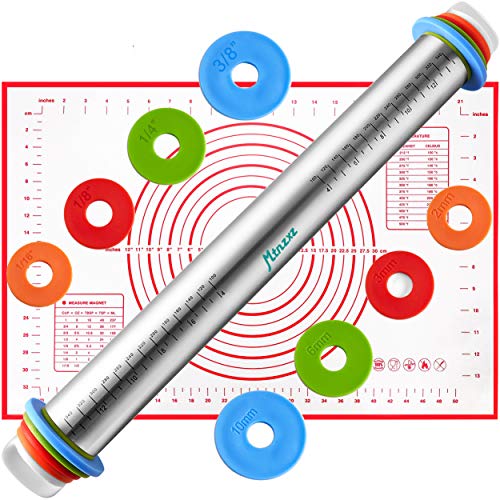
A 17-inch stainless steel rolling pin paired with a silicone pastry mat, built to solve uneven dough thickness that leaves cookies burnt on one edge and raw in the center.
Four detachable rings clamp to the pin at 1/16, 1/8, 1/4, and 3/8 inch. Roll until the rings touch the mat and the dough is done.
The barrel is food-grade 304 stainless with a satin brushed finish that stays cool and wipes clean. The mat measures 23.6 by 15.7 inches with printed guides.
The steel pin carries real weight compared to wood, and the rings sit at the ends, so extra-wide dough can thicken slightly at the center.
Best for home bakers doing pie crusts, cut-out cookies, and pizza who want consistent thickness without measuring by eye.
Best Uses
Use the 1/16 inch rings for dumpling wrappers and pasta sheets, and the 1/8 inch for pie crust and cut-out cookies that need to hold a sharp edge.
Step up to 1/4 inch for biscuits, scones, and gingerbread, and 3/8 inch for pizza bases and soft rolls that need room to rise.
Strip the rings off for fondant, tortillas, or any dough where you want to feel the thickness by hand rather than lock it in.

Pros & Cons
Pros
- Made from 100 percent natural beech hardwood, which is dense and non-porous rather than veneered or hollow.
- The 3.63-ounce weight makes it easy to control over delicate phyllo and thin pizza bases.
- Compact 6.1-inch length suits small counters, apartment kitchens and travel or camper baking kits.
- Doubles as a craft tool for clay and fondant, so it earns its drawer space beyond baking.
Cons
- At 6.1 inches long it is a mini pin, so rolling a full pie crust or large pizza base takes several passes rather than one sweep.
- As untreated hardwood it should not be soaked or run through the dishwasher, and it needs to dry fully before storage.
Details
A compact beech hardwood rolling pin for bakers who want dough control without storing a full-length pin they use a few times a year.
The polished barrel keeps sticky cookie and cinnamon roll dough moving, and its consistent 1.18-inch diameter presses sheets to an even thickness.
Solid beech at 6.1 inches long and 3.63 ounces stays light enough for one-handed passes while resisting the cracking and warping that ruin cheaper rollers.
The short barrel is the tradeoff: large crusts and pizza bases need repeated overlapping passes instead of one continuous roll.
Best for small-batch bakers, apartment kitchens and parents rolling dough alongside kids.
Best Uses
Strongest on small work: cut-out sugar cookies, hand pies, single-serve pizza bases, pasta sheets and biscuit dough that fit inside a 6-inch rolling width.
The light body helps with delicate jobs like phyllo and fondant, where a heavy pin tears the sheet before you can steer it.
Outside baking, use it to flatten polymer clay, salt dough and craft projects, then wipe it down and return it to the utensil crock.

Pros & Cons
Pros
- Sized correctly for wrapper dough, which makes it far easier to control than repurposing a large pastry pin.
- Solid one-piece bamboo has no moving parts to loosen or break over years of use.
- Genuinely versatile across Chinese, Japanese, Tibetan, and Indian doughs, plus thin flatbreads.
- Light enough that beginners can learn the roll-and-turn wrapper technique without fatigue.
Cons
- Hand wash only, and bamboo should not soak or go in the dishwasher, or it will swell and crack over time.
- Too short for pie crust, pizza, or large sheet doughs, so it will not replace a standard rolling pin.
Details
A single-piece bamboo pin built for one job: rolling small dough balls into round dumpling wrappers with an even, thin edge.
The 10-inch length lets you pin the dough with one hand and rotate with the other, the standard technique for gyoza and potsticker skins.
Made from 100 percent natural bamboo, lightweight and handle-free, so it stays balanced during repeat strokes and fits a utensil drawer.
Bamboo needs hand washing in warm soapy water and full drying; it cannot be soaked or run through a dishwasher.
Best for home cooks who fold dumplings, bao, momos, or samosas often enough to want a dedicated wrapper tool.
Best Uses
Dumpling skins: roll a small dough ball from the outside in, rotating a quarter turn each pass, to leave the center slightly thicker so the pleats hold filling.
Steamed bao and soup dumplings: the short length gives the control needed for thicker, softer rounds that still seal cleanly.
Beyond dumplings, use it for samosa pastry, chapatti, momos, and other thin flatbreads that fit inside a 10-inch stroke.
How To Choose
Choosing a choose a rolling pin starts with your own use: how often you cook, the space you have, and which uneven browning you most want to avoid. Match those to material and gauge, and nonstick or bare finish and the decision makes itself. Do not start from the spec sheet — start from your kitchen. If you are shopping, our best baking sheets and best kitchen scale guides are the fastest way in.
Common Mistakes To Avoid
The usual failure is treating a durable baking tool as indestructible. Harsh shortcuts lead to batter that sticks, and uneven browning. Do not assume pricier gear removes the need for care, either — technique matters more than the badge. Start your shortlist with best baking sheets, best kitchen scale, and best dutch oven for bread baking before narrowing by budget.
Keeping It That Way
Maintenance beats repair. Fold hand-washing to protect the finish, lining with parchment, and storing flat to prevent bending into your routine and the baking tool will stay reliable for years. Neglect any one of them and you invite uneven browning back.
How To Know You Did It Right
The result should be practical and repeatable: the baking tool should work cleanly, feel controlled, and show no signs of measurements that drift out of true. If the same issue returns quickly, the cause is usually a missed care step — not the tool itself.
Related Product Guides
If this topic is part of a buying decision, these are the HomeWhisk guides most closely tied to it:
- best baking sheets
- best kitchen scale
- best dutch oven for bread baking
- best mixing bowls
- best cutting board
- best food storage containers
Frequently Asked Questions
How do I choose a choose a rolling pin?
Weigh nonstick or bare finish, and nesting or storage shape against how you cook. Start your shortlist with best baking sheets and best kitchen scale.
What is the bottom line?
Match the baking tool to your real habits: buy for durability if it is daily, for value and storage if it is occasional.
What gear pairs well with it?
Start with a reliable core piece, then add as needs appear. Compare best baking sheets, best kitchen scale, and best dutch oven for bread baking for related choices.
What should I avoid?
Avoid buying by brand alone, ignoring skipping abrasive scrubbers, and oversizing for your space. Each invites batter that sticks down the line.
What matters most for choose a rolling pin?
Focus on nonstick or bare finish, material and gauge, and heat conductivity first. Those decide real performance; the rest is secondary. Compare best baking sheets and best kitchen scale for options that get the basics right.
The Bottom Line
How to choose a rolling pin comes down to fit: how often you use the tool, how much care it needs, and whether it solves a real kitchen problem. If you are buying, compare best baking sheets, best kitchen scale, and best dutch oven for bread baking before you spend.



Write Your Review
No reviews yet. Be the first to share your experience!