

TL;DR — Cooling rack and cutting board are not really rivals — they do different jobs, and most cooks end up using both. Use this as the practical background, then check best cutting board, best baking sheets, and best kitchen scale for specific product options.
We treated this as an editor’s note for home cooks: what matters, what is optional, and which related product guides are worth checking before you buy. For baking tools, sizing, material, accuracy, cleaning, and storage usually decide whether a tool stays useful or gets replaced.

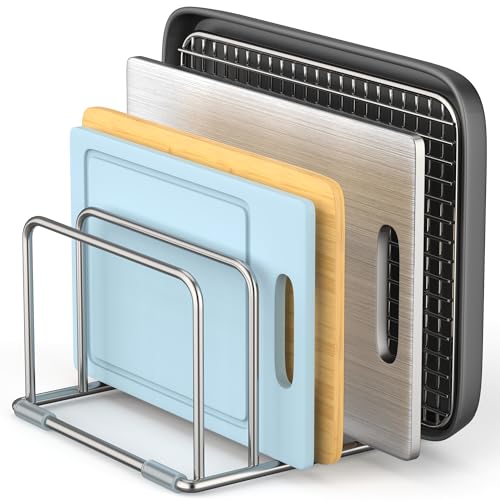
Pros & Cons
Pros
- Thick stainless steel rod construction survives daily splashes and washing without corroding.
- Mixed 1.0 and 1.2 inch slots handle boards of different thicknesses in a single rack.
- Non-slip base tubes stop the stand from sliding and keep countertops scratch free.
- Small square base works on an open counter or hidden inside a cabinet.
Cons
- Slots top out at 1.2 inch, so thick butcher block boards will not seat properly.
- The compact frame holds only a few items at a time, so a large board and sheet pan collection needs a second unit.
Details
A freestanding rack that keeps cutting boards, cookie sheets, and plates upright instead of stacked flat in a cabinet where the one you need sits on the bottom.
Two slot widths, 1.0 and 1.2 inch, hold thin plastic boards and heavier wood boards in the same stand, so a full board set stays sorted by thickness.
304 stainless steel rods resist rust near the sink, and four non-slip tubes on the base grip the counter while protecting stone or laminate from scratches.
The 6.1 by 6.1 by 4 inch footprint limits capacity to a few pieces at once, so heavy bakers may want two racks.
Best for small kitchens that need boards and sheet pans drying upright and within reach without surrendering counter space.
What Fits
Slots measure 1.0 and 1.2 inch wide, covering thin polypropylene boards, bamboo boards, and standard wood boards. Butcher blocks thicker than 1.2 inch will not seat.
Half sheet pans, cookie sheets, and cooling racks slide in on edge. Dinner plates and pot lids also stand upright when your board count is low.
At 4 inches tall the frame supports boards rather than tall pans. Board length and height are unlimited as long as the piece stays balanced.

Pros & Cons
Pros
- One-inch slot clearance covers thick commercial boards that slimmer home racks cannot hold.
- Vertical storage of six boards frees the counter and cabinet space a stack would occupy.
- Vinyl coating over the wire resists the damp conditions around a sink or dish area.
- Integrated hooks add brush and scraper storage without a second accessory.
Cons
- Winco specifies board thickness capacity but not the rack footprint, so measure your counter space before ordering the medium size.
- Slots only control thickness; long or tall boards will overhang the frame and can make a partly loaded rack front-heavy.
Details
A freestanding wire rack that holds six cutting boards on edge instead of stacked flat, which is where warping, trapped moisture, and cross contamination usually start.
Slots accept boards up to one inch thick, so heavy commercial poly boards fit next to thinner home boards. Six frame hooks hold board brushes and scrapers.
Vinyl coating over the wire frame shields board faces from bare metal and holds up to the damp air near a sink or dish station.
Thickness capacity is specified, but overall footprint is not, so measure your counter and your largest board before choosing the medium size.
Best for home cooks and small commercial kitchens running multiple color-coded boards that need to dry and stay sorted at the prep station.
What Fits
Six slots, one board each, up to an inch thick. Half-inch poly and thin plastic boards seat easily; avoid doubling boards in a slot since they will not air dry.
Thick end-grain butcher blocks over an inch will not drop in. Measure at the thickest point, including juice grooves and rubber feet.
The six hooks take board brushes, bench scrapers, and towels. Slot length is open, so oversized boards can overhang and unbalance a partly loaded rack.

Pros & Cons
Pros
- Heavy-duty stainless steel construction resists rust in humid under-sink cabinets.
- Adjustable divider spacing handles mixed cookware thicknesses instead of forcing fixed slots.
- Two-piece design gives you flexible placement across separate zones in the kitchin.
- Vertical storage makes every sheet and board reachable without lifting the stack above it.
Cons
- The open wire frame has no back stop, so tall or top-heavy cutting boards can lean unless the dividers are snugged in close.
- At its widest setting the expanded rack loses some rigidity, so it works best loaded evenly rather than weighted at one end.
Details
An expandable stainless steel rack that stores baking sheets, cutting boards, pan lids, and plates on edge instead of stacked flat in a cabinet.
Fourteen dividers slide freely along the frame, so you can widen a slot for a roasting pan and narrow the next one for a thin cookie sheet.
Heavy-duty stainless steel with anti-rust construction and anti-scratch strips on both ends. Stretches from 12 to 23 inches and splits into two separate racks.
There is no back panel or rear stop, so oversized boards need dividers set snugly to stay upright.
Best for anyone reorganizing a crowded bakeware cabinet or under-sink space who needs adjustable, tool-free storage.
What Fits
Half sheet pans, quarter sheets, cookie sheets, and cooling racks all stand upright in the arc dividers. Set narrow spacing to fit several sheets per section.
Wood and plastic cutting boards, serving platters, and dinner plates work in the wider slots. Frying pans and skillets store on edge with the handle facing out.
Measure your cabinet depth and opening first. The frame adjusts from 12 to 23 inches wide, or split it into two shorter racks for tight spots.
Cooling rack and Cutting board: Do You Need Both?
This is not really a versus question. A cooling rack and a cutting board do different jobs — the cooling rack does the actual work, while the cutting board supports it. Most cooks who care about results end up using both rather than choosing one. For product picks, compare best cutting board, best baking sheets, and best kitchen scale.
How They Work Together
Think of the cutting board as part of keeping the cooling rack performing the way it should. Used together, they make the whole task easier and more consistent; skipping the cutting board usually means the cooling rack underperforms or wears faster. The two are complements, not competitors.
When You Actually Need the Cutting board
You do not always need the cutting board on day one, but the more often you use the cooling rack, the more it pays off. If you use the cooling rack regularly, adding the cutting board is a small cost for a real improvement in material and gauge. If you are shopping, our best cutting board and best baking sheets guides are the fastest way in.
Bottom Line
If your budget forces a choice, start with the cooling rack — it is the tool that does the job. Add the cutting board soon after; together they beat either one alone.
Related Product Guides
If this topic is part of a buying decision, these are the HomeWhisk guides most closely tied to it:
- best cutting board
- best baking sheets
- best kitchen scale
- best dutch oven for bread baking
- best mixing bowls
- best food storage containers
Frequently Asked Questions
Do I need both a cooling rack and a cutting board?
They serve different purposes, so most cooks use both. The cooling rack does the work; the cutting board supports it. If budget forces a choice, start with the cooling rack. See best cutting board and best baking sheets for options.
Can a cutting board replace a cooling rack?
No — they are complements, not substitutes. A cutting board does not do the cooling rack’s job; it makes the cooling rack work better or last longer.
What should I avoid?
Avoid buying by brand alone, ignoring hand-washing to protect the finish, and oversizing for your space. Each invites measurements that drift out of true down the line.
Is a premium baking tool worth it?
Only if you use it enough to notice better control, durability, or cleanup regularly. Occasional users are well served by a mid-range pick like those in best kitchen scale.
How do I keep it in good shape?
Build hand-washing to protect the finish, and storing flat to prevent bending into normal cleanup. Light, consistent care prevents rust on bare steel far better than occasional deep effort.
The Bottom Line
A good cutting board decision should feel obvious after you line up size, material, cleaning, and durability. If it is still a purchase question, the next step is best cutting board, best baking sheets, and best kitchen scale.






Write Your Review
No reviews yet. Be the first to share your experience!