

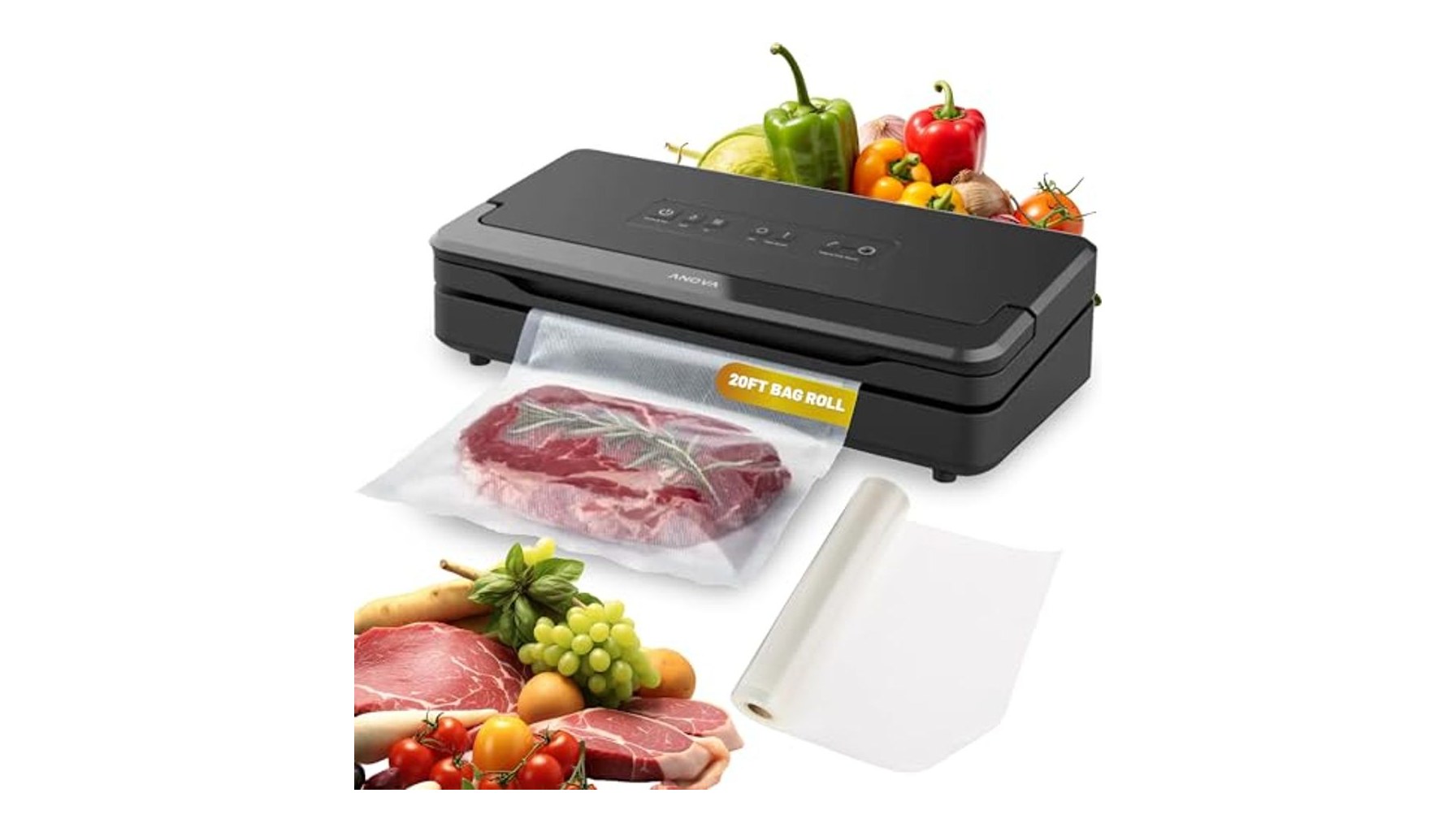
You pull a vacuum sealer out of the box, feed in a bag of chicken breasts, and press the button. The machine hums for a second, then stops. The bag sits there, half-inflated, with a weak seal that peels apart when you lift it. Or maybe the seal holds, but moisture from the food gets sucked into the vacuum channel and now nothing will seal properly until you clean it out. Sometimes the motor overheats after three bags and shuts down for twenty minutes. These aren’t rare defects—they’re the daily reality of cheap vacuum sealers that can’t handle real kitchen work.
Anova entered the vacuum sealer market after building a reputation with sous vide circulators, and their approach shows it. Instead of racing to the bottom on price, they focused on the specific failures that make most vacuum sealers frustrating: inconsistent seal strength, poor moisture handling, and motors that can’t sustain continuous use. Whether that matters to you depends entirely on what breaks your current sealer and how often you actually use it.
Why Most Vacuum Sealers Fail at the Basics
The seal bar is where everything falls apart. Cheaper units use a single heating wire that has to both melt the plastic and create enough pressure to fuse the layers. If the temperature runs too hot, you get a brittle seal that cracks. Too cool, and the plastic doesn’t bond at all. The timing matters just as much—hold it too long and you melt through the bag, too short and you get a weak seal that fails in the freezer.
Moisture makes this exponentially worse. When liquid gets pulled toward the seal area, it cools the heating element and prevents a proper bond. Budget sealers have no way to handle this. You either manually dry the bag opening with a paper towel before every seal, or you accept that one in three bags will fail. Some people tilt their sealers at an angle or freeze liquids partially before sealing. These workarounds exist because the machines can’t solve the underlying problem.
The vacuum pump is the other common failure point. Most consumer sealers use diaphragm pumps that overheat quickly. Seal three or four bags in a row and the motor cuts out for a cooling period. This isn’t a safety feature you want—it’s a design limitation. If you’re processing a bulk meat order or putting up a harvest, those mandatory breaks turn a thirty-minute job into two hours.
What Anova Changed (and What They Didn’t)
Anova’s vacuum sealer uses a dual-seal system with two independent heating bars. This creates redundancy—if one seal fails, the second one holds. More importantly, it lets you create a stronger overall seal because you’re fusing the plastic in two places instead of relying on a single line. The machine also pulses the vacuum in stages rather than running continuously, which gives you a chance to hit the seal button before liquid reaches the opening on wet foods.
The moisture management is better than most, but it’s not magic. Anova includes a removable drip tray and an accessory port that sits higher than the vacuum channel, so liquid has to work harder to reach the pump. You still need to be careful with soups or marinades, but fish filets and marinated chicken—foods with some liquid but not swimming in it—seal reliably without constant babysitting.
The motor is rated for continuous use, which matters if you’re sealing more than a few bags at a time. You can run through twenty bags of ground beef without waiting for cooldowns. That said, it’s louder than cheaper units. The pump noise is noticeable enough that you won’t want to run it early in the morning in a small apartment.
What Anova didn’t change: the bags are still expensive proprietary rolls, the footprint is large enough that it won’t fit under most cabinets, and the accessory hose for containers is exactly as fiddly as every other brand. If those are your main pain points, this won’t fix them.
Who Actually Needs the Upgrade
If you seal one or two bags a week—meal prep for lunches, the occasional bulk chicken purchase—a basic FoodSaver will frustrate you sometimes, but it’ll work. The cost difference doesn’t make sense for light use. You’re paying for reliability you won’t use often enough to appreciate.
The Anova sealer makes sense for people who hit the failure modes repeatedly. If you sous vide regularly and need to seal proteins with some surface moisture, the better moisture handling saves you time every single cook. If you hunt or fish and process dozens of pounds in a session, the continuous-duty motor means you’re not standing around waiting. If you’ve had three cheap sealers fail in two years, the durability is cheaper in the long run.
The other scenario: you’re already in the Anova ecosystem with their sous vide circulator. The app integration is minor—you can save custom vacuum and seal times for specific foods—but it’s convenient if you’re already using their app for cook times. Not worth switching ecosystems for, but a nice bonus if you’re already there.
Realistic Alternatives
The FoodSaver FM5200 sits in the middle ground. It has better moisture management than the budget models and a stronger motor, but it’s not built for continuous heavy use. If you’re sealing 5-10 bags in a session a few times a month, it’s probably enough sealer at a lower price point.
Chamber vacuum sealers eliminate most of these problems by sealing in a vacuum environment rather than sucking air out of a bag. They handle liquids perfectly and create stronger seals. They’re also $400-$2000 and the size of a microwave. Unless you’re running a catering business or processing game meat by the cooler-full, they’re overkill.
On the budget end, the Nesco VS-12 uses generic bags, which cuts your ongoing costs significantly. The sealer itself is mediocre—weak vacuum, inconsistent seals, the usual problems—but if bag cost is your main concern and you’re willing to reseal failures, the savings add up.
Can you use generic bags with the Anova sealer?
Technically yes, but the machine is designed around Anova’s bag thickness and texture. Generic bags work about 80% of the time—they seal, but the bond is weaker and more prone to failure in the freezer. If you’re storing for a few weeks it’s fine, but for long-term freezer storage the proprietary bags perform better. The cost difference is real though: Anova rolls run $25-30 for 50 feet, while generic rolls are $15-20 for the same length.
How long do vacuum-sealed foods actually last in the freezer?
Vacuum sealing extends freezer life by reducing freezer burn, but it doesn’t stop it completely. Chicken and pork stay good for 2-3 years vacuum sealed versus 6-9 months in regular freezer bags. Ground meat is shorter—about a year—because the larger surface area still allows some oxidation. Fish is the most variable: fatty fish like salmon starts to degrade after 3-4 months even vacuum sealed, while lean white fish can last 18 months. None of this is food safety related—frozen food stays safe indefinitely at 0°F—it’s about quality degradation.
What’s the real cost per bag for vacuum sealing?
An 11-inch bag cut to 10 inches long costs about $0.50 with Anova bags, $0.30-35 with generic bags, and $0.15-20 if you buy bulk commercial rolls. Ziploc freezer bags are $0.25-30 each for comparison. The vacuum sealer pays for itself only if you’re preventing enough food waste to offset both the machine cost and the ongoing bag expense. For most households that means you need to be freezing 15-20 pounds of food per month minimum. If you’re sealing smaller amounts, you’re paying for convenience and better freezer organization, not saving money.

Save $45.99
Pros & Cons
Pros
- Wet-function mode makes it practical for sealing brined proteins, sauced leftovers, and marinades that would compromise a standard sealer.
- One-handed clamping design is a real workflow advantage when the other hand is holding a filled bag.
- Built-in bag roll storage and cutter eliminate the need for any accessories sitting separately on the counter.
- The accessory port adds jar and container sealing capability, making it useful for dry goods storage beyond just freezer bags.
Cons
- At this price point there are no included accessory hose attachments in the box, so jar and container sealing requires a separate purchase.
- The unit is physically larger than compact strip sealers, which may be a drawback for kitchens with limited drawer or counter space.
Details
The Anova Precision Vacuum Sealer Pro removes air from bags and seals them for sous vide cooking or long-term freezer and pantry storage, directly addressing freezer burn and spoiled meal-prep containers.
Its dual wet/dry modes switch suction levels automatically, so you can seal a bag of marinated chicken or a dry bag of rice without adjusting technique or causing liquid ingestion into the motor.
The unit houses a full bag roll inside the hinge and integrates cord storage under the base, keeping the footprint self-contained. Build is plastic-bodied with a metal sealing strip — solid enough for daily use without feeling industrial.
The accessory port requires a compatible hose and containers sold separately, so out-of-the-box use is limited to bags only.
Best for home cooks who sous vide weekly or do bulk meal prep and need a sealer that handles wet foods reliably without babysitting the process.
How to Use
Load the included bag roll into the hinge compartment, pull the film out, and use the sliding cutter to size your bag. One hand holds the open end; the other closes the lid — the unit takes it from there.
For wet or marinated foods, press the Moist mode button before sealing. This reduces suction so liquid stays in the bag instead of getting pulled toward the sealing strip or motor.
To seal mason jars or vacuum containers, connect a compatible accessory hose to the port on the side and use the External Pulse Vacuum mode for controlled, gradual pressure removal suited to rigid containers.

Save $20.99
Pros & Cons
Pros
- Single-button operation makes it accessible for cooks who want speed over complexity.
- BPA-free bag construction is a meaningful safety detail for anyone sealing food that goes directly into a hot water bath.
- Compact size fits easily in a kitchen drawer, unlike bulkier chamber sealers that require dedicated counter space.
- Dual wet and dry sealing modes make it usable beyond sous vide, covering everyday freezer meal prep as well.
Cons
- Requires proprietary or compatible roll bags for custom sizing, which adds an ongoing supply cost beyond the included pre-cut bags.
- At 110V only, it is not compatible with international voltage standards, limiting use for travelers or those outside North America.
Details
The Anova Culinary Vacuum Sealer solves one specific kitchen problem: air getting into bags during sous vide cooking, which causes floating and uneven heat exposure.
Its single-button operation handles both vacuuming and sealing in one step, while separate pulse and seal controls let you handle soft or liquid-rich foods without crushing them.
Built from plastic with a slim profile, it is designed to store in a drawer rather than occupy permanent counter space, which matters in smaller kitchens.
It ships with only 10 pre-cut bags, so ongoing use requires purchasing additional Anova or compatible bags separately.
Best for home cooks who sous vide regularly and want a dedicated, no-fuss sealer that doubles as a meal-prep and freezer storage tool.
How to Use
Place your seasoned food inside a pre-cut or roll bag, leaving at least three inches of headspace above the food so the sealer can grip the open end cleanly.
Insert the open end of the bag into the sealer slot and press the single button. For wet or marinated items, use the pulse mode first to remove air gradually before sealing to avoid drawing liquid into the machine.
Once sealed, bags go directly into your sous vide water bath or freezer. For freezer storage, lay bags flat while they freeze to maximize stackable space and ensure an even seal throughout.

Pros & Cons
Pros
- Three seal modes (dry, moist, double) and two vacuum pressures give you control over delicate items like berries and sturdy cuts like steaks without switching machines.
- 130-watt double pump seals faster and more thoroughly than budget single-pump units, based on user reports of consistent suction across hundreds of bags.
- Includes two starter rolls (8.6-inch and 11.8-inch) and works with any brand of vacuum sealer bags, so you're not locked into proprietary refills.
Cons
- At 130 watts, it draws more power than compact sealers and may trip older kitchen circuits if used alongside high-draw appliances.
- The drip tray requires hand-washing after sealing moist foods like marinated meat, adding a cleanup step that fully sealed units avoid.
Details
The Nesco VS-12 is a countertop vacuum sealer that removes air from plastic bags to extend freezer and refrigerator life for meal-prepped portions, bulk grocery buys, and leftovers.
Its 130-watt double pump pulls air faster than single-pump models, while three seal settings (dry, moist, double) and two vacuum pressures (normal, gentle) handle everything from soup to strawberries without crushing or leaking.
The unit includes built-in roll storage, a sliding bag cutter, and a clear viewing lid, weighing enough to stay stable during sealing but compact enough to store in a pantry between uses.
The drip tray catches liquids during moist seals but requires hand-washing, and the machine draws more power than budget sealers, which may matter in older kitchens.
Best for home cooks who meal-prep weekly, buy meat in bulk, or freeze garden harvests and need consistent seals across a variety of food types.
How to Use
Plug in the sealer and choose your seal mode: dry for solid foods, moist for marinated or wet items, double for extra-strong closures on liquids or long-term freezer storage.
Select normal vacuum for firm foods like chicken breasts or vegetables, or gentle vacuum for soft items like bread, cakes, or berries that crush under full suction.
Place the open end of the bag in the vacuum channel, press the easy-lock handle down until it clicks, and the machine automatically vacuums and seals. The viewing window lets you confirm alignment before starting.

Pros & Cons
Pros
- Automatic bag detection removes the need to press buttons, making high-volume sealing sessions faster and less tedious.
- Dual heat sealing strips provide a stronger, more reliable seal than single-strip models, especially important for sous vide cooking.
- Includes 11-foot roll and five pre-cut bags so you can start sealing immediately without buying extra supplies.
- Five-year limited warranty covers defects longer than most competitors in this price range.
Cons
- Drip tray must be removed and cleaned after sealing moist foods, adding an extra step when working with marinated or wet ingredients.
- Machine footprint requires dedicated counter or cabinet space, which may be tight in smaller kitchens.
Details
The FoodSaver FM2100 is an automatic vacuum sealer that removes air from specially designed bags to prevent freezer burn and extend food storage life up to 3 years. It solves the problem of wasted groceries and freezer-burned meat by creating airtight seals that lock out moisture and oxygen.
Automatic bag detection starts the vacuum and sealing process as soon as you insert a bag, while dual heat sealing strips create a double seal that holds through repeated freezing and thawing. The built-in roll cutter lets you cut custom bag lengths on the spot, useful when sealing small portions or irregularly shaped items like fish fillets.
The machine weighs around 5 pounds and has a compact footprint designed for countertop storage. The removable drip tray catches liquid overflow from moist foods. Build quality is solid for daily home use, though the plastic housing feels lighter than commercial-grade models.
The drip tray requires frequent cleaning when sealing wet or marinated foods, and the machine takes up more counter space than handheld-only models. It also requires proprietary FoodSaver bags, which cost more per seal than generic zipper bags.
Best for home cooks who buy meat in bulk, meal prep multiple times per week, or sous vide regularly and want to reduce food waste without manual pumping.
How to Use
Plug in the machine and let it warm up for 30 seconds. Cut a bag from the roll using the built-in cutter, then seal one end by selecting Seal mode. Insert the open end with food into the vacuum chamber until the machine detects it and begins removing air automatically.
For moist foods like marinated chicken or soups, use the Moist setting to prevent liquid from being sucked into the vacuum chamber. Fold a paper towel over the open end or freeze liquids partially before sealing to keep the drip tray clean.
After sealing, remove the drip tray and rinse it if any liquid collected. Store sealed bags flat in the freezer to maximize space and thaw in cold water or directly in a sous vide bath without opening the bag.
Pros & Cons
Pros
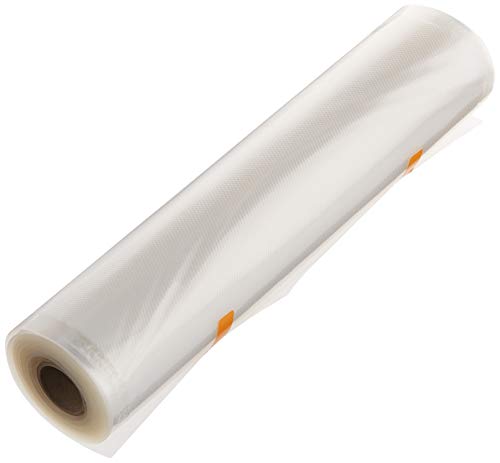
- Two generously sized rolls give you enough material to handle a full week of meal prep without reordering.
- The 7-layer ribbed design extracts air efficiently, which directly improves seal quality and cook consistency.
- 100% BPA-free construction means the bags are safe for direct-heat sous vide cooking, not just cold storage.
- Custom-cut format works for everything from single chicken breasts to full racks of ribs without wasting material.
Cons
- With zero verified reviews available, real-world durability at high sous vide temperatures remains unconfirmed by buyers.
- Roll format requires a vacuum sealer with a bag-roll port or a separate heat sealer to close one end before use.
Details
These are custom-cut vacuum sealer bag rolls designed specifically for sous vide cooking, solving the problem of standard pre-sized bags that waste material or fail under sustained heat.
The 7-layer double-ribbed structure accelerates air extraction and keeps seals intact during long cooks, where cheaper single-layer bags often delaminate or leak.
Each roll measures 11 inches wide by 19.6 feet long. The medium sizing handles most proteins and vegetable portions without trimming.
You need a compatible vacuum sealer to heat-seal one end before filling. These rolls do not come pre-sealed and cannot be used as zip-lock style bags.
Best for the home sous vide cook who preps in bulk and wants flexibility over bag length without paying for pre-sized bags that never quite fit.
Best Uses
These rolls shine for sous vide proteins where cook times run 4 hours or longer. The ribbed layers hold the vacuum seal through overnight short-rib or brisket cooks where standard bags give out.
The custom-cut format is especially useful for batch meal prep. Cut longer bags for whole tenderloins or salmon fillets, shorter ones for single chicken breasts, all from the same roll.
They also work for vacuum-sealing dry goods and marinating. The airtight seal speeds up marinade penetration significantly compared to zip bags, making them useful even when the sous vide is not involved.

Write Your Review
No reviews yet. Be the first to share your experience!