

The utility knife occupies a specific and underappreciated position in the kitchen hierarchy — longer and more capable than a paring knife, shorter and more maneuverable than a full best chef knife. With blades typically ranging from 5 to 7 inches, a utility knife handles the mid-range tasks that neither extreme of the cutlery spectrum manages well: slicing boneless chicken breasts, trimming green beans, cutting sandwich ingredients, breaking down herbs and aromatics without a full cutting board setup, and working with smaller fruits and vegetables that feel awkward under an 8-inch blade. The HomeWhisk research team analyzed owner reports from Amazon, community discussions on Reddit r/KnifeDeals and r/chefknives, and manufacturer specifications across dozens of utility knife models to identify which options consistently earn high marks from home cooks who rely on this blade type daily. What separates a reliable utility knife from a mediocre one comes down to three factors that appear repeatedly in aggregated owner feedback: steel quality and edge retention, blade geometry suited to the knife’s specific size and use case, and handle ergonomics scaled to a smaller, lighter blade. A utility knife that holds a keen edge through repeated use on everything from tomatoes to soft cheeses to poultry is fundamentally more useful than one that requires frequent touch-ups. Steel hardness, grind angle, and handle grip all play distinct roles in that performance equation. For cooks building out a complete kitchen knife setup, our guide to best kitchen knives covers the broader cutlery ecosystem that a utility knife complements.

For more, see our What Is a Boning Knife Used for and What Is a Fillet Knife Used for guides.

Save $2.01
Pros & Cons
Pros
- Retractable blade locks securely inside the metal frame, eliminating the safety hazard of exposed blades near food prep areas or around family members.
- Ergonomic matting grip prevents slipping when hands are wet or oily, a critical safety feature for kitchen environments.
- Passed 1.5-meter drop test, so accidental kitchen counter drops won't crack the handle or compromise blade alignment.
Cons
- Not designed for cutting raw food directly; it's built for packaging removal, not replacing a chef's knife for meal prep.
- Blade adjustment requires manual positioning rather than a lever mechanism, so switching between depths takes a few extra seconds.
Details
This is a heavy-duty utility knife for removing packaging and cutting non-food materials in the kitchen, not a food prep knife. The retractable design keeps the blade safely hidden when not in use, preventing accidental cuts in crowded drawers.
The heat-treated SK5 blade reaches 64 HRC hardness and holds its edge through hundreds of cuts on cardboard, plastic clamshell packaging, and food delivery boxes. The quick-release button swaps blades without tools, so you stay productive during high-volume prep work.
Built from rust-resistant aluminum alloy at just 3.2 oz, this knife survives wet kitchen environments and won’t corrode like cheaper steel models. The ergonomic matting grip prevents slipping when your hands are wet or oily.
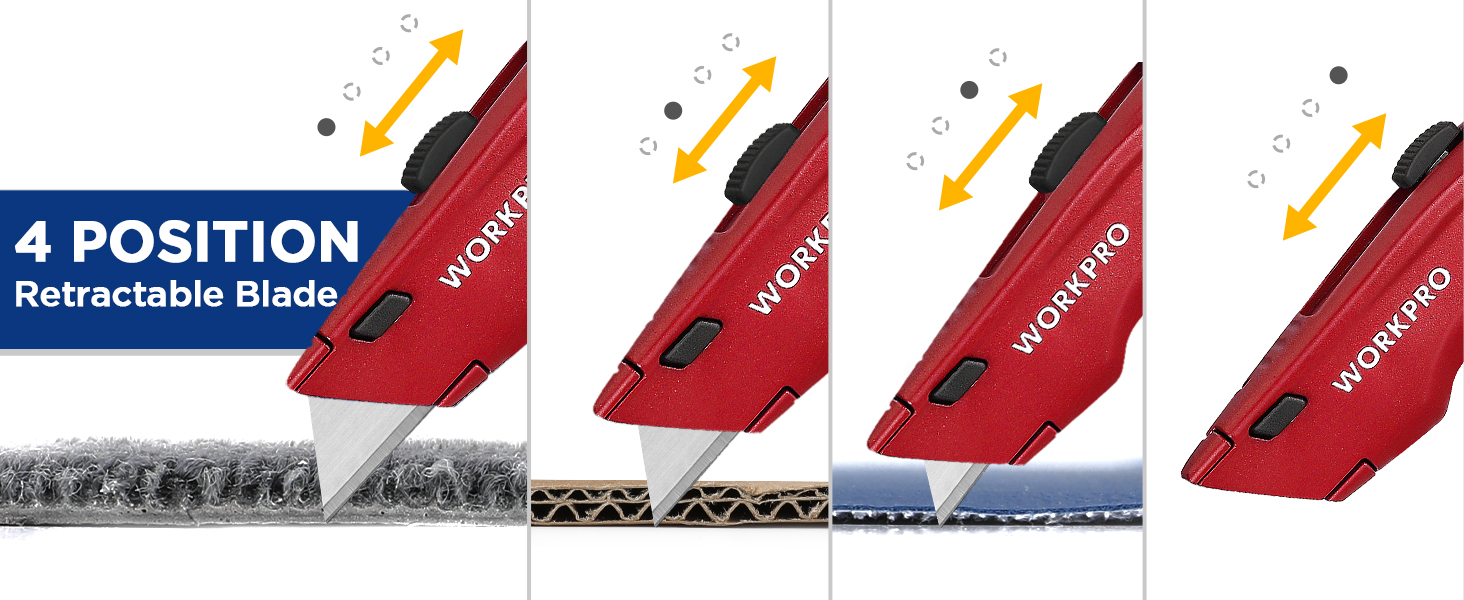
The 3-position adjustable blade lets you control cutting depth, reducing the risk of cutting too deep into countertops or your hand. One limitation: the manual blade adjustment takes a few seconds longer than lever-based systems.
Best for home cooks and meal preppers who handle frequent bulk food deliveries and need a reliable, safe tool for packaging removal.
Care Guide
Retract the blade fully after each use and store in a dry location. Wipe the aluminum frame monthly with a dry cloth to prevent dust buildup. The matting body resists corrosion, but avoid prolonged exposure to standing water.
Replace blades when cuts become ragged or require extra pressure. The quick-release button makes swaps effortless; simply press, slide out the old blade, and insert a new one from your pack of 10 extras. Double-sided blades extend your supply by flipping them when one edge dulls.
Keep the blade adjustment mechanism clean by wiping away cardboard dust or debris. Never soak the handle in water, as moisture can seep into the grip material. Store in a drawer or tool bag where the retracted blade won’t accidentally extend.

Pros & Cons
Pros
- CarbonMax blade technology outlasts standard blades by 24X, making this knife cost-effective over months of daily kitchen use.
- Dual-locking system and retractable design eliminate the risk of accidental cuts when stored or passed between prep stations.
- Full-body metal construction proves durable enough to survive drops on tile or concrete kitchen floors without blade misalignment.
Cons
- Not designed for fine kitchen knife work like slicing vegetables or meat; best suited for packaging, cardboard, and heavy-duty prep materials.
- Blade replacement excludes limited lifetime warranty, so replacement blades are an ongoing consumable cost.
Details
This folding utility knife solves the problem of dull blades wearing out mid-shift in high-volume kitchens and food prep environments where cardboard, packaging, and bulk ingredient boxes demand constant cutting.
The CarbonMax blade stays sharp 24X longer than standard blades, reducing downtime for replacements. The dual-locking safety system prevents accidental blade release, critical in crowded prep areas where multiple staff handle tools simultaneously.
Full-body metal construction resists drops and impacts common in busy kitchens. The knife weighs minimal and folds to pocket size for easy carrying between stations. One-handed flip-opening enables fast cuts when hands are full.
The blade does not accommodate fine kitchen knife tasks like vegetable slicing; use it for packaging, cardboard, drywall, and rope only.
Best for: High-volume food prep kitchens, catering operations, and warehouse staff who unbox bulk ingredients and need a durable, long-lasting cutting tool.
Care Guide
Retract the blade fully after each use and store in a dry location away from moisture. Wipe the handle monthly with a dry cloth to prevent corrosion on the metal body. Do not submerge the knife in water.
Replace the blade when cuts become ragged or require excessive pressure. Snap out the old blade by pressing the release button and slide in a fresh CarbonMax blade. Keep 2-3 replacement blades on hand to avoid downtime during peak prep hours.
Inspect the dual-locking mechanism monthly to ensure it engages fully. If the blade does not lock securely, do not use the knife until the mechanism is serviced or replaced.

Save $4.00
Pros & Cons
Pros
- Quick-release blade system eliminates fumbling with screws or complex mechanisms when you need a fresh blade mid-task.
- 10 bonus double-use blades included, so you won't run out for months of regular kitchen and household cutting.
- Titanium construction resists corrosion from moisture and acidic foods, unlike standard steel utility knives that rust in humid kitchens.
Cons
- At $35.99, this costs more upfront than basic plastic utility knives, though the 3X blade life and durability offset the premium over time.
- The compact 3.5-inch size suits precision work but may feel small for users accustomed to full-size box cutters.
Details
A titanium folding utility knife designed for precise cutting in kitchens and workshops. It solves the problem of dull blades wearing out quickly and flimsy handles breaking during regular use.
The 1.5X extended blade exposure lets you cut cardboard, drywall, and kitchen prep materials with fewer strokes. SK2M blades rated at 1922°F heat treatment last 3X longer than standard SK5 blades, reducing replacement frequency.
CNC-machined titanium construction weighs less than standard all-metal knives but passes a 1.5M drop test. The closed length is 3.5 inches, fitting easily into pockets or kitchen drawers. Ergonomic matting grip reduces hand fatigue during repetitive cutting.
The main limitation is size—compact design suits precision tasks but may feel cramped for users preferring full-size cutting tools.
Best for home cooks and kitchen prep enthusiasts who open bulk packaging daily and want a durable, pocket-sized blade that won’t dull in weeks.
Care Guide
Rinse the blade under warm water after cutting acidic foods like citrus or tomatoes to prevent corrosion. Dry immediately with a soft cloth. The titanium head resists rust naturally, but moisture left on the blade accelerates dulling.
Replace blades when cutting requires excessive pressure or tears rather than slices through cardboard or produce. Push the upward locking mechanism and slide out the old blade—no tools needed. Insert a fresh SK2M blade from the 10-pack included.
Store the closed knife in a dry drawer or apron pocket. Avoid dropping from heights above 5 feet repeatedly, though the knife withstands occasional falls. Keep the blade guard closed when not in use to protect fingers and prevent accidental cuts.

Pros & Cons
Pros
- Angled and standard locking positions provide precise control for both delicate kitchen tasks and everyday cutting without fumbling with adjustments.
- Built-in storage compartment eliminates lost blades and drawer clutter by keeping three spares secured inside the handle.
- Aluminum construction proves durable enough for professional kitchen use while remaining lightweight and easy to maneuver for extended prep sessions.
Cons
- The compact folding design means less blade exposure than a full-size kitchen knife, making it better for detail work than bulk vegetable chopping.
- Requires learning two distinct locking positions and switching techniques, adding a small learning curve compared to single-function knives.
Details
A folding utility knife and scraper combo designed to replace two separate tools in your kitchen drawer. Solves the problem of switching between cutting and scraping tasks during prep work and plating.
The dual locking positions let you angle the blade for precision work like deveining or julienning, or lock it straight for standard chopping. Built-in storage keeps three carbon steel blades protected and organized inside the aluminum handle.
Aluminum body resists impacts from countertop drops. Weighs less than a full-size chef’s knife. Folds to pocket size for storage or transport to cooking classes.
The compact blade exposure limits its use for large-volume chopping tasks like processing a full batch of onions.
Best for home cooks who prep vegetables regularly and value compact, multi-function tools over traditional knife sets.
Care Guide
Rinse the blade immediately after use under warm water to prevent food residue from drying. Dry with a soft cloth before folding to avoid moisture in the handle compartment. Never soak the assembled knife in water.
Replace blades when they stop cutting cleanly through tomato skin or herbs without crushing them. Use the quick-release button to swap blades in seconds. The knife accepts universal utility blades, so buy bulk replacement packs to save money.
Store the folded knife in a drawer or on a magnetic strip. The built-in blade compartment keeps spares from shifting during storage or transport. Wipe the aluminum body monthly with a dry cloth to maintain finish.

Pros & Cons
Pros
- Partially serrated blade pierces delicate skins cleanly while the flat edge handles precision scoring tasks without requiring multiple knives.
- Press-and-flip mechanism opens instantly with one hand, keeping your cutting hand steady and speeding up prep workflows.
- Liner lock holds the blade firmly open during use and closes reliably without pinching, making it safer than slip-joint folders.
Cons
- The tanto blade is compact by design, so it works best for detailed prep tasks rather than large vegetable chopping.
- Bit holder and screwdriver features add weight and bulk compared to a dedicated kitchen knife, though folding design minimizes storage impact.
Details
A 5-in-1 folding utility knife that combines a stainless steel tanto blade with screwdriver bits and bottle opener, solving the problem of switching between tools during kitchen prep and repairs.
The partially serrated blade handles both piercing delicate skins and scoring tougher materials. The press-and-flip opening mechanism lets you open it one-handed while keeping your other hand positioned for cutting.
Built from stainless steel with a durable belt clip and liner lock that secures the blade during use. The folded size fits a pocket or kitchen drawer without taking counter space. Weight and bulk are noticeable compared to a dedicated knife, but the multi-tool design justifies the trade-off for most users.
Best for home cooks and kitchen enthusiasts who value one compact tool over maintaining multiple single-purpose items in their prep arsenal.
Care Guide
Rinse the blade under warm water immediately after use and dry thoroughly with a cloth. The stainless steel resists rust, but moisture trapped in the hinge accelerates corrosion. Wipe the folded blade and bit holder dry before closing.
Store the knife in a dry location. The belt clip keeps it accessible without exposing the blade to moisture. Avoid leaving it wet in a drawer or dishwasher, which degrades the liner lock mechanism over time.
The blade stays sharp longer than carbon steel but will eventually dull. When sharpening becomes necessary, use a whetstone or honing steel at a 15-degree angle, matching the tanto’s original edge geometry.
Editor’s Picks
| Category | Pick | Why |
|---|---|---|
| Best Overall | Mercer Culinary Genesis 6-Inch (B097SXK3FG) | High-carbon German steel, Santoprene handle, full-tang, consistently praised for balance at the utility knife size |
| Best for Precision Work | Victorinox Fibrox Pro 6-Inch (B07GLBZ4QV) | Swiss X50CrMoV15 steel, textured Fibrox handle, slim blade profile ideal for detail-oriented utility knife tasks |
| Best Premium Upgrade | Wusthof Classic 6-Inch (B0DG51GCWK) | German 1.4116 steel at HRC 58, laser-cut 14-degree edge, full-tang triple-riveted construction |
At a Glance: Comparison Table
| Product | Blade Length | Steel Type | Handle Material | Edge Angle | Editorial Take |
|---|---|---|---|---|---|
| Mercer Culinary Genesis (B097SXK3FG) | 6 inches | High-carbon German stainless | Santoprene ergonomic | 15° per side | Benchmark balance of durability and daily utility knife performance |
| Victorinox Fibrox Pro (B07GLBZ4QV) | 6 inches | X50CrMoV15 Swiss stainless | Fibrox thermoplastic | 15° per side | Slim, nimble utility knife with outstanding grip in wet conditions |
| Wusthof Classic (B0DG51GCWK) | 6 inches | 1.4116 German stainless | POM triple-riveted | 14° per side | Premium German utility knife, tight tolerances and long-term durability |
| Cuisinart Advantage (B0F1C1LFD9) | 5.5 inches | High-carbon stainless | Ergonomic soft-grip | 15° per side | Lightweight utility knife entry point with positive owner satisfaction reports |
| J.A. Henckels Statement (B0BZYSTDVG) | 5 inches | High-carbon stainless | Riveted handle | 15° per side | Compact utility knife option well-suited to smaller prep tasks and tighter grips |
How We Evaluated These Products
The HomeWhisk team’s evaluation of these utility knife picks draws on publicly available manufacturer specifications, aggregated review analysis from Amazon and community forums, and published metallurgical documentation. Our process does not involve personal testing claims — it relies on documented data and patterns from large owner communities.
Steel Composition and Hardness. We reviewed manufacturer-published alloy designations and Rockwell Hardness (HRC) ratings for each utility knife. Relevant data points included chromium content (which drives corrosion resistance), carbon content (which affects hardness and edge-holding), and supplementary elements like vanadium and molybdenum that influence wear resistance. Where heat treatment specifications were published, those were recorded and compared. Harder steels at HRC 58-62 tend to hold edges longer on a utility knife-sized blade but may require more specialized sharpening tools.
Blade Geometry and Grind Profile. Published edge angle specifications were compared across all five products. For a utility knife — a blade used for both push cuts and rocking motions across a range of ingredients — the relationship between grind angle, blade thickness behind the edge, and overall blade width matters significantly. We analyzed whether each manufacturer’s geometry choices aligned with the typical use patterns associated with this knife category.
Handle Design and Ergonomics. Because a utility knife is often used in a pinch grip or finger-forward hold for detailed work, handle geometry affects control and fatigue differently than it would on a heavier chef knife. We reviewed handle material specifications (thermoplastic elastomers, POM composites, riveted constructions) and cross-referenced owner reports on grip security in wet conditions, palm fatigue during repeated use, and suitability for smaller hand sizes.
Aggregated Owner Review Analysis. Amazon reviews totaling several hundred or more data points per product were analyzed for recurring patterns — consistent praise, consistent complaints, and long-term ownership signals. Reddit r/KnifeDeals and r/chefknives threads were reviewed for community-level feedback on each utility knife’s real-world performance over months of regular use. Review sets with broader data samples were given greater weight in the analysis.
Community Durability Reporting. For products with multi-year review histories, patterns in long-term ownership feedback helped identify which utility knife options maintain their performance characteristics and which show early degradation in edge retention or handle integrity. We specifically tracked owner-reported sharpening frequency as a proxy for edge retention quality.
What Actually Matters:
Blade Length and Task Range
The utility knife blade length range — typically 5 to 7 inches — is not arbitrary. It reflects a genuine task gap between the 3 to 4-inch paring knife and the 8-inch chef knife that most home cooks own. Understanding where that gap falls in practical kitchen prep helps clarify what blade length makes the most sense for a given cook’s workflow.
A 5-inch utility knife blade is the most compact option in this category. Aggregated reviews from Amazon and Reddit r/chefknives indicate that cooks who favor 5-inch utility knives tend to use them as a heavy-duty paring knife — handling tasks that are slightly too large or force-intensive for a standard paring knife but that they’d rather not pick up a full chef knife for. Breaking down small squash, working with apples and pears, trimming protein ends, and slicing citrus for drinks are examples where a 5-inch utility knife sits in a natural size range. The shorter blade also appeals to cooks with smaller hands or tighter workspaces who find a 6 or 7-inch blade less maneuverable.
At 6 inches, the utility knife reaches what many aggregated owner reports describe as the sweet spot for this category. A 6-inch blade provides enough length to slice a chicken breast cleanly in two or three strokes, handle a full sandwich-prep session, cut soft vegetables and herbs with control, and take on light protein trimming tasks. Owner reviews consistently describe this length as feeling like a mini chef knife — providing a meaningful portion of a chef knife’s versatility at a lighter weight and with better maneuverability for smaller ingredients.
The 7-inch utility knife sits close enough to an 8-inch chef knife that many cooks find the distinction minimal. Reddit r/chefknives community discussions suggest that some home cooks who find 8-inch blades slightly overwhelming prefer a 7-inch Japanese-influenced utility knife (sometimes called a “petty” knife in Japanese cutlery terminology) as their primary mid-size blade. This length works well for slicing tasks and handles larger fruits and vegetables more cleanly than shorter utility knives.
For most home cooks purchasing their first dedicated utility knife, 6 inches is the most versatile choice. It handles a wider range of tasks than a 5-inch blade while remaining distinctly more maneuverable than a full chef knife — which is the core value proposition of the utility knife category.
Steel Type and Edge Retention
Steel specification is the most directly documented quality indicator for any knife, and the utility knife is no exception. Understanding the major alloy categories and how they translate to real-world edge retention in this blade format helps explain why apparently similar utility knife options perform differently over months of use.
High-carbon stainless steel alloys — including X50CrMoV15 (common in Wusthof, Victorinox, and similar German and Swiss brands) and domestic high-carbon stainless equivalents — are the most prevalent steel type in the mainstream utility knife market. These alloys typically achieve Rockwell Hardness ratings of HRC 56-58. At this hardness level, the utility knife’s edge is resilient enough to handle the varied cutting tasks this knife type encounters — including the occasional hard seed or bone-adjacent cut that would damage a more brittle high-hardness edge — while remaining soft enough to resharpen at home with basic equipment.
Manufacturer specifications for X50CrMoV15 describe it as a chromium-vanadium-molybdenum alloy specifically balanced for corrosion resistance, edge retention, and resharpening accessibility. For a utility knife that moves between acidic ingredients (tomatoes, citrus), proteins, and general prep, that corrosion resistance matters more than it might for a dedicated carbon steel knife used primarily on dry ingredients.
Harder steels at HRC 60-62, found in some Japanese-influenced utility knives, offer meaningfully better edge retention between sharpenings. Community discussions on Reddit r/KnifeDeals indicate that long-term owners of utility knives in this hardness range often report 30-50% longer intervals between resharpening compared to German-style alloys. The tradeoff is brittleness: harder edges are more susceptible to chipping if the knife contacts a hard material at an angle, and they require diamond whetstones or high-grit Japanese water stones to reprofile effectively.
For home cooks who want a utility knife that stays sharp through several weeks of regular use and resharpens easily when needed, high-carbon stainless at HRC 56-58 is the most practical choice. For cooks who prioritize extended edge retention and are comfortable with more demanding sharpening requirements, harder alloys offer a real performance advantage.
Handle Ergonomics and Grip Materials
A utility knife is often used in grip positions that differ from how a chef knife is held. Because this blade type is frequently used for detail work — trimming, peeling-adjacent cuts, close work on smaller ingredients — many cooks hold the utility knife in a finger-forward position with the index finger extended along the spine, or in a modified pinch grip positioned closer to the tip than would be typical on a heavier chef knife. Handle design significantly affects how comfortable and secure these grips feel over repeated use.
The two dominant handle material categories in the utility knife market are thermoplastic elastomers (TPE) and rigid composites like polyoxymethylene (POM). TPE materials — including Victorinox’s Fibrox and comparable rubber-composite handles — provide a softer, slightly tacky grip surface that resists slipping in wet or oily conditions. Aggregated reviews from Amazon consistently describe TPE-handled utility knives as easy to control during food prep where hands become wet, which is common in home kitchens during multi-ingredient prep sessions. The softer texture also reduces palm fatigue during extended use.
POM composite handles, common on German-style knives from Wusthof and similar manufacturers, are denser and harder to the touch. Manufacturer specifications describe POM as dimensionally stable, moisture-resistant, and capable of maintaining precise fit with the tang over years of use. Aggregated owner reports describe POM handles as more professional in feel, with a firm grip that suits cooks who prefer a more solid connection to the blade.
Handle shape — straight cylindrical, contoured ergonomic, or traditional tapered bolster — also affects how different hand sizes interact with the utility knife. Owner reports from Reddit r/chefknives indicate that cooks with smaller hands often prefer the narrower grip diameter of TPE or slim-profile handles on utility knives, as the blade’s lighter weight means the larger grip mass of a full German bolster can feel unbalanced. Full-tang construction, where the blade steel runs the full length of the handle, remains the preferred standard for long-term durability across community discussions and manufacturer recommendations alike.
Blade Geometry: Serrated vs. Straight Edge
The utility knife is one of the few kitchen knife categories where the serrated versus straight edge debate is genuinely practical rather than merely stylistic. Both geometries have well-documented strengths in the task range this blade type handles, and aggregated owner reports show that buying preferences differ significantly based on primary use case.
A straight-edge utility knife behaves like a scaled-down chef knife — it is designed for push cuts, pull cuts, and slicing through ingredients that yield to a sharp edge cleanly. Tomatoes (with a sharp enough edge), cucumbers, herbs, boneless proteins, soft cheeses, and similar ingredients respond well to a straight-edge utility knife. This edge type also produces cleaner cuts on delicate ingredients where a serrated edge would create drag or tearing. Crucially, straight-edge utility knives can be resharpened at home with whetstones, honing rods, or pull-through sharpeners — a significant long-term advantage for cooks who want to maintain their tools.
A serrated utility knife behaves more like a scaled-down bread knife. The serrated edge is optimized for materials with a firm exterior and softer interior — tomatoes with waxy skins, bread rolls, hard-skinned fruit, and similar ingredients. The serrations initiate cuts through resistant surfaces without the clean sharp edge pressure that a straight blade requires. Aggregated reviews from Amazon indicate that many home cooks own a serrated utility knife specifically for tomatoes and sandwich-prep tasks where the serrations outperform a moderately sharp straight edge.
The practical limitation of serrated utility knives is maintenance. Serrations cannot be effectively sharpened with standard whetstones or pull-through sharpeners — they require specialized tapered rod sharpeners or professional service. Community reports on Reddit r/KnifeDeals suggest that many home cooks simply replace their serrated utility knives when the edge degrades rather than attempting to resharpen them, which makes the long-term cost calculation different from straight-edge knives.
For cooks who want one utility knife that handles the full range of tasks in this category, a straight-edge utility knife in high-quality steel that holds its edge well is generally the better single-knife choice. Cooks who frequently work with crusty bread, waxy-skinned tomatoes, and similar serration-friendly ingredients may benefit from owning both types.
Maintenance and Sharpening Requirements
Long-term utility knife performance depends significantly on maintenance habits — and the right maintenance approach depends on the steel alloy and edge angle of the specific knife. Understanding these requirements before purchase avoids the common situation where a well-specified utility knife underperforms because it is being maintained with the wrong tools or technique.
German-style utility knives at HRC 56-58 are the most forgiving to maintain. A ceramic honing rod or steel honing rod used regularly — every few uses or before each session — keeps the edge aligned and extends the interval between full resharpening. When the edge needs to be reprofiled, these alloys respond well to combination whetstones in the 1000/3000 grit range, which are widely available at kitchen stores and online. Manufacturer maintenance guides for Wusthof, Victorinox, and similar German-school knives describe this routine as sufficient for maintaining the factory-specified edge geometry over years of home use. Reports from long-term owners in Amazon review histories confirm that this approach, consistently applied, keeps these utility knife options performing well across hundreds of use sessions.
Harder utility knives at HRC 60+ require more specific sharpening tools. Diamond whetstones or Japanese water stones with grits appropriate for harder steels (typically 1000 grit for reprofiling, 3000-6000 grit for finishing) are necessary to properly sharpen these alloys. Trying to maintain a hard-steel utility knife with a honing rod designed for softer German steel can actually worsen the edge — the harder steel resists the realignment that honing achieves on softer alloys, and the rod contact can introduce micro-chipping. Community discussions on Reddit r/KnifeDeals and r/chefknives consistently identify tool-mismatched maintenance as one of the most common causes of premature edge degradation on premium Japanese-influenced knives.
Storage also affects edge longevity for a utility knife. Because this blade type is often stored with other knives in a block or drawer, it is particularly vulnerable to contact damage. A knife guard, in-drawer slot, or magnetic strip mount protects the edge between uses and is specifically recommended in manufacturer guidelines for utility knife-category blades.
Frequently Asked Questions
What is a utility knife used for in the kitchen?
A utility knife handles mid-range prep tasks that fall between a paring knife and a chef knife in scale. Typical uses include slicing boneless chicken breasts and fish fillets, trimming vegetables like green beans and asparagus, cutting fruit for plating or snacking, preparing sandwiches, working with herbs, and handling smaller ingredients that feel unwieldy under an 8-inch blade. Aggregated owner reports from Amazon describe the utility knife as the knife that bridges the gap between the smaller paring knife and the larger chef knife — particularly useful for cooks who want a single blade that handles detail work and moderate-scale prep without switching tools. With a 5 to 7-inch blade, it is long enough to slice through an ingredient cleanly but short enough for controlled precision work.
What is the ideal blade length for a utility knife?
Most cooking communities and manufacturer documentation point to 6 inches as the most versatile utility knife blade length for home cooks. A 6-inch blade is long enough to handle most boneless proteins, larger fruits and vegetables, and sandwich prep in a manageable number of strokes, while remaining significantly more maneuverable than an 8-inch chef knife when working on smaller ingredients. Shorter options at 5 inches work well for cooks who primarily use the utility knife as a heavy-duty paring knife alternative. Longer options at 7 inches approach petty-knife territory and are preferred by some cooks who want a primary mid-size blade. Reddit r/chefknives community data consistently shows the 6-inch length receiving the broadest positive feedback across different cook types and kitchen setups.
What is the difference between a utility knife and a paring knife?
The primary distinction is blade length and the resulting task range. A paring knife typically has a 3 to 4-inch blade and is optimized for small, precise work — peeling, coring, making decorative cuts, and tasks done in-hand without a cutting board. A utility knife has a 5 to 7-inch blade and is designed for cutting board work at a moderate scale: slicing, trimming, and prep tasks where a paring knife would require multiple strokes and a chef knife would feel oversized. Owner reports and community discussions consistently describe the utility knife as working alongside a paring knife rather than replacing it — the two sizes handle genuinely different task ranges. Some cooks use a utility knife as their primary small-blade option, but the two tools are complementary rather than redundant.
Is a serrated or straight-edge utility knife better?
This depends on the cook’s primary use case. A straight-edge utility knife performs better on proteins, soft vegetables, herbs, and delicate ingredients where a clean push or pull cut is preferred. It can be resharpened at home with standard whetstone equipment, which makes it the better long-term investment for most home cooks. A serrated utility knife excels on ingredients with resistant exteriors and soft interiors — tomatoes, crusty rolls, hard-skinned fruits — where the serrations initiate cuts more efficiently than a straight edge of moderate sharpness. The maintenance limitation of serrated edges (they cannot be resharpened with standard home equipment) means many home cooks who choose serrated utility knives plan to replace rather than resharpen them over time. Aggregated reviews from Amazon suggest that cooks who own only one utility knife tend to prefer the straight-edge format for its broader task coverage and maintainability.
How do I sharpen a utility knife at home?
For a straight-edge utility knife in German-style stainless steel at HRC 56-58, a combination whetstone (1000 grit for reprofiling, 3000 grit for finishing) is the standard home sharpening tool. Maintain the factory edge angle — typically 14-15 degrees per side for German-style knives — by using the same angle on both sides of the blade. Pull-through sharpeners are a lower-effort option that removes more metal per stroke but keeps the angle consistent without technique training. Regular honing with a ceramic or steel rod between sharpenings reduces the frequency of full resharpening sessions. For harder steel utility knives at HRC 60+, diamond whetstones or Japanese water stones are necessary — standard whetstones and pull-through sharpeners are too soft to properly work these alloys. Manufacturer maintenance guides for each knife provide specific angle and grit recommendations, and following those specifications produces better results than applying general-purpose advice.
Can I use a utility knife instead of a chef knife?
A utility knife can substitute for a chef knife on smaller-scale tasks, but it is not a complete replacement for most home cooks. Aggregated owner reports from Amazon and Reddit r/chefknives indicate that cooks who try to use a utility knife as their only mid-to-large knife typically find it limiting for high-volume prep: a 6-inch blade requires more strokes to work through a large onion or a head of cabbage than an 8-inch chef knife, and the shorter blade does not generate the same rocking-motion momentum for rapid fine chopping. Where a utility knife genuinely excels is in situations where precision and maneuverability matter more than throughput — trimming, slicing, and light prep. Most kitchen knife advice from community sources recommends owning both: a chef knife for primary prep work and a utility knife for the mid-range tasks the larger blade handles less efficiently.
Related Guides
- What Is a Boning Knife Used for
- What Is a Fillet Knife Used for
- What Is a Utility Knife Used for
Our Top Pick
After reviewing steel composition data, blade geometry specifications, handle construction details, and patterns from aggregated owner reports across Amazon and Reddit r/KnifeDeals and r/chefknives, the Mercer Culinary Genesis 6-Inch utility knife (B097SXK3FG) stands out as the best overall option for most home cooks. Its high-carbon German stainless steel provides the corrosion resistance and resharpening accessibility that home kitchen conditions require, the Santoprene handle delivers reliable grip in wet conditions, and full-tang construction ensures durability across years of regular use. Aggregated owner feedback consistently describes this utility knife as performing above its price point with no recurring complaints about edge retention or handle fit.
- If you want the most versatile utility knife at a strong price-to-performance ratio: the Mercer Culinary Genesis (B097SXK3FG) is the straightforward choice.
- If you want a utility knife optimized for detailed, precision-forward work with excellent wet-grip security: the Victorinox Fibrox Pro (B07GLBZ4QV) offers a slim profile and outstanding handle traction.
- If you want a premium German utility knife with tight manufacturing tolerances and brand-backed long-term support: the Wusthof Classic (B0DG51GCWK) is the benchmark in this category.
- If you want a compact, lightweight utility knife for smaller prep tasks or tighter hand sizes: the J.A. Henckels Statement (B0BZYSTDVG) at 5 inches offers a well-proportioned, easy-handling option.

Write Your Review
No reviews yet. Be the first to share your experience!