

TL;DR — A “BPA-free” toaster oven is safer than one with BPA-containing plastics near food, but the label alone doesn’t make an oven non-toxic. BPA (bisphenol A) is a plastic-hardening chemical linked to hormone disruption, and it has no business near the high heat of a toaster oven anyway — so “BPA-free” mostly signals a manufacturer paying attention. The chemicals that actually matter at toaster-oven temperatures are nonstick PFAS coatings on trays, flame retardants in plastic housings, and how much bare metal or ceramic touches your food. The safest setups use stainless steel or uncoated interiors, glass or metal trays, and keep plastic away from the heating elements. For picks, see our best toaster oven guide.
The HomeWhisk editorial team researches appliances by analyzing material specs, coating data, and aggregated owner feedback from retailers and communities discussing non-toxic kitchens. Because “BPA-free” is a marketing phrase more than a safety guarantee, this guide explains what it does and doesn’t cover, and what to look at instead.


casaWare
Toaster Oven Baking Pan for Small-Batch Roasting and Baking: casaWare Ultimate Series Ceramic Non-Stick, Blue Granite
This 9.75 by 6.62-inch carbon steel pan fits standard toaster ovens and full-size ovens, with a quartz-derived ceramic coating that releases baked goods and roasted vegetables without oil or scrubbing. Buy it if you cook small portions in a toaster oven and want a pan free of PFOA, PTFE, and PFAS.
Pros and Cons
Pros
- Carbon steel construction with no aluminum gives steadier heat retention than lightweight throwaway pans.
- Scratch-resistant ceramic surface holds up better to spatulas and cleaning than sprayed-on synthetic coatings.
- Exterior dimensions are published precisely, so you can measure your toaster oven cavity before buying.
- Colored granite finish hides staining and browning better than a plain light-metal pan.
Cons
- The 450F ceiling rules out high-heat broiling and recipes that call for 475F or above.
- Carbon steel with ceramic coating generally needs hand washing and prompt drying, so it is not a dishwasher-and-forget pan.

SkyStage
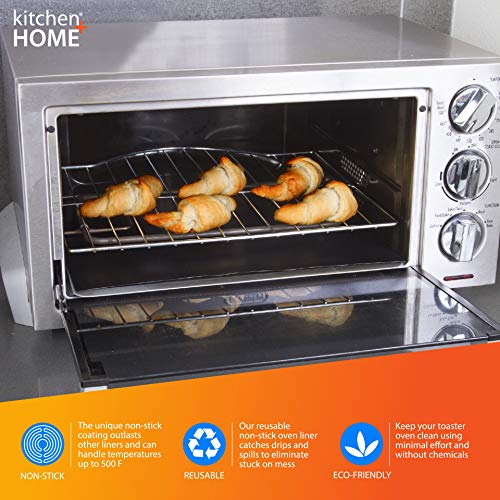
Catch Oven Spills Without Scrubbing: SkyStage 3 Pack Non-Stick Oven Liners, 17 x 25 Inch Reusable Trim-to-Fit Oven Mats
These 17 x 25 inch non-stick mats sit under your bakes and catch dripping cheese, pie filling and grease so the oven floor stays clean and a wipe or dishwasher cycle replaces scrubbing. Buy them if you roast, bake pizza or cook casseroles often and want three trimmable liners that handle heat up to 500F across your main oven, toaster oven and grill.
Pros and Cons
Pros
- BPA free and PFOA free construction keeps the liner from contaminating food during long roasts.
- Reusable design replaces disposable foil, so one mat handles months of spills.
- Generous 17 x 25 inch sheet covers most standard oven floors before trimming.
- Works across multiple appliances, including gas and electric ovens, toaster ovens and grills.
Cons
- Placement is not universal: ovens with hidden heating elements need the mat on the lowest rack, never on the oven floor, and getting this wrong risks heat damage.
- The 500F ceiling rules it out for broiling and self-clean cycles, so it has to be removed for those.
casaWare Toaster Oven Baking Pan for Small-Batch Roasting and Baking: casaWare Ultimate Series Ceramic Non-Stick, Blue Granite
casaWare
Toaster Oven Baking Pan for Small-Batch Roasting and Baking: casaWare Ultimate Series Ceramic Non-Stick, Blue Granite
This 9.75 by 6.62-inch carbon steel pan fits standard toaster ovens and full-size ovens, with a quartz-derived ceramic coating that releases baked goods and roasted vegetables without oil or scrubbing. Buy it if you cook small portions in a toaster oven and want a pan free of PFOA, PTFE, and PFAS.
$18.49 at AmazonEditors' Favorite
Color: Blue Granite Size: 9 x 6 x 0.75-Inch Dimensions: 9 x 6 x 0.75 inches Weight: 0.72973008722 pounds Product Group: Kitchen Binding: Kitchen
Shop NowSkyStage Catch Oven Spills Without Scrubbing: SkyStage 3 Pack Non-Stick Oven Liners, 17 x 25 Inch Reusable Trim-to-Fit Oven Mats
SkyStage
Catch Oven Spills Without Scrubbing: SkyStage 3 Pack Non-Stick Oven Liners, 17 x 25 Inch Reusable Trim-to-Fit Oven Mats
These 17 x 25 inch non-stick mats sit under your bakes and catch dripping cheese, pie filling and grease so the oven floor stays clean and a wipe or dishwasher cycle replaces scrubbing. Buy them if you roast, bake pizza or cook casseroles often and want three trimmable liners that handle heat up to 500F across your main oven, toaster oven and grill.
$6.99 at AmazonGreat Value
Color: Black Size: 3 Pack 17"x 25" Dimensions: 25 x 17 x 0.1 Inches Weight: 0.64 pounds Product Group: Kitchen
Shop NowWhat BPA Is and Why It’s on the Label
BPA (bisphenol A) is a chemical used to make hard, clear polycarbonate plastics and epoxy resins. Research has linked BPA to endocrine (hormone) disruption because it can mimic estrogen in the body, and its leaching increases with heat and acidity. That’s why it became notorious in water bottles and food-can linings, and why “BPA-free” became a selling point.
Here’s the key context for toaster ovens: BPA was never a major ingredient in the metal cooking parts anyway. Where it could appear is in plastic housings, control panels, handles, or any plastic component. Since heat accelerates leaching, keeping BPA out of an appliance that generates a lot of heat is sensible — but a toaster oven’s food doesn’t usually touch its plastic housing. So “BPA-free” is reassuring, not the whole safety picture. If a brand also uses BPS or BPF (chemical cousins) as replacements, “BPA-free” can be technically true while still using bisphenols.
The Chemicals That Actually Matter at Toaster-Oven Heat
Toaster ovens run hot — often 400°F and above — and that heat is what makes certain materials, not BPA, the real concern.
PFAS nonstick coatings. Many toaster-oven trays and some interiors carry nonstick coatings (PTFE, commonly known by the Teflon brand). PFAS (“forever chemicals”) are stable at normal cooking temperatures but can begin to break down and release fumes at high heat, generally cited above roughly 500°F. Empty preheating, broiling, and self-clean-style high heat are where a nonstick tray is most likely to degrade. Look for “PFOA-free and PTFE-free” if you want to avoid the whole class — an best air fryer or toaster oven with a bare stainless or uncoated tray sidesteps it.
Flame retardants. Plastic housings and electronic components can contain brominated flame retardants. These live in the housing, not in contact with food, and are a lower everyday concern than coatings that touch what you eat — but they’re part of why a mostly-metal, glass-door oven appeals to non-toxic-minded buyers.
Nonstick ceramic coatings. Marketed as a PFAS-free alternative, ceramic (sol-gel silica) coatings are generally considered safer, but they wear faster and their exact formulations vary. “Ceramic” is a reassuring word, not a guarantee — quality differs widely between brands.
Aluminum. Bare aluminum trays are common and inexpensive. Aluminum can migrate slightly into acidic foods (tomatoes, citrus) over long contact, which is why many people line trays or choose stainless. For most short toaster-oven use it’s a minor concern.
What “Non-Toxic” Actually Looks Like in a Toaster Oven
If your goal is minimizing chemical contact, the material hierarchy matters more than any single label:
- Stainless steel interior and trays — the gold standard for non-toxic use. Inert, durable, no coatings to degrade. Many stainless interiors are paired with a stainless or glass tray.
- Uncoated (bare) trays — even an aluminum tray with no nonstick coating removes the PFAS question; line it with parchment or foil if you want a barrier.
- Glass or borosilicate accessories — inert and heat-stable for baking inside the oven.
- Ceramic-coated — a reasonable PFAS-free middle ground, with the caveat that coatings wear.
- Avoid — trays with worn, scratched nonstick coatings, which are more likely to shed particles and degrade.
The single highest-impact move is swapping any nonstick tray for stainless steel or glass, since that’s the surface your food actually touches. Our best toaster oven guide flags interior materials for each pick.
Prop 65 Warnings: Why They’re Not a Red Flag on Their Own
Buyers in the US often see a California Proposition 65 warning on appliances and panic. Prop 65 requires a warning if a product can expose you to any of a long list of listed chemicals above a threshold — but the thresholds are deliberately conservative, and the warning appears on an enormous range of everyday products. A Prop 65 label on a toaster oven usually reflects trace substances in cords, solder, or components, not that the appliance is dangerous in normal use. Treat it as a prompt to check the actual materials, not as proof of harm.
Toaster Oven vs Air Fryer: Any Safety Difference?
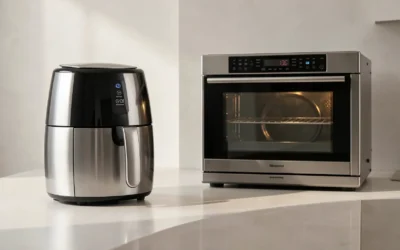
Air fryers are essentially compact convection ovens, and their nonstick baskets are the same PFAS conversation as toaster-oven trays. Neither category is inherently safer — it comes down to the coating and interior material. A stainless or uncoated model in either category beats a nonstick model in the other. If you’re choosing between them for other reasons, see our best air fryer and best toaster oven guides; the material questions are identical.
Using Any Toaster Oven More Safely
Whatever oven you own, these habits reduce chemical exposure:
1. Don’t preheat empty nonstick trays at high heat. Dry, hot nonstick is where coatings degrade fastest. 2. Skip nonstick for broiling. Use stainless, glass, or foil-lined bare metal for high-heat jobs. 3. Line trays with parchment (up to its heat rating) or foil to create a barrier between food and coating. 4. Retire scratched nonstick. Once a coating is flaking or gouged, replace the tray. 5. Ventilate. Overheated coatings and food smoke are irritants; run a hood or crack a window when broiling. 6. Let plastic parts stay cool. Keep plastic accessories and utensils away from the heating elements.
For jobs where you’d rather avoid a coated appliance entirely, a best dutch oven for bread baking (bare enameled cast iron), a best instant pot, a best blender, or a best stand mixer each handle specific tasks with inert materials.
Frequently Asked Questions
Does BPA-free mean a toaster oven is non-toxic?
No. “BPA-free” means the plastic parts don’t use bisphenol A, which is a genuine improvement, but it says nothing about the coatings, flame retardants, or interior materials that matter most at cooking heat. Some “BPA-free” products still use BPS or BPF, chemical relatives with similar concerns. For a truly low-exposure oven, look past the label at the interior and tray materials — stainless steel or uncoated surfaces are what actually keep chemicals away from your food, regardless of what the plastic housing is made of.
What is the safest toaster oven material?
Stainless steel is the safest interior and tray material: it’s inert, durable, and has no coating that can degrade or leach. Glass and borosilicate accessories are also excellent for baking inside the oven. Ceramic coatings are a reasonable PFAS-free alternative but wear over time. The materials to be cautious with are conventional nonstick (PFAS/PTFE) coatings, especially once scratched. Prioritizing a stainless or uncoated tray is the single biggest step, since that surface directly contacts your food.
Are PFAS-free and non-stick toaster ovens worth it?
For many buyers, yes. PFAS (“forever chemicals”) are stable at normal temperatures but can break down at high heat, and empty preheating or broiling on nonstick is where degradation is most likely. A PFOA- and PTFE-free oven with a stainless, ceramic, or bare tray removes that variable. The trade-off is that stainless and ceramic surfaces aren’t as effortlessly nonstick, so you may need a little oil or parchment. If you broil often or run high heat, the switch is especially worthwhile.
Is a Prop 65 warning on a toaster oven a reason to avoid it?
Not by itself. California’s Proposition 65 requires a warning whenever a product could expose you to any listed chemical above a conservative threshold, and the labels appear on a vast range of ordinary products. On appliances the warning often reflects trace substances in cords, solder, or components rather than a hazard in normal cooking use. Treat it as a nudge to check the actual food-contact materials — the interior and tray — rather than as evidence the oven is unsafe.
Are toaster ovens safer than air fryers?
Neither is inherently safer; they’re the same technology in different shapes, and both often use nonstick baskets or trays. The safety question comes down to the coating and interior material, not the category. A stainless or uncoated toaster oven beats a nonstick air fryer, and vice versa. If avoiding PFAS is your goal, choose whichever model uses inert materials. See our best toaster oven and best air fryer guides, which both note interior and tray materials.
How can I use my existing toaster oven more safely?
Swap any nonstick tray for stainless steel or glass, since that’s what touches your food. Don’t preheat nonstick empty at high heat, avoid nonstick for broiling, and line trays with parchment or foil as a barrier. Retire any tray with scratched or flaking coating. Ventilate when broiling to clear fumes, and keep plastic accessories away from the heating elements. These habits address the real exposure points far more than the “BPA-free” label ever does.
The Bottom Line
A BPA-free toaster oven is a reasonable thing to want, but the label is a starting point, not a safety certificate. BPA was never the main concern in a toaster oven; the real variables are nonstick PFAS coatings on trays, flame retardants in the housing, and how much inert stainless, glass, or ceramic touches your food. Choose an oven with a stainless or uncoated interior and tray, retire scratched nonstick, avoid empty high-heat preheating, and treat Prop 65 warnings as a prompt to check materials rather than a verdict. Do that and the appliance is safe for everyday use. For picks that flag their interior materials, see our best toaster oven, best air fryer, best dutch oven for bread baking, best blender, best instant pot, and best stand mixer guides.




Write Your Review
No reviews yet. Be the first to share your experience!