

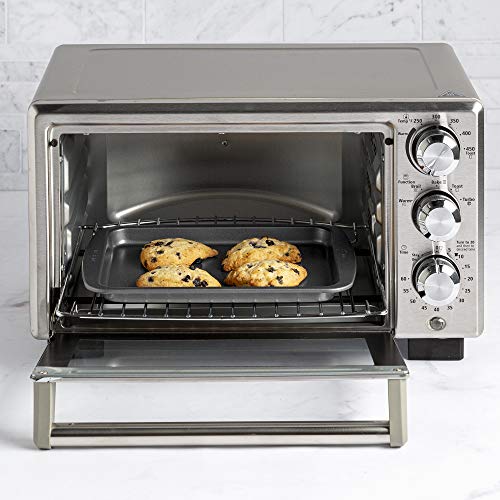
TL;DR — Yes, a toaster oven is worth it for most households, because it does the work of several appliances in one footprint. A slot toaster only toasts bread, but a toaster oven broils, bakes, roasts, reheats, and often air-fries, and it handles foods a slot toaster physically cannot: frozen pizza, a tray of vegetables, leftover casserole, open-faced sandwiches. The trade-off is counter space and a slightly slower toast cycle. If you cook for one or two, want to skip preheating the big oven for small jobs, or lack a full oven, a toaster oven earns its spot. For specific models, see our best toaster oven guide.
The HomeWhisk editorial team researches kitchen equipment by analyzing manufacturer specifications, heating-element design, and aggregated user reviews from major retailers and cooking communities such as Reddit r/Cooking and r/BuyItForLife. Our guidance reflects what the equipment actually delivers over years of use, not what marketing copy promises.
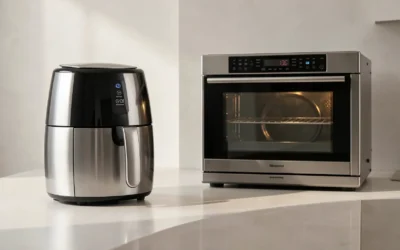
“Is a toaster oven worth it” usually comes up when someone is tired of heating a full-size oven to reheat a single slice of pizza, or when counter space is tight and a new appliance has to justify itself. The honest answer is that a toaster oven is one of the few small appliances that genuinely replaces other gear, but only if you use its range. Here is the full breakdown of what it does well, where it falls short, and who benefits. For air-fryer-capable models, see our best toaster oven and best air fryer guides.
Ecolution
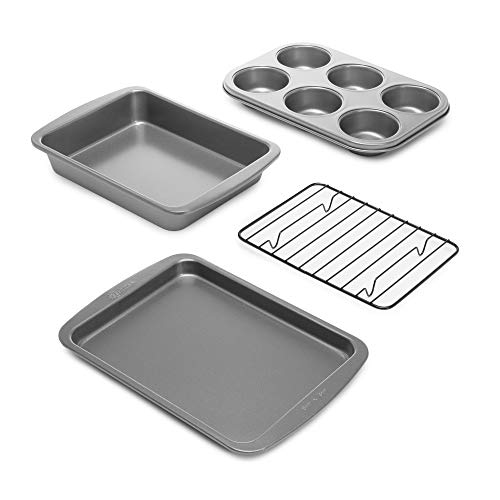
Single-Serving Toaster Oven Bakeware Set: Ecolution 4-Piece Carbon Steel Set
This Ecolution set provides compact bakeware for toaster and countertop ovens, with non-stick pieces that support easier cleanup. It suits solo cooks, couples, college students, and compact-kitchen owners who need basic pans without heating a full-size oven.
Pros and Cons
Pros
- The four-piece set covers basic baking tasks with a cake pan, cookie sheet, muffin pan, and cooling rack.
- Compact dimensions suit single servings, couples, dorms, and small kitchens.
- Carbon steel construction provides a practical base for everyday baking.
- Dishwasher-safe care makes cleanup more convenient.
Cons
- The compact pan sizes limit batch capacity compared with standard full-size bakeware.
- The product data does not provide a set weight, which may matter to buyers comparing portability.

E-far
6-Inch Square Baking Pan with Snap-On Lid for Toaster Ovens and Air Fryers | E-far Stainless Steel Brownie Pan
This 6 x 6 x 2-inch stainless steel pan bakes brownies, cornbread, and small casseroles in a toaster oven or air fryer, then seals with a snap-on see-through lid so the same dish goes straight into the fridge. Buy it if you cook for one or two people and want an uncoated pan that skips the foil-and-plastic-wrap routine after every bake.
Pros and Cons
Pros
- Uncoated stainless steel means there is no nonstick surface to scratch, flake, or wear out over time.
- The brushed finish hides scuffs and baked-on stains better than a polished pan.
- Rolled edges give you a secure grip when pulling a hot pan from a cramped toaster oven.
- One pan covers baking, roasting, storing, and transporting a dish to a potluck.
Cons
- Bare stainless steel is not nonstick, so cakes and brownies need greasing or parchment to release cleanly.
- The lid requires hand washing while the pan is dishwasher safe, so cleanup is not fully hands-off.

Buself
Protect Oven Floors from Spills with Buself 17 x 25-Inch Reusable Oven Liners
The Buself oven liner catches spills, drips, and splatters while its non-stick surface makes cleanup easier. It suits cooks with electric, gas, toaster, or convection ovens who want a reusable barrier that can be trimmed to fit.
Pros and Cons
Pros
- Heat-resistant fiberglass PTFE handles temperatures up to 500°F.
- The reusable, dishwasher-safe design simplifies cleanup after spills.
- The large liner can be trimmed for different oven and appliance sizes.
- BPA- and PFOA-free materials add useful peace of mind for kitchen use.
Cons
- The liner must be trimmed carefully for smaller ovens or appliances.
- Placement differs by oven design, since exposed heating elements require positioning below burner trays.
The Best Deals This Week*
-
Single-Serving Toaster Oven Bakeware Set
$19.19
($23.22)Save $4.03 -
Protect Oven Floors from Spills with Buself 17 x
$7.99
($9.99)Save $2.00
*Deals are selected by our commerce team
Ecolution Single-Serving Toaster Oven Bakeware Set: Ecolution 4-Piece Carbon Steel Set
Ecolution
Single-Serving Toaster Oven Bakeware Set: Ecolution 4-Piece Carbon Steel Set
This Ecolution set provides compact bakeware for toaster and countertop ovens, with non-stick pieces that support easier cleanup. It suits solo cooks, couples, college students, and compact-kitchen owners who need basic pans without heating a full-size oven.
$19.19 at AmazonEditors' Favorite
Color: Gray Size: 4-Piece Dimensions: 10.5 x 7.25 x 3.25 inches Weight: 1.85 pounds Product Group: Kitchen Binding: Kitchen
Shop NowE-far 6-Inch Square Baking Pan with Snap-On Lid for Toaster Ovens and Air Fryers | E-far Stainless Steel Brownie Pan
E-far
6-Inch Square Baking Pan with Snap-On Lid for Toaster Ovens and Air Fryers | E-far Stainless Steel Brownie Pan
This 6 x 6 x 2-inch stainless steel pan bakes brownies, cornbread, and small casseroles in a toaster oven or air fryer, then seals with a snap-on see-through lid so the same dish goes straight into the fridge. Buy it if you cook for one or two people and want an uncoated pan that skips the foil-and-plastic-wrap routine after every bake.
$11.99 at AmazonGreat Value
Color: 1 Pan + 1 Lid Size: 6" x 6" Dimensions: 6 x 6 x 2 inches Weight: 0.70988848364 pounds Product Group: Kitchen Binding: Kitchen
Shop NowBuself Protect Oven Floors from Spills with Buself 17 x 25-Inch Reusable Oven Liners
Buself
Protect Oven Floors from Spills with Buself 17 x 25-Inch Reusable Oven Liners
The Buself oven liner catches spills, drips, and splatters while its non-stick surface makes cleanup easier. It suits cooks with electric, gas, toaster, or convection ovens who want a reusable barrier that can be trimmed to fit.
$7.99 at AmazonColor: Black Size: 2 Pack 17”x25” Dimensions: 25 x 17 x 0.09842519675 Inches Weight: 0.46076612758 pounds Product Group: Kitchen Binding: Kitchen
Shop NowWhat a Toaster Oven Actually Does
A toaster oven heats with exposed radiant elements above and below the food cavity, the same principle as a full-size wall oven but scaled down. Most models add a convection fan that circulates hot air, which speeds cooking by roughly 25 to 30 percent and browns more evenly because it strips away the cool layer of air that otherwise insulates food. That convection fan is what separates a basic toaster oven from a convection model, and it is the feature that makes the appliance genuinely useful for roasting and baking rather than just toasting.
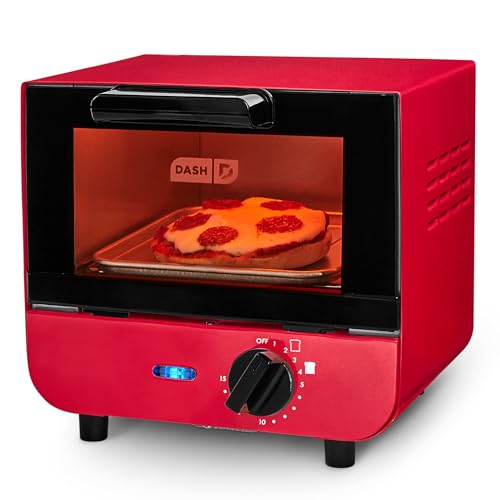
A slot toaster, by contrast, runs current through nichrome wires flanking vertical slots. It is optimized for one task — browning the flat faces of a slice — and it does that faster than any toaster oven. But a slot toaster cannot melt cheese on top of bread, cannot handle anything thicker than its slot, and struggles with irregular shapes. A toaster oven accepts anything that fits through its door.
Toaster Oven vs. Slot Toaster: The Real Trade-Off
The comparison comes down to speed versus capability. A slot toaster browns bread in two to three minutes and costs $25 to $50; a toaster oven takes four to seven minutes for the same slice because the cavity is larger and the elements cycle on a thermostat rather than running flat-out. If you only ever toast sliced bread and speed matters, a slot toaster is the better tool, and it uses less counter space.
The toaster oven wins the moment you want to do anything else: melt a cheese topping, re-crisp leftover fried chicken, broil an open-faced sandwich, warm a split roll, or toast something irregular like a croissant or thick bagel. For most two-person-and-up households, that flexibility more than offsets the extra minute per slice. Our best toaster oven guide covers models at both ends of the price range.
Size and Capacity: Measure Before You Buy
Capacity is the spec most often regretted. Toaster ovens are marketed by slice count (“four-slice,” “six-slice”), but that number is misleading because a thick slice of sourdough occupies far more space than thin sandwich bread. The spec that actually matters is the interior dimensions measured against what you cook. A 0.6-cubic-foot cavity fits a personal pizza and a quarter-sheet pan; a full 1-cubic-foot cavity fits a half-sheet pan, a nine-by-thirteen dish, and a four-pound chicken. If you want to roast vegetables alongside a protein, buy the larger cavity or you will be cooking in batches.
External footprint matters too. Most toaster ovens need an inch or two of rear clearance for ventilation, and the door swings forward and consumes counter depth when open. Owners frequently report the listed exterior dimensions understated how much room the oven claims once the door is down. Measure the spot, then add room for the open door. For compact kitchens, our best toaster oven guide includes a small-footprint pick.
Controls and Convection: What Actually Matters
User-friendly controls make a real daily difference, and aggregated reviews flag two recurring pain points: dials that are stiff or poorly indexed, and digital presets that bury a simple task behind several button presses. The most reliable layout is dedicated buttons or dials for each function (toast, bake, broil, air fry) with a clear time and temperature display. Backlit LCD or LED readouts beat hidden segment displays.
Convection is the single feature worth paying for beyond the basics, because it turns a toaster oven into a usable roaster and baker. Higher-wattage models (1,600 to 1,800 watts) recover heat faster after you open the door, which matters for back-to-back batches. Internal lighting is undervalued until you try to judge browning through a tinted glass door without it. Crumb trays that slide out the front make cleaning far easier than trays that require lifting the whole oven.
Toaster Oven vs. Air Fryer Toaster Oven
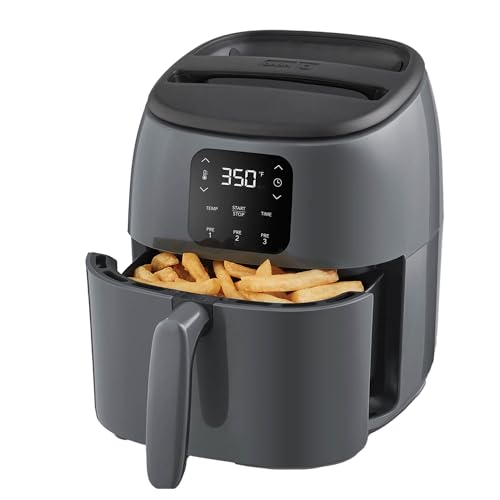
An air fryer toaster oven is a convection toaster oven with a more aggressive fan and, usually, a perforated basket that maximizes airflow around the food. The distinction is real but smaller than it sounds: any convection oven can crisp food, and the dedicated air-fry setting mainly raises fan speed and tweaks temperature. The practical benefit is faster, crisper reheating of breaded and frozen foods, plus a basket that lifts food off the tray so the bottom does not steam. If you reheat a lot of frozen fries, wings, or breaded items, the air-fryer variant is worth the premium. If your cooking is mostly toast, bake, and broil, a standard convection model is enough. Our best air fryer guide covers standalone units if counter space allows two appliances.
What a Good Toaster Oven Costs
Pricing falls into clear tiers. Basic non-convection toaster ovens run $40 to $80 and are fine for toast and simple reheating but bake unevenly. Mid-range convection models sit at $150 to $300 and are the sweet spot for most households — reliable elements, decent presets, a usable crumb tray. Premium models from $300 to $500 add faster heat recovery, better insulation, more presets, and sometimes smart features or dual temperature zones. The premium tier is worth it only if you use the oven daily as a primary cooking appliance; for occasional use, mid-range is the better value. Our best toaster oven guide breaks down which models land in each tier, and for other countertop workhorses see our best instant pot and best stand mixer guides.
The Disadvantages You Should Know
Toaster ovens are not universally worth it, and owner complaints are consistent: they consume counter space a slot toaster does not, they toast bread more slowly, convection fans can be loud in a quiet kitchen, the interior is harder to clean than a slot toaster’s crumb tray, and cheaper models brown unevenly across the rack. If you already have a full-size oven you use happily and you only toast bread, a toaster oven may sit idle — in which case it is not worth it for you. But if you keep avoiding the big oven for small jobs, or lack a full oven entirely, a toaster oven becomes one of the most-used appliances on the counter. For bread-baking specifically, many still prefer a covered vessel from our best dutch oven for bread baking guide, and for smoothies a countertop unit from our best blender guide.
Frequently Asked Questions
Is a toaster oven worth it for one person?
For a single cook, a toaster oven is often more worth it, not less. Heating a full-size wall oven to reheat one portion or bake two cookies wastes energy and warms the kitchen; a toaster oven preheats in three to five minutes and runs at a fraction of the wattage for small loads. If you cook single portions regularly and want to avoid the big oven, a compact convection toaster oven pays for itself in convenience. Our best toaster oven guide includes a compact pick suited to one-portion cooking.
What is the difference between a toaster oven and an air fryer toaster oven?
A standard toaster oven uses radiant top and bottom elements, optionally with a convection fan. An air fryer toaster oven adds a higher-speed fan and a perforated basket that lifts food so hot air hits every surface, producing crisper results on breaded and frozen foods. Functionally, the air-fryer version does everything a convection toaster oven does plus faster crisping; the trade-off is a higher price and slightly more noise. If you reheat a lot of frozen or breaded items, the air-fryer variant is worth it.
How do toaster ovens work?
Toaster ovens heat with exposed radiant elements above and below a food cavity, regulated by a thermostat that cycles them on and off to hold a set temperature. A convection fan, when included, circulates the hot air to even out hot spots and speed cooking. You set a function (toast, bake, broil), a temperature, and a time, and the oven holds that heat until the cycle ends. Broil activates only the top element at high heat for surface browning.
How much does a toaster oven cost?
Basic non-convection toaster ovens start around $40 to $80. Mid-range convection models, where most buyers land, run $150 to $300. Premium models with faster heat recovery, dual zones, or smart features cost $300 to $500. The best value for most households is a mid-range convection model; spending more only pays off if the oven becomes a daily primary appliance. See our best toaster oven guide for picks across the range.
Does a toaster oven use a lot of electricity?
No, relative to a full-size oven. A typical toaster oven draws 1,200 to 1,800 watts versus 2,500 to 5,000 watts for a wall oven, and it preheats in a fraction of the time, so a small baking or reheating job uses meaningfully less total energy. For the small and medium tasks a toaster oven is designed for, it is the more efficient choice. The dollar savings are modest; the bigger practical benefit is not heating the whole kitchen in summer.
Is a toaster oven better than a microwave for reheating?
It depends on the food. A microwave reheats liquids, stews, and pasta quickly and evenly but leaves bread, pizza, and breaded foods soggy because it heats water rather than browning the surface. A toaster oven, especially an air-fryer model, restores crispness to bread, pizza, and fried foods because its radiant heat and airflow re-crisp the exterior. For most reheating, using both — microwave for wet foods, toaster oven for crisp foods — gives the best results.
The Bottom Line
A toaster oven is worth it for most kitchens because it does the work of several appliances in one footprint: it toasts, bakes, broils, roasts, reheats, and — in air-fryer variants — crisps. It is not worth it if you only ever toast sliced bread and a slot toaster already handles that, or if your counter cannot spare the space. The decision comes down to whether you will use the range. Households that reheat leftovers, cook small batches, bake a single pizza, or want a second heat source that does not warm the whole kitchen get outsized value; households that only toast bread do not. Buy a convection model if you can, size the cavity to what you actually cook, and spend in the mid-range unless the oven will be your daily primary. For specific picks, see our best toaster oven and best air fryer guides.




Write Your Review
No reviews yet. Be the first to share your experience!