

TL;DR — Measuring cups and oven thermometer are not really rivals — they do different jobs, and most cooks end up using both. For product picks, the closest next steps are best dutch oven for bread baking, best toaster oven, and best baking sheets.
Our view is based on product specs, material trade-offs, and repeated owner feedback — not one-off kitchen anecdotes or brand claims. For baking tools, sizing, material, accuracy, cleaning, and storage usually decide whether a tool stays useful or gets replaced.

Qluisio
Oven Thermometer for Accurate Baking Temps: Qluisio Bimetallic 100°F-600°F Dial with Hook and Stand
This bimetallic dial thermometer sits inside a gas or electric oven and shows the real cavity temperature from 100°F to 600°F, exposing the hot and cold spots that ruin cakes and roasts. Buy it if your oven runs off its set point and you want a battery-free reading you can check through the door glass.
Pros and Cons
Pros
- Wide 100°F to 600°F range covers low-and-slow smoking through high-heat pizza and roasting.
- Analog dial with color zones is readable at a glance without opening the oven door.
- No batteries or electronics to fail under sustained heat.
- Two mounting options let one unit move between the oven, grill, and air fryer.
Cons
- Analog bimetallic dials read in increments rather than exact degrees, so it is better for spotting drift than for precise candy or bread work.
- It needs several minutes to stabilize after a temperature change, so quick preheat checks can read low.
Taylor
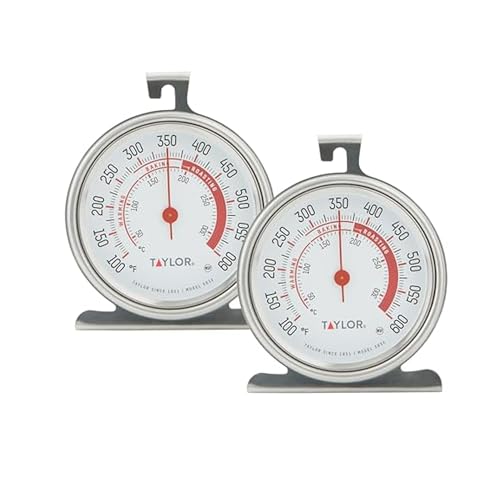
Oven Temperature Accuracy for Baking and Grilling: Taylor 5932 Large Dial Oven Thermometer, 2 Pack, 3.25 Inch Stainless Steel
The Taylor 5932 hangs or stands inside your oven, BBQ, or grill and reads 100°F to 600°F on a 3-1/4 inch dial you can check through the door glass without breaking heat. Buy it if your oven runs hot or cold and your bakes come out inconsistent, and the two-pack means you can leave one in the oven and one on the grill.
Pros and Cons
Pros
- The 3-1/4 inch dial is significantly larger than standard oven thermometers, making it legible from across the kitchen.
- Stainless steel construction and a glass lens hold up to repeated high-heat exposure without warping or clouding quickly.
- The two-pack covers a second oven, a grill, or a spare without a second purchase.
- No batteries or setup required, so it works the moment you put it in the oven.
Cons
- The 600°F ceiling falls short for pizza ovens and high-heat searing setups that run past that mark.
- As an analog gauge, it shows only the current reading with no alarms, logging, or remote monitoring.

Dwuww
Oven Temperature Monitoring Made Simple: Dwuww Stainless Steel Oven Thermometer, 100-600°F Large Dial
This stainless steel dial thermometer sits inside your oven, grill, or smoker and shows real internal temperature from 100°F to 600°F, exposing the gap between what the dial says and what the cavity actually holds. Buy it if you bake bread, roast meat, or run a smoker and need confirmation that your appliance holds the temperature you set.
Pros and Cons
Pros
- Wide 100°F to 600°F range fits both smoking and high-temperature roasting.
- Oversized dial stays legible from outside a closed oven door.
- Stainless steel construction is built for repeated exposure to high cooking heat.
- Works across ovens, grills, smokers, and fryers rather than one appliance.
Cons
- Analog dials typically need a minute or two to settle, so this is not a true instant-read tool for checking meat doneness.
- The 100°F floor means it will not track low proofing or dehydrator temperatures.
Qluisio Oven Thermometer for Accurate Baking Temps: Qluisio Bimetallic 100°F-600°F Dial with Hook and Stand
Qluisio
Oven Thermometer for Accurate Baking Temps: Qluisio Bimetallic 100°F-600°F Dial with Hook and Stand
This bimetallic dial thermometer sits inside a gas or electric oven and shows the real cavity temperature from 100°F to 600°F, exposing the hot and cold spots that ruin cakes and roasts. Buy it if your oven runs off its set point and you want a battery-free reading you can check through the door glass.
$5.58 at AmazonEditors' Favorite
Color: Blue,Red Product Group: Kitchen
Shop NowTaylor Oven Temperature Accuracy for Baking and Grilling: Taylor 5932 Large Dial Oven Thermometer, 2 Pack, 3.25 Inch Stainless Steel
Taylor
Oven Temperature Accuracy for Baking and Grilling: Taylor 5932 Large Dial Oven Thermometer, 2 Pack, 3.25 Inch Stainless Steel
The Taylor 5932 hangs or stands inside your oven, BBQ, or grill and reads 100°F to 600°F on a 3-1/4 inch dial you can check through the door glass without breaking heat. Buy it if your oven runs hot or cold and your bakes come out inconsistent, and the two-pack means you can leave one in the oven and one on the grill.
$11.99 at AmazonGreat Value
Size: Pack of 2 Product Group: Kitchen Binding: Tools & Home Improvement
Shop NowDwuww Oven Temperature Monitoring Made Simple: Dwuww Stainless Steel Oven Thermometer, 100-600°F Large Dial
Dwuww
Oven Temperature Monitoring Made Simple: Dwuww Stainless Steel Oven Thermometer, 100-600°F Large Dial
This stainless steel dial thermometer sits inside your oven, grill, or smoker and shows real internal temperature from 100°F to 600°F, exposing the gap between what the dial says and what the cavity actually holds. Buy it if you bake bread, roast meat, or run a smoker and need confirmation that your appliance holds the temperature you set.
$5.49 at AmazonColor: Silver Product Group: BISS
Shop NowMeasuring cups and Oven thermometer: Do You Need Both?
This is not really a versus question. A measuring cups and a oven thermometer do different jobs — the measuring cups does the actual work, while the oven thermometer supports it. Most cooks who care about results end up using both rather than choosing one. For product picks, compare best dutch oven for bread baking, best toaster oven, and best baking sheets.
How They Work Together
Think of the oven thermometer as part of keeping the measuring cups performing the way it should. Used together, they make the whole task easier and more consistent; skipping the oven thermometer usually means the measuring cups underperforms or wears faster. The two are complements, not competitors.
When You Actually Need the Oven thermometer
You do not always need the oven thermometer on day one, but the more often you use the measuring cups, the more it pays off. If you use the measuring cups regularly, adding the oven thermometer is a small cost for a real improvement in warp resistance. If you are shopping, our best dutch oven for bread baking and best toaster oven guides are the fastest way in.
Bottom Line
If your budget forces a choice, start with the measuring cups — it is the tool that does the job. Add the oven thermometer soon after; together they beat either one alone.

Related Product Guides
If this topic is part of a buying decision, these are the HomeWhisk guides most closely tied to it:
- best dutch oven for bread baking
- best toaster oven
- best baking sheets
- best kitchen scale
- best meat thermometer
- best mixing bowls
- best cutting board
Frequently Asked Questions
Do I need both a measuring cups and a oven thermometer?
They serve different purposes, so most cooks use both. The measuring cups does the work; the oven thermometer supports it. If budget forces a choice, start with the measuring cups. See best dutch oven for bread baking and best toaster oven for options.
Can a oven thermometer replace a measuring cups?
No — they are complements, not substitutes. A oven thermometer does not do the measuring cups’s job; it makes the measuring cups work better or last longer.
Who is this most useful for?
Mainly high-volume holiday bakers, and weekend bakers. If that is you, treat nesting or storage shape as a requirement rather than a nice-to-have.
How do I keep it in good shape?
Build hand-washing to protect the finish, and lining with parchment into normal cleanup. Light, consistent care prevents warping in a hot oven far better than occasional deep effort.
Is a premium baking tool worth it?
Only if you use it enough to notice better control, durability, or cleanup regularly. Occasional users are well served by a mid-range pick like those in best baking sheets.
The Bottom Line
The simplest takeaway: buy for your real routine, not the most impressive feature list. Match the measuring cups to your cooking frequency, cleanup habits, and storage, then use best dutch oven for bread baking, best toaster oven, and best baking sheets to compare actual products.



Write Your Review
No reviews yet. Be the first to share your experience!