

TL;DR — A mixing bowl “won’t heat” almost always because of its material and the heat source. Stainless steel bowls don’t heat in a microwave because metal reflects microwaves instead of absorbing them — that’s physics, not a fault. Glass and ceramic bowls heat in a microwave but slowly, since they mostly warm from the food inside. Over a double boiler, metal transfers heat fast while glass is a poor conductor and lags. Matching bowl material to the heating method fixes almost every case. For picks across materials, see our best mixing bowls guide.
The HomeWhisk editorial team researches kitchen equipment by analyzing manufacturer specifications, material properties, and aggregated user reviews from major retailers and communities like Reddit r/Baking and r/Cooking. This guide explains the physics behind why different bowls heat differently so you can pick the right one for the job.
If your mixing bowl isn’t heating, the bowl usually isn’t broken — it’s a mismatch between the material and how you’re trying to heat it. Metal, glass, and plastic each interact with heat in completely different ways, and a microwave behaves nothing like a stovetop double boiler. Once you understand which material does what, the confusion clears up fast. If you find you’re missing the right bowl for a task, our best mixing bowls guide covers a range of materials.
The Core Issue: Bowls Don’t All Heat the Same Way
There are two common scenarios behind “my bowl isn’t heating”:
- In the microwave — you put a bowl of food in, and the bowl (or the food) stays cold.
- On the stove, over simmering water (a double boiler / bain-marie for melting chocolate or making custard) — the bowl warms slowly or unevenly.
The answer is different for each, because a microwave heats by exciting water molecules while a double boiler heats by conduction from steam and hot water. Material choice determines the outcome in both. Let’s take them in turn.
Why Stainless Steel Bowls Don’t Heat in the Microwave
This is the single most common version of the question, and it’s not a defect. Microwaves cook by emitting electromagnetic waves that penetrate food and make water, fat, and sugar molecules vibrate, generating heat from the inside. Metal reflects those microwaves rather than letting them pass through.
So when you put a stainless steel bowl in a microwave:
- The microwaves bounce off the metal and never reach the food inside the bowl, so nothing heats.
- Worse, the reflected energy can concentrate at edges and points, causing arcing — those alarming sparks — which can damage the microwave’s interior or magnetron.
That’s why a metal bowl “won’t heat” in a microwave: it’s physically shielding the food. It’s also why you should never microwave a stainless steel bowl at all. If you need to warm or melt something in the microwave, use a microwave-safe glass or ceramic bowl instead.
Stainless steel’s reflectivity is a feature elsewhere — it makes steel bowls excellent for chilling (they cool fast) and for whipping — just not for microwaving. Our best mixing bowls guide notes which sets include microwave-safe glass alongside steel.
Why Glass and Ceramic Bowls Heat Slowly in the Microwave
Swap in a glass or ceramic bowl and microwaves pass right through the bowl to reach the food — so the food heats. But people often notice the bowl itself stays relatively cool at first, then gets hot. That’s expected:
- Microwaves target the water in the food, not the glass. The glass has little water, so it doesn’t absorb much microwave energy directly.
- The bowl heats mostly by conduction from the hot food touching it. That’s why a bowl of soup ends up with hot glass but an empty glass bowl barely warms.
If you’re microwaving a small amount of food or something with low water content (like melting butter or chocolate), heating feels slow because there’s little water to excite. Stir and use short bursts. If the bowl gets dangerously hot to handle, that’s just heat conducted from very hot food — use a towel.
Note that not all glass and ceramic is microwave-safe: pieces with metallic paint, gold or silver trim, or certain dense stoneware can arc or overheat. Check for a microwave-safe marking on the base.
Double Boilers: Why Your Bowl Melts Chocolate Slowly
The other “not heating” scenario is stovetop gentle heating — melting chocolate or making a custard, hollandaise, or lemon curd over a pot of simmering water. Here, the bowl sits above (not touching) barely-simmering water, and steam plus radiant heat warm it. Material matters a lot:
- Stainless steel bowls conduct heat well, so they warm quickly and transfer that heat evenly to the chocolate — the standard choice for a double boiler.
- Glass bowls are poor heat conductors. They heat slowly and hold heat once hot, which can feel like “the bowl isn’t heating” early on, then risk overheating delicate chocolate later because glass retains warmth even off the heat.
- The bowl must sit snugly on the pot so steam is trapped and does the work. A bowl too small drops into the water; a bowl too big lets steam escape and heats poorly.
If your double boiler bowl isn’t heating, check three things: the water should be simmering (not stone cold, not a hard boil), the bowl should form a good seal over the pot, and the bowl shouldn’t touch the water directly (direct contact overheats and seizes chocolate). A metal bowl responds fastest; if you’re using glass, be patient and expect more heat retention. For the surrounding gear, our best mixing bowls guide covers bowls sized to nest over standard saucepans.
Which Bowl Material for Which Job
A quick map of material to heating method:
- Microwave reheating or melting → glass or microwave-safe ceramic. Never metal.
- Double boiler / melting over water → stainless steel for speed and control; glass works but lags and retains heat.
- Chilling doughs, whipping cream, mixing → stainless steel (cools fast, lightweight, durable).
- Oven use (rare for mixing bowls, e.g. a bowl doubling as a baking vessel) → oven-safe glass or ceramic only; check the rating.
Most bakers keep both stainless and glass bowls precisely because no single material does everything. Steel handles chilling, whipping, and double boilers; glass handles the microwave and anything you want to watch while mixing. If you’re building a set, pair the bowls with a reliable best kitchen scale for accurate baking, prep on a good best cutting board, and store finished batters in a set of best food storage containers. When a recipe calls for oven work rather than a bowl, reach for the right vessel — our best baking sheets guide covers pans that take direct heat the way a mixing bowl never should.
Frequently Asked Questions
Can you put a stainless steel bowl in the microwave?
No. Metal reflects microwaves rather than absorbing them, so the food inside never heats, and the reflected energy can cause sparking (arcing) that damages the microwave. This is exactly why a steel bowl “won’t heat” in the microwave — it’s shielding the contents. Use microwave-safe glass or ceramic for anything you want to warm or melt in the microwave, and keep stainless bowls for mixing, whipping, chilling, and stovetop double boilers, where their heat conductivity is an advantage rather than a problem.
Why does my glass bowl heat up but the food stays cold?
Usually the reverse is true — microwaves heat the water in food, not the glass, so the food should warm while the glass stays cooler at first. If the food genuinely isn’t heating, it may be very dense or frozen (microwaves penetrate only an inch or two, so thick portions heat unevenly), or the microwave power is low. Stir midway, use short bursts, and cover the bowl to trap steam. If the glass gets hot while food stays cold, that heat is conducting from hot spots in the food, so stir to even it out.
Is stainless steel or glass better for a double boiler?
Stainless steel is generally better for melting chocolate and making delicate sauces because it conducts heat quickly and evenly, giving you responsive control. Glass conducts heat poorly, so it warms slowly and then retains heat even after you remove it from the pot, which can push chocolate past its ideal temperature and cause seizing. Steel also lets you move the bowl on and off the heat with immediate effect. Use a bowl that seals snugly over the saucepan so trapped steam does the heating, and keep the water at a bare simmer.
Can you put boiling water in a glass mixing bowl?
Only if it’s tempered or borosilicate glass rated for heat, and even then pour carefully. Thin or non-tempered glass can crack from thermal shock when hot water hits cold glass. Warm the bowl first with hot tap water, then add boiling water gradually. Stainless steel handles boiling water without any risk of shattering, so it’s the safer choice for tasks like blooming gelatin or tempering. Check the base of a glass bowl for a heat-safe or oven-safe marking before exposing it to boiling water.
Why won’t my chocolate melt in the bowl over water?
Several possibilities. The water may not be hot enough — it should be gently simmering, producing steady steam. The bowl may not seal over the pot, letting steam escape so little heat reaches the chocolate. If you’re using glass, it simply heats slowly, so give it time. Also make sure the bowl bottom isn’t touching the water, which overheats chocolate and makes it seize into a grainy clump. Stir frequently, and if a drop of water gets into the chocolate it can seize — keep everything dry.
Do metal mixing bowls work on an induction or electric stovetop directly?
Mixing bowls generally aren’t meant to be placed directly on a burner — they’re prep bowls, not cookware, and lack the flat, thick bases needed for direct-heat cooking. On induction specifically, only a ferromagnetic (magnetic) steel bowl would heat at all, and even then the thin base can scorch contents and warp. For any direct-heat task, use an actual saucepan or a proper double-boiler setup with the bowl suspended over water. Keep mixing bowls for mixing, chilling, and gentle double-boiler duty.
The Bottom Line
Your mixing bowl isn’t heating because of a material-and-method mismatch, not a defect. Stainless steel reflects microwaves, so it never heats food in the microwave and can spark — use glass or ceramic there instead. Glass and ceramic heat food in the microwave but warm mainly from the food’s own heat, so they feel slow with low-water items. Over a double boiler, metal conducts heat fast and gives control while glass lags and then over-retains heat. The practical answer is to keep both materials: stainless for chilling, whipping, and double boilers; glass for the microwave. For picks across every material, see our best mixing bowls, best kitchen scale, and best food storage containers guides.

COOK WITH COLOR
Food Prep and Storage Mixing Bowls with Lids, COOK WITH COLOR Sage Embossed Set
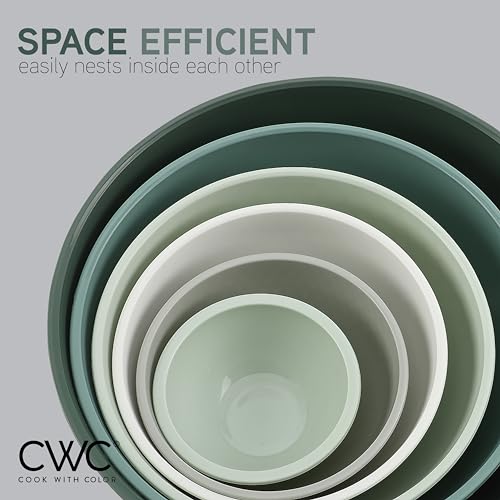
This COOK WITH COLOR set handles food prep, serving, and storage while nesting bowls and tight-fitting lids reduce cabinet clutter and simplify transport. It suits home cooks who want microwave-safe, freezer-safe plastic bowls for fruit, salads, snacks, and leftovers.
Pros and Cons
Pros
- The set combines six plastic bowls with six lids for prep, serving, storage, and transport.
- BPA-free polypropylene provides a food-safe material for regular kitchen use.
- Microwave, freezer, and top-rack dishwasher compatibility adds practical versatility.
- Nesting storage and a sage embossed finish keep the set organized and visually coordinated.
Cons
- The bowls are plastic rather than glass or metal, which may not suit buyers seeking heavier cookware.
- The product data lists five capacities even though the set includes six bowls, so size selection is not fully clear.

Nuogo
Extra Large 8 Qt Stainless Steel Mixing Bowls for Big Batch Baking and Holiday Meal Prep (Set of 4)
This set of four 13.4-inch stainless steel bowls gives you 8 quarts of mixing space per bowl, enough for large bread dough batches, family-sized salads, and holiday fillings without spills. Best for home bakers and cooks who regularly prepare food for gatherings or need bowls that won't slide during heavy mixing.
Pros and Cons
Pros
- 8-quart capacity handles large recipes that smaller bowls can't accommodate, confirmed by buyers using them for bread dough and batch cooking.
- Heavy gauge stainless steel stays put during mixing without needing a non-slip base, according to reviewer feedback.
- Mirror finish resists staining from tomato sauces and turmeric-based marinades better than matte stainless steel.
Cons
- Some units arrive with sharp unpolished edges in hidden spots like the rim underside, requiring careful inspection before first use.
- 13.4-inch diameter may not fit inside standard refrigerator shelves if you need to chill mixed ingredients overnight.

COOK WITH COLOR
Mixing and Baking Prep: COOK WITH COLOR 6-Piece Nesting Plastic Bowl Set with Pour Spouts
This six-piece plastic mixing bowl set supports cooking and baking with non-slip bases, handles, pour spouts, and interior measurement markings, while nesting saves storage space. It suits home cooks who want easy measuring, controlled pouring, and top-rack dishwasher cleanup in one organized set.
Pros and Cons
Pros
- Six bowls provide multiple sizes for mixing, measuring, and ingredient preparation.
- Handles, pour spouts, and non-slip construction improve control during everyday use.
- Interior measurement markings add convenient measuring directly inside each bowl.
- The plastic set is freezer safe and top-rack dishwasher safe for practical kitchen use.
Cons
- The bowls are specified for top-rack dishwasher cleaning, not unrestricted dishwasher use.
- Exact bowl dimensions and individual weights are not provided in the product data.

Cuisinart
3-Piece Stainless Steel Nesting Mixing Bowl Set for Baking, Cooking & Food Prep (1.5, 3, 5 Qt)
This three-bowl stainless steel set handles everyday mixing, prepping, and storage with dishwasher-safe cleanup and refrigerator-freezer compatibility. Home bakers and meal preppers who need durable, space-saving bowls that go from counter to fridge without transferring containers should consider this set.
Pros and Cons
Pros
- High-quality stainless steel withstands daily use without denting or rusting, maintaining a clean appearance over time.
- Three versatile sizes cover most home cooking and baking tasks, from whisking eggs to tossing large salads.
- Dishwasher-safe construction and smooth surface make cleanup faster than textured or coated bowls.
Cons
- Lacks non-slip bases or handles, so bowls may slide on smooth countertops during vigorous mixing.
- No lids included, requiring separate plastic wrap or covers for refrigerator storage.
COOK WITH COLOR Food Prep and Storage Mixing Bowls with Lids, COOK WITH COLOR Sage Embossed Set
COOK WITH COLOR
Food Prep and Storage Mixing Bowls with Lids, COOK WITH COLOR Sage Embossed Set
This COOK WITH COLOR set handles food prep, serving, and storage while nesting bowls and tight-fitting lids reduce cabinet clutter and simplify transport. It suits home cooks who want microwave-safe, freezer-safe plastic bowls for fruit, salads, snacks, and leftovers.
Check PriceEditors' Favorite
Color: Sage Embossed Size: 12 Pc. Dimensions: 12 x 12 x 5.5 inches Product Group: Kitchen Binding: Kitchen
Shop NowNuogo Extra Large 8 Qt Stainless Steel Mixing Bowls for Big Batch Baking and Holiday Meal Prep (Set of 4)
Nuogo
Extra Large 8 Qt Stainless Steel Mixing Bowls for Big Batch Baking and Holiday Meal Prep (Set of 4)
This set of four 13.4-inch stainless steel bowls gives you 8 quarts of mixing space per bowl, enough for large bread dough batches, family-sized salads, and holiday fillings without spills. Best for home bakers and cooks who regularly prepare food for gatherings or need bowls that won't slide during heavy mixing.
$37.99 at AmazonGreat Value
Number of Pieces: 4 Brand Name: Nuogo Specific Uses For Product: Salad, Pasta, Dinner, Pasta, Soup, Noodle, Dessert, Cereal, Snack, Ice Cream, Rice, Beans, Chili, Stews, Risotto, Casserole, Appetizers Set Name: 4 Manufacturer: Nuogo Model Number: AO-Nuogo-4638 Manufacturer Part Number: AO-Nuogo-4638 Item Weight: 3.45 Pounds Best Sellers Rank: #21,541 in Kitchen & Dining (See Top 100 in Kitchen & Dining) #111 in Mixing Bowls ASIN: B0D7LN13MC Customer Reviews: 4.2 4.2 out of 5 stars (242) 4.2 out of 5 stars Other Special Features of the Product: Dishwasher Safe, Durable Color: Silver Product Style: Classic Shape: Round Pattern: Solid Bowl Material: Stainless Steel Product Care Instructions: Dishwasher Safe Is the item dishwasher safe?: Yes Is the item microwaveable?: No Material Type: Stainless Steel Capacity: 8 Quarts Item Dimensions W x H: 12.99"W x 4.13"H Size: 13 Inch (8 Qt) Brand: Nuogo Style: Classic
Shop NowCOOK WITH COLOR Mixing and Baking Prep: COOK WITH COLOR 6-Piece Nesting Plastic Bowl Set with Pour Spouts
COOK WITH COLOR
Mixing and Baking Prep: COOK WITH COLOR 6-Piece Nesting Plastic Bowl Set with Pour Spouts
This six-piece plastic mixing bowl set supports cooking and baking with non-slip bases, handles, pour spouts, and interior measurement markings, while nesting saves storage space. It suits home cooks who want easy measuring, controlled pouring, and top-rack dishwasher cleanup in one organized set.
Check PriceColor: Mint Size: 6 Piece Non-Slip Dimensions: 11 x 11 x 7.28 inches Product Group: Kitchen Binding: Kitchen
Shop NowCuisinart 3-Piece Stainless Steel Nesting Mixing Bowl Set for Baking, Cooking & Food Prep (1.5, 3, 5 Qt)
Cuisinart
3-Piece Stainless Steel Nesting Mixing Bowl Set for Baking, Cooking & Food Prep (1.5, 3, 5 Qt)
This three-bowl stainless steel set handles everyday mixing, prepping, and storage with dishwasher-safe cleanup and refrigerator-freezer compatibility. Home bakers and meal preppers who need durable, space-saving bowls that go from counter to fridge without transferring containers should consider this set.
$39.99 at AmazonNumber of Pieces: 6 Brand Name: Cuisinart Specific Uses For Product: 5 Quart Bowl Lid, Baking, Cooking, Food Prep, Serving Included Components: 1.5 Quart Bowl, 3 Quart Bowl, 5 Quart Bowl, Lid Global Trade Identification Number: 00086279039842, 10086279039849 Recommended Uses For Product: Baking, Cooking, Food Prep Unit Count: 1.0 Count Set Name: 3-Piece Nesting Bowl Set Manufacturer: Cuisinart UPC: 086279274229 086279039842 Model Number: CTG-00-SMB Manufacturer Part Number: CTG-00-SMB Item Type Name: 3-Piece Nesting Bowl Set Item Weight: 3.9 Pounds Best Sellers Rank: #2,308 in Kitchen & Dining (See Top 100 in Kitchen & Dining) #17 in Mixing Bowls ASIN: B004YZEO9K Color: Stainless Steel Product Style: 3-Piece Nesting Bowl Set Shape: Bowl Theme: Kitchen and Dining"}"/oriquez"Kitchen and Dining Pattern: Solid Occasion: kitchen Bowl Material: Stainless Steel Product Care Instructions: Dishwasher Safe Is the item dishwasher safe?: Yes Is the item microwaveable?: No Material Type: Stainless Steel Capacity: 5 Quarts Item Dimensions W x H: 10.5"W x 10.5"H Size: 3-Piece Nesting Bowl Set Other Special Features of the Product: Dishwasher Safe, Freezer Safe, Stackable, Stainless Steel Construction Brand: Cuisinart Style: 3-Piece Nesting Bowl Set
Shop Now




Write Your Review
No reviews yet. Be the first to share your experience!