

TL;DR — VG10 is a single Japanese stainless steel made by Takefu Special Steel, not a family of grades, so “the best VG10” really means the best VG10 knife — one with good heat treatment (around 60–61 HRC), a thin blade, and a maker known for consistent grinding. VG10 hits a genuine sweet spot: it takes a keen edge, holds it well, and resists rust thanks to about 1% carbon and 15% chromium, while staying reasonable to sharpen. It’s the classic core steel of Damascus-clad Japanese chef knives. For picks, see our best japanese chef knife guide.
The HomeWhisk editorial team researches kitchen equipment by analyzing manufacturer specifications, steel metallurgy, and aggregated reviews from major retailers and knife communities like Reddit’s r/chefknives. VG10 is one of the most common questions among people buying their first serious Japanese knife, partly because the name gets misunderstood. This guide explains what VG10 actually is, what makes one VG10 knife better than another, and how it compares to the steels people cross-shop it against.
What VG10 Steel Actually Is
The first thing to clear up: there is no such thing as “VG10 grades” to choose between. VG10 (“V-Gold No. 10”) is a specific proprietary stainless steel produced by Takefu Special Steel in Japan. Every knife labeled VG10 uses the same base alloy. So the search for “the best VG10 steel” is really the search for the best VG10 knife — and that depends on how the maker treats and grinds that steel.
VG10’s composition explains its reputation. Its rough recipe is about 1% carbon (for hardness and edge retention), 15% chromium (for stainless corrosion resistance), plus molybdenum, vanadium, and cobalt. The vanadium forms hard carbides that refine the grain and help the steel take a very fine edge; the cobalt adds strength; the high chromium is why VG10 resists rust far better than traditional carbon steels. That balance — hard enough to hold an edge, stainless enough to be low-maintenance, fine-grained enough to get scary sharp — is why VG10 became the default premium stainless for Japanese kitchen knives.
It’s typically hardened to around 60–61 HRC on the Rockwell scale, noticeably harder than a Western stainless chef knife (usually 56–58 HRC). For anyone stepping up from a big-box knife, that hardness is a large part of the “wow” difference. Our best japanese chef knife guide covers VG10 knives alongside other premium steels.
What Makes One VG10 Knife Better Than Another
If the steel is identical, why do VG10 knives vary so much in performance and price? Three factors:
- Heat treatment. How a maker heats, quenches, and tempers the steel determines its final hardness, toughness, and edge stability. A well-heat-treated VG10 blade at 60–61 HRC holds an edge and resists chipping; a sloppy one can be brittle or soft. This is the biggest hidden differentiator.
- Blade geometry and grind. VG10’s thinness is a huge part of why it cuts so well. A blade ground thin behind the edge glides through food; a thick, poorly ground blade wedges no matter how good the steel. Two VG10 knives at the same hardness can feel completely different because of geometry.
- Fit, finish, and cladding. VG10 is often used as the hard core steel in a laminated (san-mai) blade, clad in softer stainless — the wavy “Damascus” pattern many VG10 knives show is this decorative cladding, not the cutting steel itself. The cladding protects the core and adds visual appeal but doesn’t change how the edge performs.
So the “best VG10” is a knife from a maker with consistent heat treatment and a thin, well-executed grind — not a special variant of the steel. Our best chef knife and best chef knife under 100 guides flag which knives get this right at each price.
VG10’s Real Strengths and Weaknesses
VG10 earned its popularity, but it’s not magic. An honest accounting:
Strengths:
- Excellent edge-taking. The fine grain lets it be sharpened to a very keen, thin edge.
- Good edge retention. At 60–61 HRC it stays sharp noticeably longer than softer Western stainless.
- Strong corrosion resistance. The 15% chromium makes it genuinely stainless and low-maintenance — no forced patina or obsessive drying required.
- Reasonable to sharpen. Harder than Western steel but still very manageable on whetstones, unlike some ultra-hard powder steels.
Weaknesses:
- Can chip if abused. Its hardness makes the thin edge somewhat brittle; twisting motions, bones, frozen food, or glass cutting boards can chip it.
- Not the ultimate in edge retention anymore. Newer powder-metallurgy steels hold an edge longer.
- “Reactive” only in the sense of being harder to baby-proof against chipping, not rust.
For a home cook who wants a sharp, low-maintenance knife that’s still easy to keep up, VG10 is close to ideal. Treat it with a bit of care — a wood or poly cutting board, no bones, hand washing — and it rewards you for years. Our best chef knife guide explains this care in context.
How VG10 Compares to Other Steels
People almost always cross-shop VG10 against a few specific steels. Here’s the honest breakdown:
- VG10 vs. stainless steel (generic Western, e.g. X50CrMoV15): VG10 is harder, holds an edge much longer, and takes a finer edge. Western stainless is softer, tougher (more chip-resistant), and even easier to sharpen but dulls faster. VG10 is the clear upgrade for cutting performance.
- VG10 vs. 440C: Both are stainless, but VG10’s finer grain and vanadium content let it take a keener edge and hold it a bit better. 440C is tough and rust-resistant but generally considered a step below VG10 for fine kitchen work.
- VG10 vs. D2: D2 is a semi-stainless tool steel that holds an edge very well but is harder to sharpen, less corrosion-resistant, and coarser-grained (so a slightly less refined edge). VG10 is easier to live with and fully stainless; D2 edges out on raw retention.
- VG10 vs. MagnaCut: MagnaCut is a modern powder steel offering better edge retention, toughness, AND corrosion resistance simultaneously — genuinely a step up on paper. It costs more and is harder to find in kitchen knives. VG10 remains the better value and is easier to sharpen.
- VG10 vs. “Damascus steel”: This is a false comparison. Damascus refers to the layered, patterned cladding, not a cutting steel — most “Damascus” kitchen knives are VG10 (or similar) at the core with decorative layers around it. You’re often comparing VG10 to VG10.
The takeaway: VG10 sits in a proven middle ground — better cutting than Western stainless, easier to maintain than exotic tool steels, and better value than the newest powder steels. For most home cooks it’s more than enough knife. Explore the range in our best japanese chef knife and best chef knife set guides.
Is VG10 Right for You?
VG10 is an excellent choice if you want a noticeably sharper, longer-lasting edge than a typical Western knife without the maintenance of reactive carbon steel or the sharpening difficulty of ultra-hard powder steels. It suits the home cook who’s ready to step up, will use a proper cutting board, and will hand wash and dry the knife.
It’s a weaker choice if you’re rough on knives (hacking bones, prying, using glass boards), in which case a tougher, softer Western stainless resists chipping better. And if you want the absolute longest edge life and don’t mind harder sharpening or higher cost, a modern powder steel goes further. But for the price-to-performance ratio most buyers care about, VG10 is one of the safest recommendations in kitchen cutlery. Pair a VG10 chef knife with a serrated best bread knife and you’ve covered most kitchen tasks; our best knife sets guide covers full lineups.
Frequently Asked Questions
Is VG10 steel good for a chef knife?
Yes, VG10 is one of the best all-round stainless steels for a chef knife. Hardened to around 60–61 HRC, it takes a very keen edge, holds it well, and resists rust thanks to about 15% chromium, while remaining reasonable to sharpen on whetstones. It’s the classic core steel of premium Japanese chef knives. The main caution is that its hard, thin edge can chip if abused with bones, frozen food, or glass boards. For most home cooks it’s an excellent, low-maintenance upgrade. See our best chef knife guide.
Is VG10 steel easy to sharpen?
Reasonably, yes — easier than most people expect for a steel this hard. At 60–61 HRC it’s harder than Western stainless, so it takes a little more effort, but its fine grain means it sharpens to a very keen edge and responds well to whetstones. It’s far more approachable than ultra-hard powder steels like S90V or even D2. A basic whetstone setup and a bit of practice will keep a VG10 knife sharp. Avoid pull-through sharpeners, which are too aggressive for a fine Japanese edge.
What steel is better than VG10?
“Better” depends on the priority. Modern powder-metallurgy steels like MagnaCut, SG2/R2, or S35VN offer longer edge retention and, in MagnaCut’s case, better toughness and corrosion resistance too — but they cost more and can be harder to sharpen. For raw edge holding, these beat VG10. For the balance of sharpness, ease of sharpening, rust resistance, and price, however, VG10 is still hard to beat and remains one of the best value choices in kitchen knives. See our best japanese chef knife guide.
Is VG10 the same as Damascus steel?
No, and this is the most common misconception. Damascus refers to the layered, patterned cladding wrapped around a knife’s core — it’s decorative and structural, not the cutting steel. Most “Damascus” kitchen knives use VG10 (or a similar steel) as the hard core, clad in dozens of layers of softer stainless that create the wavy pattern. So a “VG10 Damascus” knife is a VG10-core blade with Damascus cladding. The pattern doesn’t improve cutting performance; the core steel and geometry do.
VG10 vs. stainless steel — what’s the real difference?
VG10 is a stainless steel, but a premium one. Compared to generic Western stainless (like the X50CrMoV15 in most German knives), VG10 is harder (60–61 vs. 56–58 HRC), so it takes a finer edge and holds it significantly longer. The trade-off is that Western stainless is tougher and more forgiving of abuse, and marginally easier to sharpen. For cutting performance and edge life, VG10 is the clear step up; for durability under rough use, softer Western stainless has an edge.
Can VG10 knives rust?
VG10 is genuinely stainless and highly rust-resistant thanks to about 15% chromium, so it won’t develop the patina or rust spots that reactive high-carbon steels do. That said, “stainless” means stain-resistant, not stain-proof — leaving a VG10 blade wet, caked with acidic food, or sitting in the sink can eventually cause surface spotting. Basic care (rinse, hand wash, dry after use) keeps it pristine indefinitely. This low maintenance is a big part of VG10’s appeal over traditional carbon steel.
The Bottom Line
There’s no “best grade” of VG10 to hunt for, because VG10 is a single steel — what varies is the knife. The best VG10 chef knife comes from a maker with consistent heat treatment (targeting 60–61 HRC) and a thin, well-ground blade, ideally with clean fit and finish. As a steel, VG10 nails the balance most home cooks actually want: keen edge, good retention, strong rust resistance, and manageable sharpening, all at a fair price. Newer powder steels beat it on paper for edge life, and tougher Western stainless resists chipping better, but for value and everyday usability VG10 remains one of the smartest choices in kitchen cutlery. For our picks, see the best chef knife and best japanese chef knife guides.

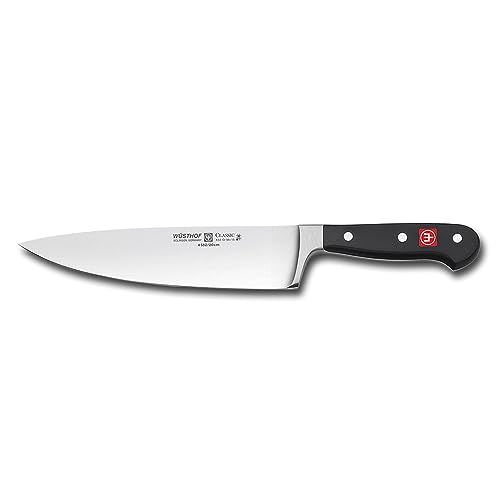
WÜSTHOF Classic 8-Inch Chef's Knife - Precision Forged German Steel for Professional Home Cooking
This precision-forged German chef's knife delivers 20% sharper cuts and twice the edge retention of previous models, making it ideal for daily chopping, mincing, and slicing tasks. Home cooks and professional chefs who want a reliable, balanced workhorse knife that holds its edge through heavy use should invest in this Classic series blade.
Pros and Cons
Pros
- German precision forging creates superior edge retention that stays sharp through months of regular kitchen use.
- The 8.5-ounce weight and ergonomic handle design reduce hand fatigue during extended meal prep.
- Backed by over 200 years of Solingen craftsmanship and strict German quality standards.
Cons
- The full bolster prevents sharpening the entire blade length on a standard whetstone without professional thinning.
- At 8.5 ounces, some cooks with smaller hands may find it heavier than Japanese-style chef's knives.

Zwilling
10-Inch Honing Steel for Kitchen Knife Maintenance and Edge Realignment
This honing steel uses an oval rod design that realigns knife edges with fewer strokes than traditional round rods, keeping your kitchen knives sharp between professional sharpening sessions. Home cooks who want to maintain their knife performance without learning complex sharpening techniques should consider this tool.
Pros and Cons
Pros
- Oval rod design requires fewer passes than traditional round honing steels to achieve the same edge realignment.
- Durable steel construction at 62 Rockwell hardness withstands regular contact with quality kitchen knives without deteriorating.
- Plastic handle with hanging hole makes storage simple in compact kitchens with limited drawer space.
Cons
- The product description contains a typo referring to the plastic handle, which may reflect less attention to quality control details.
- At this price point, some users may prefer a combination sharpening system that both hones and grinds rather than a honing-only tool.

Global Star Software
Mahjongg for Palm OS - Classic Tile Matching Game by Global Star Software for PC
This is a PC software product for installing Mahjongg solitaire on Palm OS handheld devices, not a kitchen product. It offers customizable tile sets and multiple difficulty levels for portable gaming on Palm-powered handhelds.
Pros and Cons
Pros
- Authentic mahjong solitaire experience optimized for Palm OS handhelds.
- Customizable graphics including tile sets and backgrounds for visual variety.
- Compatible with both color and grayscale Palm devices.
Cons
- Requires legacy Palm OS hardware that is no longer manufactured or widely supported.
- Not a kitchen product and provides no culinary functionality whatsoever.
WÜSTHOF Classic 8-Inch Chef's Knife - Precision Forged German Steel for Professional Home Cooking
WÜSTHOF Classic 8-Inch Chef's Knife - Precision Forged German Steel for Professional Home Cooking
This precision-forged German chef's knife delivers 20% sharper cuts and twice the edge retention of previous models, making it ideal for daily chopping, mincing, and slicing tasks. Home cooks and professional chefs who want a reliable, balanced workhorse knife that holds its edge through heavy use should invest in this Classic series blade.
$170.00 at AmazonEditors' Favorite
Brand Name: Wüsthof Set Name: Classic Manufacturer: Wüsthof UPC: 769194038526 670023145356 022934582438 Global Trade Identification Number: 00022934582438, 04002293158242, 40022931582422 Model Number: 4582-7/20 Manufacturer Part Number: 4582/20 Manufacturer Warranty Description: Lifetime warranty Item Type Name: Chef's Knives Unit Count: 16.0 Ounce Included Components: Cook's Knife Best Sellers Rank: #35,094 in Kitchen & Dining (See Top 100 in Kitchen & Dining) #103 in Chef's Knives ASIN: B00009ZK08 Blade Material Type: Stainless Steel Handle Material: Composite Is the item dishwasher safe?: No Material Type: Stainless Steel BladeLength: 8 Inches Item Weight: 0.24 Kilograms Item Length: 14 Inches Size: 8" Color: Black Blade Color: Silver Blade Edge: Chef's Knife Construction Type: Forged Blade Material: Stainless Steel Brand: Wüsthof
Shop NowZwilling 10-Inch Honing Steel for Kitchen Knife Maintenance and Edge Realignment
Zwilling
10-Inch Honing Steel for Kitchen Knife Maintenance and Edge Realignment
This honing steel uses an oval rod design that realigns knife edges with fewer strokes than traditional round rods, keeping your kitchen knives sharp between professional sharpening sessions. Home cooks who want to maintain their knife performance without learning complex sharpening techniques should consider this tool.
$59.95 at AmazonGreat Value
Material: Stainless Steel Brand: ZWILLING Color: Black/Stainless Steel Product Dimensions: 17"L x 9.8"W x 5.5"H Item Weight: 0.32 Kilograms Grit Type: Extra Fine Number of Items: 1 Manufacturer: ZWILLING J.A. HENCKELS Number of Packs: 1 Unit Count: 1.0 Count
Shop NowGlobal Star Software Mahjongg for Palm OS - Classic Tile Matching Game by Global Star Software for PC
Global Star Software
Mahjongg for Palm OS - Classic Tile Matching Game by Global Star Software for PC
This is a PC software product for installing Mahjongg solitaire on Palm OS handheld devices, not a kitchen product. It offers customizable tile sets and multiple difficulty levels for portable gaming on Palm-powered handhelds.
Check PriceASIN: B00005OL39 Customer Reviews: 4.0 4.0 out of 5 stars (6) 4.0 out of 5 stars Package Dimensions: 8.3 x 5.7 x 0.5 inches; 4.8 ounces Type of item: Video Game Rated: Everyone Item model number: GLS99509 Item Weight: 4.8 ounces Manufacturer: Global Star Software Date First Available: July 12, 2002
Shop Now




Write Your Review
No reviews yet. Be the first to share your experience!