

TL;DR — A Damascus steel chef knife is a modern kitchen knife whose blade shows a rippling, water-like pattern created by forge-welding many layers of steel together. In almost every knife sold today, the visible “Damascus” is soft outer cladding wrapped around a single hard core steel (usually VG-10, SG2/R2, or AUS-10) that actually does the cutting. The pattern is largely cosmetic; the core steel, heat treatment, and edge geometry determine how the knife performs. Genuine layered blades resist chipping and look striking, but a plain mono-steel knife with the same core cuts just as well for less. For picks, see our best chef knife guide.
The HomeWhisk editorial team researches kitchen equipment by analyzing manufacturer specifications, steel data sheets, and aggregated user reviews from major retailers and communities such as Reddit’s r/chefknives and r/Cooking. What follows separates the marketing from the metallurgy so you can decide whether a Damascus blade belongs in your kitchen.
“Damascus steel” is one of the most misunderstood terms in cutlery. The name evokes ancient sword-making, but the pattern-welded blades on a modern store shelf have almost nothing to do with the legendary crucible steel of history. Understanding what you are actually buying — and what the pattern does and does not do — is the difference between a smart purchase and paying a premium for looks alone.
What “Damascus” Actually Means on a Modern Knife
There are two very different things called Damascus, and conflating them causes most of the confusion.
Historical (wootz) Damascus was a crucible steel made in South and Central Asia centuries ago. Its surface figuring came from carbide banding within a single high-carbon ingot, and the original recipe was lost for generations. No mass-market kitchen knife today is true wootz.
Modern pattern-welded Damascus is what you buy now. A maker stacks alternating layers of two steels with different nickel or chromium content, forge-welds them under heat and pressure, then folds and draws out the billet. Because the two alloys etch at different rates in acid, the layer boundaries appear as light and dark swirls after an acid bath. Common counts run from 33 to 67 to well over 100 layers. The pattern is real metal, not printed — but on most kitchen knives those layers are the cladding, not the edge.
A warning worth internalizing: some cheap knives fake the look with a laser-etched or acid-stamped pattern on plain steel. On a genuine layered blade the pattern continues through the metal and cannot be scrubbed off; on a fake it sits only on the surface and often looks unnaturally regular.
The San-Mai Core: Where the Cutting Actually Happens
Almost every quality Damascus kitchen knife uses san-mai (three-layer) construction: a hard cutting core sandwiched between softer, patterned outer cladding. The dozens of visible layers are the cladding; the edge itself is a single high-performance steel.
Common core steels and what they bring:
- VG-10 — a Japanese stainless core hardened to roughly 60-61 HRC. Excellent edge retention, good corrosion resistance, widely available. The workhorse of mid-range Damascus.
- SG2 / R2 (powder steel) — a fine-grained powder-metallurgy steel reaching 63-64 HRC. Takes an exceptionally keen edge and holds it longer, but is more brittle and pricier.
- AUS-10 / AUS-8 — budget-friendly Japanese stainless; softer and easier to sharpen but dulls sooner.
- White (Shirogami) or Blue (Aogami) carbon steel — non-stainless cores prized for extreme sharpness; they will patina and can rust without care.
Here is the single most important buying insight: the core steel and its hardness (measured on the Rockwell C scale, HRC) tell you how the knife cuts, not the number of Damascus layers. A 67-layer VG-10 knife and a plain VG-10 knife with no pattern hold an edge almost identically. Our best japanese chef knife guide breaks these cores down in detail, and our best chef knife roundup covers Western options.
Does the Pattern Do Anything, or Is It Just Looks?
Honestly, on a kitchen knife the pattern is mostly cosmetic. Two practical points are worth knowing:
- Toughness comes from cladding, not the pattern. The soft outer layers absorb lateral stress and make a hard, brittle core less prone to snapping. That benefit comes from san-mai construction — a plain san-mai knife gets the same protection without the swirls.
- The food-release myth. Sellers sometimes claim the textured pattern reduces sticking. In reality the blade face is polished smooth and the etch is shallow, so it does little for release. Knives that genuinely shed food use a hammered tsuchime finish or dedicated dimples, which is a separate feature from Damascus layering.
So you are paying primarily for appearance and craftsmanship. That is a legitimate reason to buy — a beautiful knife you enjoy using has real value — but it should be a conscious choice, not a belief that layers cut better.
What to Look For When Buying a Damascus Chef Knife
Ignore the layer-count marketing and check these instead:
- Named core steel and hardness. If a listing won’t state the core (VG-10, SG2, AUS-10) and its HRC, treat that as a red flag.
- Blade length and profile. An 8-inch chef’s knife suits most home cooks; a 210mm gyuto is the Japanese equivalent. A santoku (165-180mm) is shorter with a flatter edge for push-cutting.
- Edge geometry and bevel. Japanese blades are ground thinner (often 12-15 degrees per side) for keener cutting; Western Damascus tends toward 15-20 degrees and more durability.
- Handle style. Western full-tang handles feel heavier and more balanced for rocking; Japanese wa handles are lighter and favor push cuts.
- Real versus faked pattern. Confirm the layers are forge-welded, not etched onto mono-steel.
For a first premium knife, a VG-10 san-mai gyuto or 8-inch chef’s knife is the safest, most versatile pick. Our best chef knife under 100 guide covers strong non-Damascus options if budget matters more than looks, and our best knife sets guide helps if you want a matched block.
Care and Maintenance: Keeping the Pattern and the Edge
Damascus knives are not fragile, but they reward good habits:
- Hand wash and dry immediately. Never use a dishwasher — the heat, detergents, and knocking dull the edge, and carbon-core blades will rust. Stainless cores are more forgiving but still deserve hand washing.
- Sharpen on whetstones. Because most cores are hard Japanese steel, whetstones (around 1000-grit to set an edge, 3000-6000 to refine) give the best results. Pull-through sharpeners can chip hard edges.
- Respect the core type. Carbon-core Damascus develops a patina and needs drying and occasional oiling; stainless cores don’t.
- Store safely. Use a knife block, magnetic strip, or edge guard so the blade doesn’t bang against other utensils.
- The pattern is permanent. Etched into the metal, it won’t wash off — but harsh scouring pads can dull its contrast over time.
A well-kept Damascus knife lasts decades; the edge is a consumable you restore, and the blade is the heirloom.
Frequently Asked Questions
Is a Damascus steel chef knife worth the money?
It depends on what you value. The layered pattern is largely cosmetic, so you are paying a premium for appearance and craftsmanship rather than sharper cutting. A plain knife with the same core steel and hardness cuts nearly identically for less. That said, many owners find real enjoyment in a beautiful, well-balanced blade, and a good Damascus knife with a VG-10 or SG2 core performs excellently. Buy it because you love the look and the core steel is solid — not because you expect the pattern to improve performance. See our best chef knife guide for comparisons.
Is a Damascus knife better than a regular chef’s knife?
Not inherently. What makes any knife cut well is the core steel, its hardness, and the edge geometry — none of which require a Damascus pattern. A quality mono-steel chef’s knife can match or beat a mediocre Damascus one. The san-mai construction common to Damascus blades does add some toughness by cushioning a hard core, but plain san-mai knives offer that too. Judge a Damascus knife by its core steel first and treat the swirls as a bonus. Our best japanese chef knife guide explains the steels that matter.
What steel is inside a Damascus kitchen knife?
Most kitchen Damascus is san-mai: a single hard core wrapped in patterned cladding. Common cores are VG-10 (about 60-61 HRC, the mid-range standard), SG2/R2 powder steel (63-64 HRC, keener and longer-lasting but more brittle), AUS-10 (softer, budget-friendly), and carbon steels like Shirogami or Aogami (extremely sharp but rust-prone). The many outer layers are softer nickel-and-chromium alloys chosen for how they etch, not for cutting. Always check which core a knife uses before buying.
How do I care for a Damascus steel knife?
Hand wash it with mild soap and dry it right away — never the dishwasher. Sharpen on whetstones (1000-grit to set an edge, 3000-6000 to refine) rather than pull-through gadgets, which can chip hard cores. If the core is carbon steel, expect a patina and oil the blade lightly between uses to prevent rust; stainless cores need less fuss. Store it in a block, on a magnetic strip, or with an edge guard. The etched pattern is permanent and won’t wash off, though harsh scouring can fade its contrast.
Are Damascus knives good for professional chefs?
Some professionals use them, but many working cooks prefer plain, tough, easily replaceable knives for a busy line. Damascus blades shine as personal, prized tools rather than beat-around workhorses — the premium price and the desire to protect the finish suit careful home cooks and enthusiasts better. Professionals who do choose Damascus usually pick it for a specific hard core (like SG2) they trust, with the pattern as a secondary consideration. For heavy daily use, edge retention and easy sharpening matter more than looks.
How can I tell a real Damascus blade from a fake?
On a genuine forge-welded blade the pattern runs continuously through the steel and shows subtle irregularities where the layers fold; it cannot be scrubbed or sanded off. Faked Damascus is laser-etched or acid-stamped onto plain mono-steel, so the pattern sits only on the surface, often looks unnaturally uniform, and can wear away. Reputable listings name the core steel and layer count and come from established makers. If a knife is suspiciously cheap and vague about its steel, assume the pattern is decorative surface work.
The Bottom Line
A Damascus steel chef knife is a modern, layered-cladding blade built around a single hard core that does the real cutting. The rippling pattern is beautiful and genuine metal, but it is mostly cosmetic — performance comes from the core steel, its hardness, and the edge geometry, not the number of layers. Buy one because you want a striking, well-crafted knife with a proven core like VG-10 or SG2, and treat the pattern as the aesthetic bonus it is. If you care more about pure cutting value than looks, a quality mono-steel knife serves just as well for less. For our full recommendations across styles and budgets, see the best chef knife, best japanese chef knife, best chef knife under 100, and best chef knife set guides, plus the best bread knife guide to round out your block.

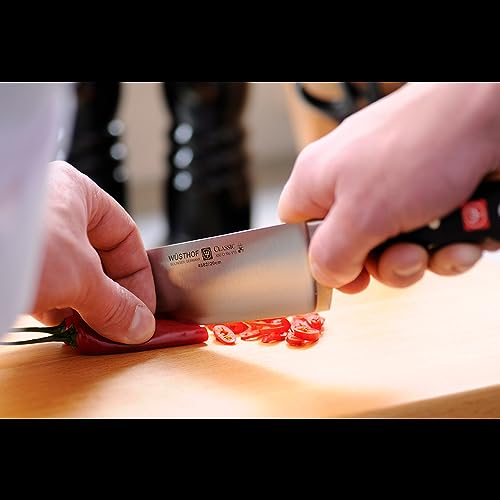
WÜSTHOF Classic 8-Inch Chef's Knife - Precision Forged German Steel for Professional Home Cooking
This precision-forged German chef's knife delivers 20% sharper cuts and twice the edge retention of previous models, making it ideal for daily chopping, mincing, and slicing tasks. Home cooks and professional chefs who want a reliable, balanced workhorse knife that holds its edge through heavy use should invest in this Classic series blade.
Pros and Cons
Pros
- German precision forging creates superior edge retention that stays sharp through months of regular kitchen use.
- The 8.5-ounce weight and ergonomic handle design reduce hand fatigue during extended meal prep.
- Backed by over 200 years of Solingen craftsmanship and strict German quality standards.
Cons
- The full bolster prevents sharpening the entire blade length on a standard whetstone without professional thinning.
- At 8.5 ounces, some cooks with smaller hands may find it heavier than Japanese-style chef's knives.

Zwilling
10-Inch Honing Steel for Kitchen Knife Maintenance and Edge Realignment
This honing steel uses an oval rod design that realigns knife edges with fewer strokes than traditional round rods, keeping your kitchen knives sharp between professional sharpening sessions. Home cooks who want to maintain their knife performance without learning complex sharpening techniques should consider this tool.
Pros and Cons
Pros
- Oval rod design requires fewer passes than traditional round honing steels to achieve the same edge realignment.
- Durable steel construction at 62 Rockwell hardness withstands regular contact with quality kitchen knives without deteriorating.
- Plastic handle with hanging hole makes storage simple in compact kitchens with limited drawer space.
Cons
- The product description contains a typo referring to the plastic handle, which may reflect less attention to quality control details.
- At this price point, some users may prefer a combination sharpening system that both hones and grinds rather than a honing-only tool.

Global Star Software
Mahjongg for Palm OS - Classic Tile Matching Game by Global Star Software for PC
This is a PC software product for installing Mahjongg solitaire on Palm OS handheld devices, not a kitchen product. It offers customizable tile sets and multiple difficulty levels for portable gaming on Palm-powered handhelds.
Pros and Cons
Pros
- Authentic mahjong solitaire experience optimized for Palm OS handhelds.
- Customizable graphics including tile sets and backgrounds for visual variety.
- Compatible with both color and grayscale Palm devices.
Cons
- Requires legacy Palm OS hardware that is no longer manufactured or widely supported.
- Not a kitchen product and provides no culinary functionality whatsoever.
WÜSTHOF Classic 8-Inch Chef's Knife - Precision Forged German Steel for Professional Home Cooking
WÜSTHOF Classic 8-Inch Chef's Knife - Precision Forged German Steel for Professional Home Cooking
This precision-forged German chef's knife delivers 20% sharper cuts and twice the edge retention of previous models, making it ideal for daily chopping, mincing, and slicing tasks. Home cooks and professional chefs who want a reliable, balanced workhorse knife that holds its edge through heavy use should invest in this Classic series blade.
$170.00 at AmazonEditors' Favorite
Brand Name: Wüsthof Set Name: Classic Manufacturer: Wüsthof UPC: 769194038526 670023145356 022934582438 Global Trade Identification Number: 00022934582438, 04002293158242, 40022931582422 Model Number: 4582-7/20 Manufacturer Part Number: 4582/20 Manufacturer Warranty Description: Lifetime warranty Item Type Name: Chef's Knives Unit Count: 16.0 Ounce Included Components: Cook's Knife Best Sellers Rank: #35,094 in Kitchen & Dining (See Top 100 in Kitchen & Dining) #103 in Chef's Knives ASIN: B00009ZK08 Blade Material Type: Stainless Steel Handle Material: Composite Is the item dishwasher safe?: No Material Type: Stainless Steel BladeLength: 8 Inches Item Weight: 0.24 Kilograms Item Length: 14 Inches Size: 8" Color: Black Blade Color: Silver Blade Edge: Chef's Knife Construction Type: Forged Blade Material: Stainless Steel Brand: Wüsthof
Shop NowZwilling 10-Inch Honing Steel for Kitchen Knife Maintenance and Edge Realignment
Zwilling
10-Inch Honing Steel for Kitchen Knife Maintenance and Edge Realignment
This honing steel uses an oval rod design that realigns knife edges with fewer strokes than traditional round rods, keeping your kitchen knives sharp between professional sharpening sessions. Home cooks who want to maintain their knife performance without learning complex sharpening techniques should consider this tool.
$59.95 at AmazonGreat Value
Material: Stainless Steel Brand: ZWILLING Color: Black/Stainless Steel Product Dimensions: 17"L x 9.8"W x 5.5"H Item Weight: 0.32 Kilograms Grit Type: Extra Fine Number of Items: 1 Manufacturer: ZWILLING J.A. HENCKELS Number of Packs: 1 Unit Count: 1.0 Count
Shop NowGlobal Star Software Mahjongg for Palm OS - Classic Tile Matching Game by Global Star Software for PC
Global Star Software
Mahjongg for Palm OS - Classic Tile Matching Game by Global Star Software for PC
This is a PC software product for installing Mahjongg solitaire on Palm OS handheld devices, not a kitchen product. It offers customizable tile sets and multiple difficulty levels for portable gaming on Palm-powered handhelds.
Check PriceASIN: B00005OL39 Customer Reviews: 4.0 4.0 out of 5 stars (6) 4.0 out of 5 stars Package Dimensions: 8.3 x 5.7 x 0.5 inches; 4.8 ounces Type of item: Video Game Rated: Everyone Item model number: GLS99509 Item Weight: 4.8 ounces Manufacturer: Global Star Software Date First Available: July 12, 2002
Shop Now


Write Your Review
No reviews yet. Be the first to share your experience!