

HomeWhisk earns commission from qualifying purchases made through links on this page. We research picks from specifications and owner reviews; we do not test products ourselves.
TL;DR — Sandwich griddle press is one of those kitchen questions where the useful answer is usually more practical than complicated. The right move depends on how you cook, what you already own, and how much maintenance you are willing to do. Use this as the practical background, then check best cookware sets, best stainless steel cookware set, and best cast iron skillet for beginners for specific product options.
We treated this as an editor’s note for home cooks: what matters, what is optional, and which related product guides are worth checking before you buy. For cookware topics, the big differences are heat behavior, material, cooktop fit, cleaning, weight, and how the pan or pot holds up after repeated use.

Pros
- Five distinct cooking modes in one footprint covers grilled cheese, hamburgers, panini, sausages, and pancakes without switching appliances.
- Griddle mode temperature range of 200°F to 425°F gives meaningful control for delicate items like eggs alongside high-heat searing.
- Dishwasher-safe removable plates and drip tray make cleanup a practical daily habit rather than a chore.
- PFAS-free nonstick coating addresses a common concern buyers have with older nonstick surfaces.
Cons
- At $115, it costs more than single-function panini presses, so buyers who only make sandwiches may not recoup the versatility.
- No customer reviews are currently available to validate real-world durability claims beyond manufacturer specifications.
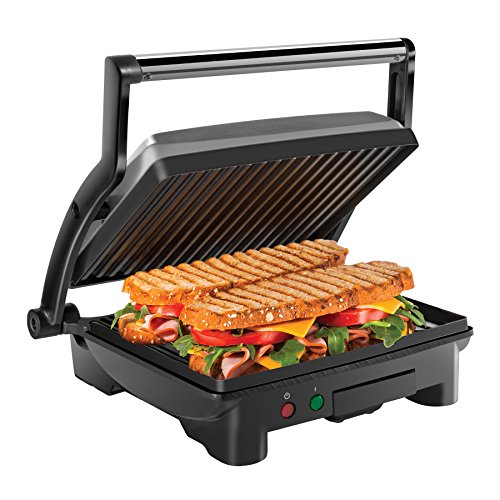
The Cuisinart GR-4NNAS is a countertop appliance that replaces a contact grill, panini press, flat griddle, and combination grill in one unit for households with limited storage.
Dual independent temperature controls are the standout feature: grill mode adjusts from warm to sear, while griddle mode offers a precise 200°F to 425°F range for consistent results across food types.
Cooking plates are PFAS-free nonstick and fully removable. The unit is stainless steel exterior with a compact countertop footprint suited for standard kitchen setups.
With no published reviews yet, long-term nonstick durability under daily use remains unverified outside the manufacturer's 3-year warranty coverage.
Best for households that cook a wide variety of meals and want one appliance to handle grilling, pressing, and griddling without dedicated single-use tools.
Open the unit flat for full grill or griddle mode, or close it for contact grilling and panini pressing. The hinge adjusts to accommodate thickness, from thin sandwiches to thicker burgers.
Set temperature using the appropriate control for your mode. Griddle mode needs a preheat of several minutes before adding food; grill mode reaches searing heat faster for proteins.
After cooking, unplug and let plates cool before removing them. Both plates and the drip tray are dishwasher-safe, so cleanup requires no hand scrubbing under normal use.
Pros
- The 180-degree hinge expands the appliance from a sandwich press into a contact grill.
- The four-slice capacity handles two large paninis or four sandwiches in one batch.
- The non-stick plates and removable drip tray make post-meal cleanup more manageable.
- The stainless steel surface and UL approval support regular kitchen use.
Cons
- The product data does not list adjustable temperature controls, which may limit cooking precision.
- The compact cooking area may be restrictive for unusually large foods despite the flexible hinge.
The Chefman RJ02-180-4 solves the need for quick sandwiches and small-batch grilling without requiring a separate countertop appliance.
Its four-slice surface handles two large paninis, while the floating hinge accommodates different sandwich thicknesses and the 180-degree opening supports flat grilling.
The stainless steel exterior, compact footprint, non-stick plates, tilt-up feet, and removable drip tray suit frequent use where storage and cleanup space are limited.
Temperature adjustment is not listed, so buyers seeking precise heat control should consider another model.
Best for small households, dorm residents, office kitchens, and anyone wanting one compact appliance for sandwiches and basic grilling.
Place sandwiches on the non-stick plates, close the floating hinge, and cook until the bread reaches your preferred level of crispness. Cooking spray is not required.
For burgers, steaks, vegetables, or other foods, open the press 180 degrees to use both plates as a flat grill.
After cooking, use the tilt-up feet and removable drip tray to direct and collect grease before cleaning the coated plates.
Pros
- Fast-heating element delivers evenly toasted sandwiches without hot spots, based on the manufacturer's heat-distribution design.
- Compact, lightweight build makes it practical for dorm rooms and small apartments where counter real estate is limited.
- Non-stick coating prevents bread from tearing during removal, which matters most for softer sandwich styles like brioche or sourdough.
- Vertical upright storage means the unit does not need to stay on the counter between uses.
Cons
- Plate size is fixed to a standard sandwich footprint, so thicker hoagies or oversized bread slices will not fit or close properly.
- Non-removable plates mean cleaning requires careful hand-wiping rather than a dishwasher run, which can be slower with melted cheese buildup.
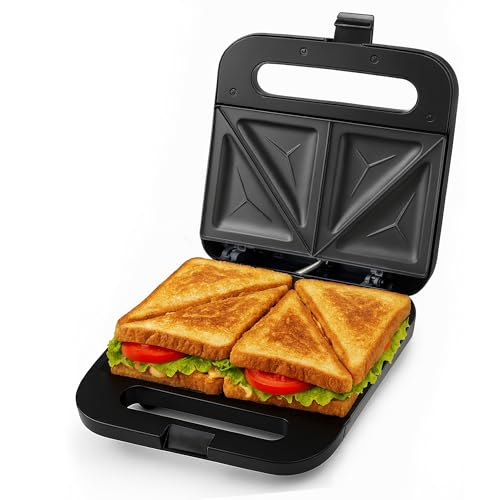
The OVENTE GPS401B is an electric sandwich press that solves the slow-morning problem by toasting and pressing sandwiches, omelets, and French toast in minutes on a single compact appliance.
Its fast-heating stainless steel element distributes heat evenly across both non-stick plates, preventing the uneven browning that plagues cheaper sandwich makers.
Built with heat-resistant stainless steel and a cool-touch handle, the unit is lightweight enough to move easily but stable enough on anti-skid feet during pressing.
Plates are non-removable, so cleanup relies on wiping rather than soaking — a minor inconvenience for dishes involving melted fillings.
Best for college students, small-apartment dwellers, or minimalist home cooks who want one affordable tool that handles breakfast and snack prep without taking up counter space.
Plug in the unit and wait for the preheat indicator light to signal it has reached cooking temperature before placing any food on the plates.
Lay your sandwich, omelet, or French toast on the bottom plate, close the lid, and apply light downward pressure through the cool-touch handle to ensure full plate contact.
Once the indicator light confirms the unit is powered off and plates have cooled, wipe both surfaces with a damp cloth to clear residue before storing the maker upright.

Pros
- The floating lid accommodates varying sandwich heights without manual repositioning, making it practical for stuffed or layered sandwiches.
- Top and bottom nonstick grids heat simultaneously, producing evenly browned results on both sides in a single pass.
- The lid lock adds a second cooking mode, extending the press beyond sandwiches to open-face items and flatbreads.
- Upright storage design means it occupies minimal cabinet space compared to flat-storing models of similar size.
Cons
- The 8 x 10-inch grid fits one standard sandwich or one quesadilla at a time, making it slow for households cooking multiple portions.
- There is no adjustable temperature control — heat output is fixed at 1400 watts, which limits precision for delicate or low-heat recipes.
The Hamilton Beach 25460MNA is a countertop panini press that solves uneven browning by applying heat from both sides simultaneously through nonstick top and bottom grids.
Its café-style floating lid self-levels to match sandwich thickness, ensuring even pressure whether you're pressing a thin wrap or a thick stacked sandwich.
Built from chrome-finished housing with nonstick aluminum grids, it measures 11.6 x 12.6 x 4.5 inches and stores upright to reduce counter footprint.
Fixed 1400-watt output means no temperature dial — buyers who regularly cook eggs or delicate items may find this limiting.
Best for home cooks who want a fast, low-effort way to make pressed sandwiches and grilled flatbreads without managing stovetop heat.
Preheat the press for 6 minutes before loading food — the green ready light confirms the grids have reached cooking temperature across the full 8 x 10-inch surface.
Place your sandwich or quesadilla centered on the bottom grid, lower the floating lid, and let both grids do the work. No flipping needed; the top grid browns the upper surface simultaneously.
To use it as an open-face grill, engage the lid lock to hold it flat, then place bruschetta, pizza slices, or flatbreads directly on the lower grid for top-down radiant heat.

Pros
- The floating hinge adjusts to different sandwich thicknesses.
- The grill opens flat to provide a 10 x 8.75-inch cooking surface.
- The non-stick plates and removable drip tray reduce cleanup effort.
- UL approval and a one-year assurance provide added purchase support.
Cons
- The 5.5 x 8.75-inch closed cooking surface is limited to about two sandwiches at a time.
- The product data does not mention adjustable temperature controls.
The Chefman RJ02-180 is a compact electric panini press that solves the need for quick toasted sandwiches and small-batch grilling without using a full-size appliance.
A floating hinge handles thick or thin sandwiches, while the 180-degree opening creates a 10 x 8.75-inch surface for burgers, steaks, and vegetables.
Its non-stick coated plates, stainless steel and black finish, compact footprint, skid-resistant feet, and removable drip tray support convenient daily use.
The closed 5.5 x 8.75-inch cooking surface limits output to about two sandwiches at once.
Best for small households, dorm rooms, offices, and anyone needing a compact sandwich press with open-grill capability.
Place the press on a stable surface, add your sandwich, and close the floating hinge so it rests evenly over the food.
Open the grill 180 degrees when cooking burgers, steaks, vegetables, or other foods across the larger flat surface.
After cooking, allow the plates to cool, remove the drip tray, and clean it with the non-stick plates according to the user guide.
When It Is Worth Paying More
Spending up pays off when you use the pan often enough to notice better cleaner results every week. If it only comes out occasionally, a mid-range pick is the smarter call. Match the money to frequency of use, not marketing.
How To Get It Right
Think through the whole workflow: avoiding metal utensils on coatings, skipping the dishwasher for nonstick, and letting the pan cool before washing. A pan that fits your routine and cleanup habits beats a technically superior one you fight with. We cover specific models in best cookware sets, best stainless steel cookware set, and best cast iron skillet for beginners.
What To Look For
Hold a pan to a short checklist: fit, control, cleanup, and durability. Those are the variables that decide whether it earns a spot in your kitchen or ends up unused. Ignore cosmetic upgrades until the fundamentals check out.
Who Benefits Most
This matters most for weeknight cooks who want low upkeep, and induction-stovetop owners. If that is you, treat coating durability, and cooktop compatibility as non-negotiable. Casual users can relax the requirements and prioritize price and storage instead.

Related Product Guides
If this topic is part of a buying decision, these are the HomeWhisk guides most closely tied to it:
- best cookware sets
- best stainless steel cookware set
- best cast iron skillet for beginners
- best non toxic cookware
- best dutch oven for bread baking
Frequently Asked Questions
What gear pairs well with it?
Start with a reliable core piece, then add as needs appear. Compare best cookware sets, best stainless steel cookware set, and best cast iron skillet for beginners for related choices.
What should I avoid?
Avoid buying by brand alone, ignoring drying fully to prevent rust, and oversizing for your space. Each invites handles that loosen over time down the line.
What is the bottom line?
Match the pan to your real habits: buy for durability if it is daily, for value and storage if it is occasional.
How do I keep it in good shape?
Build avoiding metal utensils on coatings, and using low-to-medium heat on coatings into normal cleanup. Light, consistent care prevents warping on high heat far better than occasional deep effort.
What matters most for sandwich griddle press?
Focus on coating durability, weight and maneuverability, and heat distribution first. Those decide real performance; the rest is secondary. Compare best cookware sets and best stainless steel cookware set for options that get the basics right.
The Bottom Line
A good sandwich griddle press decision should feel obvious after you line up size, material, cleaning, and durability. If it is still a purchase question, the next step is best cookware sets, best stainless steel cookware set, and best cast iron skillet for beginners.




Write Your Review
No reviews yet. Be the first to share your experience!