

TL;DR — Nonstick pasta pot is one of those kitchen questions where the useful answer is usually more practical than complicated. The right move depends on how you cook, what you already own, and how much maintenance you are willing to do. Use this as the practical background, then check best cookware sets, best stainless steel cookware set, and best cast iron skillet for beginners for specific product options.
We treated this as an editor’s note for home cooks: what matters, what is optional, and which related product guides are worth checking before you buy. For cookware topics, the big differences are heat behavior, material, cooktop fit, cleaning, weight, and how the pan or pot holds up after repeated use.
GOTHAM STEEL
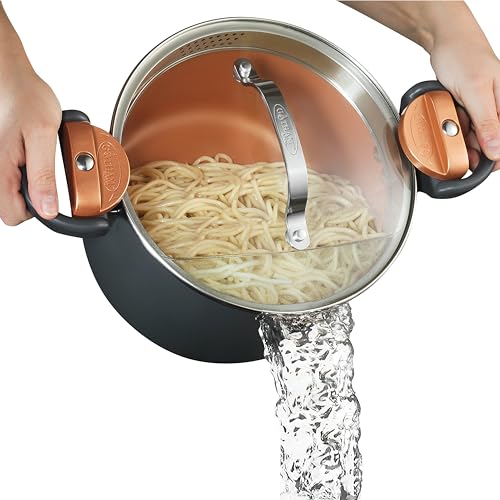
One-Pot Pasta Cooking and Draining: Gotham Steel 5-Quart Stock Pot with Strainer Lid
This 5-quart Gotham Steel pot cooks and drains pasta, rice, vegetables, and soups in one vessel, with its locking strainer lid eliminating the need for a colander. It suits home cooks who want lighter cookware, easier cleanup, and controlled draining, provided they do not use an induction cooktop.
Pros and Cons
Pros
- The integrated strainer lid combines cooking and draining in one 5-quart pot.
- The PFOA-, PFOS-, lead-, and cadmium-free ceramic surface supports low-oil cooking and easier food release.
- Its under-3-pound aluminum construction is easier to maneuver when pouring or serving.
- It works on gas, electric, ceramic, and halogen cooktops and is oven safe up to 300°F.
Cons
- It is not designed for induction cooktops.
- The 300°F oven limit may restrict high-temperature oven finishing.

BEZIA
6-Quart Ceramic Nonstick Stock Pot with Built-In Strainer Lid - BEZIA Pasta and Soup Pot for Induction and Gas Cooktops
This 6-quart ceramic-coated stock pot handles pasta, soup, and chili with a strainer lid that drains water straight from the pot, so you skip the colander entirely. It suits home cooks feeding a family or hosting gatherings who want PTFE- and PFOA-free cookware that works on gas, electric, ceramic, and induction burners.
Pros and Cons
Pros
- The pour spout and strainer lid combination drains pasta and blanched vegetables in seconds at the sink.
- Tempered glass lid lets you watch a simmer without lifting and losing heat or moisture.
- Six-quart capacity covers a full pound of pasta, large soup batches, and chili for a crowd.
- Even heat distribution across the base reduces scorching in the bottom of long-simmered sauces.
Cons
- The glass lid is not oven safe, so oven use is limited to uncovered cooking or a foil cover.
- Ceramic nonstick coatings generally wear faster than hard-anodized or stainless surfaces, especially under high heat and metal utensils.

ACTIV CUISINE
One-Pot Pasta Draining Without a Colander: ACTIV CUISINE 8.5qt Cast Aluminum Strainer Lid Stockpot
This 8.5-quart cast aluminum multipot cooks pasta, soups, and stocks, then drains them straight from the pot by twisting the locking handles to align the built-in strainer lid with either of two hole sizes. It suits cooks who make pasta often and want to skip the colander, plus anyone wanting a PFOA-free ceramic nonstick surface that goes in the dishwasher.
Pros and Cons
Pros
- Draining happens in one motion at the stove or sink instead of hauling a full pot to a separate colander.
- Ceramic coating is free of PFOA, PFOS, lead, and cadmium, and it is applied inside and out.
- Tempered glass lid lets you watch a boil or simmer without releasing heat and steam.
- Dishwasher safe, so cleanup does not depend on hand washing a large pot.
Cons
- Bakelite handles and the ceramic coating mean this is a stovetop pot, not one to move into a hot oven.
- Ceramic nonstick surfaces generally lose slickness faster than hard-anodized or stainless interiors, especially under high-heat searing.
The Best Deals This Week*
-
One-Pot Pasta Cooking and Draining
$28.99
($39.99)Save $11.00 -
GOTHAM STEEL 5 Qt Stock Pot Multipurpose Pasta Pot
$26.99
($39.95)Save $12.96 -
SENSARTE Ceramic Nonstick Stock Pot with Lid
$28.49
($29.99)Save $1.50
*Deals are selected by our commerce team
GOTHAM STEEL One-Pot Pasta Cooking and Draining: Gotham Steel 5-Quart Stock Pot with Strainer Lid
GOTHAM STEEL
One-Pot Pasta Cooking and Draining: Gotham Steel 5-Quart Stock Pot with Strainer Lid
This 5-quart Gotham Steel pot cooks and drains pasta, rice, vegetables, and soups in one vessel, with its locking strainer lid eliminating the need for a colander. It suits home cooks who want lighter cookware, easier cleanup, and controlled draining, provided they do not use an induction cooktop.
$28.99 at AmazonEditors' Favorite
Color: Graphite Size: 5 Quarts Dimensions: 13.15 x 9.45 x 7.15 inches Weight: 2.9321480846 Pounds Product Group: Kitchen Binding: Kitchen
Shop NowGOTHAM STEEL 5 Qt Stock Pot Multipurpose Pasta Pot with Strainer Lid

Great Value
Color: Cream White Size: 5 Quarts Dimensions: 13.5 x 9.45 x 7.15 inches Weight: 2.8880556322 pounds Product Group: Kitchen Binding: Kitchen
Shop NowBEZIA 6-Quart Ceramic Nonstick Stock Pot with Built-In Strainer Lid - BEZIA Pasta and Soup Pot for Induction and Gas Cooktops
BEZIA
6-Quart Ceramic Nonstick Stock Pot with Built-In Strainer Lid - BEZIA Pasta and Soup Pot for Induction and Gas Cooktops
This 6-quart ceramic-coated stock pot handles pasta, soup, and chili with a strainer lid that drains water straight from the pot, so you skip the colander entirely. It suits home cooks feeding a family or hosting gatherings who want PTFE- and PFOA-free cookware that works on gas, electric, ceramic, and induction burners.
$39.99 at AmazonColor: Gray Size: 6 Quarts Dimensions: 9.44 x 13.54 x 8.46 inches Weight: 5.20070476058 Pounds Product Group: Kitchen
Shop NowSENSARTE Ceramic Nonstick Stock Pot with Lid, 2.6/4.5/6.6/8.5/11 QT Soup Pot Casserole Pot, Non-toxic Healthy Pasta Pot, Large Cooking Pot Stew Pot, Induction Compatible, PFOA PFAS PTFE Free, White

SENSARTE
Ceramic Nonstick Stock Pot with Lid, 2.6/4.5/6.6/8.5/11 QT Soup Pot Casserole Pot, Non-toxic Healthy Pasta Pot, Large Cooking Pot Stew Pot, Induction Compatible, PFOA PFAS PTFE Free, White
$28.49 at AmazonColor: Ceramic White Size: 4.5 Quarts Dimensions: 9.448818888 x 14.9999999847 x 4.4881889718 Inches Weight: 5.16102155342 pounds Product Group: Kitchen
Shop NowACTIV CUISINE One-Pot Pasta Draining Without a Colander: ACTIV CUISINE 8.5qt Cast Aluminum Strainer Lid Stockpot
ACTIV CUISINE
One-Pot Pasta Draining Without a Colander: ACTIV CUISINE 8.5qt Cast Aluminum Strainer Lid Stockpot
This 8.5-quart cast aluminum multipot cooks pasta, soups, and stocks, then drains them straight from the pot by twisting the locking handles to align the built-in strainer lid with either of two hole sizes. It suits cooks who make pasta often and want to skip the colander, plus anyone wanting a PFOA-free ceramic nonstick surface that goes in the dishwasher.
$53.99 at AmazonColor: Black Size: 8.5 Quarts Dimensions: 11.81 x 8.66 x 6.3 inches Weight: 5.29 pounds Product Group: Kitchen Binding: Kitchen
Shop NowWhen It Is Worth Paying More
Spending up pays off when you use the pan often enough to notice better more predictable performance every week. If it only comes out occasionally, a mid-range pick is the smarter call. Match the money to frequency of use, not marketing.
Common Misconceptions
The biggest myth is that the most expensive pan is automatically the best for you. In reality, the right choice depends on oven-safe temperature, and heat distribution — plus your own habits. Another trap is buying by brand alone — the same maker sells both excellent and forgettable lines.
How To Get It Right
Think through the whole workflow: avoiding metal utensils on coatings, seasoning bare iron or carbon steel, and letting the pan cool before washing. A pan that fits your routine and cleanup habits beats a technically superior one you fight with. We cover specific models in best cookware sets, best stainless steel cookware set, and best cast iron skillet for beginners.
Why It Matters
The variables that decide the outcome — heat distribution, handle heat resistance, and base material and core — are the ones buyers most often overlook. That is why two pans that look alike can feel completely different in use — one saves time, the other quietly adds friction to every task. If you are shopping, our best cookware sets and best stainless steel cookware set guides are the fastest way in.
Related Product Guides
If this topic is part of a buying decision, these are the HomeWhisk guides most closely tied to it:
- best cookware sets
- best stainless steel cookware set
- best cast iron skillet for beginners
- best non toxic cookware
- best dutch oven for bread baking
Frequently Asked Questions
Is a premium pan worth it?
Only if you use it enough to notice better control, durability, or cleanup regularly. Occasional users are well served by a mid-range pick like those in best cast iron skillet for beginners.
How do I keep it in good shape?
Build using low-to-medium heat on coatings, and drying fully to prevent rust into normal cleanup. Light, consistent care prevents warping on high heat far better than occasional deep effort.
What gear pairs well with it?
Start with a reliable core piece, then add as needs appear. Compare best cookware sets, best stainless steel cookware set, and best cast iron skillet for beginners for related choices.
What is the bottom line?
Match the pan to your real habits: buy for durability if it is daily, for value and storage if it is occasional.
What matters most for nonstick pasta pot?
Focus on coating durability, weight and maneuverability, and heat distribution first. Those decide real performance; the rest is secondary. Compare best cookware sets and best stainless steel cookware set for options that get the basics right.
The Bottom Line
A good nonstick pasta pot decision should feel obvious after you line up size, material, cleaning, and durability. If it is still a purchase question, the next step is best cookware sets, best stainless steel cookware set, and best cast iron skillet for beginners.




Write Your Review
No reviews yet. Be the first to share your experience!