

TL;DR — A good answer to lemon juicer press starts with real kitchen habits, not a perfect spec sheet. Most readers need a clear way to avoid the wrong tool, not another list of features. When this turns into a purchase decision, compare best air fryer, best blender, and best instant pot before narrowing your shortlist.
The HomeWhisk approach is research-first: compare construction, usability, cleaning, and long-term complaints before recommending a direction. For appliance topics, we pay close attention to capacity, controls, cleanup, storage, reliability complaints, and whether the machine saves enough effort to justify the space.


Save $30.00
Pros & Cons
Pros
- The strong lever mechanism handles thick-skinned citrus with minimal effort.
- The generous bowl works with lemons, limes, oranges, and grapefruits.
- Detachable strainers make post-juicing cleanup easier.
- More than 20 color options allow it to coordinate with a kitchen or bar setup.
Cons
- This manual press is designed primarily for citrus rather than a broad range of fruits and vegetables.
- The listing does not provide a product weight, so buyers should expect a substantial cast iron countertop tool.
Details
This countertop citrus press solves the slow, messy task of extracting juice by hand from lemons, limes, oranges, and grapefruits.
Its cast iron lever provides mechanical advantage, while the 5-inch bowl and strainer help produce more juice with fewer seeds and less pulp.
Heavy-duty cast iron supports repeated pressing, and rubberized feet improve stability. The 5-inch bowl is the listed size; product weight is not provided.
It is primarily a citrus tool, so it will not replace an electric juicer for broader produce.
Verdict: best for bartenders, juice enthusiasts, and home users who regularly press fresh citrus.
Best Uses
Use it for lemons and limes when preparing cocktails, dressings, marinades, or fresh garnishes.
Press oranges and grapefruits for breakfast juice, using the large bowl to reduce repeated batches.
Remove the detachable strainer after use to make cleanup faster.
Save $2.00
Pros & Cons
Pros
- The ergonomic handle makes pressing more comfortable, including for smaller hands.
- The 2-in-1 design handles common small citrus fruits with one manual tool.
- The seed-filtering bowl helps keep pulp and seeds out of finished juice.
- A lifetime guarantee provides added support if the tool develops an issue.
Cons
- It requires manual hand pressure, so it is less suitable for high-volume juicing.
- The bowl is intended for lemons, limes, and small oranges rather than larger citrus fruit.
Details
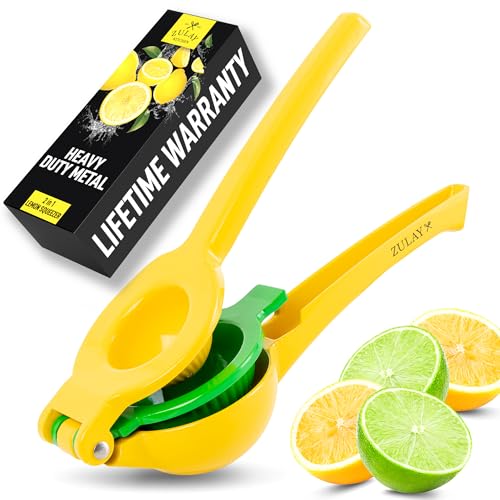
The Zulay Kitchen 2-in-1 citrus squeezer solves the problem of extracting small amounts of juice without seeds, electricity, batteries, or a bulky countertop appliance.
Its bowl holes filter seeds and pulp while the lever-style design extracts juice from lemons, limes, and small oranges with a soft squeeze.
Aluminum bowls with a food-grade coating provide a sturdy build, while the ergonomic handle supports comfortable daily use and compact storage.
Because it is manually operated, frequent high-volume juicing still requires repeated hand pressure.
Verdict: best for home cooks and cocktail makers who need quick, low-mess citrus prep.
Best Uses
Use it for lemonade, margaritas, salad dressings, marinades, seafood, sauces, and recipes needing a quick squeeze of fresh citrus.
Cut the fruit in half, place it in the bowl, and press the handles together over a glass, mixing bowl, or pan.
Rinse it under water after use or place it in the dishwasher when you want a faster cleanup.
Save $2.85
Pros & Cons
Pros
- Cast iron body and 304 stainless contact parts hold up to daily acidic fruit without degrading.
- Lever mechanism handles fruit well beyond standard citrus, including pomegranates and grapefruit.
- Removable strainer and funnel make emptying pulp and cleaning a two-part job, not a full teardown.
- Manual operation means silent juicing with no motor to service or replace.
Cons
- At 15 pounds it is not something you will move on and off the counter easily, so it needs dedicated space.
- Large fruit like grapefruit may need halving and multiple pulls, and very small limes can sit loosely in the cone.
Details
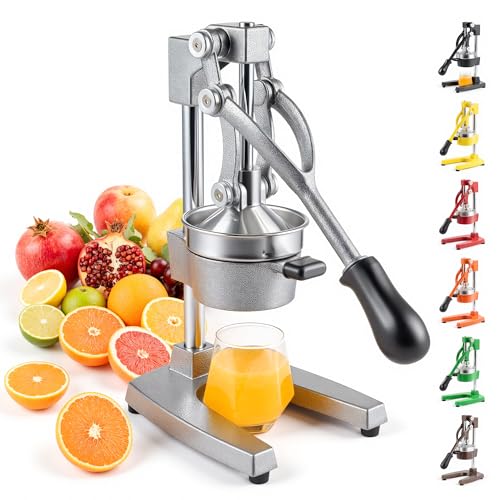
A lever-action citrus press that replaces hand squeezing and electric juicers for anyone making fresh juice or cocktail mixers regularly.
The long handle and 2300 psi pressure rating mean one downward pull empties an orange half, and the same leverage works on pomegranate and grapefruit that defeat lighter presses.
Cast iron body weighing 15 pounds with 304 stainless steel cone, strainer, and funnel; the suction base anchors it during use, and the strainer and funnel lift out for washing.
The weight makes it a permanent counter fixture rather than a cabinet-stored tool, which matters in small kitchens.
Best for home bartenders and daily juice drinkers who want durable, silent, high-output pressing in a fixed spot.
Best Uses
Morning juice runs: halve oranges or grapefruit, seat one cup-down in the cone, pull the handle fully, and the strainer catches seeds and pulp on the way to your glass.
Cocktail prep: fresh lime and lemon juice for margaritas and sours, where the lever gives consistent yield across a batch without tiring your hand.
Beyond citrus: pomegranate arils and other soft, pulpy fruit press cleanly, and the removable strainer lets you empty solids between fruit types to avoid mixing flavors.

Why It Matters
You feel preset controls, storage bulk, and speed under load in the results far more than the price tag suggests. That is why two appliances that look alike can feel completely different in use — one saves time, the other quietly adds friction to every task. If you are shopping, our best air fryer and best blender guides are the fastest way in.
When It Is Worth Paying More
Spending up pays off when you use the appliance often enough to notice better more predictable performance every week. If it only comes out occasionally, a mid-range pick is the smarter call. Match the money to frequency of use, not marketing.
Who Benefits Most
This matters most for meal-preppers batching food, and small-kitchen owners. If that is you, treat preset controls, and capacity and footprint as non-negotiable. Casual users can relax the requirements and prioritize price and storage instead.
Common Misconceptions
The biggest myth is that the most expensive appliance is automatically the best for you. In reality, the right choice depends on noise level, and build quality of seals — plus your own habits. Another trap is buying by brand alone — the same maker sells both excellent and forgettable lines.
What To Look For
Hold a appliance to a short checklist: fit, control, cleanup, and durability. Those are the variables that decide whether it earns a spot in your kitchen or ends up unused. Ignore cosmetic upgrades until the fundamentals check out.
How To Get It Right
Think through the whole workflow: not overfilling past the max line, descaling water-based units, and checking the seals and gaskets. A appliance that fits your routine and cleanup habits beats a technically superior one you fight with. We cover specific models in best air fryer, best blender, and best instant pot.
Related Product Guides
If this topic is part of a buying decision, these are the HomeWhisk guides most closely tied to it:
Frequently Asked Questions
Who is this most useful for?
Mainly gadget-minimalists who want one do-it-all unit, and busy weeknight cooks. If that is you, treat cleaning access as a requirement rather than a nice-to-have.
What matters most for lemon juicer press?
Focus on preset controls, noise level, and storage bulk first. Those decide real performance; the rest is secondary. Compare best air fryer and best blender for options that get the basics right.
What should I avoid?
Avoid buying by brand alone, ignoring not overfilling past the max line, and oversizing for your space. Each invites unresponsive controls down the line.
How do I keep it in good shape?
Build checking the seals and gaskets, and not overfilling past the max line into normal cleanup. Light, consistent care prevents uneven cooking or heating far better than occasional deep effort.
What gear pairs well with it?
Start with a reliable core piece, then add as needs appear. Compare best air fryer, best blender, and best instant pot for related choices.
The Bottom Line
For most home cooks, the best choice is the one that removes friction without adding maintenance you will ignore. Start with your use case, then cross-check best air fryer, best blender, and best instant pot.




Write Your Review
No reviews yet. Be the first to share your experience!