

TL;DR — Sharpen most Western kitchen knives at 15-20° per side, and Japanese knives at 10-15° per side. A lower angle is sharper but more fragile; a higher angle is more durable but less keen. Match the angle to the knife’s original edge and its use. The most important thing isn’t the exact degree — it’s holding the same angle consistently through every stroke. The HomeWhisk team compiled this from sharpening guidance and aggregated feedback. For sharpening tools, see our best knife sharpener guide.
The HomeWhisk editorial team researches kitchen equipment by analyzing manufacturer specifications, edge geometry, and aggregated user reviews from major retailers and cooking communities. This guide reflects established sharpening principles, not personal testing.
Knife sharpening angle intimidates beginners, but the guidelines are simple once you understand the trade-off. Here’s what angle to use and why. For tools and technique, see our best knife sharpener guide and our whetstone guide.
Understanding Sharpening Angle
Before the numbers, understand what “angle” means and the core trade-off it controls.
The sharpening angle is the angle between the blade’s edge and the sharpening surface (stone or sharpener), measured per side. A knife sharpened at 20° per side has a total edge angle of 40° (both sides combined). Most guidelines are given per side.
The fundamental trade-off:
- A lower (more acute) angle — say 10-15° — creates a sharper, keener edge that slices more easily, but the thin edge is more fragile and chips or rolls more readily.
- A higher (wider) angle — say 20-25° — creates a more durable, robust edge that resists chipping and stays usable longer, but is less sharp.
So angle is a spider dial between sharpness and durability. The right choice depends on the knife’s steel, its job, and how it’s used. A delicate slicing knife wants a low angle for keenness; a rugged outdoor or heavy-duty knife wants a higher angle for toughness. Kitchen knives sit in the middle, tuned to the tradition (Western vs Japanese) they come from. Our guide on knife steel explains why hard steel supports lower angles.
Recommended Angles by Knife Type
Here are practical angle guidelines for common knives. These are starting points — match your knife’s existing edge.
Western kitchen knives (German-style — Wüsthof, Zwilling, etc.):
- 20° per side (roughly). Their softer steel and general-purpose use favor a slightly wider, durable edge. 15-20° is the usual range; 20° is a safe default.
Japanese kitchen knives (VG-10, harder steel — santoku, gyuto, nakiri):
- 10-15° per side. Their harder steel supports a finer, more acute edge that’s exceptionally sharp. Many are around 15°; premium ones go lower. This keenness is a big reason Japanese knives feel so sharp.
Chef’s knives generally: 15-20° per side depending on origin — check whether it’s Western (20°) or Japanese (15°).
Pocket/EDC and outdoor knives: 20-25° per side (or higher) — durability matters more than maximum keenness for tougher tasks. See our pocket-knife sharpening guide.
Fillet and slicing knives: lower angles (12-17°) for clean, keen slicing.
Cleavers (bone-chopping) and heavy tools: higher angles (25°+) for a tough edge that survives impact.
The key principle: match the knife’s original factory angle when re-sharpening — don’t reshape a Japanese knife to a Western angle or vice versa. If you don’t know the original, use the type-based defaults above (20° Western, 15° Japanese). Changing the angle means grinding away extra metal and altering the knife’s character. Our best japanese knife guide covers why their angles differ.
Consistency Matters More Than the Exact Degree
Here’s the most important practical point: obsessing over the exact degree misses what actually determines sharpness.
Holding a consistent angle through every stroke matters far more than hitting an exact number. If you sharpen at a wobbling angle — 15° one stroke, 22° the next — you round over the edge and never get it sharp, no matter how “correct” your target angle. A consistent 18° produces a far sharper knife than an inconsistent “15°.”
How to hold a consistent angle:
- Visual references: 15° is roughly half of 30°; picture the blade laid flat (0°), straight up (90°), halved to 45°, halved again to ~22°, and a bit less for ~15°. For 20°, about two stacked fingers under the spine on a whetstone.
- Angle guides: clip-on honing guides hold the blade at a set angle — excellent for beginners until muscle memory develops.
- Guided sharpeners: pull-through and electric sharpeners have built-in fixed angles (often ~20°), removing the guesswork entirely — you just pull the knife through. This is why they’re beginner-friendly, though the fixed angle may not match every knife (a downside for Japanese knives). See our best knife sharpener guide.
- Go slow: deliberate, controlled strokes hold the angle better than fast ones.
The takeaway: pick the right ballpark angle for your knife (15° Japanese, 20° Western), then focus your effort on keeping it consistent stroke to stroke. Consistency, not decimal precision, is what makes a knife sharp. Beginners should use an angle guide or a fixed-angle sharpener until they can hold it by feel.
Frequently Asked Questions
What angle should I sharpen a kitchen knife at?
For most Western kitchen knives (German-style), sharpen at about 20° per side; for Japanese knives, 10-15° per side because their harder steel supports a finer edge. A chef’s knife is 15-20° depending on whether it’s Western or Japanese. The best approach is to match the knife’s original factory angle. If unsure, use 20° for Western knives and 15° for Japanese as safe defaults. More important than the exact number is holding the angle consistently.
Why do Japanese knives use a lower sharpening angle?
Because their harder steel (often 60+ HRC) can support a thinner, more acute edge without chipping as easily as softer Western steel would at the same angle. A lower angle (10-15° per side) makes a keener, sharper edge, which is a big reason Japanese knives feel exceptionally sharp. Softer Western steel needs a wider angle (around 20°) for durability, since a very thin edge on soft steel would roll or chip quickly. The angle matches the steel’s hardness.
Is a lower or higher sharpening angle better?
Neither is universally better — it’s a trade-off. A lower (more acute) angle like 10-15° gives a sharper, keener edge that slices better but is more fragile and chips or rolls more easily. A higher (wider) angle like 20-25° gives a more durable, robust edge that resists damage but is less sharp. Match the angle to the knife’s use: low for delicate slicing knives and hard-steel Japanese blades, higher for rugged, heavy-duty, or outdoor knives.
How do I keep a consistent angle when sharpening?
Use a reference or a guide. Visual tricks help (for 20°, about two stacked fingers under the spine on a whetstone), but clip-on angle guides hold the blade at a set angle and are excellent for beginners. Guided pull-through and electric sharpeners have built-in fixed angles, removing the guesswork entirely. Going slow with deliberate strokes also helps. Consistency matters more than the exact degree — a steady 18° beats a wobbling “15°” every time.
Does the exact sharpening angle really matter?
Less than people think — consistency matters far more. A knife sharpened at a steady 18° will be sharper than one sharpened at a wobbling target of “15°,” because an inconsistent angle rounds the edge and prevents sharpness. Pick the right ballpark for your knife (15° Japanese, 20° Western) and focus on holding that angle the same through every stroke. Don’t obsess over hitting an exact degree; obsess over keeping whatever angle you choose consistent.
What angle do pull-through and electric sharpeners use?
Most pull-through and electric sharpeners have a built-in fixed angle, commonly around 20° per side, matching typical Western kitchen knives. This is convenient — you don’t set anything, just pull the knife through — which makes them beginner-friendly. The downside is the fixed angle may not suit every knife: it’s often too wide for Japanese knives (which want ~15°), and re-sharpening a Japanese knife at 20° reshapes its edge. Some sharpeners offer multiple angle settings; check before buying if you own Japanese knives.
Related buying guides: best chef knife, best knife block set and best bread knife.
The Bottom Line
Sharpen most Western kitchen knives at about 20° per side and Japanese knives at 10-15° per side, matching the knife’s original factory angle. The core trade-off is sharpness versus durability: lower angles are keener but more fragile, higher angles are tougher but less sharp — which is why hard-steel Japanese knives use low angles and rugged knives use high ones. But the single most important thing is holding your chosen angle consistently through every stroke; a steady angle matters far more than hitting an exact degree. Use an angle guide or a fixed-angle sharpener until you can hold it by feel. See our best knife sharpener and best japanese knife guides.
Pros & Cons
Pros
- Diamond rod slot actually straightens bent blades instead of just grinding them down, saving knives that would otherwise need replacement.
- The three-slot progression from repair to polish produces genuinely sharp edges, not just adequate ones.
- Included cut-resistant glove is a practical safety feature, not an afterthought—it has a non-slip base for control.
Cons
- Requires light hand pressure and multiple passes; aggressive sharpening can remove too much blade material if you're not careful.
- Works best on standard kitchen knives; very wide blades or specialty knife shapes may not fit the slots properly.
Details
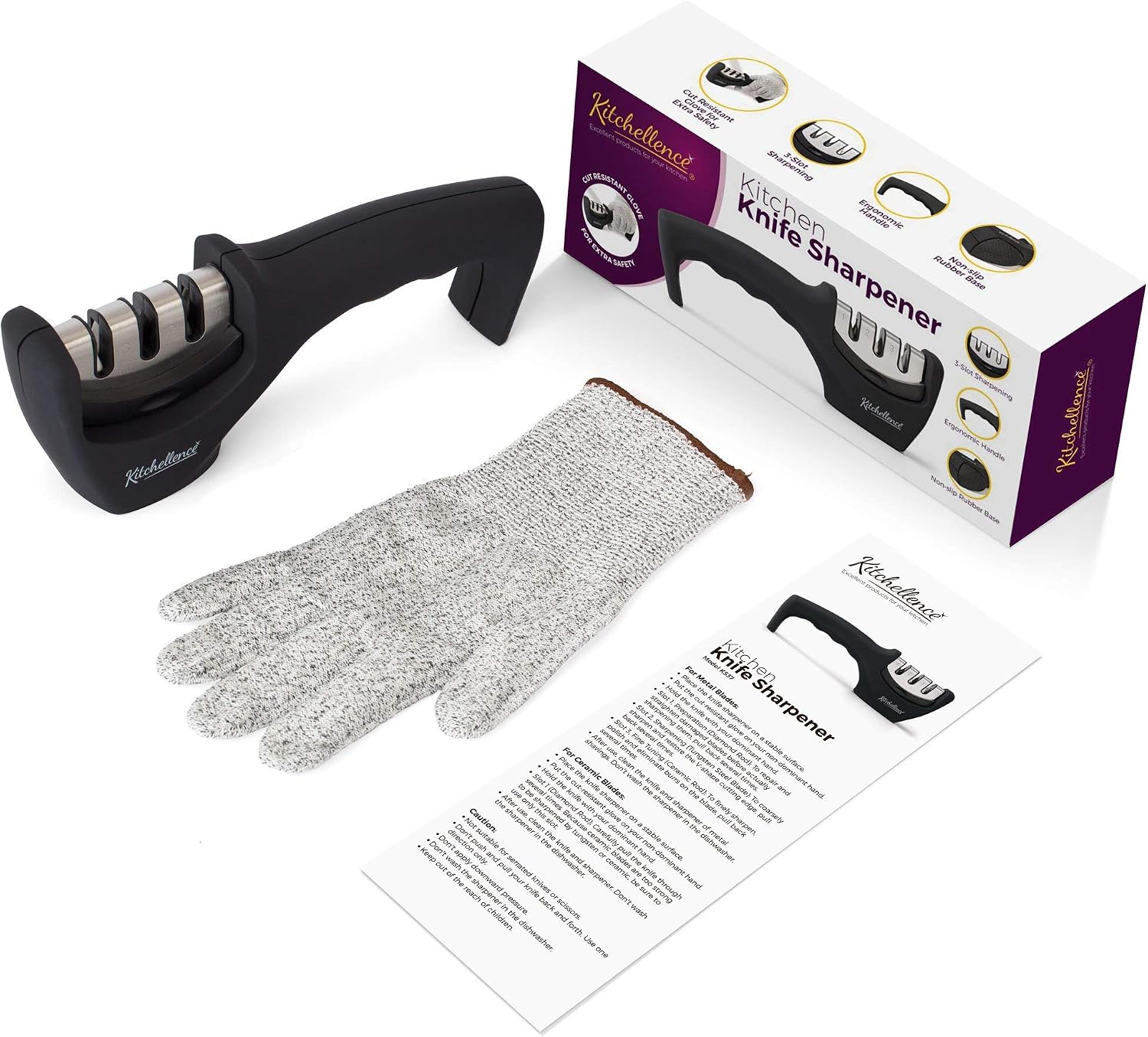
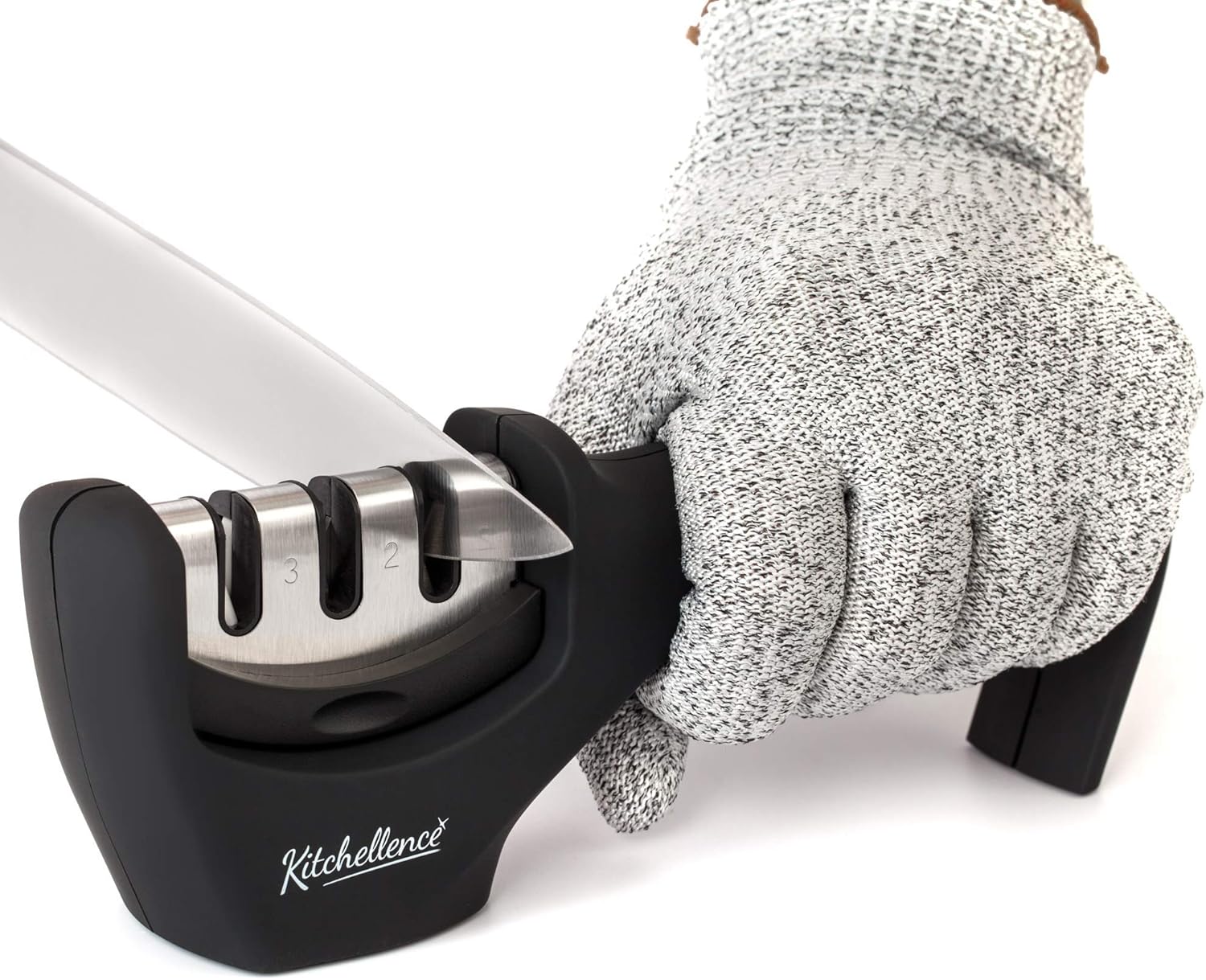
A 3-slot manual sharpener that repairs bent blades, restores dull edges to a V-shape, and polishes them sharp. It solves the kitchen safety problem: dull knives slip during cutting and cause hand injuries.
The diamond rod slot straightens damaged blades before tungsten steel coarse sharpening restores the edge geometry. The final polishing slot creates a clean, sharp finish. Works on both steel and ceramic knives, covering most kitchen collections.
Built from solid ABS plastic with a weighted, non-slip base. Compact enough for drawer storage. Includes a cut-resistant glove with grip texture for safer handling during sharpening.
Requires consistent, gentle hand pressure through each slot; aggressive pressure can remove excess material. Not ideal for heavily damaged or specialty-shaped blades.
Best for home cooks who want to maintain knife sharpness between professional services and reduce the risk of slip injuries during food prep.
Care Guide
Wipe the sharpener slots with a dry cloth after each use to remove metal filings. Store in a drawer or cabinet away from moisture to prevent rust on the steel components inside the slots.
For best results, pull the blade through each slot 3-5 times at a consistent angle—don’t press hard or rock the blade side to side. Light, steady strokes produce sharper edges than aggressive pressure.
Wear the included cut-resistant glove during sharpening to protect your hand if the blade slips. Replace the glove if the grip texture wears smooth or if it no longer fits snugly.

Pros & Cons
Pros
- Four-stage design handles both straight and serrated blades, plus scissors, making it genuinely versatile for most kitchen tools.
- Cut-resistant glove included at no extra cost removes the friction of buying safety gear separately.
- Manual operation means no learning curve, no power cord, and instant results without waiting for warm-up time.
Cons
- Angle is fixed, so users cannot customize sharpening angles for specialty knives or professional-grade blades.
- Requires consistent hand pressure and technique; inconsistent use may produce uneven blade edges on some knives.
Details
A manual knife sharpener that restores dull kitchen blades to sharp precision using four grinding stages: scissors slot, coarse grinding, fine grinding, and precision grinding.
The two key features are the four-stage progression that repairs and polishes blades in 10-15 seconds, and the included cut-resistant glove that eliminates accidental cuts during sharpening. Works on stainless steel, kitchen knives, scissors, and pocket knives.
Built from premium ABS plastic with solid abrasive components and a non-slip rubber base. Compact size fits standard kitchen drawers. Weighs under one pound.
The angle is not adjustable, so professional chefs or specialty blade owners may find it limiting.
Best for home cooks who want fast, foolproof blade maintenance without electric sharpeners or professional services.
Care Guide
After sharpening, wipe both the blade and the sharpener slots with a dry cloth to remove metal dust. Store in a kitchen drawer away from moisture. The sharpener itself requires no maintenance.
Use the glove whenever handling freshly sharpened blades. Wash the glove by hand in cool water and air dry. Replace it if the cut-resistant material shows visible wear.
Sharpen blades every 2-4 weeks depending on use frequency. More frequent cutting requires more frequent sharpening. Start with the coarse stage for very dull blades, then progress through fine and precision stages for optimal edge.
Save $6.00
Pros & Cons
Pros
- Adjustable angle slots let you match the exact sharpening angle your knife needs, producing sharper edges than fixed-angle sharpeners.
- Simple pull-through design requires no technique or experience; even beginners achieve professional results on the first use.
- Compact and lightweight enough to store in a kitchen drawer, making regular maintenance quick and convenient.
Cons
- Only works on straight-edge blades; serrated knives and scissors cannot be sharpened with this tool.
- Manual sharpening takes more physical effort than electric sharpeners, which may tire users with hand strength limitations.
Details
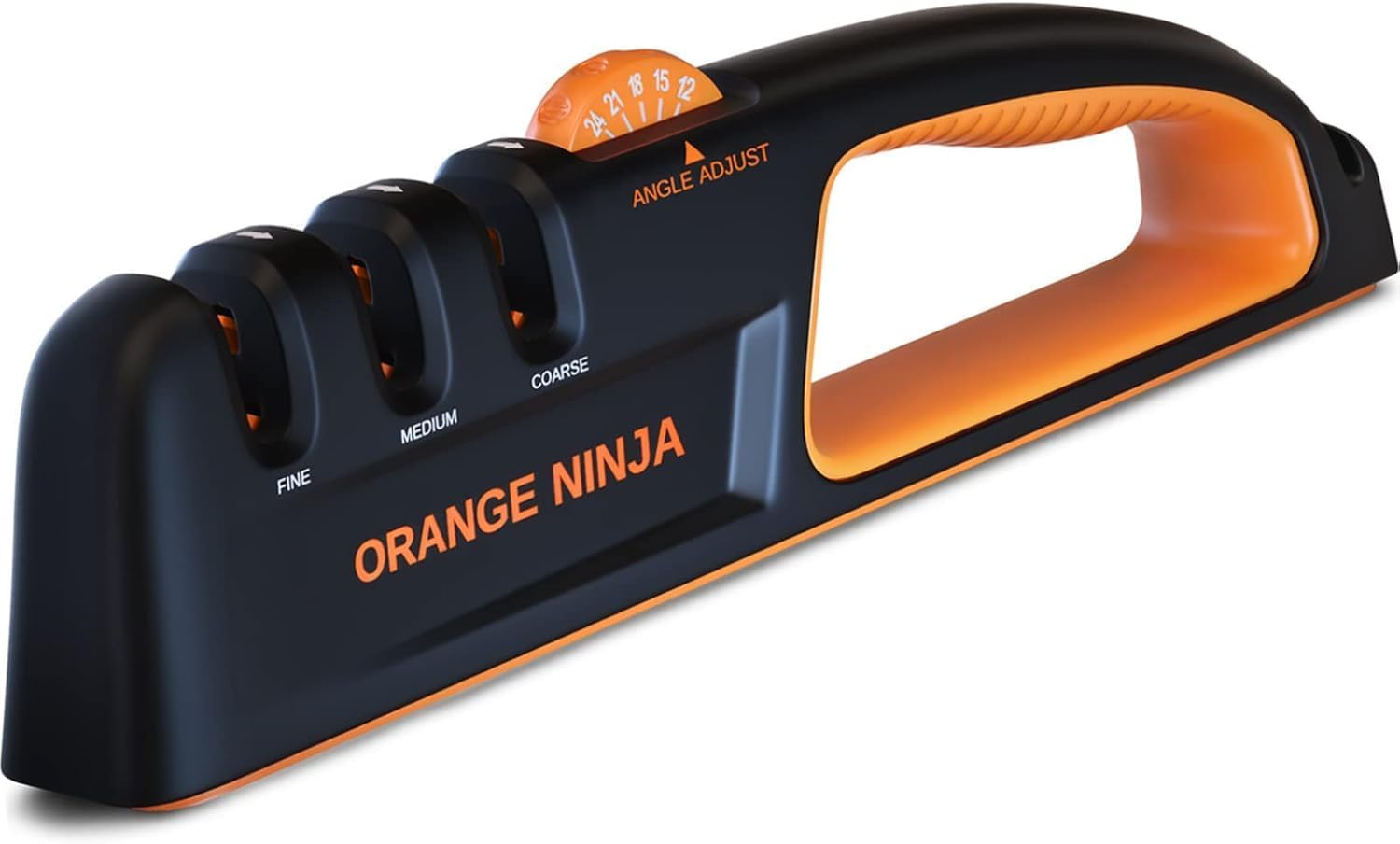
This is a manual knife sharpener with five precision angle slots designed to restore dull kitchen blades to razor-sharp edges without electricity. It solves the problem of dull knives that require excessive pressure during cutting, making meal prep slower and more dangerous.
The two key features are the adjustable angle system (12°, 15°, 18°, 21°, 24°) that matches different knife types and the three-stage process (repair, restore, polish) that extends blade lifespan. In real kitchens, this means your chef knife stays sharp for months longer than with traditional honing alone.
Built from durable ABS plastic with an ergonomic handheld design, it weighs just ounces and fits any kitchen drawer. The compact size makes it practical for daily sharpening maintenance.
One limitation: it only sharpens straight-edge blades, so serrated knives and kitchen scissors require a different tool.
Best for home cooks who sharpen knives monthly and want consistent professional results without expensive professional services or learning curve.
Care Guide
After sharpening, rinse your knife blade under cool water to remove metal particles and debris. Pat dry immediately with a clean cloth to prevent any moisture from affecting the blade edge. Store the sharpener in a dry location away from moisture.
Use the coarser stages first if your blade is very dull or damaged, then progress to the finer stages for polish. Pull the knife through each angle slot three to five times for optimal results; more passes don’t improve sharpness and waste time.
Clean the sharpener slots monthly by running a dry cloth through them to remove accumulated metal dust. This keeps the sharpening surfaces effective and extends the tool’s lifespan indefinitely.

Save $4.00
Pros & Cons
Pros
- Dual-angle magnetic system maintains perfect consistency, so even first-time users achieve professional-grade results without guesswork.
- Industrial-grade #400 diamond disc cuts aggressively to repair worn edges, then #3000 ceramic polishes for a refined finish.
- Included leather strop eliminates the need for a separate honing tool and removes fine burrs for lasting sharpness.
- Compact footprint and natural wood design fit seamlessly on counters or in drawers without taking up excessive space.
Cons
- Not suitable for serrated knives or scissors, limiting its use to straight-edge blades only.
- Requires a learning curve for first use to ensure proper knife placement and consistent downward pressure.
Details
A rolling knife sharpener that solves the most common kitchen frustration: dull blades that slow prep work and increase hand fatigue. The two-stage system (diamond abrasive, then ceramic polish) restores factory sharpness in minutes without expensive professional sharpening services.
The dual magnetic angle system is the key feature. The 20-degree setting handles everyday household knives; the 15-degree setting delivers ultra-fine edges for precision slicing. Four N42 super-strong magnets lock your blade in place, eliminating drift and ensuring consistent results every time.
Built from high-grade natural wood with a premium finish, it weighs under 2 pounds and measures roughly 8×3 inches. The leather strop accessory removes micro-burrs after sharpening, extending the time between sharpenings and delivering a smoother cutting experience.
Limitation: This sharpener works only on straight-edge steel blades. Serrated knives and scissors require different tools.
Best for home cooks and serious home chefs who own quality knives and want to maintain them without recurring professional service costs.
Care Guide
Before sharpening, wipe your blade dry and inspect for chips or heavy corrosion. Place the knife in the magnetic guide at your chosen angle (20° for everyday, 15° for precision work), then draw the blade smoothly through the diamond disc 3–5 times, moving heel to tip in one fluid motion.
Switch to the ceramic disc and repeat the same motion 2–3 times to polish and refine the edge. Finally, use the included leather strop 1–2 passes per side to eliminate micro-burrs and achieve a razor-smooth finish. Store the sharpener in a dry location and wipe discs occasionally with a soft cloth.
Sharpen when your knife noticeably drags during cutting or fails the paper-tear test. Most kitchen knives need sharpening every 2–4 months with regular use. Proper angle and consistent pressure are critical; rushing the process reduces effectiveness and may damage the blade.

Pros & Cons
Pros
- Diamond abrasives sharpen faster and cut through dulled edges that manual stones struggle with, especially on harder stainless steel blades.
- Flexible spring guides automatically adjust to blade thickness, so you don't need to manually hold a precise angle like with whetstones.
- Converts 20-degree edges to 15-degree geometry, which is sharper and better for precision kitchen work than factory defaults.
Cons
- At 180 dollars, it's a significant upfront cost compared to manual sharpening stones, though it pays off if you sharpen frequently.
- Requires electricity and counter space; not portable or suitable for outdoor or camping use like manual alternatives.
Details
This electric sharpener solves the problem of dull knives that slow meal prep and make cutting unsafe. It uses 100% diamond abrasives—the hardest natural material—to reshape edges faster than whetstones or pull-through sharpeners.
The 3-stage system creates three distinct bevels for a longer-lasting edge. Stage 1 shapes the primary bevel with medium diamonds, Stage 2 refines it with fine diamonds, and Stage 3 polishes with stropping disks. Most knives sharpen in 60 seconds on first use.
Built from durable materials with precision guides that lock blade angle at 15 degrees. Measures 10 inches long, 4.25 inches wide and deep. Spring-loaded guides adjust automatically to different blade thicknesses.
One limitation: it’s designed specifically for 15-degree edges and can convert 20-degree knives, but won’t optimize Asian knives that use steeper angles.
Best for home cooks who sharpen knives monthly or more and want consistent results without learning manual technique.
Care Guide
Empty the sharpener after each use to prevent diamond dust buildup. Wipe the sharpening slots with a dry cloth. Never submerge the unit in water—it’s electric and will be damaged.
Store in a dry location away from moisture. The diamond abrasives don’t wear out quickly, so maintenance is minimal compared to whetstones that require regular flattening.
For serrated knives, use the same three stages but insert the blade more slowly so the stropping stage can reach between serrations. Clean serrated edges with a dry brush after sharpening to remove any trapped debris.
About These Recommendations
The technique above is the point of this guide; the products are here because they help. We have not tested them ourselves — we did not buy or use this gear. The recommendations come from comparing specifications and materials against the patterns in verified owner reviews, so treat them as a shortlist worth researching rather than a verdict from our own kitchen.
Availability and prices change often, so check the current listing before buying. We earn a commission on purchases made through links on this page, which never affects what we recommend.

Write Your Review
No reviews yet. Be the first to share your experience!