

TL;DR — A good answer to kitchen counter oven starts with real kitchen habits, not a perfect spec sheet. Most readers need a clear way to avoid the wrong tool, not another list of features. When this turns into a purchase decision, compare best air fryer, best blender, and best instant pot before narrowing your shortlist.
The HomeWhisk approach is research-first: compare construction, usability, cleaning, and long-term complaints before recommending a direction. For appliance topics, we pay close attention to capacity, controls, cleanup, storage, reliability complaints, and whether the machine saves enough effort to justify the space.

Save $70.00

Save $10.00
Pros & Cons
Pros
- Massive 26-quart capacity handles full family meals, from whole roasted chickens to multiple sheet pans at once.
- 24 one-touch presets cover everything from air frying and baking to dehydrating and slow cooking without manual temperature adjustments.
- Rotisserie function with included spit and fetch tool delivers evenly cooked, self-basting meats with crispy skin.
- French door design provides wide access and stays cooler to the touch than traditional drop-down doors.
Cons
- Large footprint requires significant counter space—measure before purchasing if your kitchen is compact.
- Learning curve for optimal rack positioning across different cooking modes may require trial and error initially.
Details
This is a countertop convection oven that air fries, bakes, roasts, broils, dehydrates, and slow cooks—eliminating the need for separate appliances. It solves the problem of limited counter space while expanding cooking methods.
The dual-speed fan and 360° air circulation cook food 30% faster than conventional ovens while using little to no oil. Digital controls and 24 presets remove guesswork from temperature and timing.
Stainless steel construction with French doors and tempered glass. Measures approximately 20 x 16 x 13 inches. Weighs around 25 pounds. Interior fits a 12-inch pizza or 6-pound chicken. Racks adjust to multiple heights.
The size is both an advantage and a limitation—it handles large batches but demands permanent counter real estate. Not ideal for small kitchens or infrequent cooks.
Best for families of four or more who cook daily and want appliance consolidation without sacrificing capacity or function variety.
How to Use
Place the oven on a heat-resistant surface with 4 inches of clearance on all sides. Plug into a grounded outlet. Select a preset or manually set temperature and time using the digital dial.
For air frying, use the included basket on the middle rack. For rotisserie, insert the spit through the center of the meat, secure with forks, and place on the rotisserie supports. The fetch tool removes hot accessories safely.
Preheat when baking or roasting for even results. Toast mode automatically shuts off when the timer ends—no need to monitor. Wipe interior and accessories after each use; removable crumb tray catches drips.

Pros & Cons
Pros
- Large 0.6 cubic foot interior fits full family meals without cooking in batches.
- Eight preset functions eliminate guesswork for air frying, convection baking, grilling, and toasting.
- Includes five accessories out of the box: grill plate, air fry basket, oven rack, baking pan, and drip tray.
- Interior oven light lets you monitor browning without opening the door and losing heat.
Cons
- Takes up 16 inches of counter width, which crowds smaller kitchens or limits workspace.
- Grill and griddle plate requires handwashing due to ceramic nonstick coating that can degrade in dishwashers.
Details
This is a full-size countertop oven that replaces your air fryer, toaster, and indoor grill. It solves the problem of cooking full meals without heating up a wall oven or juggling multiple appliances.
The 1800-watt heating element and top-mounted fan deliver faster air circulation than traditional toaster ovens. AirAdvantage technology pushes hot air down onto food for crispier chicken skin and evenly browned toast in 25% less time than non-convection models.
Stainless steel exterior and interior stand up to daily use. The 0.6 cubic foot cavity measures large enough for a 12-inch pizza or 4-pound chicken. Weighs 21 pounds, so it stays put on the counter but remains light enough to move for cleaning behind it.
The 60-minute timer does not have a digital display, so precise timing under 5 minutes requires watching the dial. The unit also runs hot on the exterior during broiling, so keep it away from cabinets.
Best for families of three or more who want one appliance that air fries appetizers, roasts proteins, and toasts breakfast without switching gear.
How to Use
Preheat for 3 minutes before air frying or baking. This stabilizes temperature and prevents undercooked centers. Skip preheating only when toasting bread or reheating leftovers on the warm setting.
Use the air fry basket for wings, fries, and anything breaded. Place the baking pan underneath to catch drips. Flip food halfway through for even browning since the top heater does most of the work.
The reversible grill and griddle needs a light oil coating before first use. Grill side works for steaks and vegetables; flip it over for pancakes and eggs. Wipe it down after each use while still warm to prevent buildup.
Pros & Cons
Pros
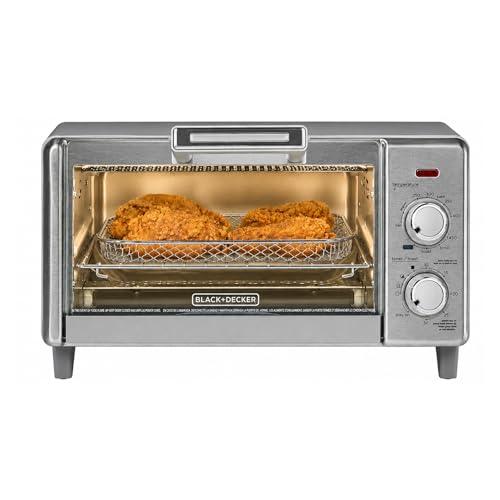
- Air Fry, Bake, Broil, Toast, and Keep Warm settings cover common breakfast, snack, and small-meal tasks.
- The compact 11.5 by 15.5 by 8.2-inch footprint is easier to place in kitchens with limited worktop space.
- EvenToast technology is designed to provide consistent browning without concentrated hot spots.
- At 9.14 pounds, the oven is manageable to reposition when counter space is needed.
Cons
- The 9-inch pizza and four-slice capacity may be too limited for larger families or full-size meals.
- The 30-minute timer may need to be reset when preparing recipes that require longer cooking times.
Details
This compact 5-in-1 oven handles air frying, baking, broiling, toasting, and warming, reducing the need for multiple small appliances in a crowded kitchen.
Air frying uses little to no oil for crisp foods, while EvenToast technology helps four bread slices brown consistently without noticeable hot spots.
Its stainless-steel color, 11.5 by 15.5 by 8.2-inch dimensions, and 9.14-pound weight suit daily countertop use and occasional repositioning.
The medium interior fits only a 9-inch pizza or four bread slices, so it is not intended for large-batch cooking.
Best for small households, apartment kitchens, and cooks preparing compact meals or snacks.
How to Use
Select Air Fry, Bake, Broil, Toast, or Keep Warm based on the food, then set the 30-minute timer and monitor doneness through the oven door.
Use the mesh tray for air frying, the bake pan for baked foods, and the wire rack for toast or dishes needing direct heat circulation.
Keep food clear of the heating element, use the drip tray while cooking, and remove crumbs or drippings after the oven cools.

Save $100.05
Pros & Cons
Pros
- The flip-up storage design reduces the oven's counter footprint by 50% when it is not cooking.
- Six infrared heating elements provide an 85°F to 450°F temperature range for dehydrating through high-heat roasting.
- The included air fry basket, sheet pan, wire rack, and removable crumb tray support multiple cooking methods immediately.
- Air frying can produce foods with up to 75% less fat than traditional deep frying, based on testing with hand-cut fries.
Cons
- The oven requires sufficient clearance near the backsplash for its flip-up storage position.
- Its 1800-watt power draw may require a dedicated outlet without other high-wattage appliances running on the same circuit.
Details
The Ninja SP151 combines a toaster oven and air fryer, solving the need for versatile family cooking without permanently surrendering substantial counter space.
OvenCrisp technology uses infrared heating and rapid circulating air for even results, while eight modes handle foods ranging from toast and bagels to roasted chicken and pizza.
Its stainless steel exterior suits daily countertop use, and the removable crumb tray simplifies routine cleanup. Dimensions and weight are not provided, so measure the intended counter and backsplash area before ordering.
The flip-up feature still requires adequate backsplash clearance, and the oven must cool before being moved into its storage position.
Best for households of up to four that want faster air-fried, toasted, roasted, and baked meals from one space-saving appliance.
How to Use
Select the matching mode, place food on the air fry basket, sheet pan, or wire rack, and set a temperature between 85°F and 450°F based on the recipe.
Use the air fry basket for maximum airflow, the sheet pan for roasting or baking, and the wire rack for toast, bagels, and other supported oven tasks.
After cooking, allow the appliance to cool, empty the removable crumb tray, clean the accessories, and flip the oven upright when the storage area is clear.
Common Misconceptions
The biggest myth is that the most expensive appliance is automatically the best for you. In reality, the right choice depends on storage bulk, and speed under load — plus your own habits. Another trap is buying by brand alone — the same maker sells both excellent and forgettable lines.
Why It Matters
Small differences in capacity and footprint, speed under load, and noise level change the result more than most buyers expect. That is why two appliances that look alike can feel completely different in use — one saves time, the other quietly adds friction to every task. If you are shopping, our best air fryer and best blender guides are the fastest way in.
The Short Answer
Kitchen counter oven usually comes down to one thing: matching the appliance to how you actually cook rather than to a spec sheet. The practical takeaway is that speed under load matters more day to day than headline features. For product picks, compare best air fryer, best blender, and best instant pot.
What To Look For
Judge a appliance by how it feels in normal use, how easy it is to clean, and whether it solves the job you bought it for. Those are the variables that decide whether it earns a spot in your kitchen or ends up unused. Ignore cosmetic upgrades until the fundamentals check out.
Who Benefits Most
This matters most for small-kitchen owners, and busy weeknight cooks. If that is you, treat motor or heating-element power, and build quality of seals as non-negotiable. Casual users can relax the requirements and prioritize price and storage instead.
Related Product Guides
If this topic is part of a buying decision, these are the HomeWhisk guides most closely tied to it:
Frequently Asked Questions
What should I avoid?
Avoid buying by brand alone, ignoring wiping the interior after use, and oversizing for your space. Each invites motors that bog down under load down the line.
Is a premium appliance worth it?
Only if you use it enough to notice better control, durability, or cleanup regularly. Occasional users are well served by a mid-range pick like those in best instant pot.
What is the bottom line?
Match the appliance to your real habits: buy for durability if it is daily, for value and storage if it is occasional.
What matters most for kitchen counter oven?
Focus on digital versus dial controls, build quality of seals, and capacity and footprint first. Those decide real performance; the rest is secondary. Compare best air fryer and best blender for options that get the basics right.
How do I keep it in good shape?
Build letting the motor rest between heavy loads, and descaling water-based units into normal cleanup. Light, consistent care prevents uneven cooking or heating far better than occasional deep effort.
The Bottom Line
For most home cooks, the best choice is the one that removes friction without adding maintenance you will ignore. Start with your use case, then cross-check best air fryer, best blender, and best instant pot.







Write Your Review
No reviews yet. Be the first to share your experience!