


TL;DR — Yes, a stainless steel frying pan is safe for everyday cooking. Stainless steel is an inert iron alloy protected by a passive chromium-oxide layer that keeps the metal from reacting with food. Tiny amounts of nickel and chromium can leach, especially from brand-new pans and long acidic simmers, but for most people those amounts stay well below health limits. The main exception is people with a diagnosed nickel allergy, who may prefer 18/0 or nickel-free grades. Unlike bare nonstick, stainless releases no fumes when overheated. For picks, see our best stainless steel cookware guide.
The HomeWhisk editorial team researches kitchen equipment by analyzing metallurgy, manufacturer specifications, and aggregated user reviews from retailers and communities like Reddit r/Cooking and r/cookware. This guide explains what stainless steel actually is, where the safety concerns come from, and when they matter — so you can decide with facts rather than fear.
Stainless steel is the default material in professional kitchens for good reason, yet a steady stream of questions about nickel, “toxic” metals, and leaching keeps home cooks worried. The honest answer is that stainless steel is one of the safest cookware materials available, with a few narrow caveats worth understanding before you cook your next acidic sauce.
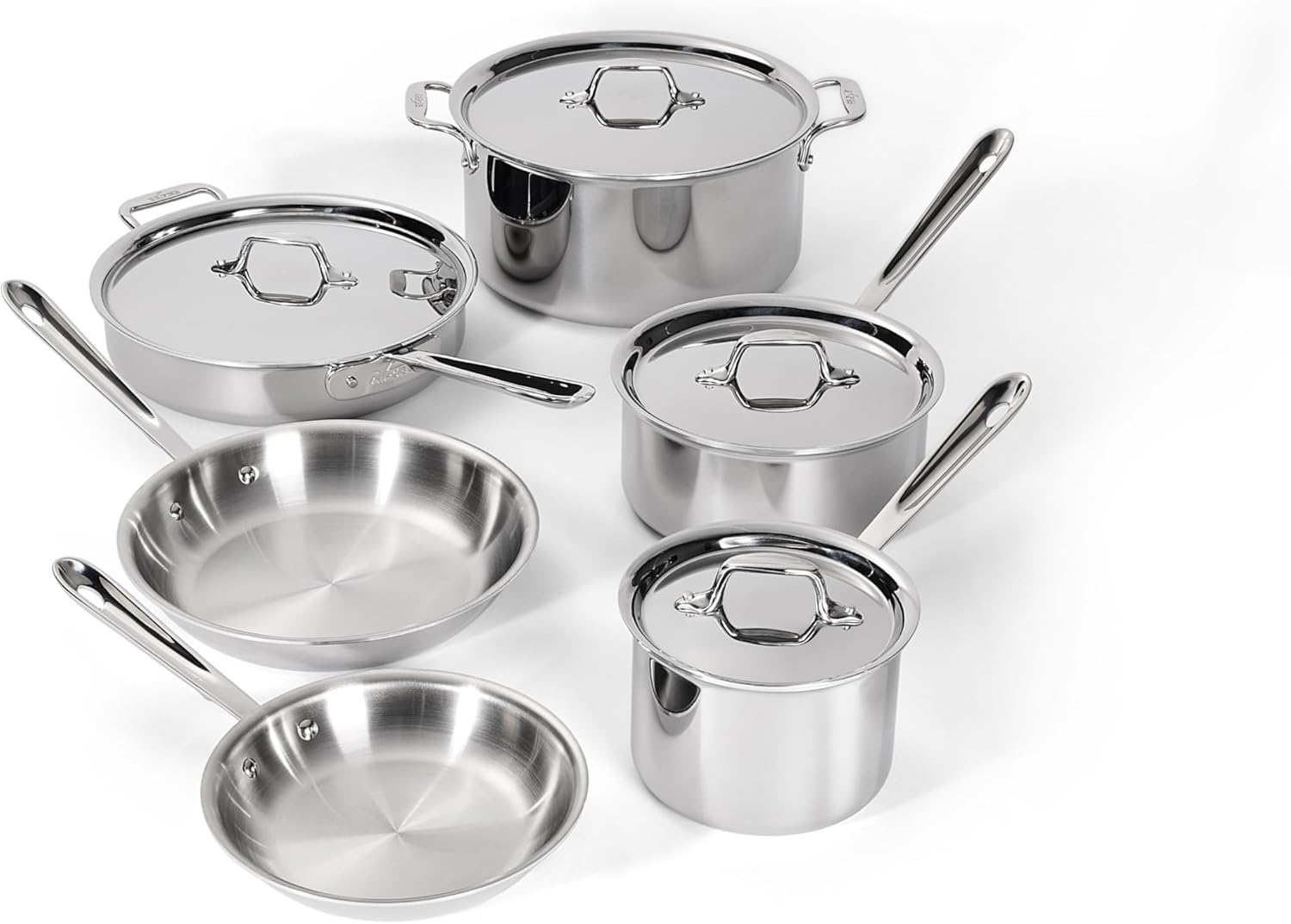
All-Clad D3 10-Piece Cookware Set | Professional Tri-Ply Stainless Steel
This tri-ply stainless steel set delivers fast, even heat distribution across all cooking surfaces with a thick aluminum core bonded between stainless steel layers, eliminating hot spots and enabling professional searing results. Buy it if you cook frequently, value durability over trends, and want cookware that performs identically on gas, electric, or induction ranges while lasting decades.
Pros and Cons
Pros
- Bonded tri-ply construction ensures even heat distribution from edge to edge, preventing burnt bottoms and undercooked centers on stovetop and in oven.
- Made in USA with handcrafted assembly in Pennsylvania factory, delivering precision engineering and quality control unavailable in imported cookware.
- Mirror-polished stainless steel surface resists fingerprints and staining, maintaining showroom appearance through years of daily washing and cooking.
Cons
- Hand-washing required to maintain polish and prevent etching; dishwasher use voids the warranty and dulls the mirror finish over time.
- Premium price point demands significant upfront investment, though per-piece cost becomes reasonable when amortized over 20+ years of use.

Cuisinart
Best Stainless Steel Cookware Set for Home Cooks – Cuisinart 12-Piece MultiClad Pro Triple Ply Review
The Cuisinart MultiClad Pro 12-Piece Set delivers even, consistent heat across induction, gas, and electric cooktops using triple-ply construction with a pure aluminum core that eliminates hot spots. Home cooks who want restaurant-level durability without replacing pans every few years will find this set covers every fundamental cooking task from searing to simmering.
Pros and Cons
Pros
- Heat Surround technology ensures sidewall heating, which matters when reducing sauces or simmering stocks that need consistent all-around warmth.
- Compatible with induction cooktops as well as gas and electric, so the set moves with you if you change kitchen setups.
- Tapered rims allow clean, drip-free pouring directly from saucepans, which reduces countertop mess during everyday cooking.
- The 12-piece configuration covers a wide range of tasks — the 3.5-quart sauté pan with helper handle alone handles most weeknight proteins and vegetables.
Cons
- Stainless steel requires proper preheating and oil management to prevent sticking; cooks accustomed to nonstick surfaces will need to adjust technique.
- At 12 pieces, storage space becomes a practical consideration — this set works best in kitchens with dedicated pot drawer or rack space.
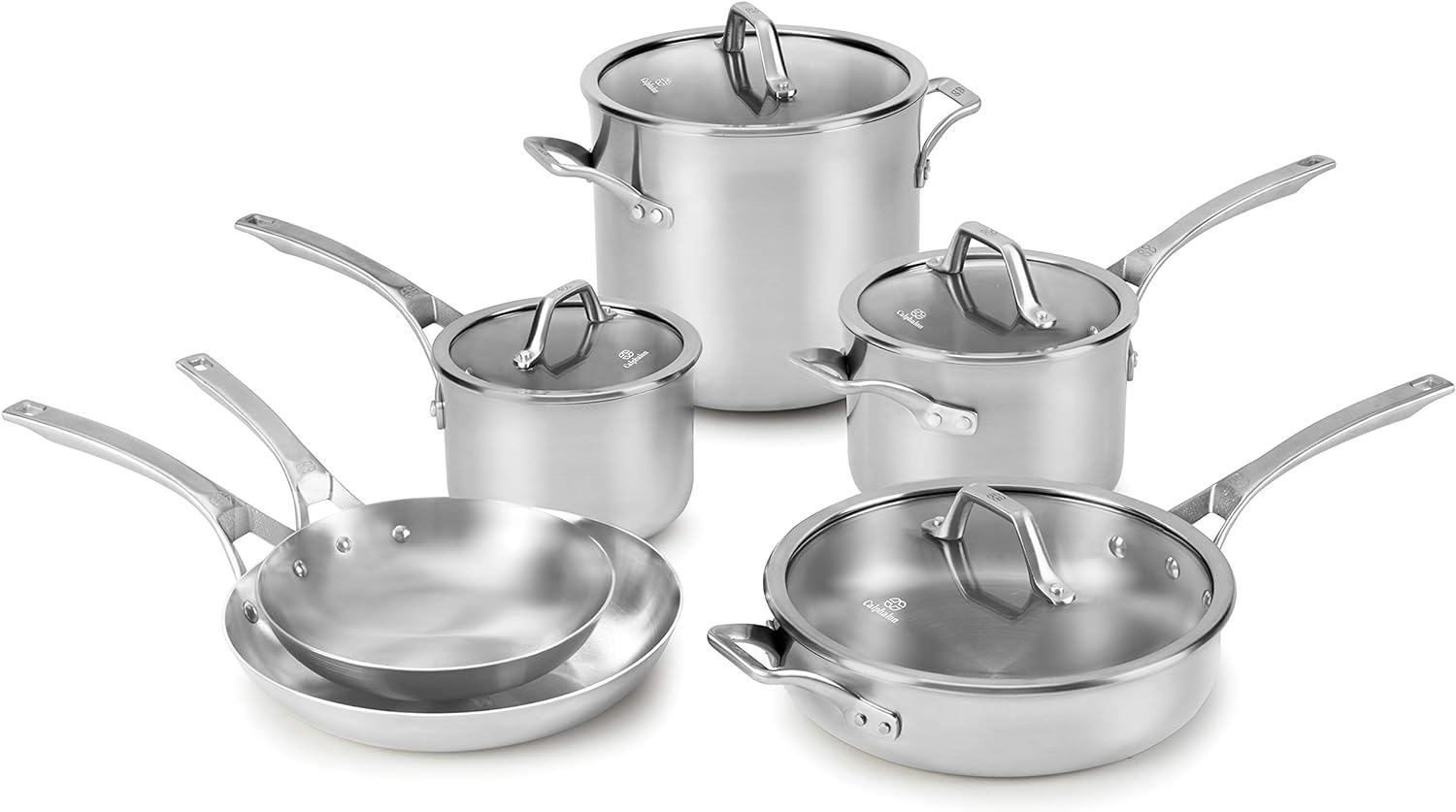
Calphalon 5-Ply Stainless Steel 10-Piece Cookware Set Induction Oven Safe
This 5-ply stainless steel set delivers even heat distribution across all pieces thanks to its triple-layer aluminum core, eliminating hot spots during searing and sautéing. Buy it if you cook frequently on multiple stovetop types and need oven-safe cookware that transitions seamlessly from stovetop to table.
Pros and Cons
Pros
- Triple-layer aluminum core distributes heat evenly across pan bottoms, eliminating the uneven browning common in cheaper cookware.
- Lifetime warranty backs the durability claim, giving you long-term protection on your investment.
- Metal-utensil-safe design means you can use metal whisks and spatulas without worrying about coating damage or scratches.
Cons
- At $599.99, this set requires significant upfront investment compared to non-clad alternatives, though the lifetime warranty justifies the cost.
- Stainless steel exterior shows fingerprints and water spots, requiring regular polishing to maintain the showroom appearance.

Cuisinart
Multiclad Pro 12-Piece Tri-Ply Stainless Steel Cookware Set
This 12-piece set features professional tri-ply construction with drip-free pouring rims and 18/10 stainless steel surfaces that won't discolor or react with food. Buy it if you cook regularly and want durable, dishwasher-safe cookware that handles everything from sauces to skillets without replacing pieces.
Pros and Cons
Pros
- Tri-ply construction ensures consistent, even heating that prevents scorching and reduces cooking time for faster meal prep.
- Dishwasher safe with riveted handles that don't loosen, making cleanup effortless after heavy cooking sessions.
- 18/10 stainless steel resists staining from acidic foods and won't leach metallic flavors into dishes.
Cons
- Heavier than non-stick cookware, which can be tiring during extended cooking or for users with limited hand strength.
- Requires proper seasoning technique and oil to prevent sticking, unlike non-stick alternatives that work immediately out of the box.

All-Clad D3 7-Piece Stainless Steel Cookware Set | Induction Ready
The D3's tri-ply construction delivers even heat distribution across all cooktops, eliminating hot spots that ruin sauces and sears. Buy this if you cook frequently and want cookware that won't warp, discolor, or need replacing for decades.
Pros and Cons
Pros
- Aluminum core distributes heat instantly and evenly, eliminating the cold spots that cause uneven browning in skillets or boiling rings in stockpots.
- Lifetime warranty and USA manufacturing signal confidence in durability; owners report pieces performing identically after 10+ years of daily use.
- Induction compatibility means you can upgrade to induction cooktops without abandoning your cookware, protecting your investment long-term.
Cons
- Hand-washing only; the dishwasher convenience of budget cookware is sacrificed for surface preservation, adding 5 minutes per use to cleanup.
- Premium price point makes this a significant upfront investment compared to non-bonded stainless sets, though cost-per-year drops dramatically over a 20-year lifespan.
All-Clad D3 10-Piece Cookware Set | Professional Tri-Ply Stainless Steel
All-Clad D3 10-Piece Cookware Set | Professional Tri-Ply Stainless Steel
This tri-ply stainless steel set delivers fast, even heat distribution across all cooking surfaces with a thick aluminum core bonded between stainless steel layers, eliminating hot spots and enabling professional searing results. Buy it if you cook frequently, value durability over trends, and want cookware that performs identically on gas, electric, or induction ranges while lasting decades.
Check price on AmazonThis 10-piece set solves the problem of uneven heating and hot spots that plague budget cookware, delivering consistent results whether you're searing steaks or simmering delicate sauces.
The tri-ply bonded construction features a thick aluminum core sandwiched between stainless steel layers, enabling rapid heat absorption and even distribution across the entire cooking surface. Flared edges ensure drip-free pouring and precise plating without mess.
Each piece is handcrafted in Pennsylvania using ultra-durable stainless steel that resists warping, tarnishing, and discoloration. The set includes 8 and 10-inch fry pans, 2 and 3-quart saucepans with lids, a 3-quart sauté pan with lid, and an 8-quart stockpot with lid, covering 95% of home cooking tasks.
Riveted handles are engineered for a chef's underhand grip, providing exceptional balance and control when moving heavy cookware from stovetop to oven or table.
Best for home cooks who value performance and longevity over affordability and plan to use the same cookware for 20+ years.
Cuisinart Best Stainless Steel Cookware Set for Home Cooks – Cuisinart 12-Piece MultiClad Pro Triple Ply Review
Cuisinart
Best Stainless Steel Cookware Set for Home Cooks – Cuisinart 12-Piece MultiClad Pro Triple Ply Review
The Cuisinart MultiClad Pro 12-Piece Set delivers even, consistent heat across induction, gas, and electric cooktops using triple-ply construction with a pure aluminum core that eliminates hot spots. Home cooks who want restaurant-level durability without replacing pans every few years will find this set covers every fundamental cooking task from searing to simmering.
Check price on AmazonThe Cuisinart MultiClad Pro is a 12-piece stainless steel set built to replace mismatched pans with one cohesive system that handles searing, simmering, steaming, and boiling.
Triple-ply construction bonds two stainless steel layers around a pure aluminum core, delivering Heat Surround technology that heats sidewalls as effectively as the base — critical for even reductions and custards.
The set includes seven vessels and five matching lids, covering 1.5-quart to 8-quart capacities, plus a 20cm steamer insert. All pieces are oven-safe to 500°F and induction-compatible.
Stainless steel requires technique — food will stick if the pan isn't properly preheated. This is not a drop-in replacement for nonstick without a short learning curve.
Best for home cooks upgrading from entry-level cookware who want a durable, oven-to-table set that performs consistently across multiple heat sources.
Calphalon 5-Ply Stainless Steel 10-Piece Cookware Set Induction Oven Safe
Calphalon 5-Ply Stainless Steel 10-Piece Cookware Set Induction Oven Safe
This 5-ply stainless steel set delivers even heat distribution across all pieces thanks to its triple-layer aluminum core, eliminating hot spots during searing and sautéing. Buy it if you cook frequently on multiple stovetop types and need oven-safe cookware that transitions seamlessly from stovetop to table.
Check price on AmazonThis 10-piece Calphalon set solves uneven heating and hot spots that plague budget cookware, delivering restaurant-quality browning on home stovetops.
The triple-layer aluminum core sandwiched between stainless steel layers ensures heat spreads uniformly across the entire pan bottom. The 500°F oven-safe rating lets you sear proteins on the stovetop, then finish them in the oven without dirtying extra dishes.
Fully clad 5-ply construction means aluminum runs all the way up the sides, not just the bottom, maximizing heat retention during cooking. The set includes two fry pans, two sauce pans with lids, one sauté pan with lid, and one stock pot with lid, covering 95% of everyday cooking tasks.
Stainless steel handles require careful hand positioning during high-heat cooking to avoid contact with the pan rim, which can transfer heat despite the "cool-to-touch" design.
Best for home cooks who sear and sauté regularly and want cookware that performs like commercial-grade equipment without the commercial price tag.
Cuisinart Multiclad Pro 12-Piece Tri-Ply Stainless Steel Cookware Set
Cuisinart
Multiclad Pro 12-Piece Tri-Ply Stainless Steel Cookware Set
This 12-piece set features professional tri-ply construction with drip-free pouring rims and 18/10 stainless steel surfaces that won't discolor or react with food. Buy it if you cook regularly and want durable, dishwasher-safe cookware that handles everything from sauces to skillets without replacing pieces.
Check price on AmazonThis 12-piece set delivers professional-grade cookware for home cooks who prepare multiple dishes regularly. The tri-ply construction solves uneven heating that burns food on cheap single-layer pans.
Drip-free pouring rims eliminate spills when transferring hot liquids, and tight-fitting lids seal in moisture for faster, healthier cooking. The 18/10 stainless steel surface resists discoloration from acidic foods like tomatoes, vinegar, and citrus.
Solid stainless steel riveted handles stay secure through hundreds of dishwasher cycles. The set weighs more than aluminum cookware, which some users find tiring during extended cooking.
Cool-grip handles require brief cooling after stovetop use, unlike silicone handles that stay cool throughout cooking.
Best for home cooks who cook 4+ times weekly and want durable cookware that handles acidic ingredients without staining or flavor transfer.
All-Clad D3 7-Piece Stainless Steel Cookware Set | Induction Ready
All-Clad D3 7-Piece Stainless Steel Cookware Set | Induction Ready
The D3's tri-ply construction delivers even heat distribution across all cooktops, eliminating hot spots that ruin sauces and sears. Buy this if you cook frequently and want cookware that won't warp, discolor, or need replacing for decades.
Check price on AmazonAll-Clad D3 solves the uneven heating problem that causes hot spots, scorched bottoms, and failed sauces. The tri-ply bonded construction (stainless-aluminum-stainless) ensures responsive, predictable heat distribution across all cooktop types.
The 10-inch skillet sears meat evenly without moving it; the 6-quart stockpot boils water in 8 minutes instead of 12. Aluminum core runs edge-to-edge, not just the bottom, eliminating the ring of heat that plagues cheaper cookware.
Each piece is handcrafted from 18/10 stainless steel in Canonsburg, Pennsylvania. The set weighs approximately 15 pounds total; the stockpot alone holds 6 quarts and fits standard cabinet space. Mirror-polished surfaces reflect light and show fingerprints, requiring hand-washing to maintain appearance.
The only real limitation: you cannot use a dishwasher, which adds roughly 5 minutes of hand-washing per cooking session. For daily cooks, this is negligible; for occasional users, it may feel burdensome.
Best for home cooks who prepare 4+ meals weekly and value precision heating and 20-year durability over convenience features.
What Stainless Steel Actually Is
Stainless steel is not a single metal — it is an alloy of iron mixed with chromium and, in most cookware grades, nickel. The numbers stamped on a pan — 18/10, 18/8, or 18/0 — describe that recipe. The first number is the percentage of chromium; the second is the percentage of nickel. So 18/10 means 18 percent chromium and 10 percent nickel, while 18/0 means 18 percent chromium and effectively no nickel.
The chromium is what makes the steel “stainless.” When chromium meets oxygen, it forms an ultra-thin, invisible layer of chromium oxide on the surface. This passive layer is chemically stable and self-healing — scratch it and it re-forms within seconds as long as oxygen is present. It is this passive film, not the raw steel underneath, that touches your food, and it is inert. Nickel is added mainly for corrosion resistance, ductility, and the bright, non-magnetic finish. The 18/10 and 18/8 grades (both part of the 304 family) are the most common cooking surfaces. A quality best stainless steel cookware set almost always bonds that 304 surface to an aluminum or aluminum-and-magnetic-steel core for even heat.
Where the Safety Concern Comes From: Nickel and Chromium Leaching
The real question behind “is stainless steel safe” is whether metals migrate from the pan into food. They can, in trace amounts.
Research on metal migration shows that small quantities of nickel and chromium can leach, and the amount rises with three factors:
- Acidity. Simmering tomato sauce, citrus, vinegar, or wine for a long time pulls more metal than searing a steak.
- Cooking time and temperature. Long, hot simmers leach more than quick, dry cooking.
- A brand-new or damaged surface. New pans shed slightly more during their first several uses; heavily scoured or pitted surfaces expose more raw metal.
The reassuring part: studies consistently find that for people without a nickel sensitivity, the leached amounts stay well within tolerable intake levels, and the numbers drop sharply once a pan is broken in. The chromium that leaches is the trivalent form, which is actually an essential trace nutrient in small quantities — not the toxic hexavalent chromium of industrial pollution. For most households, an 18/10 pan simmering the occasional tomato sauce is a non-issue.
Who Should Actually Be Careful About Nickel
The one group with a legitimate reason to pay attention is people with a nickel allergy. Nickel is among the most common contact allergens, affecting a meaningful share of the population and more women than men, usually sensitized through jewelry or watch backs. In sensitive individuals, dietary nickel can occasionally aggravate symptoms such as dermatitis, and the classic sign is a skin reaction to costume jewelry.
If you are in that group, you have easy options. Choose 18/0 stainless (a 400-series, magnetic grade with essentially no nickel), or look for cookware explicitly marketed as nickel-free. You can also lean on other inert materials: enameled cast iron and a well-seasoned best carbon steel pan for cooking both sidestep nickel entirely while giving you a durable, high-heat surface. Carbon steel and cast iron do add small amounts of dietary iron, which is a benefit for most people rather than a drawback.
Is Stainless Steel Toxic When Heated?
No. This is where stainless has a clear advantage over some alternatives. Stainless steel is stable at any temperature a home stovetop, oven, or broiler reaches; it does not break down, off-gas, or release toxic fumes. There is no PTFE, PFOA, or other PFAS “forever chemical” coating on bare stainless, so an empty pan left on a hot burner will not produce the polymer fumes that can come off an overheated nonstick pan. That thermal stability is exactly why stainless is oven- and broiler-safe (check the handle material) and why professional cooks trust it for aggressive, high-heat searing.
The Real Trade-Offs: Benefits and Disadvantages
Stainless steel’s safety profile is excellent, but it is not a perfect material, and the honest picture includes real downsides.
Benefits:
- Durability. It resists dents, does not chip, and can last decades — often outliving nonstick pans several times over.
- High-heat and metal-utensil friendly. No coating to scratch, so metal spatulas and hard searing are fine.
- Great for browning. The fond (browned bits) that sticks during a sear is the foundation of pan sauces.
- Dishwasher- and oven-safe, and easy to sanitize.
Disadvantages:
- It is not nonstick. Food sticks readily if the pan is not preheated and oiled correctly.
- Uneven heating unless clad. Pure stainless conducts heat poorly, which is why quality pans bond it to an aluminum or copper core; a thin single-ply pan develops hot spots.
- Discoloration. Rainbow “heat tint,” white calcium spots from hard water, and stuck-on burnt residue are cosmetic annoyances, all removable with a mild abrasive cleanser.
For anyone weighing a full kitchen refresh, our best cookware sets and best stainless steel cookware guides compare clad construction, weight, and value across brands. If you also want a stovetop espresso maker or a pressure cooker to round out the kitchen, see our best moka pot and best instant pot guides.
How to Cook on Stainless Without Sticking (and Keep It Safe)
Stainless steel cannot be “seasoned” into a permanent nonstick surface the way cast iron can — the passive chromium layer will not hold a baked-on oil polymer for long. But you can get a nearly nonstick result every time with the right technique:
1. Preheat the dry pan over medium heat for a minute or two. 2. Run the water test. Flick a few drops in. When they form a single ball that glides across the surface (the Leidenfrost effect), the pan is at temperature. 3. Add oil, let it shimmer, then add the food. 4. Let food release on its own. Proteins stick when raw and naturally let go once a crust forms — if it resists, wait a little longer.
This technique, not any coating, is what makes stainless behave. To protect the surface long-term: avoid thermal shock (do not plunge a screaming-hot pan into cold water, which can warp it), skip chlorine bleach that can pit the steel, and dry it after washing to prevent water spots.
Frequently Asked Questions
Is a stainless steel frying pan safe to use daily?
Yes. The cooking surface is protected by an inert, self-healing chromium-oxide layer, and the trace metals that leach during normal cooking stay well within safe intake limits for people without a nickel allergy. It is the standard material in professional kitchens precisely because it is durable, sanitary, and chemically stable. Daily use is fine. If you constantly cook long, acidic dishes, an occasional switch to enameled cast iron avoids even the small leaching that acids cause. See our best stainless steel cookware set guide for durable everyday options.
Is 18/10 stainless steel safe for cooking?
Yes, 18/10 is one of the most common and trusted cookware grades. The 18 is the percentage of chromium, which forms the protective passive layer, and the 10 is the percentage of nickel for corrosion resistance and shine. It is a food-grade 304-series steel used worldwide in commercial kitchens. The only people who might prefer an alternative are those with a nickel allergy, who can choose 18/0 (nickel-free) instead. For everyone else, 18/10 offers excellent durability and safety.
Is stainless steel toxic when heated to high temperatures?
No. Stainless steel is thermally stable and does not off-gas or release toxic fumes at stovetop, oven, or broiler temperatures. Unlike bare nonstick pans, which can emit polymer fumes if overheated empty, stainless has no coating to degrade. That makes it a safe choice for high-heat searing and oven finishing, as long as the handles are rated oven-safe. This thermal stability is a major reason professional cooks rely on it for hard, high-temperature cooking.
Can a stainless steel pan go in the microwave?
No — like all metals, stainless steel should not go in a microwave. Metal reflects microwaves rather than absorbing them, which prevents food from heating and can cause arcing (sparks) that may damage the appliance. This is a limitation of the appliance, not a food-safety problem. Stainless is fully safe on gas, electric, and induction cooktops (18/10 works on induction only if the pan has a magnetic base layer) and inside conventional ovens.
What are the main disadvantages of stainless steel cookware?
The biggest drawbacks are that it is not naturally nonstick, so food sticks without proper preheating and oil, and that pure stainless conducts heat poorly, causing hot spots unless the pan has a bonded aluminum or copper core. It also shows cosmetic discoloration — heat tint, hard-water spots, and stuck-on residue — though these clean off with a mild abrasive cleanser. None of these are safety issues; they are convenience trade-offs against its outstanding durability and longevity.
Is a nonstick or stainless steel pan safer?
Both can be used safely, but they fail differently. Modern nonstick coatings are safe at normal cooking temperatures but can degrade or release fumes if overheated empty, and the coating wears out over a few years. Bare stainless has no coating to degrade or ingest, releases no fumes, and lasts for decades, though it leaches trace nickel and chromium. For people avoiding coatings entirely, stainless, carbon steel, and cast iron are the options. Many kitchens keep one nonstick pan for eggs and stainless for everything else.
The Bottom Line
A stainless steel frying pan is safe for the vast majority of home cooks. Its inert chromium-oxide surface, thermal stability, and lack of any chemical coating make it one of the safest and most durable materials you can cook on. The only real caveat is nickel: people with a diagnosed nickel allergy may prefer 18/0, nickel-free grades, or a carbon steel pan, and everyone benefits from breaking in a new pan and not simmering acidic foods for hours on end. If you want a workhorse that lasts decades and handles high heat without worry, stainless is an easy recommendation — see our best stainless steel cookware roundup for specific picks.






Write Your Review
No reviews yet. Be the first to share your experience!