

TL;DR — A plastic-free (or minimal-plastic) espresso machine is safe, and for many people it is the safer choice, because it moves the hot-water path onto stainless steel, brass, and glass instead of polymers, PTFE, and PFAS-family linings. The catch is that a truly 100% plastic-free espresso machine barely exists — nearly every pump machine has some polymer somewhere. What you can realistically get is a machine with metal and silicone on every surface hot water touches, which is the part that matters. For picks, see our best espresso machine under 200 guide.
The HomeWhisk editorial team researches kitchen equipment by analyzing manufacturer specifications, teardown documentation, and aggregated user reviews from major retailers and communities like Reddit r/espresso. This guide explains what “plastic-free” honestly means for an espresso machine, whether it is safe, and how to actually find one.
Interest in plastic-free espresso machines has grown alongside concern about microplastics, PFAS “forever chemicals,” and taste contamination from hot water sitting against cheap polymer. The espresso context makes it sharper than drip coffee, because espresso forces near-boiling water at nine bars of pressure through the machine’s internals, maximizing contact between hot water and whatever the plumbing is made of.
CASABREWS
PFAS-Free Home Espresso and Latte Brewing: CASABREWS Semi-Automatic 20 BAR Espresso Machine with Steam Wand
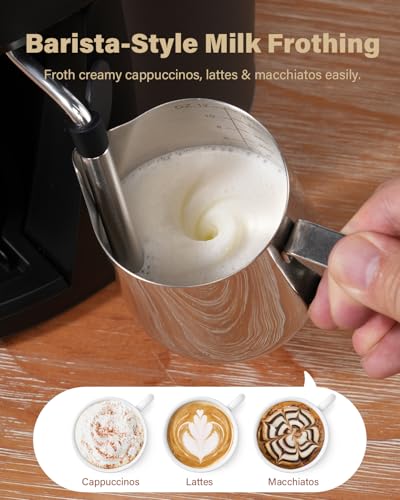
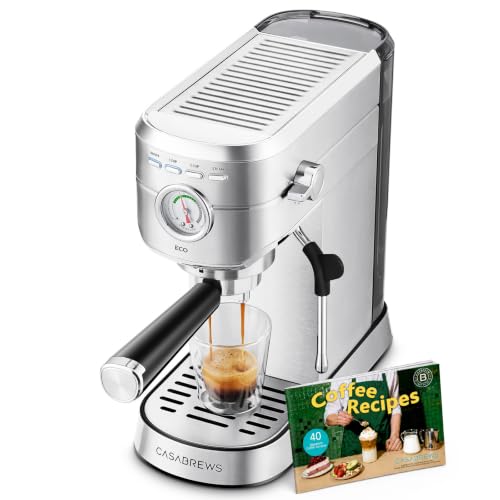
This semi-automatic machine pulls 20 BAR espresso shots and steams milk through a dedicated wand, with a fully PFAS-free water path and aluminum portafilter so no plastic contacts your coffee. It suits home and office drinkers who want cafe-style lattes and cappuccinos without a bulky footprint or plastic-tainted flavor.
Pros and Cons
Pros
- Aluminum portafilter and PFAS-free water path deliver better heat stability and cleaner-tasting espresso than plastic-lined competitors.
- The pressure gauge turns a semi-automatic machine into a learning tool for beginners dialing in grind size.
- Steam wand and brew group in one compact unit replace a separate frother on the counter.
- Removable 34oz tank makes daily refilling and cleaning straightforward.
Cons
- You cannot brew straight after steaming milk, the machine needs a cool-down cycle or it trips Over-Heating Protection Mode with flashing cup lights.
- As a semi-automatic, it requires your own grinder and tamping technique to get consistent results.

SHARDOR
Compact Home Cappuccino Maker: SHARDOR 3.5 Bar 4-Cup Espresso Machine with Milk Frother
The SHARDOR 3.5 Bar Espresso Machine brews up to four cups of espresso-style coffee, with an 800W fast-heating system that reduces morning wait time. It suits beginners, small kitchens, dorm rooms, and offices needing simple one-knob brewing and milk frothing in a compact appliance.
Pros and Cons
Pros
- The compact 11.8-inch-tall body fits tight counters while providing capacity for up to four cups.
- A fast-heating 800W system helps shorten the wait before brewing.
- The adjustable steam wand supports multiple milk textures for cappuccinos and lattes.
- BPA-free materials and built-in overheat and overpressure protection add practical safety features.
Cons
- The 3.5-bar system makes lighter espresso-style coffee rather than the concentrated extraction associated with higher-pressure espresso machines.
- Brewing and steaming share one control knob, so users cannot perform both functions simultaneously.

VisitIMUSA
IMUSA Electric Espresso Maker for Cuban Coffee & Moka - 6 or 3 Cup Capacity, One-Touch Brewing
This electric espresso maker brews authentic Cuban coffee, Moka, and traditional espresso with one-touch simplicity, eliminating stovetop monitoring. Home baristas who want cafe-quality espresso without the learning curve or price tag of expensive machines should consider this cast aluminum option.
Pros and Cons
Pros
- Detachable electrical base with on/off switch allows safe, cordless serving and simplified storage.
- Brown tinted Tritan top lets you watch the brewing process while resisting heat damage and staining.
- Cast aluminum body heats evenly for consistent espresso extraction across all 6 cups.
Cons
- Cast aluminum construction requires hand washing and cannot go in the dishwasher, adding cleanup time.
- The 6-cup maximum capacity (9 oz total) may not satisfy households that consume multiple large mugs daily.

De'Longhi
Fast Lattes and Cappuccinos at Home: De'Longhi Classic Signature Espresso Machine
The De'Longhi Classic Signature brews single or double espresso with a 15-bar pump, while Thermoblock technology minimizes temperature wait time. It suits home coffee drinkers who want automated espresso dosing and adjustable milk textures for lattes, cappuccinos, and other café-style drinks.
Pros and Cons
Pros
- The professional 15-bar pump supports espresso extraction for lattes, cappuccinos, iced macchiatos, and espresso martinis.
- Thermoblock heating reduces warm-up time and provides stable temperature control.
- Adjustable frothing settings handle both dairy milk and milk alternatives.
- Programmable single and double espresso recipes reduce repeated manual dosing.
Cons
- The steam wand requires manual frothing, so producing consistent microfoam may take practice.
- A built-in coffee grinder is not listed, so whole-bean users may need a separate grinder.
The Best Deals This Week*
-
PFAS-Free Home Espresso and Latte Brewing
$113.99
($159.99)Save $46.00 -
Compact Home Cappuccino Maker
$39.99
($49.99)Save $10.00 -
IMUSA Electric Espresso Maker for Cuban Coffee
$34.99
($44.99)Save $10.00
*Deals are selected by our commerce team
CASABREWS PFAS-Free Home Espresso and Latte Brewing: CASABREWS Semi-Automatic 20 BAR Espresso Machine with Steam Wand
CASABREWS
PFAS-Free Home Espresso and Latte Brewing: CASABREWS Semi-Automatic 20 BAR Espresso Machine with Steam Wand
This semi-automatic machine pulls 20 BAR espresso shots and steams milk through a dedicated wand, with a fully PFAS-free water path and aluminum portafilter so no plastic contacts your coffee. It suits home and office drinkers who want cafe-style lattes and cappuccinos without a bulky footprint or plastic-tainted flavor.
Check price on AmazonA compact semi-automatic espresso machine for people who want cafe drinks at home without a plastic-lined brew path altering the taste.
The 20 BAR pump plus pressure gauge lets you read each shot and correct grind or tamp, while the steam wand builds microfoam for latte art in seconds.
Build centers on a solid aluminum portafilter and PFAS-free internal waterway for heat stability, with a 34oz removable tank and a footprint sized for tight counters.
Honest limitation: brewing right after steaming triggers Over-Heating Protection Mode, so back-to-back milk drinks need a cool-down step.
Best for beginner to intermediate home baristas who want manual control and non-toxic materials in a small kitchen.
SHARDOR Compact Home Cappuccino Maker: SHARDOR 3.5 Bar 4-Cup Espresso Machine with Milk Frother
SHARDOR
Compact Home Cappuccino Maker: SHARDOR 3.5 Bar 4-Cup Espresso Machine with Milk Frother
The SHARDOR 3.5 Bar Espresso Machine brews up to four cups of espresso-style coffee, with an 800W fast-heating system that reduces morning wait time. It suits beginners, small kitchens, dorm rooms, and offices needing simple one-knob brewing and milk frothing in a compact appliance.
Check price on AmazonThis compact semi-automatic machine brews up to four cups of espresso-style coffee and froths milk, reducing the need for separate coffee and foaming appliances.
Its 800W heating system and die-cast aluminum boiler warm quickly, while 3.5-bar pressure delivers a smooth, lighter brew with delicate crema.
The BPA-free construction measures 8.3 by 6 by 11.8 inches, making it suitable for limited counter space. Product weight is not specified.
The lower-pressure extraction may not satisfy buyers seeking the intensity and body of traditional high-pressure espresso.
Best for beginners and space-conscious coffee drinkers who want straightforward cappuccinos, lattes, and espresso-style coffee at home.
VisitIMUSA IMUSA Electric Espresso Maker for Cuban Coffee & Moka - 6 or 3 Cup Capacity, One-Touch Brewing
VisitIMUSA
IMUSA Electric Espresso Maker for Cuban Coffee & Moka - 6 or 3 Cup Capacity, One-Touch Brewing
This electric espresso maker brews authentic Cuban coffee, Moka, and traditional espresso with one-touch simplicity, eliminating stovetop monitoring. Home baristas who want cafe-quality espresso without the learning curve or price tag of expensive machines should consider this cast aluminum option.
Check price on AmazonThis electric espresso maker solves the stovetop monitoring problem by automating the Moka brewing process with one-touch operation. Fill the lower chamber with water, add ground espresso to the funnel, and the heating base does the work.
The cast aluminum body distributes heat evenly for consistent extraction, while the visual brewing indicator shows when coffee is percolating. Adjustable capacity lets you brew 3 cups (4.5 oz) or 6 cups (9 oz) using 1.5 oz espresso servings.
Cast aluminum construction with brown Tritan top and black exterior measures compact enough for small kitchens. The detachable base separates for easy pouring and storage. Cool-touch handle prevents burns during service.
Hand washing is required since aluminum cannot go in the dishwasher. The 6-cup maximum may feel limiting for large households or those who drink 8-12 oz servings.
Best for home baristas who want authentic Cuban or Italian espresso without stovetop babysitting or the expense of pump-driven machines.
De'Longhi Fast Lattes and Cappuccinos at Home: De'Longhi Classic Signature Espresso Machine
De'Longhi
Fast Lattes and Cappuccinos at Home: De'Longhi Classic Signature Espresso Machine
The De'Longhi Classic Signature brews single or double espresso with a 15-bar pump, while Thermoblock technology minimizes temperature wait time. It suits home coffee drinkers who want automated espresso dosing and adjustable milk textures for lattes, cappuccinos, and other café-style drinks.
Check price on AmazonThis semi-automatic machine prepares espresso and textured milk at home, reducing reliance on separate brewing and frothing appliances.
Its 15-bar Italian pump supports proper extraction, while Thermoblock technology quickly delivers stable brewing temperature for back-to-back drinks.
The adjustable steam wand offers steamed milk or microfoam settings, making it easier to switch between cappuccinos, lattes, and latte art.
Its compact stainless-steel body suits limited counter space, although exact dimensions and weight are not provided in the product data.
The manual frothing process adds a learning curve; best for home baristas who want control without a fully automatic machine.
Why People Want Plastic Out of the Water Path
Not all plastic in a machine is equal. A plastic housing panel or a cold-water reservoir sees little heat and poses little concern. The worry is plastic on the heated, pressurized path — the tubing, seals, and linings that near-boiling water contacts on its way to the cup.
- Heat plus acidity accelerates leaching. Hot, mildly acidic coffee water is a more aggressive solvent than cold water, so any extractables in polymer tubing are more likely to migrate.
- Microplastics. Repeated hot-water flow across polymer surfaces is a plausible source of microplastic shedding, which is why glass, steel, and ceramic brewers are popular among cautious buyers.
- Taste. Even where a plastic is perfectly food-safe, new tubing and reservoirs can impart a plastic or “off” taste to early shots.
Reducing plastic on that path is the whole point, and it is a reasonable, safety-minded goal even though food-grade plastics used correctly are not dangerous.
PFAS and PTFE: The Real Target
The materials most plastic-free shoppers are actually trying to avoid are PFAS — a large family of fluorinated compounds — and specifically PTFE, the fluoropolymer used in some high-pressure lines, non-stick linings, and low-friction seals.
PTFE is chemically stable and does not break down at espresso temperatures, so a well-made PTFE line is not an acute hazard. The concerns are longer-term and precautionary: PFAS persistence in the body and environment, and the possibility of degradation if components overheat or age badly. If avoiding PFAS is your priority, look for machines that explicitly use silicone and stainless steel for tubing and seals rather than fluoropolymers. Manufacturer spec sheets and teardown photos from enthusiast communities are the best sources, since marketing rarely lists every polymer.
Aluminum, and Why Material Choices Compound
Plastic is not the only material plastic-free shoppers scrutinize. Aluminum boilers and water pathways are common in budget machines because aluminum is cheap and heats fast, but it corrodes and pits over time, especially with hard or acidic water. Many buyers seeking a “clean” machine also want aluminum off the hot side in favor of:
- Stainless steel — corrosion-resistant, inert, durable, the default premium choice for boilers and wetted parts.
- Brass — used in group heads and boilers on traditional machines; it contains a small amount of lead by alloy standard, so quality machines use low-lead or lead-free brass rated for potable water.
- Copper — found in boilers and hot-water lines on some Italian-built machines, valued for heat transfer.
A machine that removes plastic but keeps a corroding aluminum boiler has only solved half the problem. The goal is metal-and-silicone across the entire wetted path.
Machine Types Ranked by Plastic Exposure
Different espresso designs inherently use different amounts of plastic. From least to most, roughly:
- Manual lever and hand-pump machines (piston presses, hand levers) — the closest to plastic-free, since they use a metal piston, a metal or glass chamber, and silicone seals, with no electric pump or plastic tubing. These are the machines most often recommended to plastic-avoiders.
- Stovetop moka pots — technically not espresso but pressure-brewed; all-metal aluminum or stainless designs with a silicone gasket, extremely low plastic.
- Traditional pump machines with brass or steel boilers — some plastic in the reservoir and possibly tubing, but metal on the core path.
- Budget pump and capsule machines — the most plastic, often with polymer tubing, plastic brew units, and PTFE lines.
If a near-total plastic-free result matters most, a manual lever or a quality moka setup gets you there. If you want electric convenience, target a pump machine with documented stainless or brass wetted parts. Our best espresso machine under 200 guide notes materials, and a best coffee and espresso maker combo can cover both espresso and drip with metal internals.
How to Verify a Machine Before You Buy
Marketing claims like “BPA-free” or “non-toxic” are not the same as plastic-free on the water path. To actually verify:
1. Read the materials spec for the boiler, group or brew head, and tubing — look for stainless steel, brass, or copper, not “durable plastic.” 2. Check seals and gaskets for food-grade silicone rather than unspecified rubber or PTFE. 3. Find a teardown. Enthusiast forums and repair videos reveal the actual internal materials better than any listing. 4. Prefer a metal or glass reservoir if you can, and never let hot water sit in a plastic tank. 5. Flush a new machine several times before first use to clear residues, and expect early shots to improve as any manufacturing taste clears.
If espresso itself is negotiable, note that some of the cleanest hot-coffee setups aren’t espresso machines at all — a glass-and-stainless best cold brew coffee maker or a stainless best grind and brew coffee maker avoids high-pressure plastic entirely, and a standalone burr grinder from our best coffee grinder guide keeps grinding plastic-minimal too.
Frequently Asked Questions
Does a 100% plastic-free espresso machine exist?
Realistically, no electric pump espresso machine is completely plastic-free — there is almost always polymer somewhere, such as a switch housing, reservoir, or minor fitting. What you can achieve is a machine with no plastic on the wetted, heated path, which is the part that matters for safety and taste. Manual lever machines and hand-pump presses come closest to fully plastic-free because they use a metal piston, metal or glass chamber, and silicone seals with no pump tubing at all.
Is plastic in an espresso machine actually dangerous?
Food-grade plastics used within their rated temperatures are not acutely dangerous, and regulators permit them for exactly this use. The concerns are precautionary: hot, acidic water is a more aggressive solvent that can extract more from polymers, repeated hot flow may shed microplastics, and PFAS-family materials like PTFE persist in the body and environment. Reducing plastic on the heated path lowers these exposures and often improves taste, which is why many careful buyers prefer metal-and-silicone machines even though the risk from quality plastic is low.
What is PTFE and why is it used in espresso machines?
PTFE is a fluoropolymer, part of the PFAS family, prized for being slippery, heat-stable, and chemically resistant, so manufacturers use it for some high-pressure lines, low-friction seals, and non-stick surfaces. It is stable at espresso temperatures and not an acute hazard when intact, but PFAS avoidance is precautionary because these compounds are persistent. If you want to steer clear of it, look for machines that specify silicone and stainless steel for tubing and gaskets, and consult teardowns since PTFE is rarely mentioned in marketing.
Are stainless steel espresso machines the safest option?
Stainless steel is the most inert and durable common choice for wetted parts: it resists corrosion, does not react with coffee acids, and lasts for years. A machine with a stainless boiler, group head, and tubing plus food-grade silicone seals is about as low-concern as espresso hardware gets. Brass and copper are also good on the hot path when made to potable-water standards. The material to be most cautious about is aluminum on the heated path, since it corrodes and pits over time.
Is a manual or lever espresso machine more plastic-free?
Yes. Manual lever and hand-pump machines are the closest to plastic-free because they generate pressure with a metal piston rather than an electric pump, so they skip the polymer tubing and plastic brew units that budget machines rely on. Water typically contacts only metal, glass, and a silicone seal. The trade-offs are a learning curve, more effort per shot, and usually no built-in steam wand, but for anyone prioritizing minimal plastic on the water path they are the strongest option.
Do plastic-free machines make coffee taste better?
Often yes, though the effect is largest early on. New polymer tubing and reservoirs can impart a plastic or chemical note to the first shots, which metal-and-glass machines avoid entirely, giving a cleaner cup from the start. Over the long term, the taste benefit is more about avoiding degraded seals, corroding aluminum, and scale-trapping surfaces than about plastic itself. Fresh beans, a consistent grind, and filtered water still influence flavor far more than the machine’s housing material.
The Bottom Line
A plastic-free espresso machine is safe, and for cautious buyers it is the safer, better-tasting choice because it keeps hot water on stainless steel, brass, or glass rather than polymers and PFAS-family linings. The honest caveat is that “100% plastic-free” is largely a myth for electric machines — aim instead for no plastic on the heated, pressurized path, verified through spec sheets and teardowns. Manual lever machines and quality moka setups get closest; among electric options, prioritize stainless or brass wetted parts and food-grade silicone seals, and keep aluminum off the hot side. For picks and adjacent brewers, see our best espresso machine under 200, best coffee and espresso maker combo, and best coffee maker with grinder guides.



Write Your Review
No reviews yet. Be the first to share your experience!