

The pour-over hit the cup at six in the morning, the beans were a fresh roast from a local roaster picked up two days ago, and the brew tasted bitter and muddled — like dishwater with caffeine. That kind of mismatch between bean quality and cup quality almost always traces back to one piece of equipment, and it is rarely the kettle, the dripper, or the filter. It’s the grinder. A blade grinder, the spinning-propeller style sitting in most kitchen cabinets, doesn’t grind coffee so much as shatter it. The result is a chaotic mix of dust and boulders in the same brew bed, where the dust over-extracts into bitterness while the boulders sit underextracted and sour. No brewer in the world fixes that. The grinder either produces a uniform particle size or it sabotages every cup downstream, and there is almost no middle ground. A burr grinder, by contrast, crushes beans between two abrasive surfaces — either two cone-shaped burrs nested inside each other (conical) or two parallel discs (flat) — at a controlled gap that determines particle size. The gap is the grind setting. The burr geometry, motor speed, retention path, and static control determine whether the resulting grind is genuinely uniform or just better than a blade. This guide separates the burr grinders that earn their price from the ones that ride on the burr-grinder label without delivering its benefits. If your brewing focus runs toward immersion brewing, our best french press guide covers the companion category where grind tolerance is more forgiving but still matters more than most owners realize.

For more, see our Burr vs Blade Coffee Grinder and Coffee Grind Size Guide guides.
Save $11.00
Pros & Cons
Pros
- 43 micro-adjustments between 15 main settings give precise control for dialing in espresso or switching between brew methods without guesswork.
- Powerful DC motor grinds quietly and stays cool, preventing heat buildup that can degrade coffee flavor during longer grind sessions.
- Named Wirecutter's top pick in 2025 for grind consistency and ease of use, backed by over 22,000 verified buyer ratings averaging 4.3 stars.
Cons
- Grounds container capacity is smaller than the hopper, so grinding the full 12 ounces at once requires emptying the cup midway or using a separate container.
- No built-in scale or dosing by weight, which means espresso users who demand shot-to-shot precision will need to weigh separately.
Details
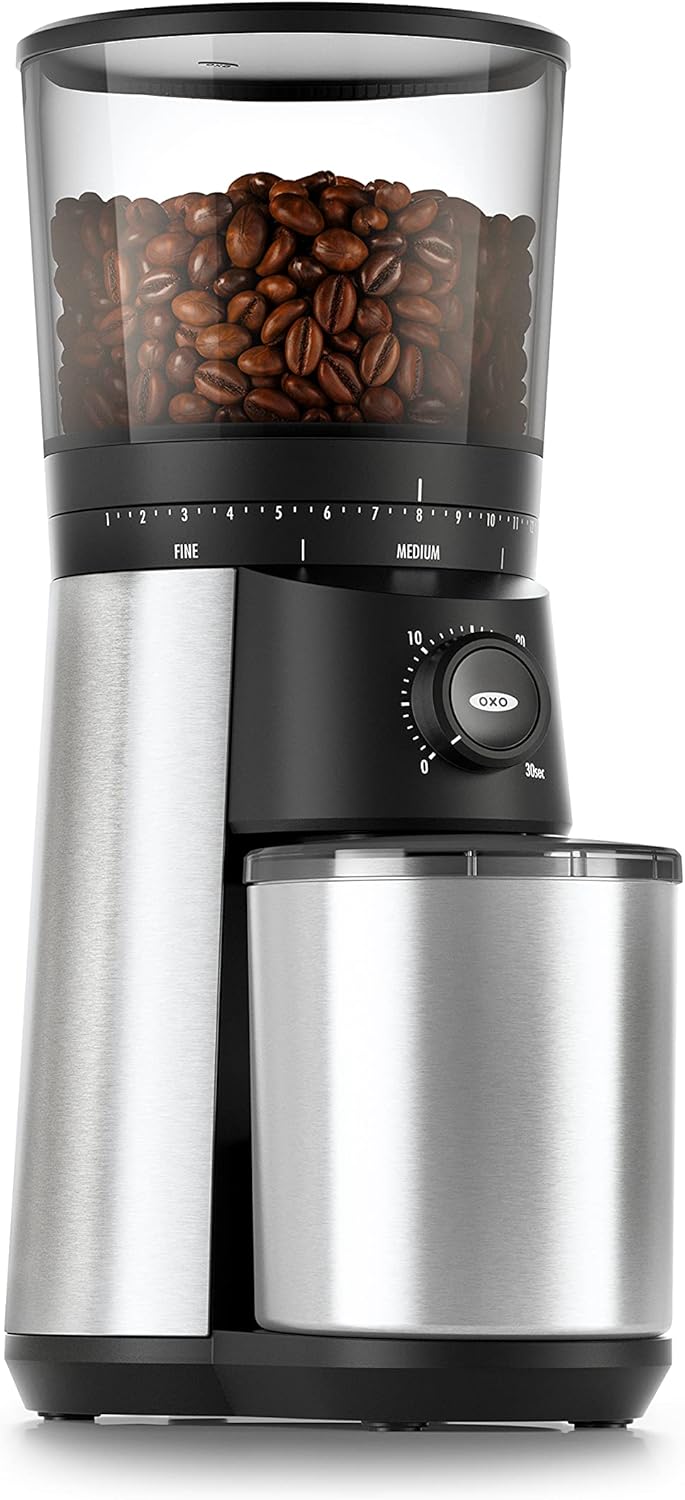
This electric burr grinder solves the uneven grind problem that blade grinders create, giving you uniform particle size for better extraction and flavor across espresso, pour-over, drip, and French press.
The 40mm stainless steel conical burrs grind without generating excess heat, and the adjustable timer lets you set grind duration by the second so you get the exact dose you need. The one-touch start remembers your last setting, cutting out the daily ritual of resetting dials.
Built with a stainless steel exterior and grounds cup, the grinder measures compact enough to fit under cabinets. The 12-ounce hopper is UV-tinted to block light and includes a trap door that stops beans from spilling when you remove it.
The grounds cup is static-reducing but not perfectly static-free, so a light tap or quick stir may still be needed when transferring to very fine mesh filters. The hopper holds more beans than the cup holds grounds, requiring a mid-grind pause if you fill it completely.
Best for home brewers who make multiple coffee styles and want repeatable results without the mess, noise, or heat of cheaper grinders.
How to Use
Fill the hopper with whole beans, twist the grind size dial to match your brew method (lower numbers for espresso, higher for French press), and set the timer knob to control how much coffee you grind. Press the one-touch button to start.
The grinder stops automatically when the timer runs out. Remove the stainless steel cup, tap it lightly to settle any static cling, and pour grounds directly into your portafilter, drip basket, or French press.
Clean the burrs every few weeks by removing the hopper and upper burr, brushing out residue with the included tool or a dry brush. Wipe the exterior and grounds cup with a damp cloth but avoid getting the motor housing wet.

Save $20.96
Pros & Cons
Pros
- 18-position grind selector covers every brew method from Turkish coffee to cold brew, eliminating the need for multiple grinders.
- One-touch operation with separate power bar and electric timer requires no manual monitoring once started.
- Removable hopper and chamber design allows thorough cleaning between bean types to prevent flavor crossover.
- Black stainless finish resists fingerprints and matches most kitchen appliances without showing wear quickly.
Cons
- Static buildup can cause fine grounds to cling to the chamber walls, requiring a tap or brush sweep after each grind.
- Hopper holds only 3.2 ounces of beans despite the 18-cup capacity claim, so you may need to refill mid-grind for large batches.
Details
The Cuisinart DBM-8P1 is an electric burr grinder that solves the stale pre-ground coffee problem by grinding whole beans seconds before brewing, maximizing flavor and aroma.
Its flat burr mill crushes beans between two abrasive surfaces rather than chopping them, producing uniform particle sizes that extract evenly. The 18-position dial adjusts grind coarseness to match your brewing method, from fine espresso to coarse French press.
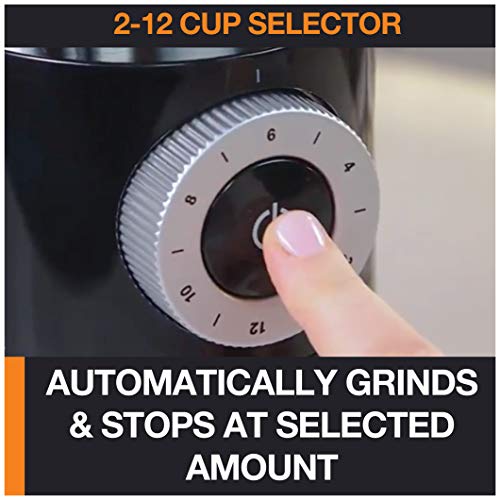
The grinder features an 8 oz removable bean hopper, a grind chamber that holds grounds for up to 18 five-ounce cups, and a one-touch power bar with automatic shutoff. Housing is black stainless steel with cord storage and an included scoop-brush.
The hopper capacity is smaller than advertised cup yield suggests, so brewing for a crowd requires refilling beans mid-cycle. Static also causes fine grounds to stick inside the chamber.
Best for home brewers who use multiple brewing methods and want consistent results without the effort of manual grinders or the uneven chop of blade models.
How to Use
Fill the removable hopper with whole beans up to the 8 oz line, then slide the grind selector dial to match your brew method: settings 1-6 for espresso, 7-12 for drip or pour-over, 13-18 for French press or cold brew.
Turn the cup selector to your batch size, then press the power bar once. The grinder runs automatically and shuts off when the timer completes your selected amount. Tap the chamber gently to dislodge static-clinging grounds.
Empty the grind chamber after each use and brush out residual grounds with the included tool. Remove and wash the hopper weekly to prevent oil buildup that turns rancid and affects flavor.

Pros & Cons
Pros
- Intuitive one-button operation requires no learning curve and works reliably for daily use.
- Durable stainless steel construction outlasts plastic grinder bowls that crack or stain over time.
- Lid safety lock eliminates spills and prevents the motor from running when improperly assembled.
Cons
- Blade grinders produce less consistent particle size than burr grinders, which matters for precision brewing methods like pour-over.
- 2/3 cup capacity requires multiple batches for large households or meal prep tasks like grinding spice blends in bulk.
Details
This electric blade grinder solves the stale coffee problem by grinding whole beans seconds before brewing, preserving oils and aromatics that fade in pre-ground bags.
The stainless steel blades spin at high speed to chop beans into uniform particles, and the one-touch button lets you pulse for coarse grinds or hold for fine powder. The 2/3 cup bowl holds enough beans for a full pot without wasting counter space.
Stainless steel blades and bowl resist rust and odor absorption better than plastic models. The compact footprint fits in cabinet storage, and the 150-watt motor runs on standard 110V outlets.
Blade grinders create some particle size variation compared to burr grinders, which matters for manual brewing methods that demand precision. The small capacity means multiple batches for large families.
Best for drip coffee drinkers who want fresh-ground flavor without spending over $100 on a burr grinder.
How to Use
Fill the bowl with beans up to the 2/3 cup line, snap the lid until it clicks, then press and hold the button. Check grind size every few seconds by releasing the button and tilting the unit.
For coarse grinds, pulse the button in 1-2 second bursts. For fine grinds, hold continuously for 10-15 seconds. Tilt the grinder gently while running to redistribute beans toward the blades.
Clean the bowl and blades after each use by wiping with a damp cloth, or grind a small amount of uncooked rice to absorb oils between coffee and spice grinding sessions.

Pros & Cons
Pros
- Achieves fine, even grounds suitable for drip coffee makers in seconds.
- Stainless steel blade construction resists corrosion and maintains sharpness over time.
- Clear lid with safety lock prevents accidental spills and lets you monitor grind progress.
- Affordable entry point for home grinding without sacrificing build quality.
Cons
- Blade-style grinding can produce less uniform particle size compared to burr grinders.
- Small 30-gram capacity requires multiple batches for larger households or entertaining.
Details
This is an electric blade grinder designed to turn whole coffee beans into grounds fine enough for drip brewing. It solves the staleness problem of pre-ground coffee by letting you grind only what you need each morning.
The stainless steel blade spins at high speed to pulverize 30 grams of beans in roughly 10 seconds. The transparent safety lid locks in place during operation and lets you visually check grind consistency without stopping.
The body is compact and lightweight with a modern look. The blade and grinding chamber are stainless steel, while the housing is durable plastic. It stores easily in a cabinet or sits on the counter without taking up much space.
The 30-gram capacity is enough for about three cups of coffee, so larger households will need to run multiple batches. Blade grinders also produce less uniform particle size than burr models, which can affect extraction.
Best for budget-conscious coffee drinkers who want fresh grounds daily without spending on premium grinder technology.
How to Use
Add up to 30 grams of whole coffee beans to the grinding chamber. Secure the lid by pressing down until it locks into place, then press and hold the top button to start grinding.
Watch through the clear lid and release the button when the grounds reach your desired consistency. For drip coffee, 10 to 15 seconds usually produces the right texture. Pulse in short bursts for coarser results.
Unplug the unit before removing the lid. Tap the grinder gently on the counter to dislodge grounds clinging to the blade and chamber walls, then pour into your coffee maker or storage container.
How We Evaluated These Picks
This guide is research-based, not a hands-on test. We did not buy, cook with, or measure the products below. Instead we compared manufacturer specifications, materials and construction details, listed capacities and wattages, and the patterns that repeat across large volumes of verified owner reviews — particularly the complaints that only surface after weeks of use, such as coatings failing, motors weakening, controls drifting, or a product proving awkward to clean and store.
Where we describe how something performs, we are reporting what the specifications state and what owners consistently report, not a result we produced ourselves. Prices and availability change constantly, so check the current listing before buying. We earn a commission on purchases made through links on this page, which never affects which products we include or how we rank them.
The Picks
| Coffee Grinder | Burr Type | Best For | Steps |
|---|---|---|---|
| Baratza Encore (B07CSKGLMM) | 40mm conical steel | Daily drip and pour-over | 40 stepped |
| Cuisinart DBM-8 (B00018RRRK) | Flat plate | Budget batch grinding | 18 stepped |
| Baratza Virtuoso+ (B07Z8G97PY) | 40mm M2 conical | Pour-over precision | 40 stepped |
| Baratza Encore ESP (B0H1RHGKGT) | 40mm M2 dual-range | Espresso plus pour-over | 40 espresso + 20 brew |
| OXO Brew Conical Burr (B07SYTRPSG) | 40mm conical steel | Quiet kitchen, drip focus | 15 stepped + micro |
What Goes Wrong With Coffee Grinders
The blade-versus-burr distinction is the most consequential split in the entire coffee grinder market, and it’s also the one most buyers don’t fully understand until they’ve tasted the difference. A blade grinder, the kind that costs twenty dollars and looks like a tiny food processor, spins a flat propeller blade at high speed and shatters beans through impact. The longer you run it, the smaller the average particle gets, but the particle-size distribution stays a chaotic mess of dust, medium fragments, and stubborn boulders. Pour hot water through that mixed bed and the dust over-extracts almost instantly, dumping bitter compounds into the cup, while the boulders sit underextracted and contribute sour, vegetal notes. A burr grinder crushes beans at a controlled gap between two abrasive surfaces, producing a tight particle-size distribution where almost every fragment is within a narrow window of the target. The difference in the cup is not subtle. The same beans through a burr grinder taste cleaner, sweeter, and more like what the roaster intended.
Static cling is the second nuisance that almost no first-time burr grinder owner expects. Coffee beans build a tribocharge as they tumble between the burrs, which is why ground coffee jumps to the sides of the grounds bin, clings to the chute, and produces a fine cloud of grounds that drift onto the counter every time the bin is removed. The worst static days are dry winter mornings when humidity drops below thirty percent. A simple trick — spritzing the whole beans with a drop of water before grinding, called the Ross Droplet Technique — reduces static dramatically but doesn’t eliminate it. Grinders with deeper chutes, larger exit angles, and grounded metal components manage static better than plastic-bin entry-level machines, and grinders engineered with anti-static features (like the Encore ESP) genuinely reduce the mess.
Retention from one grind to the next is the third issue that quietly degrades cup quality. Every burr grinder traps some fraction of the ground coffee inside its burr chamber, chute, and bin — typically a gram or two on entry-level machines, less than half a gram on well-engineered single-dosing grinders. The trapped grounds stay there until the next session, when they get pushed out first as stale, oxidized fines mixed with the fresh grind. For drip and pour-over, retention of a gram or two is annoying but rarely cup-noticeable. For espresso, where dose precision is measured in tenths of a gram, retention is the difference between a balanced shot and a sour disaster. Motor heat is the fourth quiet enemy — a grinder running too hot transfers heat into the beans, accelerates oxidation of the volatile oils that carry coffee aroma, and produces a duller cup. High-end grinders run slower motors (around 400 to 600 RPM) to keep burr temperature low. Cheap grinders spin twice that speed and pay the flavor price.
What You Actually Need
Burr Type — Conical vs Flat
The two dominant burr geometries are conical and flat, and the choice between them shapes both the cup character and the price. A conical burr uses a cone-shaped inner burr nested inside a ring-shaped outer burr, with beans falling into the gap by gravity and getting crushed as they spiral downward. Conical burrs run quieter, demand less motor torque, and produce a bimodal particle distribution — a tight cluster of medium particles with a small population of fines that adds body to immersion brews like French press and AeroPress. Almost every Baratza grinder in this lineup uses 40mm conical burrs because the geometry scales down efficiently to home-counter sizes without sacrificing uniformity. A flat burr uses two parallel disc-shaped burrs facing each other, with one spinning and the other stationary. Flat burrs produce a more unimodal distribution with fewer fines, which translates into a cleaner, more clarity-forward cup that pour-over and espresso specialists tend to prefer. Flat burrs also demand more motor torque, run louder, and cost more. For most home coffee drinkers brewing drip and pour-over, a quality 40mm conical burr is the right answer at the right price. The Cuisinart DBM-8 uses a flat plate at a budget price — but the small diameter and budget motor don’t deliver the clarity that larger flat burrs in higher-end grinders are known for.
Grind Range and Step Resolution
A coffee grinder’s grind range determines what brewing methods it can serve, and step resolution determines how precisely you can dial in. Drip and pour-over need a medium grind around 600 to 900 microns. French press wants coarse, around 900 to 1100 microns. Espresso demands fine, around 200 to 400 microns. A grinder that can’t reach espresso fineness — like the Baratza Encore and the OXO Brew at their finest settings — is genuinely incapable of espresso, no matter how many times the bag says “all grind sizes.” A stepped grinder offers a fixed number of discrete settings; a stepless grinder allows infinite micro-adjustment. The Baratza Encore offers 40 stepped settings across the brew range, plenty for drip, pour-over, and French press but limited for espresso. The Encore ESP solves this with a dual-range design: 20 settings across the brew range, plus 20 micro-stepped settings across the espresso range. The Cuisinart DBM-8 offers only 18 settings across its entire range, which means each step is a large jump — workable for drip but coarse for any method that benefits from fine-tuning. The OXO Brew adds micro-adjustment within its 15 settings. Match grind range to the methods you actually use, not the ones you aspire to.
Retention and Static Control
Retention is how much ground coffee gets stranded inside the grinder between sessions, and static is how much of what does exit jumps to the wrong place. The two problems are related — static charge holds fine particles against grinder walls, increasing retention, and the trapped grounds release as stale fines on the next grind. For drip and pour-over at home, retention of a gram or two is annoying but rarely cup-noticeable, especially if you grind immediately before brewing. For espresso, retention matters intensely, which is why the Encore ESP includes a redesigned grounds chute with anti-static treatments and a more direct exit path. The Baratza Virtuoso+ adds a similar grounds-path improvement over the base Encore. The Cuisinart DBM-8 retains the most of any grinder in this lineup because its grounds bin sits below a plastic chute that builds significant static on dry days. The OXO Brew uses a stainless-steel hopper and grounded metal chute that reduces static to a manageable level, especially when paired with the Ross Droplet Technique — a single drop of water mixed into the beans before grinding.
Motor Speed and Heat
A coffee grinder’s motor speed is one of the quieter specs in the category, but it has a direct line to cup quality. Faster motors generate more heat in the burr chamber, and burr heat transfers into the bean fragments during the grind, accelerating oxidation of the volatile aromatic compounds that make great coffee taste like great coffee. The result of an over-fast motor is a duller, less aromatic cup, with the difference most noticeable on lighter roasts. The Baratza Encore runs at 450 RPM, slow enough that burr heat stays low even during longer grind sessions for batch brewers. The Virtuoso+ runs at a similar speed with a slightly more powerful motor that maintains RPM under heavier load. The Encore ESP runs at the same controlled speed and adds a thermal cutoff for long sessions. The Cuisinart DBM-8 runs faster because the budget motor needs the RPM to develop adequate torque at the burr; the trade-off is more heat and a marginally duller cup, though the difference is subtle at the drip-grind level. The OXO Brew sits at the slower end with a sound-dampened motor housing that’s noticeably quieter than the Baratza line — a real-world win in households where the morning grind happens before everyone else is awake.
Choosing for Your Setup
If you brew espresso: The Baratza Encore ESP (B0H1RHGKGT) is the only coffee grinder in this lineup that genuinely covers espresso plus brew methods without compromising either. The dual-range design gives 20 micro-stepped settings across the espresso range and 20 stepped settings across the brew range, with M2 conical burrs that hold their edge through years of espresso-fineness grinding. The grounds chute is redesigned for low retention and reduced static, which matters intensely for espresso dose precision. The Encore ESP is not as flexible as a dedicated single-dose espresso grinder costing three times more, but it’s the most credible entry point into home espresso grinding at its price.
If you only do pour-over and drip: The Baratza Encore (B07CSKGLMM) is the long-running default for home pour-over and drip, and it earns the position. The 40 stepped settings across the brew range cover everything from coarse French press to medium-fine pour-over, the 40mm conical steel burrs produce a clean particle distribution, and the slow motor keeps burr heat low. The Encore is the right answer for any coffee drinker whose routine is daily pour-over or batch drip and who never plans to brew espresso. The step up to the Virtuoso+ (B07Z8G97PY) buys M2 burrs for longer service life, a digital timer, and tighter retention — meaningful but not transformative improvements over the base Encore.
If you use French press exclusively: A high-end coffee grinder is genuinely overkill for French press, because the immersion brew method is forgiving of broader particle-size distribution. The OXO Brew Conical Burr (B07SYTRPSG) is a strong fit — coarse enough at its top setting for a clean French press grind, quiet enough to run in a shared kitchen without waking the house, and priced below the Baratza line. Pair the OXO with a best electric kettle that holds a stable temperature, and the resulting cup is competitive with far more expensive setups. The Cuisinart DBM-8 (B00018RRRK) is a credible budget option too, though coarse-end step resolution is limited.
Quick Answers
Are blade grinders ever acceptable?
For grinding spices, yes. For coffee, no — and the gap between blade and burr is one of the largest performance gaps in any kitchen appliance category. A blade coffee grinder produces a chaotic mix of dust and boulders in the same brew bed, which over-extracts the dust into bitterness while leaving the boulders underextracted and sour. The same beans through a burr grinder taste dramatically cleaner. If you’re still using a blade grinder, the upgrade to even an entry-level burr is the single highest-impact change you can make to home coffee quality.
How often should burrs be replaced?
Steel conical burrs in a home coffee grinder typically last 500 to 1,500 pounds of coffee ground before they noticeably dull — roughly seven to fifteen years of daily home use at 15 to 20 grams per day. M2 hardened steel burrs in the Virtuoso+ and Encore ESP last roughly twice as long as the standard burrs in the base Encore. Burr replacement is genuinely user-serviceable on Baratza machines — replacement sets cost less than the grinder itself and install in fifteen minutes with a screwdriver. The signal that burrs need replacement is not catastrophic failure; it’s a gradual decline in particle uniformity and a duller cup.
Why do some grinders cost $500+?
The premium coffee grinder market is anchored by larger flat burrs (typically 64mm to 83mm), slower and more powerful motors, single-dosing workflows with near-zero retention, and burr alloys that hold their edge longer. The cup-quality difference between a $200 Virtuoso+ and a $700 single-dose flat-burr grinder is real but considerably smaller than the gap between a blade grinder and the Virtuoso+. For most home drinkers brewing one or two pots a day, diminishing returns above the Baratza price tier are steep. The exception is espresso enthusiasts chasing the last few percent of clarity, where flat-burr precision and near-zero retention move the needle.
Does anti-static technology actually work?
Yes, with the caveat that no treatment eliminates static entirely on a dry winter day below thirty percent humidity. The Encore ESP’s redesigned grounds chute genuinely reduces the cloud of grounds that escapes when the bin is removed, and the difference compared to the base Encore is visible. The OXO Brew’s stainless-steel grounded chute also performs well. The most reliable static reducer across any grinder is still the Ross Droplet Technique — a single drop of water mixed into whole beans before grinding, which adds just enough moisture to suppress the tribocharge without affecting cup quality.
Can hand grinders match electric quality?
For pour-over and brew methods, yes — a quality hand grinder with 38mm or larger steel burrs can match or exceed the particle uniformity of a $150 electric grinder. The trade-off is time and effort. A hand grinder takes two to four minutes of cranking for a single pour-over dose, which becomes tedious for multiple cups daily or batches for a drip brewer. For espresso, hand grinders become less practical — the very fine setting demands significantly more torque per turn, and grinding an 18-gram dose can take ten minutes. For a one-cup pour-over routine, a quality hand grinder is competitive. For higher volume or any espresso involvement, an electric coffee grinder like the Encore or Encore ESP is the practical choice.
Related Guides
- Burr vs Blade Coffee Grinder
- Coffee Grind Size Guide
- Coffee Maker Buying Guide
- Espresso vs Drip vs Pour Over
- French Press vs Pour Over
- How to Brew Pour Over Coffee
Final Verdict
The coffee grinder category is one where the upgrade from blade to burr is the single largest cup-quality jump anywhere in home brewing, and the choices within the burr-grinder market come down to brewing method, daily volume, and how much grind range and step resolution you genuinely need. The Baratza Encore is the right default for pour-over and drip households. The Encore ESP is the right entry point for home espresso plus brew flexibility. The Virtuoso+ buys longer burr life and tighter retention for the same brew workflow. The OXO Brew is the quieter alternative for kitchens where noise matters. The Cuisinart DBM-8 is the budget pick when the upfront cost has to stay low and the brew method is forgiving. None of these grinders are wrong; they’re each right for a specific use case.
- If you want one coffee grinder that covers espresso plus pour-over with real precision: Baratza Encore ESP (B0H1RHGKGT).
- If you brew only pour-over and drip and want the long-running default: Baratza Encore (B07CSKGLMM).
- If kitchen noise matters and your routine centers on drip and French press: OXO Brew Conical Burr (B07SYTRPSG).


Write Your Review
No reviews yet. Be the first to share your experience!