

TL;DR — A glass air fryer is safe when the cooking bowl is made from borosilicate glass rated for oven and high-heat use, which is the case for the mainstream models like the Ninja Crispi and similar pod-style units. Borosilicate handles the 350-400°F range these appliances run at, and because the food touches glass rather than a nonstick basket, there is no PTFE or PFAS coating to scratch or off-gas. The one real risk is thermal shock: cracking the glass by exposing it to a sudden temperature swing. Avoid that and a glass air fryer is one of the least “toxic” ways to air fry. For picks, start with our best air fryer guide.
The HomeWhisk editorial team researches kitchen equipment by analyzing manufacturer specifications, material behavior, and aggregated user reviews from major retailers and cooking communities like Reddit’s r/airfryer and r/Cooking. Our conclusions are based on how the materials actually behave under heat, not on marketing language.

“Glass air fryer” has become a shorthand for a specific design: instead of a metal basket lined with nonstick coating, the food sits in a borosilicate glass container that drops into the heating base. Shoppers reach this question for two reasons — they want to know whether the glass can crack in use, and whether “glass” genuinely means a cleaner, coating-free cook. Both are fair questions with real answers. If you are cross-shopping with conventional models, our best air fryer and best deep fryer guides cover the wider field.
Yomvzake
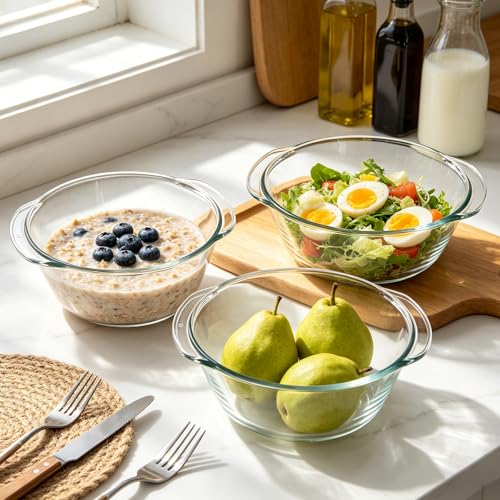
Individual Glass Casserole Dishes for Oven, Microwave and Air Fryer, Yomvzake 2-Pack
These two borosilicate glass dishes reheat, bake and serve individual portions while moving from freezer to oven, microwave or air fryer. They suit cooks who want reusable portion containers with dishwasher-safe cleanup and versatile meal-prep use.
Pros and Cons
Pros
- Borosilicate glass offers high transparency, heat resistance and corrosion resistance.
- The two-dish set works for baking, reheating, serving and meal preparation.
- Dishwasher-safe construction makes post-meal cleanup easier.
- The dishes handle temperatures from -40°F to 482°F when used according to the thermal-shock instructions.
Cons
- The dishes require natural cooling when hot or cold, and the instantaneous temperature difference must stay below 248°F.
- The product instructions say not to use tinfoil with the dishes.

Kismile
Crispy Everyday Meals: Kismile 5QT Glass Air Fryer with Digital Touch Control
The Kismile 5QT Glass Air Fryer cooks crispy foods with 1500W air circulation and up to 95% less oil than traditional frying. It suits apartment kitchens, dorms, and small households that want a compact air fryer with a coating-free glass basket and simple digital controls.
Pros and Cons
Pros
- The glass basket provides a clear view of food during cooking.
- Eight presets and digital touch controls make routine air frying straightforward.
- The compact 5QT design fits apartments, dorms, and smaller kitchens.
- Dishwasher-safe removable parts make cleanup easier.
Cons
- The 5QT capacity may be limiting when preparing large family-sized meals.
- The 60-minute timer and 400°F maximum temperature may not suit recipes requiring longer or hotter cooking.

Ninja
Portable Countertop Air Frying in Borosilicate Glass: Ninja Crispi 4-in-1 Glass Air Fryer FN101PR, Frosted Lilac
The Ninja Crispi pairs a handheld PowerPod heating unit with 4-quart and 6-cup borosilicate glass containers, so you cook, store, and carry the same dish without transferring food. It suits small households and meal-preppers who want air fryer crisping without surrendering permanent counter space to a bulky basket unit.
Pros and Cons
Pros
- Cooking and serving happen in the same glass vessel, which removes the usual transfer step and an extra dish.
- Permanently fixed heat-safe feet let you set the unit directly on granite, quartz, marble, laminate, or butcher block.
- Four functions cover Max Crisp, Bake, Air Fry, and Recrisp, including reheating leftovers back to crisp.
- A container adapter is included, so one PowerPod drives both the small and large containers.
Cons
- The 4-quart glass container is heavier and more fragile than a standard nonstick air fryer basket, so it needs careful handling near the sink.
- There is no cooking basket you can shake mid-cycle, so food needs manual tossing for even browning on larger batches.

Fritaire
Glass Air Fryer for Self-Cleaning Meals: Fritaire Non Toxic Air Fryer Pro 9-in-1
The Fritaire Non Toxic Air Fryer Pro air fries, roasts, bakes, broils, reheats, dehydrates, rotisseries, and tumbles food while its self-cleaning cycle simplifies cleanup. It suits households wanting BPA-free, Teflon-free, PFAS-free cooking with a clear glass bowl and hands-free rotation.
Pros and Cons
Pros
- The rotisserie and tumbling accessories expand what you can cook without constant handling.
- The self-cleaning function and dishwasher-safe accessories simplify post-meal cleanup.
- The glass bowl provides a clear view of food while it cooks.
- Nine preset systems support multiple cooking methods in one appliance.
Cons
- The glass bowl is not dishwasher-safe, so it still requires manual washing.
- Its five-quart capacity may limit batch sizes for larger households.
The Best Deals This Week*
-
Crispy Everyday Meals: Kismile 5QT Glass Air Fryer
$89.99
($109.99)Save $20.00 -
Portable Countertop Air Frying in Borosilicate
$159.99
($169.95)Save $9.96
*Deals are selected by our commerce team
Yomvzake Individual Glass Casserole Dishes for Oven, Microwave and Air Fryer, Yomvzake 2-Pack
Yomvzake
Individual Glass Casserole Dishes for Oven, Microwave and Air Fryer, Yomvzake 2-Pack
These two borosilicate glass dishes reheat, bake and serve individual portions while moving from freezer to oven, microwave or air fryer. They suit cooks who want reusable portion containers with dishwasher-safe cleanup and versatile meal-prep use.
$19.99 at AmazonEditors' Favorite
Color: Clear Size: Medium-Round Dimensions: 8 x 4 x 7.4 inches Product Group: Kitchen
Shop NowKismile Crispy Everyday Meals: Kismile 5QT Glass Air Fryer with Digital Touch Control
Kismile
Crispy Everyday Meals: Kismile 5QT Glass Air Fryer with Digital Touch Control
The Kismile 5QT Glass Air Fryer cooks crispy foods with 1500W air circulation and up to 95% less oil than traditional frying. It suits apartment kitchens, dorms, and small households that want a compact air fryer with a coating-free glass basket and simple digital controls.
$89.99 at AmazonGreat Value
Color: White Size: 13.19 x 11.22 x 9.96 inches Dimensions: 13.19 x 11.22 x 9.96 Inches Weight: 11.02 pounds Product Group: Kitchen Binding: Kitchen
Shop NowNinja Portable Countertop Air Frying in Borosilicate Glass: Ninja Crispi 4-in-1 Glass Air Fryer FN101PR, Frosted Lilac
Ninja
Portable Countertop Air Frying in Borosilicate Glass: Ninja Crispi 4-in-1 Glass Air Fryer FN101PR, Frosted Lilac
The Ninja Crispi pairs a handheld PowerPod heating unit with 4-quart and 6-cup borosilicate glass containers, so you cook, store, and carry the same dish without transferring food. It suits small households and meal-preppers who want air fryer crisping without surrendering permanent counter space to a bulky basket unit.
$159.99 at AmazonColor: Frosted Lilac Size: 4 QT Dimensions: 13.38 x 11.96 x 13.58 inches Product Group: Kitchen Binding: Kitchen
Shop NowFritaire Glass Air Fryer for Self-Cleaning Meals: Fritaire Non Toxic Air Fryer Pro 9-in-1
Fritaire
Glass Air Fryer for Self-Cleaning Meals: Fritaire Non Toxic Air Fryer Pro 9-in-1
The Fritaire Non Toxic Air Fryer Pro air fries, roasts, bakes, broils, reheats, dehydrates, rotisseries, and tumbles food while its self-cleaning cycle simplifies cleanup. It suits households wanting BPA-free, Teflon-free, PFAS-free cooking with a clear glass bowl and hands-free rotation.
$199.99 at AmazonColor: White Size: 5 Quart Dimensions: 10.8 x 13.9 x 12.6 inches Weight: 15.44999532096 Pounds Product Group: Kitchen Binding: Kitchen
Shop NowWhat a “Glass Air Fryer” Actually Is
Most glass air fryers are not fully glass appliances. The heating element, fan, and controls live in a plastic-and-metal base, exactly like a normal air fryer. What is different is the cooking vessel: a thick borosilicate glass bowl or pod that holds the food and, in pod-style designs, doubles as a storage and serving container.
Borosilicate is the same glass family used in laboratory beakers and classic ovenware. It contains boron trioxide, which gives it a very low coefficient of thermal expansion — meaning it expands and contracts far less than ordinary soda-lime glass when heated. That property is the entire reason it works in an appliance that cycles a fan of 350-400°F air directly across the surface. Cheaper soda-lime glass would be far more prone to cracking under the same conditions.
The airflow principle is identical to any air fryer: a heating coil warms the air and a fan drives it in a rapid convection loop around the food, crisping the exterior through the Maillard reaction while pulling moisture away. The glass simply replaces the coated metal basket that food normally sits in.
Is the Glass Itself Safe at Air-Fryer Temperatures?
Yes, within its rating. Quality borosilicate is commonly rated for sustained use in the 400-500°F range and tolerates steep temperature gradients that would shatter regular glass. Air fryers rarely exceed 400°F, so a properly made borosilicate bowl operates comfortably inside its limits.
The important qualifier is thermal shock, not absolute temperature. Glass cracks when one part expands much faster than another. That happens when you:
- Take the bowl straight from the refrigerator or freezer and drop it into a preheated base.
- Pour cold liquid or add frozen food into an already-hot bowl.
- Set a hot bowl on a cold granite counter, a wet surface, or into a sink of water.
Follow the reverse of those, and the glass stays intact. Let the bowl come near room temperature before heating, place hot glass on a dry trivet or wooden board, and you have removed essentially all of the fracture risk. This is the same discipline that keeps ovenware alive for years.
One note on Pyrex specifically: modern Pyrex sold in the United States is often soda-lime (tempered) glass rather than borosilicate, while European “Pyrex” typically remains borosilicate. Soda-lime tempered glass is oven-safe but more sensitive to thermal shock, so treat it more carefully than a dedicated borosilicate air-fryer bowl.
The Real Advantage: No Nonstick Coating
The safety appeal of a glass air fryer is less about the glass surviving heat and more about what it replaces. Conventional air-fryer baskets are typically coated with PTFE (the compound behind the Teflon name). PTFE is stable at normal cooking temperatures, but the coating is thin, scratches with metal utensils, and degrades over the life of the pan. Owners of coated baskets routinely report flaking after a year or two of daily use.
Glass sidesteps that entire category of concern. It is chemically inert, so it does not leach into food, does not react with acidic ingredients like tomato or lemon, does not absorb odors, and has no coating to scratch off into your dinner. For readers specifically avoiding PFAS-class chemicals, a borosilicate cooking surface is about as neutral as kitchen materials get. If a coating-free kitchen is your goal more broadly, the same logic drives choices like a good best blender jar, a best instant pot with a stainless insert, or the right best cookware for glass top stove that will not scratch a smooth surface.
Cleaning, Durability, and the Trade-Offs
Glass is easy to clean. Because nothing bonds chemically to the surface, baked-on residue lifts with a soak, and most glass bowls are dishwasher safe. You can also see through the vessel to judge browning without opening the drawer, which conventional baskets do not allow.
The trade-offs are physical rather than chemical:
- Weight. Thick borosilicate is heavier than a thin metal basket, which some owners find awkward to lift and pour when full.
- Breakage from impact. Thermal shock is avoidable, but a hard knock on the sink edge or a drop to the floor can still shatter glass in a way metal would only dent. Replacement bowls are sold for popular models, which is worth checking before you buy.
- Airflow geometry. Air frying depends on air moving freely around the food. A tall or narrow glass bowl can restrict circulation, so results depend on the model being designed for convection rather than a random glass container jammed into a basket.
Weighed against the coating-free surface and easy cleanup, most owners consider these acceptable. If you cook large batches daily, a metal basket in our best air fryer roundup may simply be more practical; if a clean surface matters most, glass wins.
Putting Glass Cookware Inside a Regular Air Fryer
Separately from dedicated glass air fryers, many people want to set an oven-safe glass dish inside their existing metal-basket fryer. That is workable with rules:
1. Use only glass explicitly labeled oven-safe (borosilicate is ideal; tempered soda-lime is acceptable with care). 2. Leave clearance on all sides — roughly half an inch to an inch — so hot air can circulate. A dish that seals the basket turns your air fryer into a slow, uneven oven. 3. Keep the glass away from the heating element. Compact air fryers put food close to the coil, and glass sitting too near a glowing element sees a harsher temperature gradient. 4. Never move the dish through a sudden temperature change, as covered above.
Used this way, glass is handy for saucy foods, egg bakes, or anything that would drip through a basket. It does slightly reduce crisping, since the glass shields the underside of the food from direct airflow.
Frequently Asked Questions
Can you put Pyrex in an air fryer?
Usually yes, if the piece is oven-safe and fits with room for air to circulate. Be aware that Pyrex sold in the US is often tempered soda-lime glass, which is more sensitive to thermal shock than the borosilicate used in dedicated glass air fryers or European Pyrex. Let it warm to room temperature before heating, keep it clear of the heating element, and never add cold liquid to the hot dish or set it on a cold, wet surface. Leaving space around the dish also preserves the crisping airflow.
Is borosilicate glass in an air fryer non-toxic?
Borosilicate is chemically inert, so it does not leach chemicals, react with acidic foods, or shed a coating the way a scratched nonstick basket can. There is no PTFE, PFOA, or PFAS on a bare glass surface. That makes a borosilicate glass air fryer one of the cleanest options for anyone specifically avoiding coating-related compounds, provided the glass stays intact and is not cracked or chipped.
Is a glass air fryer better than a regular one?
It depends on your priority. Glass wins on a coating-free surface, easy cleaning, and visibility while cooking. A conventional metal-basket model, like the ones in our best air fryer guide, tends to win on light weight, larger usable capacity, and impact durability. For crisping performance, a well-designed glass unit is competitive, but a poorly shaped glass bowl can restrict airflow. Choose glass if a clean surface is your main concern; choose metal if capacity and ruggedness matter more.
What should you not put in an air fryer?
Avoid loose parchment or paper without food weighing it down, since the fan can lift it into the heating element and scorch it. Skip wet, drippy batters that never set in convection air, excessive oil that smokes, and any plastic or glass not rated as oven-safe. Very light foods can also blow around and hit the element. When in doubt, only heat cookware and liners specifically labeled safe for oven or air-fryer temperatures.
Can the glass bowl actually crack during cooking?
Quality borosilicate rarely cracks from the heat alone, because air fryers stay within its rating. Cracks come almost entirely from thermal shock or physical impact. Do not move the bowl between extreme temperatures, do not add frozen food to a hot bowl, and set hot glass only on a dry trivet or wood board. Handle it as carefully as you would a glass casserole and it should last for years. Many popular models also sell replacement bowls.
Are glass air fryers dishwasher safe?
Most borosilicate cooking bowls are dishwasher safe, and the inert surface means residue rinses off easily even by hand. The heating base, controls, and any electrical components are never dishwasher safe and should be wiped with a damp cloth only. Always check the specific model’s manual, but the glass vessel itself is one of the easier air-fryer components to keep clean.
The Bottom Line
A glass air fryer is safe for the vast majority of home cooks, and in one meaningful way it is safer than a conventional model: the food touches inert borosilicate glass instead of a nonstick coating that can scratch and degrade. The glass comfortably handles air-fryer temperatures, and the only genuine hazard, thermal shock, is entirely avoidable with a little care about temperature swings. The real trade-offs are weight and the possibility of breakage from a drop, not chemical exposure. If a coating-free surface and easy cleanup top your list, a glass model is an excellent choice; if you prioritize capacity and ruggedness, compare it against the metal-basket options in our best air fryer, best deep fryer, and best instant pot guides before deciding.




Write Your Review
No reviews yet. Be the first to share your experience!