

TL;DR — Yes, a Damascus steel chef knife is safe for kitchen use. “Damascus” refers to the visible folded-pattern look of the blade, not a separate type of steel — the actual cutting edge is normal high-carbon or stainless knife steel, so safety and performance come down to the underlying steel, not the pattern. The pattern itself is decorative and doesn’t make a knife sharper, harder, or more prone to breakage. The real safety considerations are the same as any quality knife: edge geometry, handle construction, and whether the steel is rust-resistant stainless or high-carbon (which needs care to avoid corrosion). For picks, see our best chef knife guide.
The HomeWhisk editorial team researches kitchen knives by analyzing manufacturer specifications, steel grades, and aggregated user reviews from major retailers and knife communities like Reddit r/chefknives and r/sharpening. “Is a Damascus steel chef knife safe?” usually comes from one of two worries: that the layered pattern makes the blade fragile or prone to cracking, or that Damascus steel is somehow different or riskier than ordinary kitchen knives. Neither is true, but there’s real nuance in how Damascus knives are made and what to look for. This guide covers the safety question and the practical buying decisions behind it.

NANFANG BROTHERS
Damascus Chef Knife Set for Everyday Prep and Steak Service: NANFANG BROTHERS 14-Piece VG10 Block Set
This 14-piece set covers every cutting task in a home kitchen, from breaking down proteins with the chef's knife to slicing crusty loaves, with a 67-layer Damascus cladding over a VG10 core that holds a sharp edge through repeated use. It suits home cooks who want a full matched set including six steak knives, shears, and a sharpener in one wooden block rather than assembling knives piece by piece.
Pros and Cons
Pros
- Fourteen pieces cover chef, bread, carving, utility, and paring work plus a full steak knife set in one purchase.
- Damascus-clad VG10 steel delivers strong edge retention and corrosion resistance for daily use.
- Full-tang construction with riveted handles gives the blades solid balance during extended prep.
- Ergonomic non-slip handles reduce hand fatigue when working through large batches of vegetables.
Cons
- ABS plastic handles feel less premium than the pakkawood or G10 found on comparable Damascus sets.
- Hardened VG10 steel is prone to chipping if used on bone or frozen food, and hand washing is required.

FINTISO
7-Inch Damascus Santoku for Fast Vegetable and Protein Prep: FINTISO 67-Layer Chef Knife with G10 Handle
This 7-inch santoku handles mincing, chopping, and slicing with a 67-layer Damascus blade hand-polished to 12-14 degrees per side, so it parts vegetables and boneless protein with minimal downward pressure. It suits home cooks who prep daily and want a hard 62 HRC edge that holds up between sharpenings, plus gift buyers who need something presentable out of the box.
Pros and Cons
Pros
- Hand-polished thin bevel arrives sharp enough for precision work without an initial sharpening.
- G10 scales resist wear, cracking, and color fade far better than wood or resin-filled handles.
- The 7-inch santoku profile fits smaller boards and tighter kitchens better than a 8-inch gyuto.
- Ships in presentation packaging, so it works as a gift without extra wrapping.
Cons
- At 62 HRC the edge is hard and thin, which makes it prone to chipping on bones, frozen food, or hard squash rind.
- Damascus patterning and a high-carbon-adjacent core mean handwashing and immediate drying are required; the dishwasher will dull and spot it.
ASETY
Everyday Meat and Vegetable Prep: ASETY 3-Piece Damascus Japanese Kitchen Knife Set
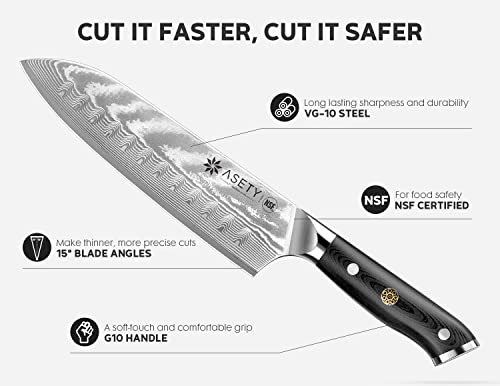
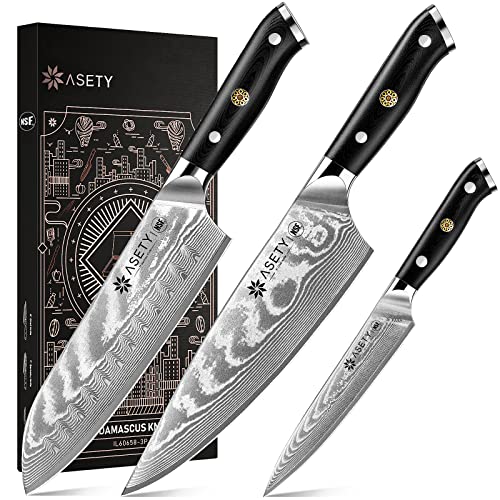
The ASETY 3-piece Damascus knife set handles meat, vegetable, and fruit prep with a 10 to 15° edge that supports precise, clean cuts. It suits beginners and experienced cooks seeking three versatile, full-tang knives with ergonomic G10 handles.
Pros and Cons
Pros
- The three included blade styles provide useful coverage without requiring a large knife collection.
- The 67-layer Damascus construction combines a hard 10Cr15CoMoV core with a precise cutting edge.
- Full-tang G10 handles offer durability, grip stability, and balanced handling.
- All three knives are NSF certified for use in food-preparation environments.
Cons
- The set does not include a bread knife, paring knife, storage block, or blade guards.
- Individual knife weights are not listed, making it harder to judge whether the balance and heft will suit a buyer before purchase.
NANFANG BROTHERS Damascus Chef Knife Set for Everyday Prep and Steak Service: NANFANG BROTHERS 14-Piece VG10 Block Set
NANFANG BROTHERS
Damascus Chef Knife Set for Everyday Prep and Steak Service: NANFANG BROTHERS 14-Piece VG10 Block Set
This 14-piece set covers every cutting task in a home kitchen, from breaking down proteins with the chef's knife to slicing crusty loaves, with a 67-layer Damascus cladding over a VG10 core that holds a sharp edge through repeated use. It suits home cooks who want a full matched set including six steak knives, shears, and a sharpener in one wooden block rather than assembling knives piece by piece.
Check price on AmazonA 14-piece Damascus block set for cooks tired of mismatched, dull knives and separate steak cutlery cluttering drawers.
The 67-layer Damascus cladding over a VG10 core keeps a fine edge through tomatoes, herbs, and protein without constant honing.
Full-tang blades are riveted into one-piece molded ABS handles, putting balance at the pinch grip and keeping seams out of the handle.
ABS handles are durable but plainer than wood or composite options, and the steel demands hand washing and drying.
Best for home cooks outfitting a kitchen from scratch who want prep knives and steak service in one block.
FINTISO 7-Inch Damascus Santoku for Fast Vegetable and Protein Prep: FINTISO 67-Layer Chef Knife with G10 Handle
FINTISO
7-Inch Damascus Santoku for Fast Vegetable and Protein Prep: FINTISO 67-Layer Chef Knife with G10 Handle
This 7-inch santoku handles mincing, chopping, and slicing with a 67-layer Damascus blade hand-polished to 12-14 degrees per side, so it parts vegetables and boneless protein with minimal downward pressure. It suits home cooks who prep daily and want a hard 62 HRC edge that holds up between sharpenings, plus gift buyers who need something presentable out of the box.
Check price on AmazonA 7-inch santoku built for the repetitive board work that dulls cheap knives fast: dicing onions, breaking down peppers, and slicing boneless chicken.
The 12-14 degree per side edge on a 62 HRC core lets the blade fall through produce, while double-sided grooves keep starchy slices from clinging.
67-layer Damascus cladding over 10Cr15CoMoV, full-tang, with textured G10 scales that stay secure under wet hands and resist fading.
The hard, thin edge is not a bone knife; lateral force or hard contact risks chipping the tip and edge.
Best for home cooks doing daily vegetable and protein prep who will handwash and dry after each use.
ASETY Everyday Meat and Vegetable Prep: ASETY 3-Piece Damascus Japanese Kitchen Knife Set
ASETY
Everyday Meat and Vegetable Prep: ASETY 3-Piece Damascus Japanese Kitchen Knife Set
The ASETY 3-piece Damascus knife set handles meat, vegetable, and fruit prep with a 10 to 15° edge that supports precise, clean cuts. It suits beginners and experienced cooks seeking three versatile, full-tang knives with ergonomic G10 handles.
Check price on AmazonThis three-knife set handles common kitchen prep with dedicated chef's, santoku, and utility blades for chopping, slicing, trimming, and portioning.
The 60 to 62 HRC steel core supports edge retention, while the 10 to 15° edges make controlled cuts through meat, produce, and fruit.
Each knife combines 67-layer Damascus steel, full-tang construction, triple rivets, and a G10 handle. Blade sizes are 8 inches, 7 inches, and 5.5 inches.
Individual weights are not provided, and the set lacks specialty blades and storage accessories.
Best for home cooks who want a compact, versatile knife set with hard steel and secure full-tang handles.
What Damascus Steel Actually Is
The name “Damascus” comes from the historical city and originally referred to wootz steel, an ancient crucible steel from the Middle East and India known for its distinctive watery patterns and legendary edge. That original process was lost centuries ago and isn’t what’s sold today.
Modern Damascus — also called pattern-welded steel — is made by forge-welding multiple layers of different steels together, folding and twisting the billet, then acid-etching it to reveal the contrast. The layers show up as the characteristic rippled pattern. The blade might be built from 50, 100, or several hundred alternating layers of two or more steels (commonly a high-carbon steel and a nickel-bearing or stainless steel for contrast).
Critically, the pattern is largely decorative. The cutting edge is typically a separate core steel (in a san-mai or V-grade construction) or simply the outer layers ground to an edge. So a Damascus knife’s sharpness and durability depend on whatever steel forms the edge — not on the visible folds. Our best chef knife guide focuses on the edge steel, since that’s what does the work.
Are Damascus Knives Safe to Use? The Core Question
The short answer is yes, with no meaningful safety difference from any well-made kitchen knife. The pattern-welding process doesn’t introduce toxins, and the steels used are standard knife steels. A few specific safety points:
- The edge steel is conventional. Whether it’s VG-10, AEB-L, 1095, or another common cutlery steel, it’s the same material used in non-Damascus knives. There’s nothing chemically different about a Damascus blade touching food.
- Layering can actually add toughness. Forge-welded multi-layer construction can resist chipping well if done properly, because alternating steels can stop crack propagation.
- The main risk is the same as any knife: a dull or poorly maintained knife is more dangerous than a sharp one, because it requires more force and slips unpredictably. Sharpness and technique, not the pattern, determine safety in the hand.
So there’s no Damascus-specific safety hazard. What matters is build quality — which brings us to the wide variation between knives.
Not All Damascus Knives Are the Same
This is the most important thing to understand, and it’s where safety and value concerns actually live. Damascus knives range from excellent to terrible:
- High-end pattern-welded knives from reputable makers use real steels, proper heat treatment, and a quality edge core. These perform like any premium knife and the Damascus is a legitimate, durable finish.
- Mid-range factory Damascus (common on popular brands) often pairs a VG-10 or similar stainless core with pattern-welded outer layers — a good, functional design.
- Budget “Damascus” knives are where caution is warranted. Some use cheap steels with an etched or laser-engraved fake pattern, weak heat treatment, or soft edges that won’t hold. These aren’t unsafe to touch food, but they perform poorly and the “Damascus” is cosmetic marketing rather than real layered construction.
The pattern count (e.g., “67 layers,” “100 layers”) tells you about the look, not the quality. Heat treatment and the edge-core steel are what matter. A well-heat-treated simple steel outperforms a badly treated “premium” one. See our best chef knife under 100 guide for real value picks, and best japanese chef knife for high-end options.
High-Carbon vs Stainless Damascus: The Real Care Difference
The practical “is it safe / will it last” question splits along the steel type, not the Damascus pattern.
- Stainless Damascus (and stainless-core san-mai): rust-resistant, low-maintenance, wipe and store. The safest choice for most home cooks who don’t want to baby a knife. A VG-10 core with stainless Damascus cladding is a common, excellent all-around design.
- High-carbon Damascus (e.g., 1095/15N20 patterns): holds a screaming edge and is easier to sharpen, but rusts and reacts with acidic foods. It can discolor onions, citrus, and tomatoes, and it needs to be wiped dry immediately and lightly oiled for storage. It’s not unsafe — the discoloration is cosmetic and the steel is food-grade — but it demands care.
If you want a Damascus look without the maintenance, choose stainless or san-mai with a stainless core. High-carbon Damascus is for enthusiasts who don’t mind oiling their blade. The care difference is the single biggest factor in whether a Damascus knife stays safe and performing long-term.
Edge Retention and Sharpening
Damascus doesn’t change how a knife sharpens or holds an edge — the edge steel does. A VG-10 core holds an edge longer than softer steels; a high-carbon core can take a finer edge but needs more frequent touch-ups and rust care. Any quality Damascus knife sharpens normally on whetstones. Avoid aggressive pull-through sharpeners on hard Japanese steels, which can chip the edge; whetstones or a honing rod for touch-ups are the better approach. For an overview of value options, see our best chef knife set and best knife sets guides.
How to Care for a Damascus Knife
- Hand-wash only and dry immediately — never the dishwasher, which damages both the edge and the etched pattern.
- Wipe and dry between uses, especially with high-carbon steel, to prevent rust and food reaction.
- Store in a block, magnetic strip, or sheath — not loose in a drawer where edges chip against each other.
- Oil high-carbon blades lightly with food-safe mineral oil for storage.
- Sharpen on whetstones rather than pull-throughs; hone regularly to maintain the edge between sharpening.
Proper care keeps a Damascus knife safe, sharp, and looking good for decades. Neglect — especially of high-carbon steel — leads to rust and pitting, which is the main way these knives degrade.
Is Damascus Better Than Stainless Steel?
It’s a false comparison. Damascus is a construction method and look; stainless is a steel property. You can have stainless Damascus (stainless steels, pattern-welded), carbon Damascus, or a plain stainless knife with no pattern at all. The relevant comparison is the edge steel and heat treatment, not “Damascus vs stainless.” A high-quality plain stainless knife will outperform a cheap Damascus one, while a well-made Damascus knife with a great core steel is a top performer that also looks striking.
Frequently Asked Questions
Is Damascus steel good for kitchen knives?
Yes, provided the knife is well-made. The Damascus pattern itself is decorative; what makes the knife good is the edge-core steel and its heat treatment. A stainless-core Damascus knife with VG-10 or similar steel performs excellently for everyday cooking. The only Damascus knives to avoid are cheap ones with fake etched patterns and poor heat treatment, which cut poorly regardless of the look. Focus on the edge steel and maker reputation rather than layer count. See our best chef knife guide.
Is Damascus steel stronger than regular steel?
Not inherently. Pattern-welded Damascus can be tough and resist chipping due to its layered structure, but strength and hardness come from the specific steels used and their heat treatment, not the pattern. A well-heat-treated single-steel knife can be just as strong or stronger than a mediocre Damascus one. The marketing claim that Damascus is universally “stronger” isn’t accurate — it depends entirely on the steel and how it was treated.
Do Damascus steel knives stay sharp?
They stay sharp according to their edge-core steel, not the Damascus pattern. A hard stainless core like VG-10 holds an edge well for a long time; a high-carbon core can take a finer edge but may need more frequent touch-ups. Damascus doesn’t improve or worsen edge retention on its own. What keeps any knife sharp is proper honing between uses and sharpening on whetstones when needed. Avoid pull-through sharpeners on hard Japanese Damascus to prevent chipping. See our best chef knife set guide.
Are Damascus knives only for looks?
For many consumer knives, the Damascus pattern is largely cosmetic — it looks striking but doesn’t change cutting performance, which comes from the edge core. That said, real pattern-welded Damascus is a legitimate, durable construction, and on well-made knives the layered structure can add toughness. So while the look is a primary reason people buy Damascus, it’s not “only” decorative on a quality knife — it’s a real construction with real (if modest) benefits, plus a beautiful finish.
What is the best Damascus knife for beginners?
A stainless-core san-mai Damascus chef knife is the best beginner choice. The stainless edge core means low maintenance — no rust or food discoloration to worry about — while the Damascus cladding gives the attractive look beginners often want. Avoid high-carbon Damascus until you’re ready to wipe and oil the blade, and avoid ultra-budget knives with likely fake patterns. An 8-inch stainless-core Gyuto or western chef’s knife is the most versatile starting point. See our best chef knife under 100 and best japanese chef knife guides.
Is Damascus steel safe to cut food with?
Yes. Damascus knives are made from standard, food-grade knife steels — the pattern-welding process doesn’t introduce anything unsafe. The edge steel (whether VG-10, AEB-L, 1095, or another cutlery steel) is the same material used in non-Damascus kitchen knives. High-carbon Damascus can discolor acidic foods like onions or tomatoes, which is cosmetic rather than a safety issue. As with any knife, the real safety factor is keeping it sharp and using good technique. See our best chef knife guide.
The Bottom Line
A Damascus steel chef knife is safe for kitchen use. “Damascus” describes the layered pattern and construction, not a different or riskier kind of steel — the cutting edge is ordinary knife steel, so sharpness, durability, and food safety come down to the edge core and heat treatment, not the folds. The pattern is mostly decorative; the practical considerations are the same as any quality knife: choose stainless for low maintenance or high-carbon for performance-with-care, hand-wash and dry, store properly, and sharpen on whetstones. Avoid ultra-budget knives with likely fake patterns. For real picks across budgets, see our best chef knife, best chef knife under 100, and best japanese chef knife guides, plus best bread knife for the rest of the block.




Write Your Review
No reviews yet. Be the first to share your experience!