

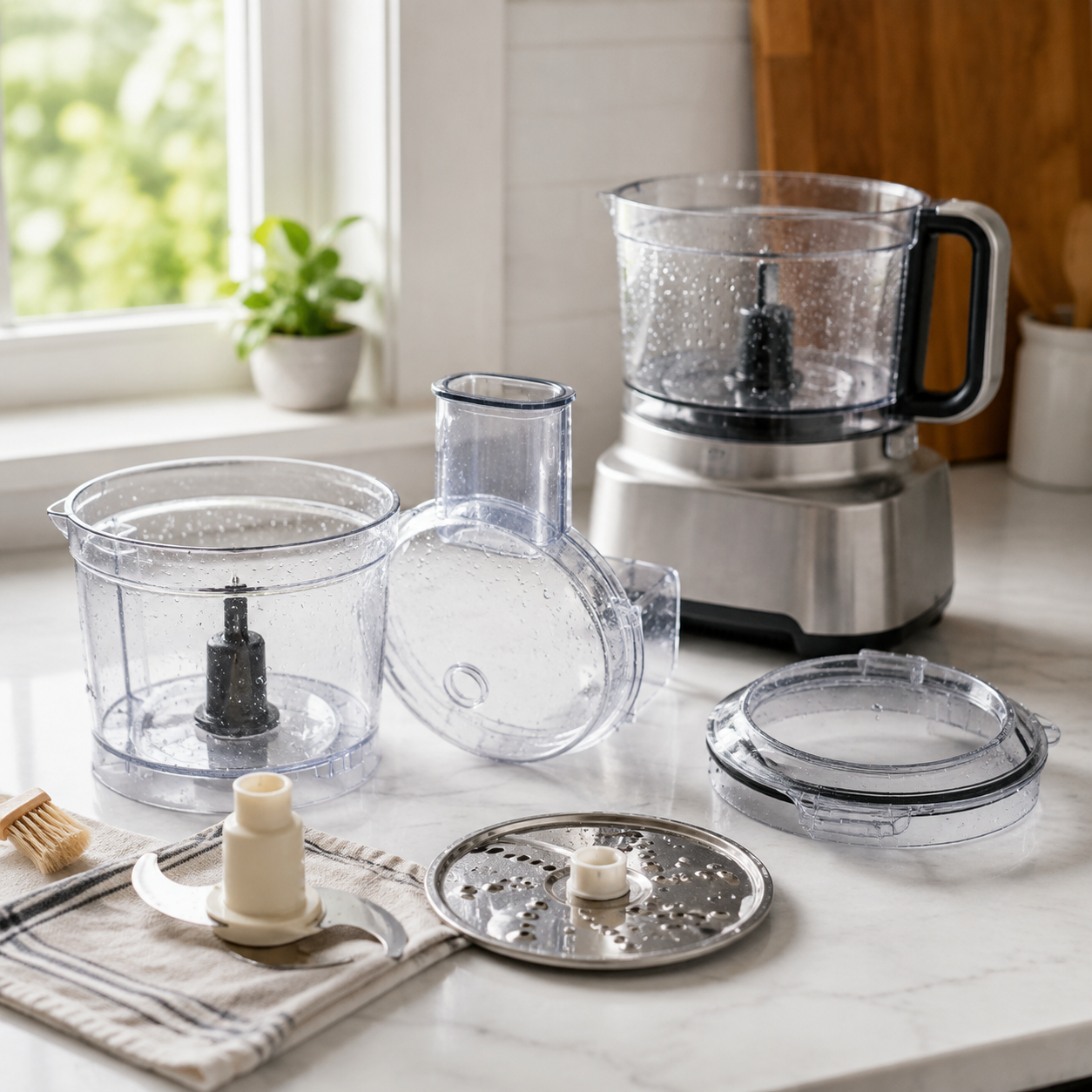
TL;DR — Unplug it, disassemble the removable parts (bowl, lid, blades, discs), and wash them in warm soapy water or the dishwasher (if safe) — handling the sharp blades carefully. Wipe the motor base with a damp cloth (never submerge it). Clean promptly after use and dry everything before reassembling. Careful blade handling and never submerging the base are the keys. The HomeWhisk team compiled this from care guidance and aggregated feedback. For picks, see our best food processor guide.
The HomeWhisk editorial team researches kitchen equipment by analyzing manufacturer specifications, cleaning guidance, and aggregated user reviews from major retailers and cooking communities. This guide reflects established cleaning principles, not personal testing.
A food processor is easy to clean if you do it promptly and handle the sharp blades safely. Here’s the step-by-step, plus a quick-clean trick. For choosing one, see our best food processor guide.
Step-by-Step Cleaning
Cleaning a food processor is straightforward — the key is disassembling it and handling the blades carefully.
1. Unplug the food processor. Always disconnect it from power before cleaning — the blades are sharp and it’s an electrical appliance.
2. Disassemble the removable parts. Take apart the components:
- Bowl (the work bowl).
- Lid (and feed tube/pusher).
- Blades and discs (the S-blade, slicing/shredding discs, dough blade, etc.) — handle these very carefully; they’re extremely sharp.
Remove all removable parts from the motor base.
3. Wash the removable parts.
- Wash the bowl, lid, blades, and discs in warm soapy water with a sponge or brush, or in the dishwasher if they’re dishwasher-safe (check your manual — many parts are, often top-rack).
- Handle blades and discs with extreme care — hold them by the safe central hub or edges, not the cutting edge, and wash them individually (never leave sharp blades hidden in soapy water where you might reach in and cut yourself). Use a brush to clean around the blades rather than wiping with your hand.
- Clean the feed tube and pusher too.
4. Wipe the motor base (never submerge). The motor base contains the electrical components and must never be immersed in water or put in the dishwasher. Wipe it with a damp cloth with a little dish soap to remove any food splatter, then wipe with a clean damp cloth. Keep water out of the base.
5. Rinse and dry everything thoroughly. Rinse the washed parts and dry them completely (especially around blades and the bowl) before reassembling — this prevents water spots, odors, and any moisture issues.
6. Reassemble the dry parts, or store them separately.
That’s the core process — unplug, disassemble, wash removable parts (carefully with the blades), wipe the base, and dry. The two rules: handle the sharp blades carefully and never submerge the motor base. Our best food processor guide covers models with easy-clean, dishwasher-safe parts.
The Quick-Clean Trick and Stuck-On Food
For a fast rinse between tasks and for stubborn residue, these approaches help.
The quick-clean (self-clean) trick: for a fast clean between uses (not a deep clean), you can: 1. Put the empty bowl and blade back on the base. 2. Add a little warm water and a drop of dish soap. 3. Run the processor for a few seconds — it swirls the soapy water and cleans the bowl and blade. 4. Pour it out, rinse, and dry. This is handy for a quick rinse between processing different ingredients (though a thorough wash is still needed after finishing).
For stuck-on or dried food:
- Clean promptly — food is much easier to remove before it dries on. Rinse or wash parts soon after use.
- Soak the bowl, lid, and parts in warm soapy water to loosen dried-on food, then wash.
- Use a brush (a bottle brush or dish brush) to clean around blades, in corners, and in the feed tube where food lodges — safer and more effective than fingers near blades.
- For the narrow center tube of the bowl and around the blade hub, a brush reaches spots a sponge can’t.
Removing odors/stains:
- For lingering odors (garlic, onion) or stains (from carrots, tomato), soak with a little baking soda solution, or make a baking soda paste and gently scrub, then rinse.
- Ensure parts are fully dry before storing to prevent musty odors.
Cleaning around the blade safely: the blades are the main hazard — always handle them by the hub/edges, use a brush (not bare hands) to clean the cutting edges, wash them separately (never buried in soapy water), and store them safely. Careful blade handling prevents cuts.
The quick-clean trick handles between-task rinsing, while prompt washing and soaking handle stuck-on food. Our best food processor and best blender guides cover the appliances.
Maintenance and Tips
A few habits keep the food processor clean, working, and lasting.
Maintenance tips:
- Clean after each use — don’t let food dry on the parts (much harder to clean later) or sit in the base area. Prompt cleaning is the biggest factor in easy maintenance.
- Dry all parts thoroughly before reassembling or storing — prevents water spots, odors, and mold.
- Store blades safely — keep sharp blades in a safe spot (a blade holder if provided, or separately) so no one reaches in and gets cut, and so the edges are protected.
- Check dishwasher-safe status — most bowls, lids, and blades are dishwasher-safe (often top rack), but verify in your manual; the base never is.
- Keep the base clean — wipe it after use to prevent buildup, and keep the buttons/controls free of food.
- Handle blades carefully during both use and cleaning to avoid cuts and to keep the edges sharp.
- Check seals/gaskets (if any) are clean and intact for proper operation.
A note on the sharp blades: the food processor’s blades are its main safety consideration. Always unplug before cleaning, handle blades by the safe parts, use a brush to clean the edges, wash them individually (never hidden in water), and store them safely. This prevents the cuts that are the most common food-processor cleaning injury.
The takeaway: unplug, disassemble, and wash the removable parts in warm soapy water or the dishwasher (handling the sharp blades carefully), wipe the motor base without submerging it, and dry everything before reassembling. Use the quick-clean trick for fast rinses, clean promptly to avoid dried-on food, and store blades safely. Our best food processor guide covers easy-clean models.
Frequently Asked Questions
How do you clean a food processor?
Unplug it, then disassemble the removable parts (bowl, lid, blades, discs) and wash them in warm soapy water or the dishwasher if they’re dishwasher-safe — handling the sharp blades very carefully by their hub or edges, not the cutting edge. Wipe the motor base with a damp cloth (never submerge it, as it contains electrical parts). Rinse and dry everything thoroughly before reassembling. Clean promptly after use so food doesn’t dry on. The two key rules are handling the sharp blades carefully and never immersing the motor base.
Are food processor parts dishwasher safe?
Usually the bowl, lid, blades, and discs are dishwasher-safe (often on the top rack), but check your specific model’s manual to confirm, as it varies. The motor base is never dishwasher-safe or submersible — only wipe it with a damp cloth. When putting blades and discs in the dishwasher, place them carefully (they’re sharp). Hand-washing in warm soapy water is always a safe alternative for any part except the base. Verify which parts are dishwasher-safe for your food processor, and always keep the electrical base out of water.
How do I clean a food processor quickly?
Use the quick-clean trick: put the empty bowl and blade back on the base, add a little warm water and a drop of dish soap, and run the processor for a few seconds — it swirls the soapy water to clean the bowl and blade. Pour it out, rinse, and dry. This is handy for a fast rinse between processing different ingredients. It’s not a substitute for a thorough wash after you finish (disassembling and washing all parts), but it’s great for quick cleaning between tasks. Always still do a full wash after your final use.
How do I clean the food processor blade safely?
Handle it with extreme care — the blades are very sharp. Always unplug the processor first, then hold the blade by its safe central hub or plastic parts, not the cutting edge. Use a brush (like a dish or bottle brush) to clean around and along the cutting edges rather than wiping with your bare hand or fingers. Wash blades individually and never leave them hidden in a sink of soapy water where you might reach in and cut yourself. Dry and store them safely (in a blade holder or separate spot). Careful handling prevents the cuts that are the most common cleaning injury.
Can I submerge a food processor in water?
No — never submerge the motor base of a food processor in water, as it contains the electrical components and doing so is dangerous and will damage it. Only the removable parts without electrical components (bowl, lid, blades, discs, feed tube, pusher) can be washed in water or the dishwasher. The motor base should only be wiped with a damp cloth, keeping water away from the electrical parts and controls. Always disassemble the removable parts for washing and only wipe the base.
How do I get rid of food processor odors or stains?
For lingering odors (like garlic or onion) or stains (from carrots or tomato) on the bowl and parts, soak them in a warm baking soda solution, or make a baking soda paste and gently scrub, then rinse well. Washing promptly after use prevents most odors and stains from setting. Ensure all parts are completely dry before storing, since trapped moisture causes musty odors. For tough stains, a longer baking soda soak usually lifts them. Baking soda is a gentle, effective way to deodorize and remove stains without harsh chemicals.
Related buying guides: best air fryer, best instant pot and best toaster oven.
The Bottom Line
Cleaning a food processor: unplug it, disassemble the removable parts (bowl, lid, blades, discs), and wash them in warm soapy water or the dishwasher (if safe), handling the sharp blades very carefully by their hub — never the cutting edge, and never buried in soapy water. Wipe the motor base with a damp cloth but never submerge it. Rinse and dry everything before reassembling. Use the quick-clean trick (run soapy water in the bowl) for fast rinses between tasks, clean promptly so food doesn’t dry on, and store the sharp blades safely. Careful blade handling and never submerging the base are the two key rules. See our best food processor and best blender guides.

Save $20.00
Pros & Cons
Pros
- Auto-iQ presets deliver consistent results for common tasks like salsa and pie dough without needing to manually pulse or adjust speed.
- The 9-cup bowl capacity handles family-sized portions in one batch, reducing the need to process ingredients in multiple rounds.
- Stainless steel blades stay sharp through repeated use and handle both delicate herbs and hard vegetables without dulling quickly.
Cons
- The 9-cup bowl takes up significant counter and cabinet space, which may be too large for small kitchens or single-person households.
- The motor is louder than compact models during operation, especially when processing hard ingredients like nuts or ice.
Details
The Ninja BN601 is a 1000-peak-watt food processor built to replace manual chopping, slicing, and kneading for home cooks who want faster meal prep without sacrificing consistency.
The Auto-iQ Technology uses timed pulsing patterns across four preset programs, so chopping onions, slicing carrots, pureeing soup, or mixing pizza dough happens with one button press. The 1000-watt motor maintains speed under load, which means it processes fibrous vegetables like kale and sticky dough without bogging down.
The 9-cup BPA-free bowl, stainless steel slicing disc, chopping blade, and dough blade are all dishwasher safe. The unit measures approximately 10 inches wide and 15 inches tall with the feed chute attached, requiring dedicated counter or cabinet space.
The feed chute is narrower than some competitors, so larger vegetables like whole potatoes need to be halved before slicing. The motor noise level is typical for this wattage class but noticeably louder than lower-powered compact processors.
Best for home cooks who regularly meal prep for families, bake from scratch, or want to eliminate repetitive knife work without learning manual pulse timing.
How to Use
Lock the bowl onto the base, insert the blade for your task (chopping blade for vegetables, slicing disc for uniform cuts, dough blade for mixing), then add ingredients. For Auto-iQ presets, press the corresponding program button and the processor runs through the timed cycle automatically.
When using the feed chute for slicing, cut larger vegetables to fit the chute diameter and use the pusher to guide ingredients onto the spinning disc. Avoid overloading the bowl past the max-fill line, as this reduces chopping efficiency and can cause uneven results.
For dough, add dry ingredients first, pulse to combine, then slowly pour liquid through the feed chute while the dough blade runs until the mixture pulls away from the bowl sides. This typically takes 30 to 60 seconds for most bread and pizza doughs.

Save $90.00
Pros & Cons
Pros
- The 4mm slicing disc and shredding disc produce uniform cuts for even cooking and professional presentation in salads and gratins.
- Buyers report the suction-cup feet keep the processor stable during heavy kneading tasks, unlike lighter models that walk across counters.
- The on/pulse buttons give precise control for coarse chopping nuts or making chunky salsas without over-processing into mush.
Cons
- The slicing and shredding discs are fixed at one thickness with no adjustment options, limiting versatility for recipes that need paper-thin or thick-cut slices.
- The 14-cup bowl requires significant cabinet space (10 inches wide, 15 inches tall when assembled), making storage difficult in small kitchens.
Details
The Cuisinart DFP-14BCNY is a 14-cup food processor designed to eliminate repetitive knife work and reduce meal prep time for families and batch cooks.
The 720-watt motor maintains consistent speed under load when kneading dough or shredding hard cheeses. The extra-large feed tube fits whole fruits and vegetables, removing the pre-cutting step that adds minutes to every recipe.
Brushed stainless steel housing resists kitchen wear better than plastic models. The assembled unit weighs 18 pounds and stands 15 inches tall, requiring dedicated counter or cabinet space.
The slicing and shredding discs are not adjustable, so recipes requiring paper-thin cuts or thick slices need a mandoline or knife as backup.
Best for home cooks who prepare meals for 4+ people regularly or batch-cook for the week ahead.
How to Use
Lock the work bowl onto the base by aligning the handle to the right and twisting counterclockwise until it clicks. Insert the blade or disc onto the center stem before adding ingredients.
Use the pulse button for controlled chopping when making salsa, pesto, or coarsely chopped nuts. Hold for 1-second bursts and check texture between pulses to avoid over-processing.
For slicing or shredding, push ingredients through the feed tube with steady pressure using the included pusher. The motor automatically adjusts speed based on resistance, so avoid forcing hard vegetables that could jam the blade.

Save $20.00
Pros & Cons
Pros
- The 11-cup capacity handles family-size recipes and party prep without needing to empty the bowl mid-task.
- Multiple discs and a chopping blade cover slicing, shredding, mixing, and dough kneading in one machine.
- Dishwasher-safe parts make post-cooking cleanup fast and hands-off.
Cons
- The 11-cup bowl takes up significant counter and cabinet space, which may be tight in smaller kitchens.
- The motor is powerful but loud during operation, especially when processing hard vegetables or dough.
Details
This is a full-size electric food processor built to replace hand-chopping, slicing, and shredding for everyday meal prep and batch cooking.
The industrial-quality motor powers through dense ingredients like pizza dough and hard vegetables without stalling. The 11-cup work bowl fits a full head of cauliflower or enough shredded carrots for a week of salads.
Stainless steel blades and discs hold their edge through repeated use. The chrome base is sturdy and heavy enough to stay put during high-speed chopping. The entire unit measures roughly 15 inches tall and weighs around 12 pounds.
The feed tube opening is narrower than some newer wide-mouth models, so larger vegetables need quartering before processing.
Best for home cooks who prep multiple meals weekly and have counter or cabinet space for a full-size appliance.
How to Use
Lock the work bowl onto the base, insert the blade or disc, then lock the cover. The processor will not start unless all parts are seated correctly. Use the large pusher for whole vegetables and the small pusher for narrow items like celery.
Pulse tough ingredients like nuts or hard cheese to avoid over-processing into paste. Use continuous run for softer vegetables, doughs, and sauces. Let the motor do the work instead of pressing down hard on the pusher.
After each use, disassemble all parts and place them on the top rack of the dishwasher. Wipe the motor base with a damp cloth only, never submerge it in water.

Save $4.96
Pros & Cons
Pros
- Built-in scraper eliminates the need to stop and manually push food down, which reviewers cite as a major time-saver during batch cooking.
- All removable parts are dishwasher safe and reviewers confirm they come out clean without hand-scrubbing stuck-on residue.
- Handles tough ingredients like hard cheeses and fibrous vegetables without bogging down, according to users who process these foods weekly.
Cons
- The 10-cup bowl is not large enough for users who regularly process more than one full recipe batch at a time, requiring you to work in stages.
- Some reviewers note the pulse button requires continuous pressure rather than toggling on and off, which can be tiring during long chopping sessions.
Details
The Hamilton Beach 70730 is a 10-cup food processor designed to eliminate the scrape-down step that interrupts most food prep tasks. The built-in bowl scraper rotates with the bowl to push ingredients toward the blades continuously.
The 450-watt motor processes hard vegetables and aged cheeses without stalling. Two speeds plus pulse let you control texture: pulse for coarse chops, low for thin slices, high for smooth purees and dips.
The unit includes a stainless steel S-blade for chopping and pureeing, plus a reversible disc that slices on one side and shreds on the other. The 10-cup bowl, lid, pusher, and all blades are BPA-free plastic and metal that go in the dishwasher.
The motor base measures roughly 10 inches tall when assembled, so it fits under most cabinets but requires counter space. The pulse function needs continuous pressure, which some users find less convenient than a toggle switch.
Best for home cooks who prep vegetables, shred cheese, or make dips and sauces multiple times per week and want cleanup that takes under five minutes.
How to Use
Lock the bowl onto the base by aligning the tabs and twisting clockwise until it clicks. Insert the blade or disc onto the center shaft, then add ingredients and secure the lid the same way.
Use pulse for chopping onions, nuts, or herbs where you want visible texture. Press in short bursts and check progress every few pulses to avoid over-processing into paste.
For slicing or shredding, use the low speed and feed ingredients through the chute with the pusher. For smooth purees, dips, or sauces, run on high speed for 30 to 60 seconds until the mixture is uniform and the scraper has worked all ingredients into the blend.

Pros & Cons
Pros
- Separate bowls eliminate the need to wash between raw meat and vegetables, saving time during multi-recipe meal prep.
- Two-speed control handles delicate herbs on low and frozen nuts or tough meat on high without over-processing softer ingredients.
- Removable blades and dishwasher-safe bowls make cleanup faster than traditional food processors with fixed blade assemblies.
Cons
- Overheating protection kicks in during extended grinding sessions, requiring 3-5 minute cooldown breaks when processing large batches.
- Glass bowl adds weight and requires careful handling compared to all-plastic models, though it resists staining better than plastic.
Details
This electric food processor solves the cross-contamination problem that slows down cooks who prep both raw proteins and fresh produce in the same meal cycle.
The 450W copper motor spins bi-level blades fast enough to mince garlic in 3 seconds or grind raw chicken breast into ground meat in under 10 seconds. Two-speed control prevents over-processing delicate ingredients like fresh herbs while still powering through frozen fruit and hard nuts.
Build centers on an 8-cup borosilicate glass bowl for vegetables and an 8-cup stainless steel bowl for raw meat, both with BPA-free lids. The motor unit weighs 2.8 pounds and measures 9 x 6 x 6 inches when stored with one bowl attached.
The overheating protection system stops the motor after 60-90 seconds of continuous high-speed grinding, requiring a 3-5 minute rest before you can resume processing large batches.
Best for home cooks who prepare meals with both raw meat and fresh produce multiple times per week and want to eliminate mid-prep bowl washing.
How to Use
Lock the bowl onto the base by aligning the tabs and twisting clockwise until it clicks. Drop ingredients into the bowl in 2-cup batches for even chopping, never filling past the 6-cup line to prevent jamming.
Press and hold the top button for continuous chopping or pulse in 1-2 second bursts for coarse texture control. For ground meat, cube raw protein into 1-inch pieces first and use high speed with 8-10 one-second pulses instead of continuous grinding.
If the motor stops mid-task, unplug the unit and wait 4 minutes for the thermal protection to reset. Clean blades immediately after processing onions or garlic to prevent odor transfer between the glass and steel bowls.
About These Recommendations
The technique above is the point of this guide; the products are here because they help. We have not tested them ourselves — we did not buy or use this gear. The recommendations come from comparing specifications and materials against the patterns in verified owner reviews, so treat them as a shortlist worth researching rather than a verdict from our own kitchen.
Availability and prices change often, so check the current listing before buying. We earn a commission on purchases made through links on this page, which never affects what we recommend.




Write Your Review
No reviews yet. Be the first to share your experience!