

To clean a bench scraper with vinegar, wipe or soak a stainless steel blade in a 1:1 mix of white vinegar and warm water for 5 to 10 minutes, scrub with a soft sponge, rinse well, and dry right away. Wooden scrapers get a quick wipe instead of a soak.
This guide walks through the full routine for steel and wood scrapers, explains what vinegar does and doesn’t do, and covers the mistakes that leave blades cloudy, rusty or rough. Short version: it’s easy, but the material matters.
Why vinegar works on a bench scraper
White vinegar is a mild acid, usually around 5 percent acetic acid. That’s enough to loosen dried flour paste, break down mineral film left by hard water, and cut through the light greasy residue that butter-heavy doughs leave behind. It won’t sanitize like a bleach solution, but for a tool that only touches dough, a proper wash plus a vinegar rinse covers most home kitchens.
Dough is the real enemy here. Flour and water form a glue that bonds to metal as it dries. Once it hardens along the edge, you’ll need more than a quick rinse. Vinegar softens that layer so it lifts instead of scraping off in flakes.
A steel scraper such as the HULISEN 10-Inch Bench Scraper, a stainless steel dough cutter with a measuring scale, is a good example. The scale lines are where residue hides, so a soak followed by a soft brush pays off there.
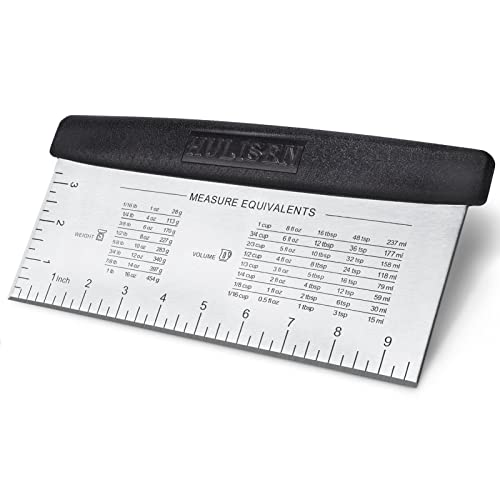
HULISEN
10-Inch Bench Scraper for Dough Cutting and Cake Frosting: HULISEN Stainless Steel Dough Cutter with Etched Scale
This 10-inch stainless steel bench scraper cuts and divides dough, transfers chopped vegetables from board to pan, and smooths buttercream along the sides of tall cakes, with etched inch and cm markings that never rub off. Bakers working large dough batches or decorating layer cakes get the most from the extra blade width and built-in conversion chart.
Pros and Cons
Pros
- Extra width at 10 inches covers more board area than standard bench scrapers when moving chopped vegetables.
- Etched measurement markings and conversion chart stay legible through repeated dishwasher use.
- Rounded handle gives a comfortable grip for the repeated pressure that dividing dough requires.
- Single-piece stainless steel design cleans up with soap and water in seconds.
Cons
- The 10-inch width is awkward inside narrow mixing bowls and small saucepans where a shorter scraper maneuvers better.
- Etched markings sit flush with the steel, so they can be hard to read at a glance under dim kitchen lighting.
HULISEN 10-Inch Bench Scraper for Dough Cutting and Cake Frosting: HULISEN Stainless Steel Dough Cutter with Etched Scale
HULISEN
10-Inch Bench Scraper for Dough Cutting and Cake Frosting: HULISEN Stainless Steel Dough Cutter with Etched Scale
This 10-inch stainless steel bench scraper cuts and divides dough, transfers chopped vegetables from board to pan, and smooths buttercream along the sides of tall cakes, with etched inch and cm markings that never rub off. Bakers working large dough batches or decorating layer cakes get the most from the extra blade width and built-in conversion chart.
Check price on AmazonA 10-inch stainless steel bench scraper built for dividing dough, clearing a floured work surface, and moving prepped ingredients without dragging a knife across the board.
The beveled blade edge bites into stiff dough on contact, and the wide flat face doubles as a frosting smoother for the sides of tall layer cakes.
Solid stainless steel throughout, rustproof and dishwasher safe, with a rounded handle sized for the repeated pressure that portioning heavy dough demands.
The extra width that helps on a large board becomes a liability in narrow bowls and small pans.
Best for home bakers who work large dough batches and decorate layer cakes.
Divide bread and pizza dough into portions using the etched inch scale to size each piece consistently, then lift and transfer without stretching the gluten.
Hold the blade vertical against a frosted cake and rotate the turntable to pull buttercream into a smooth, even side.
Sweep chopped onions, carrots, or herbs off the cutting board straight into the pan, then scrape dried flour and dough scraps off your pastry mat.
Step-by-step: cleaning a stainless steel scraper
Start while the dough is still fresh if you can. Scrape the blade against the edge of your work surface to knock off the bulk of it, then follow these steps.
Step 1: Rinse off loose dough
Use cold water first. Hot water cooks the flour proteins and turns them gummy, which makes the job harder. A quick cold rinse removes most of the loose paste.
Step 2: Mix the vinegar solution
Combine equal parts white distilled vinegar and warm water in a shallow dish, a baking pan or the sink. A cup of each is plenty for a 6 to 10 inch blade. Lay the scraper flat so the whole blade is covered, or soak a cloth in the mix and wrap it around the blade.
Step 3: Let it sit for 5 to 10 minutes
Set a timer. Stainless steel handles short acid contact well, but long soaks aren’t needed and can dull a polished finish over time. Ten minutes is the ceiling for routine cleaning.
Step 4: Scrub gently
Use a soft sponge or a non-scratch nylon pad. Work along the length of the blade, not across it, and pay extra attention to the edges and any measurement markings. Skip steel wool. It leaves fine scratches that grab dough next time.
Step 5: Rinse and dry completely
Rinse with warm running water until the vinegar smell is gone, then dry with a clean towel. Don’t air-dry. Standing water is what causes spotting and, on lower-grade steel, rust.
Removing stuck-on dough and cloudy film
Some residue needs a second pass. If dried dough is still clinging after the soak, lay a vinegar-soaked paper towel directly on the spot for another few minutes, then use a plastic scraper or an old gift card to lift it. Metal-on-metal scraping is a bad idea because it can mark the surface.
For a cloudy white haze, usually mineral deposits from hard water, wipe the blade with undiluted vinegar on a cloth, rinse and dry. The haze typically disappears on the first or second try. If it doesn’t, that’s often a worn finish, not dirt.
For a rougher cleaning job, add a pinch of baking soda to a damp sponge after the vinegar rinse. Don’t mix them in the same container, since the fizz neutralizes both and leaves you with little more than salty water. Use them one after the other.
Cleaning a wooden bench scraper
Wood is different. It absorbs liquid, swells and can crack if it stays wet. A wooden tool like the Superbaking 6″ Wooden Dough Scraper should never be soaked in vinegar or anything else.
Instead, dampen a cloth with a 1:1 vinegar and water mix, wring it until it’s barely wet, and wipe both faces and the edge. Follow with a cloth dampened in plain water, then dry immediately with a towel and let it stand upright to finish drying. Dried dough on wood can be scraped away gently with a butter knife before wiping.

Superbaking
Divide and Lift Sticky Dough Without Dragging: Superbaking 6" Wooden Bench Scraper with Beech Handle and Engraved Inch/CM Markings
This 6-inch scraper cuts dough portions, lifts sticky bread dough off the counter, and clears flour and scraps in one pass thanks to its machine-honed 0.8 mm steel edge. It suits home bread and sourdough bakers who want a hand tool with permanent engraved measurements instead of printed guides that wash off.
Pros and Cons
Pros
- Beech wood handle paired with a steel blade is more comfortable to grip for long portioning sessions than all-metal scrapers.
- Engraved measurements stay legible for the life of the tool rather than fading like printed scales.
- Balanced weight gives enough control to shave dough off the counter without gouging the surface.
- Straight, flat blade doubles as a cake smoother and pan scraper.
Cons
- The wooden handle rules out the dishwasher, so it needs a quick hand wash and dry to prevent swelling or cracking.
- At 6 inches the blade is narrower than pro bench knives, so moving large batches of dough takes extra passes.
Superbaking Divide and Lift Sticky Dough Without Dragging: Superbaking 6" Wooden Bench Scraper with Beech Handle and Engraved Inch/CM Markings
Superbaking
Divide and Lift Sticky Dough Without Dragging: Superbaking 6" Wooden Bench Scraper with Beech Handle and Engraved Inch/CM Markings
This 6-inch scraper cuts dough portions, lifts sticky bread dough off the counter, and clears flour and scraps in one pass thanks to its machine-honed 0.8 mm steel edge. It suits home bread and sourdough bakers who want a hand tool with permanent engraved measurements instead of printed guides that wash off.
Check price on AmazonA bench scraper for dividing and moving dough. It solves the problem of wet, sticky dough clinging to the counter and hands during shaping.
The machine-honed straight steel edge cuts through proofed dough without dragging, so portions keep their shape instead of deflating.
Engraved inch and centimeter markings sit on the blade for sizing rolls and bars mid-shaping, with no fading over time.
Built from a beech wood handle and 0.03 inch steel blade at 6 inches wide, with balanced weight for daily scraping.
Wood handle means hand wash only. Best for home sourdough and bread bakers wanting a comfortable, measurement-marked scraper.
Portioning dough: press straight down through bulk dough to divide loaves, rolls, or cinnamon buns, then use the engraved scale to check each piece is even.
Shaping and cleanup: slide the blade under sticky dough to lift and turn it, then scrape flour, dough bits, and dried starter off the counter.
Beyond bread: sweep chopped vegetables from board to pan, smash garlic under the flat blade, and smooth buttercream on cake sides.
Keeping wood in shape
Every month or so, rub a thin coat of food-safe mineral oil into dry-looking wood. It slows moisture absorption and keeps the grain from raising. Skip cooking oils like olive oil, which can turn rancid.
Handwash only
Dishwashers are rough on wood. High heat and long wet cycles warp the blade and split the grain. Wash by hand every time.
When vinegar isn’t the right choice
Vinegar suits stainless steel and sealed or oiled wood. It isn’t ideal for everything. Avoid it on scrapers with aluminum parts, since acid can pit and darken aluminum. Skip it on cheap plated metal, where it can eat through thin coatings. And never combine vinegar with bleach. The mix releases chlorine gas.
Plastic scrapers are fine with vinegar, though they rarely need it. A hot soapy wash does the job, and the occasional vinegar wipe removes any cloudiness.
Not sure which kind you own? Check the packaging or the product listing. Most metal models, like the Matscover Bench Scraper Dough Scraper for bread, cake and pizza work, are meant for quick, simple care.

Matscover
Cut, Lift and Scrape Dough Cleanly: Matscover 2-in-1 Bench Scraper and Flexible Bowl Scraper Set with Laser-Engraved Measurements
This set pairs a 304 stainless steel bench scraper with a flexible silicone and nylon bowl scraper, so you can portion and lift sticky dough off the counter and then clear every last bit of batter from a curved mixing bowl. Home bread and pizza bakers who currently fight dough with a chef's knife and a rubber spatula get both jobs done faster with one purchase.
Pros and Cons
Pros
- Food-grade 304 stainless steel blade holds a sharp working edge for slicing bread, pizza and pastry as well as cutting dough.
- The silicone and nylon bowl scraper flexes enough to turn rising dough in the bowl without knocking the air out of it.
- Ergonomic non-slip handle gives control when you press down hard through stiff bread dough.
- Arrives in a gift box, which makes it usable as a present for a baker without extra packaging.
Cons
- The listing does not state blade dimensions or weight, so check the size before assuming it spans your loaf or dough batch.
- The steel edge is sharp enough to score wooden boards and nonstick bakeware if you scrape with force.
Matscover Cut, Lift and Scrape Dough Cleanly: Matscover 2-in-1 Bench Scraper and Flexible Bowl Scraper Set with Laser-Engraved Measurements
Matscover
Cut, Lift and Scrape Dough Cleanly: Matscover 2-in-1 Bench Scraper and Flexible Bowl Scraper Set with Laser-Engraved Measurements
This set pairs a 304 stainless steel bench scraper with a flexible silicone and nylon bowl scraper, so you can portion and lift sticky dough off the counter and then clear every last bit of batter from a curved mixing bowl. Home bread and pizza bakers who currently fight dough with a chef's knife and a rubber spatula get both jobs done faster with one purchase.
Check price on AmazonA two-piece dough handling set: a rigid stainless bench scraper and a flexible bowl scraper. It replaces the knife-and-spatula workaround most home bakers use for cutting, lifting and cleaning up dough.
The steel blade cuts and transfers dough in a single motion, while the curved plastic scraper clears batter from round bowls and pans that a straight blade cannot reach.
Blade is food-grade 304 stainless steel; the bowl scraper uses silicone and nylon for flex and heat resistance. Both are dishwasher safe, and the handle is shaped to stop slipping under pressure.
No dimensions are published, so confirm blade width suits your loaf sizes and cutting board before ordering.
Best for home bread, pizza and pastry bakers who work dough by hand on a counter.
Bread and pizza work: divide bulk dough into equal portions using the engraved markings, lift sticky dough off the bench, and scrape the counter clean afterward.
Prep beyond baking: chop nuts, fruit and vegetables, then use the wide blade to carry the whole pile to the pan in one trip.
Bowl scraper duty: fold and turn rising dough without deflating it, and empty batter, sauces and creams from bowls and pans.
Common mistakes to avoid
A few habits cause most of the trouble with bench scraper care.
Soaking for hours
Overnight soaks aren’t needed and can pit the finish or loosen a riveted handle. Short and regular beats long and rare.
Using hot water on fresh dough
It sets the flour into a sticky film. Start cold, finish warm.
Skipping the dry step
Even good steel can show water spots or tiny rust specks if it stays damp. Dry every time. No exceptions.
Mixing cleaners
Vinegar with baking soda cancels out. Vinegar with bleach is dangerous. Pick one cleaner per step, and rinse between them.
Vinegar smell, food safety and storage
The vinegar smell is the first thing people worry about, and it fades fast. A thorough warm rinse removes nearly all of it, and any trace left on the metal evaporates within minutes. If you still catch a whiff on a wooden handle, wipe it with a damp cloth and let it air out upright for an hour before storing.
Because acetic acid is a common food ingredient, a trace of diluted vinegar on a dough tool isn’t a safety concern. Detergent residue is the bigger issue, so rinse until the water runs clear and the blade squeaks lightly under your thumb.
Store the scraper dry and away from damp spots. A drawer divider, a magnetic strip for steel blades or a hook for a wooden one works well. Don’t toss it loose in a crowded drawer where the edge can nick against other tools.
How often to clean and when to replace
Wash the scraper after every use. A vinegar soak every few weeks is plenty unless you’re working with sticky enriched doughs or you live in a hard water area, where monthly or even biweekly may suit you better.
Time to replace? Look for deep pitting, rust that returns after cleaning, a loose or cracked handle, or a bent blade that no longer sits flat on the counter. A scraper that doesn’t sit flat leaves dough behind and makes cutting uneven. Wooden models should be replaced when they crack or the edge splinters.
If you want to round out your baking setup, our guides to the best cookware, best nonstick cookware and best nontoxic cookware cover the pans you’ll use after the dough is shaped. Prefer other materials? See the best titanium cookware and best copper cookware pages, or the best chef knife for the cutting side of your prep.
FAQ
Can I clean a bench scraper with vinegar every time?
You can, but you don’t need to. Soap and water handle most daily cleaning. Use the vinegar step when you see a film, a dull haze or stubborn dried dough. Using it occasionally keeps the blade clear without wearing the finish.
How long can a stainless steel scraper soak in vinegar?
Keep it to 5 to 10 minutes for routine cleaning. Longer exposure isn’t needed and can dull a polished surface or affect plated parts. Rinse well and dry right after.
Is vinegar safe on a wooden dough scraper?
Only as a quick wipe with a barely damp cloth. Never soak wood. Dry it at once and oil it lightly every month or so to protect the grain.
Will vinegar remove rust from a bench scraper?
It can loosen light surface rust. Wipe with vinegar for a few minutes, scrub gently with a soft pad, then rinse and dry fully. Deep rust or pitting means the blade has worn out and should be replaced.
Can I mix vinegar and baking soda to clean my scraper?
It’s better not to. The two react and cancel each other out. Use them one after the other instead: vinegar first, rinse, then a light baking soda scrub if you need more cleaning power.



Write Your Review
No reviews yet. Be the first to share your experience!