

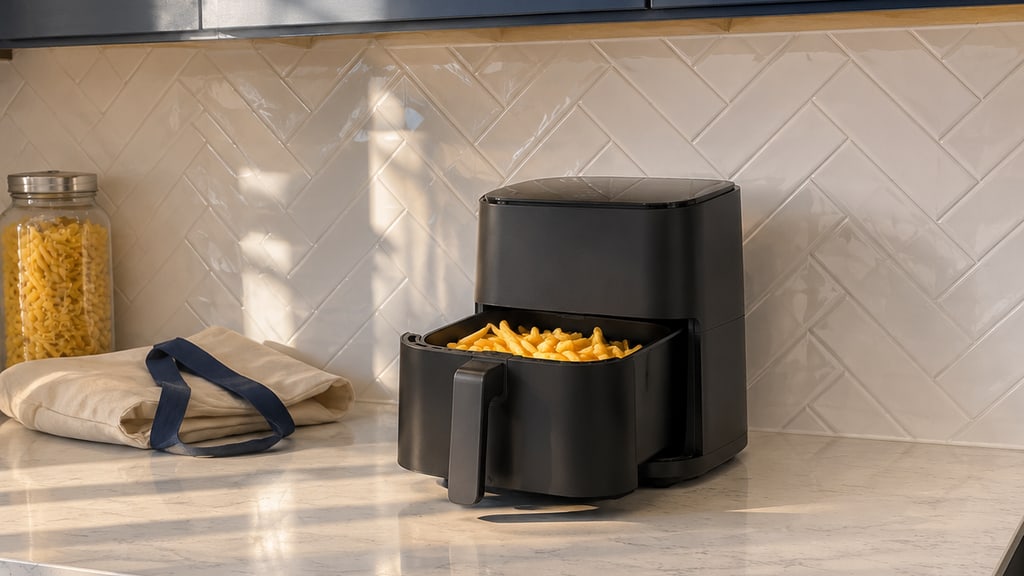
TL;DR — An air fryer is a compact convection oven: a fan forces very hot air around food at high speed, crisping it with a fraction of the oil deep frying needs. To use it, preheat, load the basket in a single layer, set the temperature about 25°F (14°C) below a conventional-oven recipe and the time roughly 20% shorter, and shake or flip halfway through. Don’t crowd the basket, don’t use aerosol nonstick spray, and open the drawer whenever you want to check progress — it won’t lose much heat. For picks, see our best air fryer guide.
The HomeWhisk editorial team researches kitchen appliances by analyzing manufacturer specifications, heating mechanism design, and aggregated user reviews from major retailers and cooking communities. This guide covers how an air fryer works and the practical steps, settings, and tips that produce good results.

Air fryers sell on the promise of crispy food without much oil, and they largely deliver — but only if you use them correctly. Most disappointment comes from overcrowding the basket, skipping the preheat, or expecting deep-fryer results. Below is how the appliance actually works, how to set it up and cook, the settings you’ll see on the dial, and the techniques that consistently produce crisp, evenly cooked food. If you’re still choosing a unit, our best air fryer guide covers the options.
Majosta
Air Fryer Recipes, Cooking and Buying Help by Majosta: B0DW41HM29
This Majosta guide provides recipes, cooking instructions, usage guidance, and purchasing help for any air fryer in one resource. It suits new or comparison-shopping air fryer owners who want practical cooking support beyond basic recipes.
Pros and Cons
Pros
- Covers recipes, cooking, usage, and purchasing help in one guide.
- Designed for use with any air fryer.
- Focuses on easy and practical home cooking.
Cons
- The available product data does not identify recipe count, dietary coverage, or included photographs.
- It is a cooking guide, not an air fryer or countertop appliance.

ctizne
Mess-Free Air Fryer Cleanup: ctizne Disposable Air Fryer Liners, 100 Pack 8-Inch Square Parchment for 5-8 QT Baskets
These pre-cut 8-inch square parchment bowls drop into a 5 to 8 QT basket and catch grease, breading, and marinade so cleanup becomes a peel and toss instead of a scrub. Buy them if you run a Ninja AF141, Cosori, or Instant Pot basket and cook saucy or greasy food on a regular basis.
Pros and Cons
Pros
- Three-layer construction with coating on both sides resists tearing when you lift out heavy, saucy portions.
- Sizing matches the most common baskets, including Ninja AF141, AF142, AF181, AF182, Cosori, and Instant Pot.
- The same sheets work in ovens, microwaves, and pans, so one box covers pizza reheats, bacon, and roti.
- Food-grade tested and biodegradable, so used liners go in the trash without a plastic residue concern.
Cons
- The 8-inch square footprint is too wide for compact 2 to 4 QT baskets and leaves gaps in oversized models.
- The solid base blocks airflow from below, so fries and wings crisp more slowly than on the bare perforated tray.

Helinkart
Air Fryer Parchment Liner Magnets, Helinkart 8PCS Silicone Magnetic Buckles, 464°F Heat Resistant Accessories (Red)
These eight silicone-wrapped magnets clamp parchment liners to the rim of a magnetic air fryer basket so the paper cannot lift into the heating element mid-cycle. Buy them if you line your basket regularly and own an iron or magnetic stainless steel model, since aluminum and ceramic baskets will not hold them.
Pros and Cons
Pros
- Keeps liners clear of the heating element, removing the scorched-paper risk that comes with loose parchment.
- Silicone is odorless and safe for direct food contact, so nothing transfers to what you are cooking.
- Rinse or wipe clean after use with no disassembly or special care.
- Eight pieces give enough coverage for large baskets and dual-basket models.
Cons
- Only works on iron or magnetic stainless steel baskets, so aluminum, ceramic, and non-magnetic stainless models are ruled out entirely.
- You need to test your basket with a household magnet before ordering, since fit depends on your fryer rather than the product.

WaterLuu
Secure Air Fryer Paper Liners with WaterLuu Magnetic Silicone Holders B0F2MLRTXM
WaterLuu silicone magnetic holders keep parchment liners from shifting or lifting in compatible air fryer baskets, improving airflow and reducing contact with heating elements. Buy them if your air fryer has a magnetic metal basket and you want easier liner positioning and cleanup.
Pros and Cons
Pros
- Strong magnets help secure disposable parchment liners in compatible baskets.
- Food-grade, BPA-free silicone is designed for direct food contact and high heat.
- Waterproof construction can be rinsed or wiped clean after use.
- The eight-piece set provides multiple holders for repeated air fryer sessions.
Cons
- They work only with magnetic metal baskets and are incompatible with aluminum, ceramic, stainless steel, and other non-magnetic models.
- The product data does not list the holders' dimensions or weight, so fit should be confirmed before purchase.

LOTTELI KITCHEN
Air Fryer Cooking Time and Temperature Guide Magnet Set by Lotteli Kitchen
This two-magnet air fryer guide displays cooking times, temperatures, and portions for over 100 foods, reducing the need to search while preparing meals. Beginners and busy home cooks should buy it for quick reference across vegetables, meats, seafood, frozen foods, and desserts.
Pros and Cons
Pros
- Includes cooking guidance for vegetables, frozen foods, beef, chicken, seafood, and desserts.
- The small magnet uses larger font for easier reading of popular frozen foods.
- Waterproof and oil-resistant construction suits routine kitchen use.
- Two sizes provide both comprehensive information and a compact frozen-food reference.
Cons
- The charts provide general reference guidance, so cooking results may still vary by air fryer and food size.
- The magnets require a magnetic surface for storage and display.
Majosta Air Fryer Recipes, Cooking and Buying Help by Majosta: B0DW41HM29
Majosta
Air Fryer Recipes, Cooking and Buying Help by Majosta: B0DW41HM29
This Majosta guide provides recipes, cooking instructions, usage guidance, and purchasing help for any air fryer in one resource. It suits new or comparison-shopping air fryer owners who want practical cooking support beyond basic recipes.
$19.99 at AmazonEditors' Favorite
Dimensions: 6 x 0.87 x 9 inches Product Group: Book Binding: Hardcover
Shop Nowctizne Mess-Free Air Fryer Cleanup: ctizne Disposable Air Fryer Liners, 100 Pack 8-Inch Square Parchment for 5-8 QT Baskets
ctizne
Mess-Free Air Fryer Cleanup: ctizne Disposable Air Fryer Liners, 100 Pack 8-Inch Square Parchment for 5-8 QT Baskets
These pre-cut 8-inch square parchment bowls drop into a 5 to 8 QT basket and catch grease, breading, and marinade so cleanup becomes a peel and toss instead of a scrub. Buy them if you run a Ninja AF141, Cosori, or Instant Pot basket and cook saucy or greasy food on a regular basis.
$9.85 at AmazonGreat Value
Color: Nature Size: 8"Square Dimensions: 23 x 20 x 0.25 inches Product Group: Kitchen Binding: Kitchen
Shop NowHelinkart Air Fryer Parchment Liner Magnets, Helinkart 8PCS Silicone Magnetic Buckles, 464°F Heat Resistant Accessories (Red)
Helinkart
Air Fryer Parchment Liner Magnets, Helinkart 8PCS Silicone Magnetic Buckles, 464°F Heat Resistant Accessories (Red)
These eight silicone-wrapped magnets clamp parchment liners to the rim of a magnetic air fryer basket so the paper cannot lift into the heating element mid-cycle. Buy them if you line your basket regularly and own an iron or magnetic stainless steel model, since aluminum and ceramic baskets will not hold them.
$9.99 at AmazonColor: Red Size: 0.86in Product Group: Kitchen
Shop NowWaterLuu Secure Air Fryer Paper Liners with WaterLuu Magnetic Silicone Holders B0F2MLRTXM
WaterLuu
Secure Air Fryer Paper Liners with WaterLuu Magnetic Silicone Holders B0F2MLRTXM
WaterLuu silicone magnetic holders keep parchment liners from shifting or lifting in compatible air fryer baskets, improving airflow and reducing contact with heating elements. Buy them if your air fryer has a magnetic metal basket and you want easier liner positioning and cleanup.
$9.99 at AmazonColor: Black Size: 8pcs Weight: 0.01 pounds Product Group: Kitchen Binding: Kitchen
Shop NowLOTTELI KITCHEN Air Fryer Cooking Time and Temperature Guide Magnet Set by Lotteli Kitchen
LOTTELI KITCHEN
Air Fryer Cooking Time and Temperature Guide Magnet Set by Lotteli Kitchen
This two-magnet air fryer guide displays cooking times, temperatures, and portions for over 100 foods, reducing the need to search while preparing meals. Beginners and busy home cooks should buy it for quick reference across vegetables, meats, seafood, frozen foods, and desserts.
$8.98 at AmazonColor: Black Size: 10.5 x 6.5 inch, 5 x 5 inch Dimensions: 10.75 x 6.75 x 0.1 inches Weight: 0.29982867632 Pounds Product Group: Kitchen Binding: Kitchen
Shop NowHow an Air Fryer Actually Works
An air fryer is a small, powerful convection oven. A heating element sits above the food, and a strong fan rapidly circulates hot air (typically up to around 400°F / 200°C) in a small, enclosed chamber. That fast-moving air transfers heat to the food much more efficiently than still air, which is why a thin layer of oil on the surface crisps and browns similarly to frying. It’s not frying in the literal sense — there’s no deep oil bath — but the rapid convection reproduces much of the crispy surface that makes fried food appealing. Because the chamber is small, an air fryer often hits those results faster than a full-size convection oven. The trade-off is capacity: most basket air fryers hold far less than an oven.
Setting Up and Cooking: The Real Steps
1. Place the air fryer on a clear, heat-safe counter with space above and behind it for venting. The back and sides get hot, and the exhaust releases steam and heat, so keep it away from walls and cabinets. 2. Preheat. Most recipes call for 3-5 minutes of preheating at the target temperature. A hot basket sears the surface immediately for better crisping. Some models skip this, but preheating reliably improves results. 3. Prepare the food and coat lightly with oil. A teaspoon or two of oil brushed or tossed onto dry food is enough for browning. Pat wet foods (chicken wings, fries) dry first — surface moisture causes steaming instead of crisping. 4. Load the basket in a single layer. This is the most important step. Air needs to move around each piece; a piled-up basket steams and cooks unevenly. Work in batches if needed. 5. Set the temperature. As a rule of thumb, set it about 25°F (14°C) lower than a conventional-oven recipe, or roughly the same as a standard recipe for convection. Most cooking lands between 350°F and 400°F (175-200°C). 6. Set the time about 20% shorter than an oven recipe, and check early the first time you make something. Foods cook surprisingly fast in a preheated air fryer. 7. Shake the basket or flip halfway through. This exposes the underside to the airflow and evens out browning. Thin items like fries need a shake; larger items like chicken thighs need a flip. 8. Check and remove. Open the drawer whenever you like to peek — the unit pauses and resumes, and it loses little heat. Use a meat thermometer for proteins to confirm doneness. 9. Clean after it cools. Most baskets and drawers are dishwasher-safe; a quick hand wash with warm soapy water and a soft sponge handles most messes. Soak stubborn residue rather than scouring the nonstick coating.
What You Can (and Can’t) Cook
Air fryers shine with foods that benefit from a crispy exterior: fries and other potato cuts, chicken wings and thighs, fish fillets, chops, breaded items, tofu, vegetables (broccoli, Brussels sprouts, cauliflower), and reheating leftovers like pizza and fried chicken to a near-fresh crisp. They also roast nuts and re-crisp stale baked goods well.
They’re less suited to wet batters (the batter blows off before it sets), very light batters that need gentle heat, delicate greens that will blow around, large roasts that won’t fit, and anything that needs a deep pool of liquid or a lid to hold moisture. Cheese-heavy items can melt and drip through the basket unless frozen or breaded first. For genuinely deep-fried texture in wet batters, a best deep fryer still wins — the air fryer is a complement, not a full replacement.
Air Fryer Settings Explained
Beyond the basic temperature and time, many units offer preset modes. Here’s what each actually does:
- Air Fry: the main convection mode — high heat, fast fan, for crisping and roasting.
- Bake: lower fan speed, moderate heat, for cakes, muffins, and baked goods that need gentler, even heat rather than a blast.
- Broil: top-down high heat for melting cheese, char, or finishing the top of a dish.
- Reheat: a moderate, low-oil setting designed to warm leftovers without the rubberiness a microwave causes.
- Keep Warm: holds food at a low temperature after cooking.
- Toast / Bagel: dries and browns the surface; bagel mode typically heats one side more.
- Proof / Dehydrate: low, steady heat for rising dough or drying fruit, jerky, and herbs (a convection toaster oven or best toaster oven often handles these better with more room).
These presets are conveniences — you can always just set temperature and time yourself, and experienced users often skip the presets entirely.
Tips for Consistently Good Results
- Don’t overcrowd. A single layer with gaps beats a heaping basket every time. If you need a lot of food fast, consider a larger or dual-basket model from our best air fryer guide.
- Avoid aerosol nonstick sprays. Propellant-based sprays can damage the nonstick coating over time and leave a sticky film. Use a small amount of oil from a spray bottle or brushed on instead.
- Preheat for crispness. A cold start produces softer food; a hot start sears.
- Pat food dry and use just enough oil. Moisture is the enemy of crispness, and excess oil pools and smokes. A light, even coating is all you need.
- Shake or flip halfway. The bottom and any touching surfaces stay pale without it.
- Adjust rack or basket position if your model has layers; keep food near the heat source for browning.
- Mind fatty foods. Bacon, sausages, and skin-on chicken render fat that can pool, smoke, or flare. Use a lower temperature, consider a rack to lift food above the drippings, or add a little water to the drawer bottom to catch grease.
- Don’t discard drawer juices too fast. For some dishes the rendered fat is useful for basting or finishing; pour it off only when it risks smoking or burning.
Caring for Your Air Fryer
Let the unit cool before handling. Wash the basket and drawer with warm soapy water and a soft sponge — most are dishwasher-safe, but hand washing extends the life of the nonstick coating. Avoid metal utensils and abrasive scrubbers that scratch the coating. Wipe the heating element area gently with a damp cloth if crumbs or grease accumulate (unplug first and make sure it’s fully cool). Keeping the basket clean prevents the smell and smoke that burnt-on residue causes on the next cook.
Frequently Asked Questions
How do I use an air fryer for the first time?
Before the first cook, wash the basket and drawer with warm soapy water, dry them, and run the empty unit at around 400°F for about 5-10 minutes to burn off any manufacturing residue — some smell is normal and fades. Then preheat, load food in a single light-oil layer, set the temperature about 25°F below an oven recipe, and shorten the time by roughly 20%. Check early, shake or flip halfway, and use a thermometer for proteins. Our best air fryer guide covers reliable models.
How do I cook fries in an air fryer?
Cut potatoes to an even size, soak them in cold water for 20-30 minutes to remove surface starch, then dry thoroughly. Toss with about a tablespoon of oil and salt, and arrange in a single layer in the basket — work in batches rather than piling. Air fry at around 380-400°F for 12-20 minutes depending on thickness, shaking the basket every 5-7 minutes. The even size and dry surface are what give crisp rather than soggy fries. Frozen fries are even simpler: most need no added oil since they’re pre-fried.
How do I cook chicken in an air fryer?
Pat chicken pieces dry, coat lightly with oil, and season. Bone-in pieces like thighs and drumsticks air fry at 380-400°F for 18-25 minutes, flipping halfway, until a thermometer in the thickest part reads 165°F (74°C). Boneless breasts cook faster, around 10-15 minutes. A single layer is essential for crisp skin; overcrowding steams it instead. Preheating and a light oil coating are what produce browned, crispy skin.
Do I need to preheat an air fryer?
Preheating isn’t strictly required, but it reliably improves crisping. A hot basket sears the food’s surface on contact, while a cold start lets moisture linger and produces softer results. Most recipes call for 3-5 minutes of preheating. For delicate items or reheating, you can often skip it; for fries, wings, and anything you want crisp, preheat.
Can I open the air fryer to check on food?
Yes, and you should. Pulling out the drawer pauses the cook and the fan, but the unit holds most of its heat and resumes when you push it back in. Opening to check, shake, or flip is a normal part of air frying — it’s how you avoid overcooking and even out browning. You lose very little heat compared with opening a full oven door.
Is an air fryer better than a deep fryer?
They do different things. A deep fryer fully submerges food in hot oil for the classic fried texture, a wet batter crust, and even cooking — something an air fryer can’t fully replicate, especially for battered foods. An air fryer uses a fraction of the oil, makes less mess, avoids handling large amounts of hot oil, and is far easier to clean. For everyday crispy food with less fat, the air fryer wins; for authentic fried chicken, tempura, and wet batters, a best deep fryer is still the right tool.
The Bottom Line
Using an air fryer well comes down to treating it as the compact convection oven it is: preheat, keep food in a single layer, use a little oil, set the temperature lower and the time shorter than an oven recipe, and shake or flip halfway. Skip the aerosol sprays, don’t crowd the basket, and open the drawer freely to check progress. It excels at crispy proteins, vegetables, fries, and reheating, and falls short on wet batters and large or wet dishes. Clean it gently to protect the nonstick coating, and you’ll get years of use. For reliable picks, see our best air fryer guide, and round out the kitchen with a best instant pot for pressure cooking, a best blender for sauces and smoothies, a best stand mixer for baking, or a best toaster oven when you want more capacity.




Write Your Review
No reviews yet. Be the first to share your experience!