

TL;DR — An espresso machine forces hot water at roughly 9 bars of pressure through a compacted “puck” of finely ground coffee for about 25 to 30 seconds. A pump builds the pressure, a boiler or heating element brings water to around 90 to 96 degrees Celsius (195 to 205 F), and the group head channels that water evenly through a portafilter holding the coffee. The pressure and fine grind are what extract the concentrated, syrupy shot with crema that plain drip brewing cannot produce. For grinder picks that make this possible, see our best coffee grinder guide.
The HomeWhisk editorial team researches kitchen equipment by analyzing manufacturer specifications, mechanism design, and aggregated reviews from major retailers and coffee communities like Reddit’s r/espresso and r/Coffee. This explainer describes how the parts actually work, not brand marketing.

Espresso is defined less by a bean and more by a method: pressurized hot water pushed through finely ground, compressed coffee. Every espresso machine, from a $150 entry model to a commercial two-group, is built around the same handful of components solving the same problem, which is delivering water at the right temperature and pressure through the coffee for the right amount of time. Understanding those parts makes it far easier to buy sensibly and to troubleshoot a bad shot. For an affordable machine and the grinder it needs, our best espresso machine under 200 and best coffee grinder guides pair naturally.
Kismile
Espresso Machine with Built-In Grinder and Steam Wand: Kismile 20 Bar 58mm Semi-Automatic for Home Cappuccino and Latte
The Kismile pairs a 30-setting conical grinder with a 20 bar pump and PID temperature control, so beans go from whole to extracted shot on one counter without a separate grinder. It suits home baristas who want commercial-style 58mm portafilter control and steam-wand microfoam without assembling a multi-appliance setup.
Pros and Cons
Pros
- Grinder, 20 bar pump, and steam wand in one stainless steel unit at a price well under separate grinder-plus-machine setups.
- PID control and four brew baskets give real room to dial in single and double shots, pressurized or not.
- 58mm portafilter size means aftermarket tampers, distribution tools, and baskets fit without hunting for odd sizes.
- Complete accessory kit including frothing pitcher and cleaning tools ships in the box.
Cons
- Kismile's own listing warns that the calibration is delicate and points buyers to the manual and video guides first, so expect a real learning curve before your shots are consistent.
- This is a 2026 release with essentially no independent review history yet, so long-term grinder and pump reliability is unproven.

CASABREWS
Barista-Style Lattes and Cappuccinos at Home: CASABREWS 3700 Essential 20 Bar Stainless Steel Espresso Machine
The CASABREWS 3700 pulls 20 bar pressure shots and steams milk through a dedicated wand, so lattes, cappuccinos, and macchiatos come together on one compact stainless steel unit. Buy it if you want real portafilter espresso and textured milk foam without surrendering half your counter to a full-size machine.
Pros and Cons
Pros
- Includes the portafilter, both filter baskets, and a tamper with spoon, so nothing extra is needed on day one.
- Semi-automatic control lets you dose, tamp, and time your own shots as your technique improves.
- Stainless steel exterior wipes clean and resists the scuffs that dull plastic machines within months.
- Compact width makes it workable in apartment kitchens, dorms, and small office break rooms.
Cons
- First use requires removing a rubber plug under the water tank and running a priming cycle, a step buyers who skip the manual often miss.
- Milk texturing is fully manual, so expect a learning curve before your foam is smooth enough for latte art.

Bosch
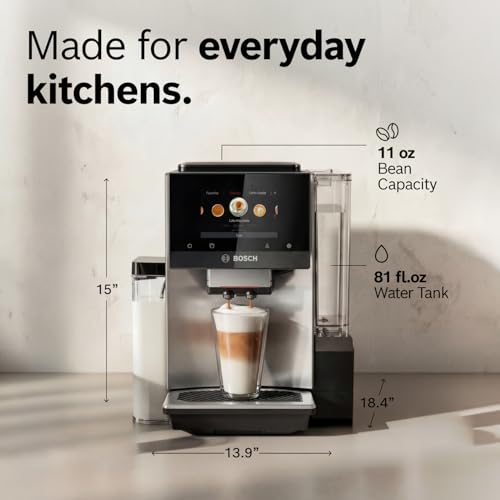
One-Touch Lattes and Espresso at Home: Bosch VeroCafe 800 Series TQU60307 Coffee Machine
The Bosch VeroCafe 800 prepares espresso, cappuccino, and latte macchiato with its biggest advantage being precise control over strength, size, milk ratio, and aroma. It suits households wanting a wide drink selection, touchscreen operation, and app-based remote brewing from one automatic machine.
Pros and Cons
Pros
- The fully automatic system prepares multiple coffee and milk-based beverages through a large touchscreen.
- Extensive drink controls allow precise adjustments to strength, serving size, milk ratio, and aroma.
- Home Connect adds remote operation and access to more than 35 beverage choices.
- The included water filter, milk container, cleaning cloth, and hardness test strip support setup and maintenance.
Cons
- Using remote brewing features requires the Home Connect app and compatible connectivity.
- The machine still requires regular milk-system cleaning and descaling, although Calc'n Clean streamlines the process.
The Best Deals This Week*
-
Espresso Machine with Built-In Grinder and Steam
$289.99
($339.99)Save $50.00 -
Barista-Style Lattes and Cappuccinos at Home
$116.99
($129.99)Save $13.00 -
One-Touch Lattes and Espresso at Home
$1,698.95
($2,499)Save $800.05
*Deals are selected by our commerce team
Kismile Espresso Machine with Built-In Grinder and Steam Wand: Kismile 20 Bar 58mm Semi-Automatic for Home Cappuccino and Latte
Kismile
Espresso Machine with Built-In Grinder and Steam Wand: Kismile 20 Bar 58mm Semi-Automatic for Home Cappuccino and Latte
The Kismile pairs a 30-setting conical grinder with a 20 bar pump and PID temperature control, so beans go from whole to extracted shot on one counter without a separate grinder. It suits home baristas who want commercial-style 58mm portafilter control and steam-wand microfoam without assembling a multi-appliance setup.
Check price on AmazonA semi-automatic espresso machine with an integrated burr grinder, built for home users who want café drinks without buying a grinder and machine separately.
The 30-setting grinder and PID temperature control work together: adjust grind for extraction speed while the PID keeps brew water stable shot to shot.
Stainless steel housing with a 58mm commercial portafilter and 1500W heating element. The 58mm size matches standard café accessories rather than proprietary small baskets.
Manufacturer guidance emphasizes reading the manual and watching setup videos before first use, which signals a machine that rewards patience over plug-and-play expectations.
Best for a home barista willing to learn dialing in, who wants 58mm control in a single all-in-one footprint.
CASABREWS Barista-Style Lattes and Cappuccinos at Home: CASABREWS 3700 Essential 20 Bar Stainless Steel Espresso Machine
CASABREWS
Barista-Style Lattes and Cappuccinos at Home: CASABREWS 3700 Essential 20 Bar Stainless Steel Espresso Machine
The CASABREWS 3700 pulls 20 bar pressure shots and steams milk through a dedicated wand, so lattes, cappuccinos, and macchiatos come together on one compact stainless steel unit. Buy it if you want real portafilter espresso and textured milk foam without surrendering half your counter to a full-size machine.
Check price on AmazonThe CASABREWS 3700 is a semi-automatic espresso maker for people who want cafe drinks at home without paying cafe prices or driving anywhere.
Its 20 bar pump and 1350 W heater reach brewing pressure quickly, while the steam wand textures milk for cappuccinos and flat whites right after the shot.
The stainless steel body, 43.9 oz detachable tank, and removable drip tray are built for daily counter use and fast wipe-downs between drinks.
Honest limitation: there is no built-in grinder, so you will need pre-ground espresso or a separate burr grinder.
Best for first-time espresso drinkers and small-kitchen owners ready to learn manual technique.
Bosch One-Touch Lattes and Espresso at Home: Bosch VeroCafe 800 Series TQU60307 Coffee Machine
Bosch
One-Touch Lattes and Espresso at Home: Bosch VeroCafe 800 Series TQU60307 Coffee Machine
The Bosch VeroCafe 800 prepares espresso, cappuccino, and latte macchiato with its biggest advantage being precise control over strength, size, milk ratio, and aroma. It suits households wanting a wide drink selection, touchscreen operation, and app-based remote brewing from one automatic machine.
Check price on AmazonThe Bosch VeroCafe 800 is a fully automatic coffee and espresso machine that replaces separate brewing and milk-frothing steps with touchscreen drink preparation.
Its strongest feature is detailed personalization, including strength, size, milk ratio, and aroma adjustments for espresso, cappuccino, latte macchiato, and other beverages.
Home Connect enables remote control and provides access to more than 35 drink options, useful when several household members prefer different coffee styles.
The stainless-steel exterior supports a polished kitchen setup, but the supplied data does not list dimensions or weight, so buyers should confirm counter clearance before ordering.
This machine is best for frequent coffee drinkers who value broad drink variety, precise customization, and automated milk-based preparation.
The Water and the Pump: Where Pressure Comes From
Water starts in a reservoir (a refillable tank) or, on higher-end and commercial machines, a direct plumbed line. Water quality matters more than beginners expect: hard water leaves scale that clogs boilers and valves, while overly soft or distilled water can taste flat and, in some machines, fail to trigger water-level sensors.
The pump is what separates espresso from drip coffee. Espresso needs roughly 9 bars of pressure (about 130 psi, or nine times atmospheric pressure) to force water through the dense coffee puck. Two pump types dominate:
- Vibratory pumps use an oscillating piston driven by an electromagnet. They are compact, cheap, and standard in home machines. They are slightly noisier and pulse a little, but for single or double shots the difference is minor.
- Rotary pumps use a spinning motor to deliver smooth, continuous pressure and are quieter under load. They are larger, more expensive, and usual on prosumer and commercial machines, and they are what you want if plumbing directly to a water line.
Many machines also use an OPV (over-pressure valve) to cap pressure at the target so the pump does not over-extract. This is why the pump is genuinely the heart of the machine.
The Boiler: Heating Water to the Right Temperature
Espresso extracts best when brew water sits around 90 to 96 degrees Celsius (roughly 195 to 205 F). Too cool gives sour, under-extracted shots; too hot scorches the coffee into bitterness. How a machine heats and holds that temperature defines its category.
- Single boiler: One boiler heats water for both brewing and steaming, but not at the same time. You brew, then wait for the boiler to climb to steam temperature before frothing milk. Cheapest and simplest; fine for one or two milk drinks with a pause.
- Heat exchanger (HX): A single boiler runs hot for steam, while a pipe (the heat exchanger) passes fresh water through it to reach brew temperature on demand. This lets you brew and steam simultaneously, a big convenience jump.
- Dual boiler: Two separate boilers, one held at brew temperature and one at steam temperature. This gives the most stable, independently controlled temperatures and is the enthusiast and commercial standard.
Because temperature stability is so important, most quality machines add a PID controller, an electronic thermostat that holds the boiler within about a degree instead of the wide swings of a basic mechanical thermostat. That precision is the difference between repeatable shots and lucky ones.
The Group Head: Where Water Meets Coffee
The group head is the metal fixture the portafilter locks into, and it distributes hot water evenly across the coffee puck. Even distribution matters because if water finds an easy path it will “channel,” rushing through one spot and leaving the rest of the coffee under-extracted.
- The E61 group head is a classic thermosyphon design (introduced by Faema in 1961) in which water continuously circulates from the boiler through the heavy brass group, keeping it hot and thermally stable. Its distinctive three-position lever manages pre-infusion and pressure release. E61 groups are prized for temperature stability and serviceability, which is why so many prosumer machines still use them.
- Saturated group heads are directly connected to and heated by the boiler itself, giving excellent stability; they are common on dual-boiler machines.
- Semi-saturated groups sit between E61 and fully saturated designs, balancing stability and cost.
Many group heads perform pre-infusion, gently wetting the puck at low pressure for a second or two before full pressure hits. This settles the grounds evenly and reduces channeling.
The Portafilter and the Puck
The portafilter is the handled basket that holds the coffee. Preparing the puck correctly is where most home extraction problems start or end.
- Dose: A double shot typically uses 18 to 20 grams of coffee in a standard basket.
- Grind: Espresso needs a fine, uniform grind, much finer than drip. This is non-negotiable and is why a quality burr grinder is more important than most beginners think.
- Distribution and tamp: After dosing, you level the grounds and tamp (press) them flat with roughly consistent pressure. An uneven or under-packed puck lets water channel.
- The shot: Locked in and started, a good double shot flows in about 25 to 30 seconds, yielding roughly 36 to 40 grams of liquid, with a reddish-brown crema on top. Crema is an emulsion of coffee oils and CO2 gas released under pressure, and it is a rough visual cue that pressure and freshness are on track.
Pressurized (dual-wall) baskets exist for pre-ground coffee and forgive a coarse grind by creating artificial back-pressure, but they mask flaws rather than fix them. Serious results still start at the grinder, which is why our best coffee grinder guide is the companion to any machine.
The Steam Wand: Milk and Microfoam
The steam wand is a nozzle that releases pressurized steam from the boiler to heat and texture milk. Steam is injected below the milk’s surface to whip in tiny air bubbles (aeration), then the wand position shifts to create a whirlpool that folds those bubbles into smooth “microfoam” for lattes and cappuccinos. Milk drinks want steaming to around 60 to 65 C (140 to 150 F); much hotter scalds the milk and flattens sweetness. Single-boiler machines require waiting between brewing and steaming, while HX and dual-boiler machines steam on demand.
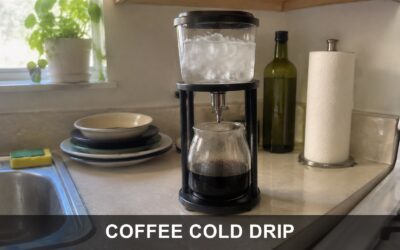
If a full espresso setup feels like too much equipment for your routine, a combo appliance may fit better, which our best coffee and espresso maker combo and best coffee maker with grinder guides address. And for a no-pressure alternative entirely, cold brew is the easiest place to start, covered in our best cold brew coffee maker guide.
Frequently Asked Questions
What is the difference between a vibratory and a rotary pump?
A vibratory pump uses an electromagnet to oscillate a small piston, building pressure in pulses. It is compact, inexpensive, and standard in home machines, though slightly noisier. A rotary pump uses a spinning motor to deliver smooth, continuous pressure, runs quieter under load, and can plumb directly to a water line, but it is larger and more expensive. For one or two shots at home the vibratory pump is perfectly capable; rotary pumps mainly benefit high-volume or plumbed setups.
Should I buy a single boiler, heat exchanger, or dual boiler machine?
A single boiler is cheapest and fine if you drink mostly straight espresso or do not mind a pause between brewing and steaming milk. A heat exchanger lets you brew and steam at the same time, a major convenience for milk drinks, at moderate cost. A dual boiler gives the most stable, independently controlled brew and steam temperatures and is the enthusiast standard, but it costs the most. Match the choice to how many milk drinks you make and your budget. Our best espresso machine under 200 guide covers affordable single-boiler options.
What does a PID do on an espresso machine?
A PID (proportional-integral-derivative) controller is an electronic thermostat that holds boiler temperature within about one degree, instead of the wide swings a basic mechanical thermostat allows. Because espresso extraction is sensitive to temperature, with too cool tasting sour and too hot tasting bitter, that stability makes shots far more consistent and repeatable. Many machines with a PID also let you set and display the exact target temperature, which helps you dial in different beans deliberately rather than by guesswork.
Do I need a plumbed machine or is a reservoir better?
For almost all home users, a reservoir (refillable tank) is the better choice: no plumbing work, easy to move, and simple to fill with filtered water you control. Plumbed machines connect directly to a water line, which removes refilling and suits cafes or very heavy home use, but they require installation and a water filtration setup to prevent scale. Unless you are pulling many shots a day or want a permanent built-in station, a reservoir machine is more practical.
What is an E61 group head and why is it popular?
The E61 is a group head design introduced by Faema in 1961. It uses a thermosyphon system that continuously circulates hot water from the boiler through a heavy brass group, keeping it thermally stable and ready to brew. Its signature lever enables gentle pre-infusion before full pressure. It is popular because it delivers excellent temperature stability, is widely serviceable with standardized parts, and has decades of proven reliability, which is why many prosumer machines still build around it.
Why is the grinder so important for espresso?
Espresso relies on a fine, uniform grind to create the resistance that lets 9 bars of pressure extract evenly in 25 to 30 seconds. A blade grinder produces uneven particles that cause channeling, where water rushes through gaps and leaves the rest under-extracted, giving sour and bitter flavors at once. A quality burr grinder crushes beans to a consistent size and offers the fine, precise adjustment espresso demands. Many enthusiasts consider the grinder more important than the machine itself. See our best coffee grinder and best grind and brew coffee maker guides.
The Bottom Line
An espresso machine works by combining four essentials: a pump that builds about 9 bars of pressure, a boiler that holds water near 90 to 96 C, a group head that distributes that water evenly through the coffee, and a portafilter holding a finely ground, tamped puck that flows a shot in 25 to 30 seconds. The differences between machines, single versus dual boiler, vibratory versus rotary pump, E61 versus saturated group, PID versus mechanical thermostat, all come down to how precisely and conveniently they control temperature and pressure. Whatever you buy, the grinder is half the system, so budget for a good one. For an affordable entry point and the grinder to match, see our best espresso machine under 200 and best coffee grinder guides, and for simpler all-in-one brewing, our best coffee maker with grinder picks.




Write Your Review
No reviews yet. Be the first to share your experience!