

TL;DR — When people ask about heavy duty stainless steel baking sheet, they are usually trying to make a buying or care decision without wasting money. This guide keeps the focus on what changes day-to-day use. When this turns into a purchase decision, compare best baking sheets, best mixing bowls, and best kitchen scale before narrowing your shortlist.
The HomeWhisk approach is research-first: compare construction, usability, cleaning, and long-term complaints before recommending a direction. For baking tools, sizing, material, accuracy, cleaning, and storage usually decide whether a tool stays useful or gets replaced.

Pros & Cons
Pros
- Heavy-gauge steel with thick rack wires resists the warping and pinging that thin sheet pans do at high oven temperatures.
- Stainless construction will not discolor or corrode like bare aluminum, so the pans still look presentable when used for serving.
- The 19.8 by 13.6 inch footprint fits a whole chicken or a full batch of cookies in one pass.
- Racks nest inside the pans, making the set usable for roasting, smoking, draining, and cooling without extra gear.
Cons
- The 450F oven ceiling rules out broiling and high-heat roasting recipes that call for 475F or above.
- Bare stainless has no nonstick coating, so eggs, cheese, and sugary doughs need parchment or oil to release cleanly.
Details
A two-pan, two-rack stainless steel set for cooks tired of replacing warped, flaking nonstick sheet pans every year or two.
The 0.75 inch rack feet lift food into circulating air, so wings and bacon crisp underneath instead of steaming in their own fat. Two full sets mean protein and vegetables roast simultaneously.
Built from 18/0 commercial-grade steel measuring 19.8 by 13.6 by 1.2 inches, with polished, burr-free edges for safe handling and stackable storage.
Heat is capped at 450F, and bare steel needs parchment or oil for sticky foods.
Best for batch cooks and meal preppers who want pans with no coating to wear out.
Cooking Tips
Set the rack inside the pan for bacon, wings, and ribs. Fat drips into the 1.2 inch well below while air circulates underneath, so you skip flipping halfway through.
Line the pan with parchment for cookies, roasted sweet potatoes, and anything glazed. Bare stainless grips sugars and starches, and parchment cuts scrubbing time to nothing.
Run both sets at once for sheet-pan dinners, rotating positions midway since the 450F limit rewards even exposure over blasting heat.

Pros & Cons
Pros
- Tri-ply clad construction delivers more even heat conductivity than single-layer aluminum or steel sheet pans.
- Engineered and thermal tested for warp resistance, so it holds its shape through repeated high-heat cycles.
- Curved, wide handles make loaded transfers in and out of the oven noticeably more secure.
- Stainless surface will not react with acidic foods like tomatoes, citrus, or wine-based pan sauces.
Cons
- Bare stainless is not nonstick, so roasted sugars and proteins will need parchment, a light oil coat, or a soak before scrubbing.
- Handles add roughly three inches to the total length, which can be tight in compact or apartment-sized ovens.
Details
A 13″ x 18″ half sheet pan built to replace thin aluminum trays that warp, discolor, and roast unevenly after a season of heavy use.
Triple-bonded construction places an aluminum core between stainless layers, spreading heat so a full tray of vegetables browns evenly rather than burning near the hot spots.
Heavy-gauge clad stainless with a brushed baking surface and polished exterior. Cooking surface measures 18″ by 13″, extending to 21″ long with the handles, sized for 30″ ovens.
The uncoated stainless surface offers no release, so sticky glazes and skin-on proteins need parchment or oil to come off cleanly.
Best for the frequent roaster or serious home baker willing to invest once in a pan that stays flat.
Cooking Tips
Preheat the empty pan before adding proteins or potatoes. The clad base holds that stored heat on contact, giving you a harder sear and less sticking.
Give food room. On an 18″ x 13″ surface, crowding traps steam and softens what should be crisp, so split large batches across two rounds.
For sticky glazes and cookies, use parchment. For stuck-on roasting residue, deglaze the warm pan with water and scrape rather than attacking cooled stainless with abrasives.

Pros & Cons
Pros
- Racks are sized to drop neatly inside the pans, so the set works as one roasting unit or as separate broiling racks and sheet pans.
- Uncoated stainless steel handles high-heat roasting and broiling without the coating concerns of nonstick bakeware.
- Rolled edges add rigidity to the pan lip and remove the sharp cut edges found on cheaper sheet pans.
- Dishwasher safe, with a polished finish that resists staining and rust after repeated washing.
Cons
- At 19.6 by 13.5 inches these run larger than a standard half sheet, so measure your oven and dishwasher rack before buying.
- Bare stainless steel is not nonstick, so sticky doughs, cheese, and sugary glazes need parchment or oil to release cleanly.
Details
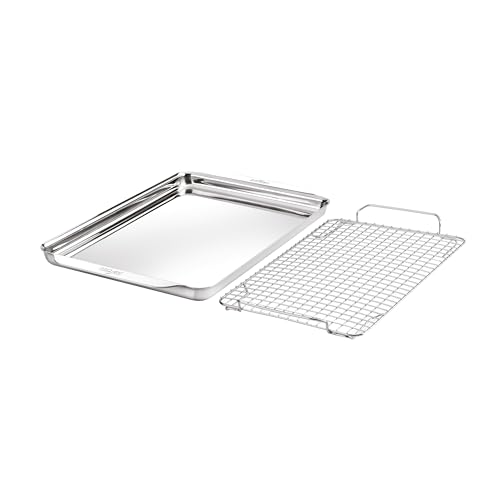
A four-piece bakeware set of two stainless steel sheet pans and two matching flat racks, aimed at cooks who want coating-free pans and elevated roasting in one purchase.
The rack drops inside the pan to raise food above rendered fat, letting air reach all sides for crisp skin on wings and bacon while drippings collect below.
Pans measure 19.6 by 13.5 by 1.2 inches with rolled edges and a mirror-polished surface; racks measure 18.75 by 12.5 by 0.75 inches with closely spaced parallel wires.
The steel has no nonstick coating, so eggs, melted cheese, and caramel will stick unless you use parchment or a light coat of oil.
Best for batch bakers and sheet-pan cooks with full-size ovens who prefer bare stainless steel over aluminum or coated pans.
Cooking Tips
Set the rack inside the pan for bacon, wings, and roasts so fat drains away and the underside crisps instead of steaming in its own juices.
Line the pan with parchment for cookies and sticky glazes. Bare polished steel browns bottoms faster than dull aluminum, so check a few minutes early.
Use the two pieces separately when it helps: the rack alone for cooling cookies or draining fried food, the pan alone for sheet-pan dinners and roasted vegetables.
Pros & Cons
Pros
- No nonstick coating to flake or wear out, so the cooking surface stays the same year after year.
- Integrated handles give a secure grip through mitts when pulling a loaded pan from a hot oven.
- The pan and rack together cover roasting, baking, draining, and cooling without buying extra accessories.
- Bonded stainless and aluminum deliver steady browning on pastries, vegetables, and cookie bottoms.
Cons
- Bare stainless offers no release, so sticky doughs, cheese, and sugary glazes need parchment or a well greased surface.
- Handwashing is recommended, and the listed dimensions differ between the title and the feature details, so confirm the size against your oven before ordering.
Details
A two piece half sheet pan and wire rack set built to replace flimsy sheet pans that buckle in the oven and scorch one side of the tray.
Tri-ply bonding places aluminum between stainless layers, spreading heat so cookie edges set evenly and vegetables brown instead of steaming.
Heavy gauge stainless resists warping, the polished interior takes metal utensils, and integrated handles help you move a loaded pan safely at 600F.
There is no nonstick coating and handwashing is recommended, so plan on parchment for sticky bakes and a sink soak afterward.
Best for frequent bakers and roasters who want one durable pan instead of replacing coated sheets every year.
Cooking Tips
Set the rack inside the pan for bacon, wings, and chicken thighs so fat drains away and the undersides crisp without flipping.
Line the pan with parchment for cookies and sugary glazes, and roast vegetables directly on the bare steel for deeper browning.
Let the pan cool before washing to avoid thermal shock, then lift baked on residue with a soak and a scrub instead of the dishwasher.
Materials That Matter
Material decides how a heavy duty stainless steel baking sheet performs and lasts: it drives sizing and volume, and heat conductivity and how much skipping abrasive scrubbers it demands. There is rarely one best material — each trades cost against durability and upkeep, so pick for how you actually cook. If you are shopping, our best baking sheets and best mixing bowls guides are the fastest way in.
The Short Answer
Heavy duty stainless steel baking sheet usually comes down to one thing: matching the baking tool to how you actually cook rather than to a spec sheet. The practical takeaway is that nonstick or bare finish matters more day to day than headline features. For product picks, compare best baking sheets, best mixing bowls, and best kitchen scale.
Who Benefits Most
This matters most for high-volume holiday bakers, and cooks short on cabinet space. If that is you, treat sizing and volume, and release performance as non-negotiable. Casual users can relax the requirements and prioritize price and storage instead.
How To Get It Right
Think through the whole workflow: avoiding thermal shock, skipping abrasive scrubbers, and storing flat to prevent bending. A baking tool that fits your routine and cleanup habits beats a technically superior one you fight with. We cover specific models in best baking sheets, best mixing bowls, and best kitchen scale.
What To Look For
The keeper is the one you reach for without thinking; the drawer occupant is the one that asks too much for too little payoff. Those are the variables that decide whether it earns a spot in your kitchen or ends up unused. Ignore cosmetic upgrades until the fundamentals check out.
Related Product Guides
If this topic is part of a buying decision, these are the HomeWhisk guides most closely tied to it:
- best baking sheets
- best mixing bowls
- best kitchen scale
- best cutting board
- best food storage containers
Frequently Asked Questions
Which material is best for a heavy duty stainless steel baking sheet?
It depends on your priorities around warp resistance, and sizing and volume. See best baking sheets and best mixing bowls for how materials play out in real models.
Is a premium baking tool worth it?
Only if you use it enough to notice better control, durability, or cleanup regularly. Occasional users are well served by a mid-range pick like those in best kitchen scale.
Who is this most useful for?
Mainly cooks short on cabinet space, and weekend bakers. If that is you, treat measurement accuracy as a requirement rather than a nice-to-have.
What gear pairs well with it?
Start with a reliable core piece, then add as needs appear. Compare best baking sheets, best mixing bowls, and best kitchen scale for related choices.
How do I keep it in good shape?
Build storing flat to prevent bending, and hand-washing to protect the finish into normal cleanup. Light, consistent care prevents warping in a hot oven far better than occasional deep effort.
The Bottom Line
For most home cooks, the best choice is the one that removes friction without adding maintenance you will ignore. Start with your use case, then cross-check best baking sheets, best mixing bowls, and best kitchen scale.




Write Your Review
No reviews yet. Be the first to share your experience!