

TL;DR — Food processor with grater is one of those kitchen questions where the useful answer is usually more practical than complicated. The right move depends on how you cook, what you already own, and how much maintenance you are willing to do. If you are comparing products, start with best air fryer, best blender, and best instant pot; those guides give the model-level context behind this advice.
We looked at manufacturer details, material behavior, recurring owner-review patterns, and where this topic overlaps with related buying guides. For appliance topics, we pay close attention to capacity, controls, cleanup, storage, reliability complaints, and whether the machine saves enough effort to justify the space.

Pros & Cons
Pros
- Powered by the mixer motor, so shredding a block of cheese or a bag of carrots takes a fraction of the time of a box grater.
- Slides into the housing without tools and locks onto the mixer's front attachment hub in seconds.
- Inward-facing blade edges and a covered pusher make it safer to handle than open graters.
- Food-grade materials throughout the housing, drums, and pusher.
Cons
- Only the blade drums are dishwasher safe; the housing and pusher require hand washing, so cleanup is not fully hands-off.
- Three drums means slicing thickness is fixed rather than adjustable, so you cannot dial in paper-thin or extra-thick cuts.
Details
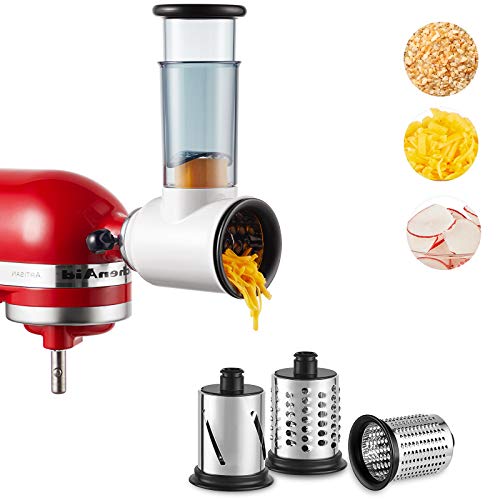
A three-drum slicer and shredder that attaches to the front hub of a KitchenAid stand mixer, replacing the box grater and knife work behind cheese, vegetable, and nut prep.
The coarse drum handles cheese and firm carrots; the slicing drum produces even cucumber, celery, and zucchini rounds for salads, gratins, and sheet pan meals.
Stainless steel drums with 360-degree holes sit on plastic bases inside a high-gloss white housing, with a steel-gray pusher wrapped in soft-touch rubber for grip.
Only the drums are dishwasher safe on the top rack; the housing and pusher must be hand washed to avoid damage.
Best for KitchenAid owners who shred cheese or slice vegetables in volume and want the mixer motor doing the work.
How to Use
Slide your chosen blade drum into the housing until it seats, then fit the housing onto the mixer’s front attachment hub and tighten. No tools needed.
Feed food into the chute and guide it with the rubber-topped pusher, never your fingers. Run the mixer at a moderate speed and let the drum pull food through.
To switch drums mid-prep, leave the housing on the mixer and pull the drum straight out by its base, avoiding the cutting holes.
Who Benefits Most
This matters most for small-kitchen owners, and gadget-minimalists who want one do-it-all unit. If that is you, treat capacity and footprint, and cleaning access as non-negotiable. Casual users can relax the requirements and prioritize price and storage instead.
Common Misconceptions
The biggest myth is that the most expensive appliance is automatically the best for you. In reality, the right choice depends on digital versus dial controls, and noise level — plus your own habits. Another trap is buying by brand alone — the same maker sells both excellent and forgettable lines.
Why It Matters
The variables that decide the outcome — motor or heating-element power, capacity and footprint, and speed under load — are the ones buyers most often overlook. That is why two appliances that look alike can feel completely different in use — one saves time, the other quietly adds friction to every task. If you are shopping, our best air fryer and best blender guides are the fastest way in.
What To Look For
The keeper is the one you reach for without thinking; the drawer occupant is the one that asks too much for too little payoff. Those are the variables that decide whether it earns a spot in your kitchen or ends up unused. Ignore cosmetic upgrades until the fundamentals check out.
Related Product Guides
If this topic is part of a buying decision, these are the HomeWhisk guides most closely tied to it:
Frequently Asked Questions
Who is this most useful for?
Mainly small-kitchen owners, and gadget-minimalists who want one do-it-all unit. If that is you, treat noise level as a requirement rather than a nice-to-have.
What should I avoid?
Avoid buying by brand alone, ignoring not overfilling past the max line, and oversizing for your space. Each invites uneven cooking or heating down the line.
Is a premium appliance worth it?
Only if you use it enough to notice better control, durability, or cleanup regularly. Occasional users are well served by a mid-range pick like those in best instant pot.
How do I keep it in good shape?
Build cleaning removable parts by hand, and descaling water-based units into normal cleanup. Light, consistent care prevents uneven cooking or heating far better than occasional deep effort.
What matters most for food processor with grater?
Focus on build quality of seals, digital versus dial controls, and speed under load first. Those decide real performance; the rest is secondary. Compare best air fryer and best blender for options that get the basics right.
The Bottom Line
Food processor with grater comes down to fit: how often you use the tool, how much care it needs, and whether it solves a real kitchen problem. If you are buying, compare best air fryer, best blender, and best instant pot before you spend.



Write Your Review
No reviews yet. Be the first to share your experience!